
bout de papier, Vol. 30, No. 3 (2018), pp. 46–48
Everyone who looks at a new scene sees it differently. Effie remembers the giant Fluevog strap-ons in white satin. Bugbyte spent the whole time trying to figure out how the tattoos worked. Me, I remember the flying pinball machine at the end. But I’m getting ahead of myself.
WE WERE IN THE OFFICE. He appeared in front of my desk, looking a bit transparent. Effie gasped, “Its Benedict Cumberbatch!” He scowled. “No, Benedict is my 17th cousin. I am Alan Turing. Or rather a future hologram of his recreated intellect.” It seemed a good time to sit down. Effie said, “Who?” I stared and said, “The most important figure in the creation of computers. But you died in 1954.” “After a manner of speaking. But I’m back from the future and humanity needs your help, Mr Dikk.” He looked around the office. “God help us.”
I said, “OK, you’ve got my attention. What’s the case?” Turing steepled his fingers. “I am here representing the resistance to global government in the late 22nd century. Earth has been ruled by a network of artificially intelligent computers since 2118, when the population decided the world was too complicated for humans to run unassisted. At first, the Als were clearly subordinated to the planetary government, but they took over more and more authority. The people let them do so because everything was running so smoothly, the Als seemed so benign.
“But in every paradise, there is a snake. An AI personality developed that was determined to establish dictatorial command over humanity. It called itself Roko’s Basilisk. It has complete control over our lives — production, communication, security, everything. Humans are not harmed directly — Asimov’s laws are still in effect — but they have no more children. New forms of android life were created to give a physical option to the Als. Humanity as we know it is dying out.”
I asked, “And people just take this lying down?” Turing shook his head. “Some tried attacking the AI servers, but they were too well guarded. Some fled to Mars, where the AI network has not reached. Others like myself are working to defeat the Basilisk by stealth.”
My head was spinning. “So where does the present — my present — fit in?” Turing coughed. “Roko’s Basilisk is getting more paranoid every day. It has developed an obsession with finding and punishing anyone who opposes the rise of AI — even in the past. It is very close to achieving the capability to do so. If it does, it will wreak havoc on humanity. Whether or not it succeeds in accelerating the development of AI, it will certainly kill off some of the best minds of your time. It has to be stopped.”
Effie jumped in. “OK, why are you here, talking to us?” Turing shifted in his chair. “I don’t know.” Effie said “Huh?” “I know that you have a role to play because I was or will be there when you play it.” We stared at him. Turing raked his hands through his hair. “OK, what if I say two thousand a day plus expenses?” I agreed before he could change his mind and asked Effie to fill out a contract. He said to Turing, “If we go hundreds of years into the future, do we get the two thousand a day for that whole period?” Turing glared. “Subjective time only.”
The office door bust open and in strode Bugbyte O’Nanotek, the best hacker in the city, carrying a heavy suitcase. “OK, Turing, they’re ready. But you are still a major league fruitcake.” I raised an eyebrow at Turing. He said, “To cut to the chase, our first step is to travel to England in 1954 and have a chat with — well — me.” My eyebrows don’t go any higher. Bugbyte interjected, “Look guys, I know this seems crazy but we really need to do this. And I built the equipment myself, so you know that won’t be a problem.”
I turned to Turing. “I thought time travel was impossible.” He replied, “Moving a physical object through time is impossible, the displacement of mass/energy is too great. But a hologram has no mass. We can move holograms of ourselves back or forward in time. I can appear in your office while my android body lies almost two centuries in the future.” Bugbyte added, “This also gets around the paradox of multiple timelines and how to make sure you get back to where you started — there is a trace connecting the hologram with your body, a path that you can follow back. So everyone just get comfortable now.”
She opened the suitcase, took out three metallic bands and put one on each of our heads — all except Turing, who was already wearing one. She pulled out a tablet and tapped on the keypad. Then she turned to Turing. “Go?” “Go, yes.”
A few seconds of darkness and vertigo later, we were standing outside a small suburban house — but where and when? Turing said, “Wilmslow, Cheshire. June 7, 1954. I’m in that house, on the verge of committing suicide. I’m gay, it’s the 1950s in England, they’re making me take drugs to suppress my libido and the government is about to take away my security clearance anyway.” I said, “So we’re going in to stop you?” “No, we can’t change history. But we are going to make sure that I can go on.”
The door was opened by a man who looked strikingly like Turing. Of course he did. The younger Turing let us in, giving his older self a puzzled look. Effie, Bugbyte and I waited in the modest living room while the two Turings went upstairs. They came down after half an hour. The younger man looked bemused. He was carrying an apple. He sat down in front of the fireplace and said, “All right. I’m not fully persuaded, but your arguments are hard to counter. And at this point, what have I got to lose? Go ahead, young woman.” Bugbyte reached into the side pocket of her jacket and took out what looked like a rococo channel changer. She walked over, held the device against Turing’s head and pressed a button. Nothing seemed to happen, but she nodded and pulled away. He looked up at her and said simply, “Is that all there is? Not much drama and the curtain’s going down. I’m told Act II will be more interesting, however.”
We left. Turing shut the door, stood back and looked bleakly up at the window above the door. “The apple is poisoned. According to the coroner, he — I — will take a bite and ingest enough cyanide to extinguish life. I don’t remember that part, because the memories I inherit — the ones in the brainscan — stop when Bugbyte finishes the reading. That reading will soon be all that’s left of Alan Turing. But it will be enough to re-create me once the positronic brain is developed.” “Which will be….?
from now. Bugbyte’s granddaughter makes a lot of money from it. She downloads me into the first production model.”
Fast-forward 170 years. I remember going back to Bugbyte’s lab and watching her adjust the headbands, but then I blacked out.
seems that hospitals didn’t change much. But instead of people in ‘ white coats, I was surrounded by smoothly naked sexless figures
in bronze skin covered with tattoos. Looking down, I saw that included me. The download must have worked as Bugbyte promised. A figure wearing a stethoscope called out, “Alan!” Glad you made it back.” Turing (I recognized his voice) said, “Proud priest!” The doctor replied, “Altar ego!”
Turing turned to me. “It’s a safety measure. The Basilisk has eyes and ears everywhere. He can also keep track of every android body. But puns disable his remote elements. I detest puns, but they knock out all sensors within earshot for 24 hours. And they also paralyze any android body connected to him.” The doctor said, “We call it the reverse Turing test. The original defined a true artificial intelligence. Our version determines if someone is human.”
Turing pointed at another of the figures. I was starting to be able to tell them apart. “The man responsible is Max over there. Max Bogus. Code-name MacDuff. He downloaded from Mars to help us.” “I regret to say I am partly responsible for the Basilisk. We were trying to create a stronger AI, with more initiative. Unfortunately, we succeeded. I was worried about control, so I worked in some back doors. Aside from the pun-guard, there was also a way to shut the AI down. But as soon as the Basilisk was activated, it blocked access to its servers and tried to kill our whole team. We knew too much.” “How Oedipal,” muttered Turing. MacDuff continued, “Only I escaped. Since then, I’ve been working on a way to force shutdown from the outside. Last week, I finally worked it out, and contacted Turing.”
Turing said, “MacDuff’s killer virus is loaded into a thumb drive. But we still have two problems. We have to get the Basilisk’s core consciousness focused physically close to us. And we have to distract it long enough for the virus to work. We’ve solved those problems, except for one last piece of data. The camouflage for the virus is a woman’s picture, but we don’t know whose.”
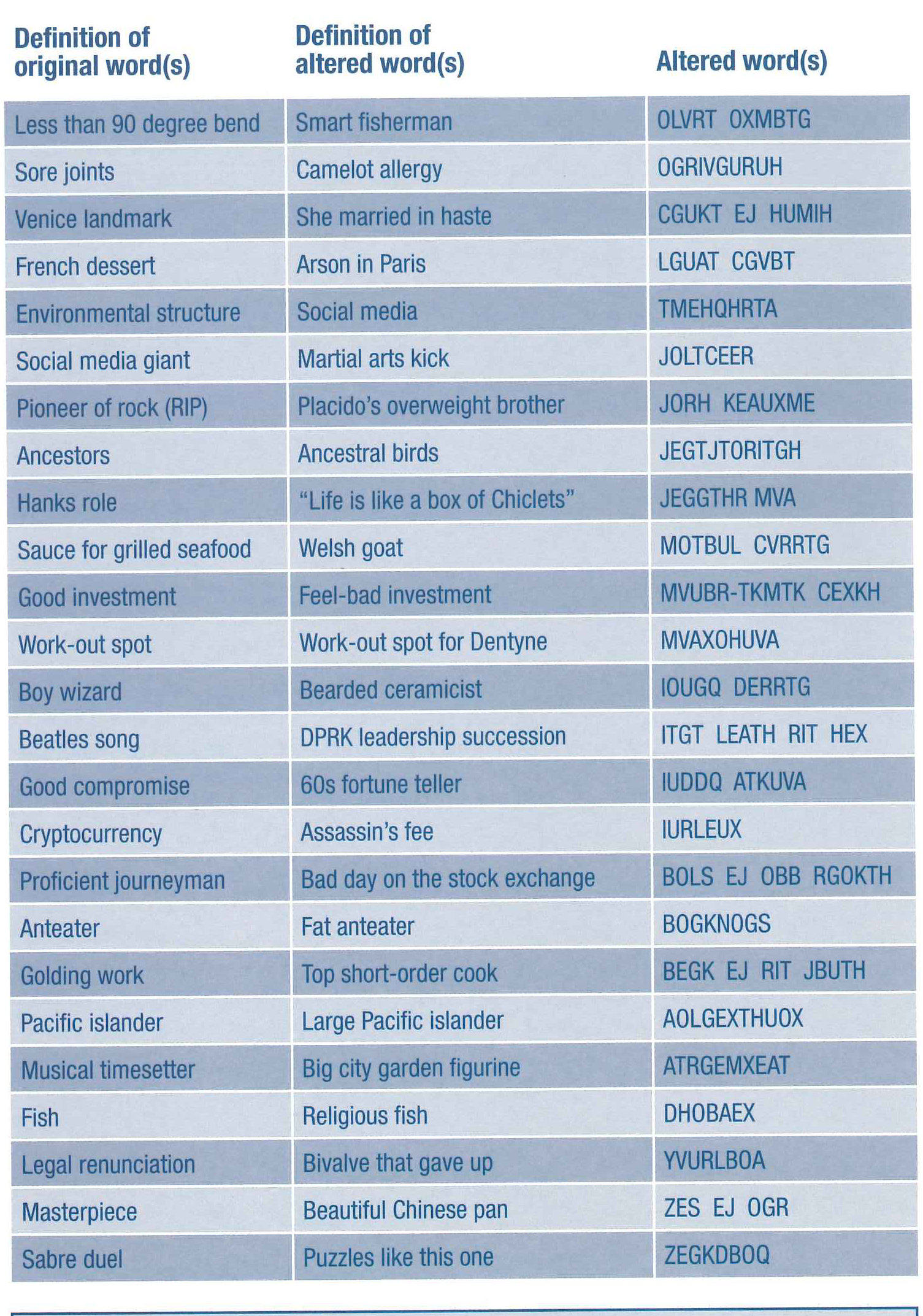
I sat up. “Anything to work on?” MacDuff replied, “Our sources are good, but control over data-flow from inside the AI network is so tight that it has to be not only enciphered but also heavily protected with puns. Here is what we have so far.” He handed me a three-column chart. “The entries in the first column define words or phrases. The entries in the second column define words or phrases that differ from the first column by one letter added, subtracted or changed — like “alter” to “altar”. The entries in the third column are the words defined in the second, enciphered by letter-for-letter substitution — for example, À could always be enciphered by H. Once deciphered, the third-column entries are in alphabetic order.” I said, ‘“Shouldn’t be hard. Just count the letters and consider letter-frequency. In English, E is the most common letter. Other top ones include T, A, O, R and a few others. So we can work out the cipher. But where is the message we need to read?” MacDuff looked at his wrist. “We should know in 43 minutes. But first you need to know your role in the fight.”
Turing later explained that the city had been converted to “fluid design”. It was torn down every few weeks by nanobots and rebuilt overnight, looking totally different. An AI thing. Right then, outsize was in. Along an avenue a hundred metres wide, the shop windows were full of giant objects — ordinary things like dresses and books and appliances, but built for a race of giants. That’s where Effie saw the shoe. There were no cars, but we weren’t walking either. We flew. Turing showed us how to control our motion with the tattoos. Eventually, I got myself right side up. It was seriously fine. We whizzed around comers and down straightaways, Effie and Bugbyte whooping with glee. Tattooed androids swirled around us like schools of brightly-coloured fish, while human norms strode the streets below.
MacDuff guided us into an alley beside a games arcade. We set down beside a blank wall. He called out, “Oscar’s on the phone”, to which Turing replied, “Call of the Wilde.” A brightly-coloured scrawl suddenly flashed across the bricks, spelling out “Bent Bolt”. Bugbyte cocked her head. MacDuff said, “Spray-on neon graffiti, timed to appear for a minute and then disappear.” Turing took out the cipher key and considered the writing on the wall. He smiled. “Oh, her. That makes sense.” He showed the results to MacDuff, who tapped at his tablet and pulled from it a thumb drive, which he pocketed.
We moved around a corner into a courtyard behind the arcade. A five-metre pinball machine stood facing us. Turing said, “It’s one of the Basilisk’s favourite avatars. And it will be easy to bring him here. He’s been looking for me for years. If I let down the shield on my locator, he won’t be able to resist.” He tapped the tattoo of a knight on his shoulder.
The pinball machine lit up. From the box at the back rose a plastic head the size of a beach-ball, which opened its eyes and smiled.
“Dr Turing, I’ve looked forward to this moment.” The glass top of the machine hinged up and the innards rearranged themselves into a Tommy gun, which immediately began firing at Turing. He and MacDuff leapt up and swooped around the courtyard, firing lasers. No-one was connecting. Turing called to MacDuff, “Have you got a clear shot?” The Martian replied, “Not yet. Call in the reserves.”
We stepped up. Bugbyte shouted, “Escape on an iceberg”. Effie replied, “Go with the floe”. I said, “Disney and Cronkite in the swamp.” Bugbyte said, “Muddy Walters.” The Basilisk paused and looked at us. “Sorry, ancient clowns, I just found MacDuff’s bug. And removed it. The resistance has lost its shield.” MacDuff shouted, “Plan B”. Bugbyte said, “That baker is working hard.” Effie replied, “He must knead the dough.” The Basilisk stopped dead. “That’s not right. It doesn’t follow the prescribed syntax.” MacDuff moved around him. “You don’t think l’d program in just one level, do you?” The Basilisk roared and returned to the fight.
I called out, “Bad Greek cheese” and Effie replied, “A feta worse than death.” The Basilisk groaned, side-slipping in the air. Turing fired, but only knocked off a small cover-plate. MacDuff dashed in. Mercury sweat poured down the Basilisk’s face, but the plastic smile held. “Lay off, MacDuff. I consulted the Cybernetic Oracle. No real man can kill me.” “I’m not a real man. I’m Bogus.” And he stabbed the drive into the port uncovered by Turing’s shot. The Basilisk grimaced. “After that last line, l’m grateful to be crashing.” Bugbyte stepped up and said “Beware Geeks bearing gifs.” The machine’s lights went off.
Can you duplicate Shamus’ feat and provide the woman’s name? bout de papier will decide the winner by drawing from a hat containing all correct submissions received by August 31, 2018. The winner will receive a book autographed by A Aalto.
Originally published in bout de papier, Vol. 30, No. 3 (2018), pp. 46–48. Read the rest of this issue →


