
bout de papier, Vol. 25, No. 1 (2010) — Spring 2010 // Printemps 2010, pp. 38–39
M RRR 0 U G fl KR clear response in =U”
uw his loudest operatic baritone voice. A cat’s voice of course. Sylvester’s location — a school playground separated from our looted house by a ten-foot wall in Mogadishu, Somalia. How strange. What happened?
As with most events, there is a beginning and there is an end. And this is only one act of a rather long play.
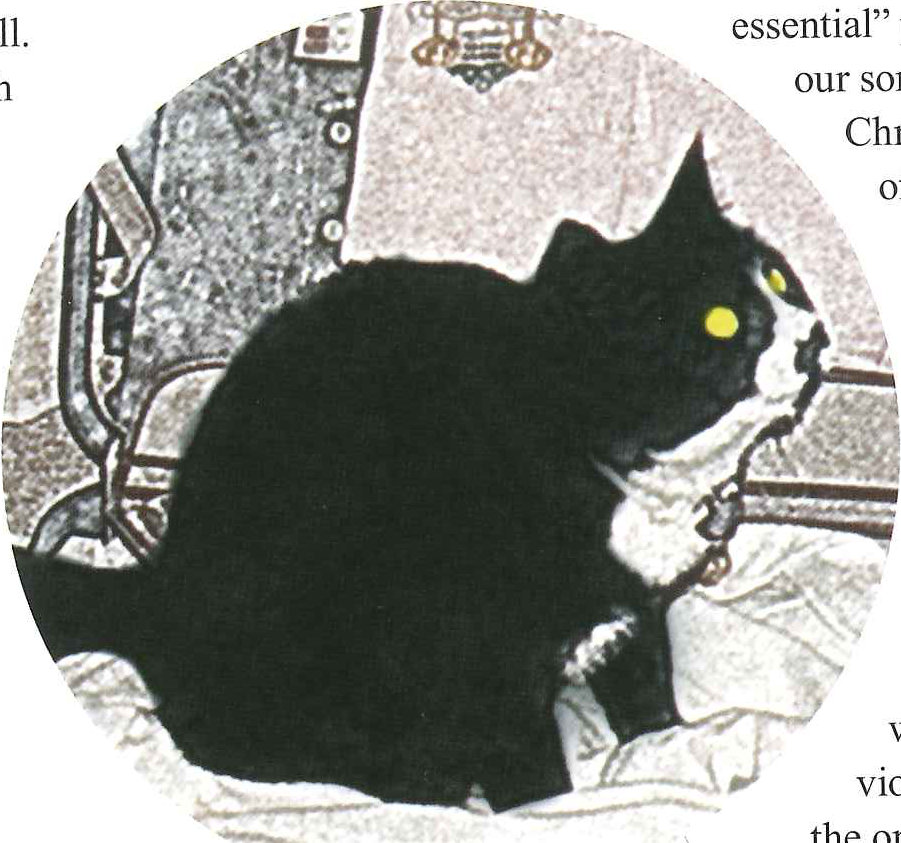
When at our cottage near Perth, Or my wife Anne and I went on a long st1 An unwanted black and white stray w: a Führer moustache and a sleek coat of silky fur seduced us completely. Being cat-lovers, it was easy. He followed us, but was limping with a sore foot. Sure enough, that guaranteed a carry in Anne’s arms all the way home and a visit to the local veterinarian for vaccinations, removal of a thorn in his foot, and a change of life from dominant male, to a docile “consultant.” He was named “Sylvester” for record purposes, and from that moment he was a family member.
Sylvester was dog-like in his attachment to us and followed us everywhere — to the lakeshore, to visiting neighbours, to picking wild berries and flowers. He respected the sofa as a place to preen and sleep, not a scratching post. Instead of demanding to be fed, were we late with presenting him with dinner, he might quietly present us with a self-caught meal from the outdoor world as a reminder of our negligence. He soon discovered that open suitcases meant travel and to ensure his inclusion, he would sit in a half-packed bag just to draw additional emphasis.
Judging by the quality of his fur, his feline flexibility, and his statuesque poses, we could see why Sylvester traced his ancestry back through several homestead barns, to European castles, to Roman and Gallic expeditions on Mediterranean shores, to the Valley of the Kings in Egypt and Persepolis in Persia. What a superior social animal. Off he trotted with us with all his chattels (comprising two plastic bowls and a toy mouse) to Bonn, Munich, Lagos, Edmonton, Tuscany and then Somalia.
Here I should insert that I had retired from the Canadian Foreign Service in 1990 and joined the Food and Agriculture Organization (FAO), a specialized agency of the UN with headquarters in Rome. My first juicy assignment as FAO representative was the Republic of Somalia where many conflicts were underway because of tribal differences and power-hungry warlords.
After a few months, civil unrest and rebel activity accelerated. to evacuate families and “nonrsonnel. Anne left for Nairobi with David, who had just arrived for tmas. I joined them on the beaches Malindi a week later with a commit-ent to return to Somalia within wo weeks, leaving Sylvester in the tender care of our two house girls — Queresh and Jamilla — and five guards. Sadly, all of them had to abandon Sylvester and flee for their own safety during the initial insurgents’ raid on the city.
How naive, how trusting I was ile there in the Horn of Africa where nce and destruction rapidly became or of the day. Rebel militias overthrew the Government and the civic authorities, followed by looting and chaos throughout.
Naturally, all flights were cancelled. It was impossible to return and we confined ourselves to a studio apartment in Nairobi, trying to help a nation under siege next door. A hopeless task in itself.
And there was poor Sylvester — alone and frightened. Each evening we sat on our tiny balcony watching the ibis birds and egrets settle for the night and implored Sylvester, “Hang in there, chap. Hang in there!”
It was two months before I could return with colleagues on a UN plane to assess living conditions in Mogadishu, but only for five hours, including a luncheon with the Acting Prime Minister. Before landing, we first had to sweep camels and goats from the runway with a couple of low flying passes.
My first stop was the FAO office — a disaster, fully looted and partially burnt. No files were left, all equipment had been removed, and even the copper wire was ripped out of the electrical systems.
Next stop was our house next to the school playground. I felt an abnormal fear as we approached. On leaving the Nairobi apartment that morning, Anne handed me a pillowcase — just in case. It was now in my hand. A squatter family was in the garden skinning a goat; the car and large generator has disappeared; the front door of the house was open. The girls and the guards had long vanished. I entered the house somewhat hesitantly because I suspected that after two months of no electricity, no water, and no food that I could find Sylvester’s corpse in the room — if not this one, the next one. I found only rubble — all our personal effects and furnishings were gone, even the broom and the cat’s plastic bowls. Not one personal item remained. I reached the roof terrace, went to the edge overlooking the school yard and pleaded with a friendly call, “Sylvester, Sylvester, come.”
“MRRR-O-U-GH, MRRR-O-U-GH”. That low pitched bush call twice in reply was such a part of Sylvester.
He was alive. HE WAS ALIVE!
Before I could reach the front door, Sylvester had climbed over the ten-foot wall of the schoolyard and was waiting for me. He recognized my voice, he brushed me, he smelled me, and he touched my face with his paw. happy to go into the pillowcase where he fe and protected for the first time in weeks. Ju ponder this — two months without water and food. His only hiding place would have been in the thorn bush over the wall in the school playground, probably shared with the mongooses (or is it mongeese?). No wonder his leg was wounded and quite swollen.
I was now late for the Prime Minister’s luncheon, so on entering, I apologized to him and my colleagues and added, “But I found my cat, Mr. Prime Minister,” holding aloft in the pillowcase for all to applaud, “A your permission, Mr. Prime Minister, he is joining us for lunch.” You see, I already knew the PM was fond of cats from a discussion during his visit to our house weeks before the breakout of hostilities. He was a kindly man and handed me a short string to tie up the pillowcase which in turn allowed me to use both hands for eating the two chicken legs on a bed of rice. Sylvester refused to eat or drink anything. He was too sedated with his own safety.
Sylvester and I boarded the plane for Nairobi with my UN colleagues and arrived at Wilson Airport well after sunset. While skirting an electric storm en route, the Venezuelan pilot informed me that Kenyan customs regulations demanded that animals without proper health certificates be put down immediately. All of Sylvester’s papers had been destroyed in Mogadishu so it was a matter of smuggling him in. The pilot suggested that I leave Sylvester aboard, proceed through Customs while he parked the aircraft in its usual place — a shadowy corner of the tarmac. I was then to return by following the ground mechanics to the plane with my driver and station wagon. The moon that night was as bright as the African sun, it seemed, and never had I come across such giant Kenyan guards on duty where the UN plane was parked, but obviously they did not see one loaded pillowcase disappear instantly into the rear seat of the station wagon beside me.
So, now you know the pertinence of Sylvester’s bush call which clearly identified his whereabouts.
But there is a final scene. On reaching the studio apartment, Anne opened the door for me and I handed over the pillowcase. The lump in the bottom was warm and Anne, on realizing who was there, cried for joy for the next three hours. Sylvester, so thin and dehydrated, slept beside me that night, stretched out like a contented cheetah with his head nestled on my pillow. I think it was an act of gratitude.
The next day, Anne took Sylvester to an animal clinic to be examined by a lady veterinarian. She was horrified with the condition of Sylvester and gave Anne a rapier-like reprimand, “What have you done to him? Where are his papers?”
A meek but honest reply, “I don’t have any.” w did you get him here?”
e offered, “Shall I tell you the truth?” Yes, please do,” said the vet rather firmly d from that moment on, we became good riends, all of us. Sylvester was rehydrated intravenously, had a chemical bath to remove the ticks, and received new papers which made him a legal pet in Kenya.
Sylvester quickly regained his appetite and recovered from his wounds and varidus scratches. He joined us on our balcony ch evening without fail — the place where pleas for his safety emanated.
n Anne recalled that a few weeks earlier, reorge Bush, Sr. had presented the
Purple Heart to several American soldiers in the Iraq/Kuwait conflict. So, she tracked down a purple heart at a Nairobi button factory, attached it to a ribbon and draped it around Sylvester’s neck. He too had been wounded while never leaving his post of duty!
One brave cat.
Sylvester lived the balance of his 18 years, somewhat coddled in comfort, in Kenya, Iran, and Italy. He then returned to his domicile and favourite home — our cottage in the bush on Farren Lake near Perth. And there he rests in eternal peace.
We still miss him.
View the original scanned pages →
Originally published in bout de papier, Vol. 25, No. 1 (2010) — Spring 2010 // Printemps 2010, pp. 38–39. Read the rest of this issue →



