
bout de papier, Vol. 25, No. 4 (2011) — Winter/Spring 2011 // Hiver/Printemps 2011, pp. 12–14
Editor’s Note: Ms. Fruman is a Canadian and the former Country Director for NDI Pakistan. While Mr. Preston believes that Bob Rae offers policy makers in Ottawa a future for Canadian foreign policy, Ms. Fruman offers a “test case” on how Canadians have helped promote democratic solutions to the seemingly intractable problems of Baluchistan, a province that has seen far more than its share of tragedy and violence. To their credit, the current elected government of Pakistan and Pakistan $ military have taken important steps to address the root causes of the conflict in Baluchistan, and Canadians were helpful in facilitating that process. However, the healing has only just begun and the challenges all parties face in Baluchistan remain enormous. If nursing democracy from the bottom up and peace building were to become as central to Canadian diplomacy as some would have them be, Canadian diplomats will be busy as never before.
Bob Rae’s Exporting Democracy is an important study on the need to nurture democracy. He argues that legitimacy is based on consent, not force, and that long term social and political order ultimately depends deeply on the development of democratic institutions. That view resonates with my own experience as former Country Director for the National Democratic Institute (NDJ) for Macedonia and Pakistan.
NDI is a U.S.-based non-government, non-partisan organization with international funding. Founded in 1983, NDI and its local partners have worked to establish and strengthen democratic institutions and practices in approximately 70 countries around the world by helping to build political parties and civic organizations, safeguard elections, and promote citizen participation, openness and accountability in government.
While there is no comparable Institute in Canada one interesting aspect of NDI is the number of Canadians it employs in dozens of countries. In my case, after a lengthy career in provincial politics and government in British Columbia, I was recruited by NDI as Country Director for Macedonia in 2001 and, after serving with the UN in Afghanistan in 2005, I was head of the NDI Pakistan office from 2006-2010. My successor in Islamabad is also Canadian.
I think there are several reasons why Canadians are such a solid contingent in NDI. Our Westminster style parliamentary system, unlike the U.S. system, is close to the political systems of many countries in transition to democracy where NDI works. The Canadian model of political parties, supported by public financing, with relatively strong organizations focused primarily on ideological differences, is more relevant to developing democracies than the U.S. parties which tend to focus on individual candidates and the need to raise big money. Canadians tend to come without colonial baggage and we can relate to the challenges others face in nation building. In short, Canadians have a lot to offer countries in transition and we are warmly welcomed for our experience.
We think of ourselves as a new country with a young political system; in fact, we are among the most experienced federalists with over 140 years managing federal dynamics. We survived many a crisis and have learned the need for compromise.
Countries like Pakistan have not been so fortunate. Created some 60 years ago in trying circumstances, its founding father died within months of independence. Institutions that should have guided Pakistan to a bright future did not have a chance to take root as the country’s military repeatedly intervened in the political process suppressing democratic institution building. As Bob Rae notes, and Pakistan’s history attests, there are no military solutions to political problems.
Today Pakistan faces deadly challenges: religious extremism, no real progress on the Kashmir question, the endless test of wills with India, extending the writ of the state throughout the Tribal Areas, sectarian violence, widespread corruption, and continued intrusion and control of the military over much of the country’s political life. With the ongoing challenges of the current transition to democracy, institutions like NDI and Canadian experience can be helpful.
One of the most brutal challenges to democratic development and sustainable federalism, I concluded early on, was in the province of Baluchistan. It lies below Kandahar, Afghanistan, and its turmoil has obvious implications for Canada and our allies in Afghanistan. The issues are complex and involve domestic and foreign players. The key source of tension is directly linked to federalism and goes back years to the federal government’s refusal to negotiate Baluch demands for political and economic provincial autonomy. These include:
exploitation of Baluchistan’s vast natural resources without
giving the province its due share;
* construction of military garrisons to strengthen an extensive network of military bases; and centrally driven and controlled economic projects that do not benefit locals but raise fears that the resulting influx of economic migrants could make the Baluch a minority in their own homeland.
The Baluch wanted a restructured relationship transferring powers from what is seen as an exploitative central government to the provinces. Authoritarian military rule deprived them of participatory, representative avenues to articulate demands and to voice grievances. Politically and economically marginalized, many Baluch saw insurgency as a defensive response to the perceived colonization of their province by the Punjabi-dominated military. The failure to accept the legitimacy of grievances lay at the heart of an increasingly intractable conflict, as did Islamabad’s reliance on coercion and indiscriminate force to silence dissent.
My first exposure to Baluchistan was in August 2006. The Pakistani military, under President General Pervez Musharraf, escalated tensions enormously when it killed 79-year-old tribal leader and former “Chief Minister’ of Baluchistan, Nawab Akbar Bugti, at his mountain hide-out. He led a “nationalist” party demanding more provincial autonomy and greater gas and mineral revenues.
Soon after the attack, the military forcibly displaced some 160,000 Bugti tribesmen from their homes in the gas rich region of Dera Bugti and Kohlu. General Musharraf’s government refused to allow humanitarian assistance to the displaced families; hundreds, if not thousands, of women and children died of exposure and hunger that winter as they wandered in an unforgiving terrain.
Islamabad also imposed a media blackout with heavy economic sanctions for organizations reporting any news from the province. Reporters were threatened, harassed and some were killed trying to report on the military operation and its repercussions. It became extremely dangerous for moderate politicians and members of civil society to come together to discuss the critical issues facing the province. Public space for dialogue was simply non-existent.
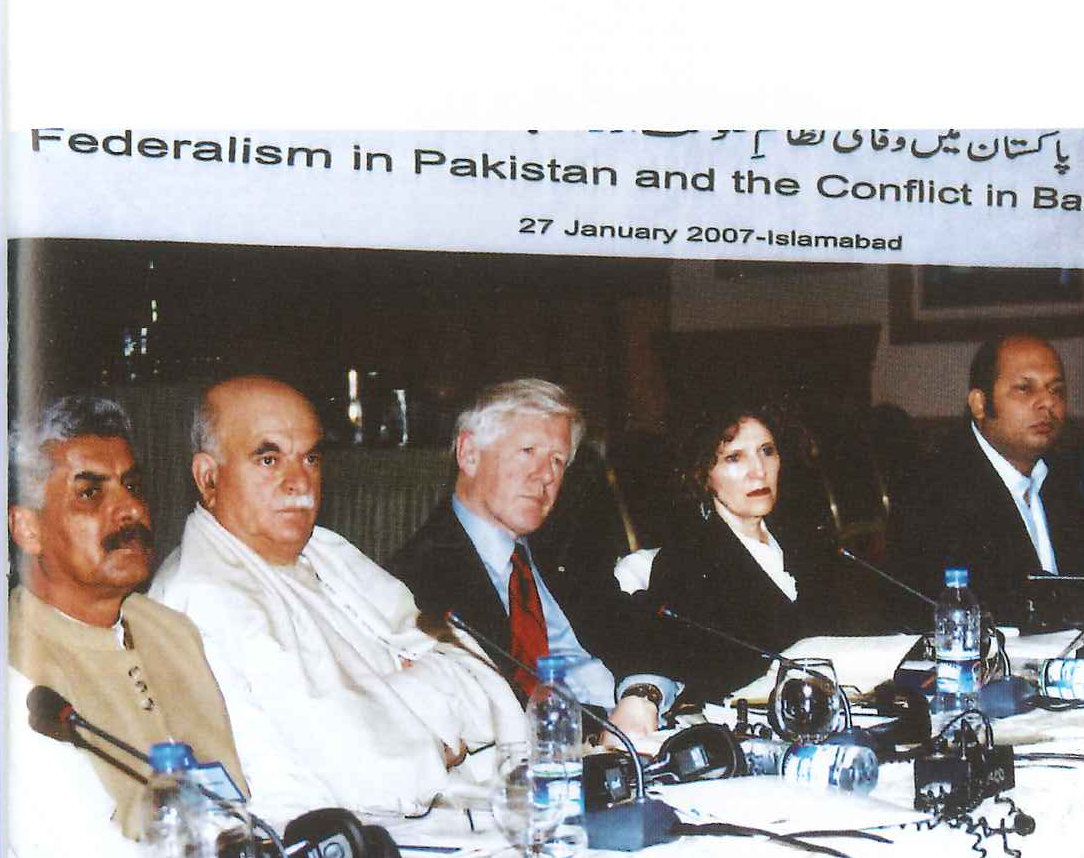
I arrived in Pakistan as NDI Country Director a few months prior to Bugti’s killing. A first contact I made was with the Canadian High Commission (CHC), which proved a valuable and productive connection. By January 2007, NDI was able to launch, with the support of the CHC, and funding from the DFAIT Glynn Berry Fund, a forum on “Federalism and the Conflict in Baluchistan”. The aim was to bring together many of the stakeholders for a dialogue on the issues in the dispute.
As a Canadian, I had some sense of Baluchistan’s predicament. Canada has struggled with federal-provincial relations since the country’s founding. Issues such as federal-provincial relations, resource development and revenue sharing, taxation, language rights and the role of diverse cultures all had a familiar ring.
Over the years Canadians have found workable solutions that I believed could serve to generate ideas and options, modified to conditions in Pakistan, for some of the difficult issues between the province of Baluchistan and the federal government. As an international organization, NDI could provide a relatively “safe space” where stakeholders could come together, along with national-level elected representatives of the opposition and government, to debate the issues in a neutral setting and raise public awareness about them. It was an opportunity to expose Pakistanis to Canadian federal and provincial politicians who had grappled with similar issues of federal-provincial jurisdiction.
Several high-level Canadian politicians made themselves available to share experience relevant to the federal-provincial Pakistani context. Bob Rae launched the series with a keynote address to a gathering of more than 40 provincial politicians, nationalist political party leadership, media organizations, civil society leaders, national level opposition Senators and Members of Parliament and federal Cabinet Ministers.
It was the first time such a diverse group assembled to focus on the critical issues facing the province. Bob Rae’s experience as founder of the Forum of Federations, Premier of Ontario, Member of Parliament and foreign affairs critic generated much interest. He illustrated, using examples from his extensive experience in Canada and around the world, the fundamental features of a federation and how it could peacefully address challenges like the ones faced by the province of Baluchistan and the federal government.
The launch was followed over the next few months by two more day-long sessions on resources, taxation, language and culture with the participation of former federal Minister of Justice and National Revenue, Martin Cauchon from Quebec and former Minister of Justice, Health, and Deputy Prime Minister Anne McLellan from Alberta. Experience from their key portfolios, along with their very different provincial perspectives, provided a comprehensive overview of Canadian federal-provincial dynamics.
The trio of Canadian politicians generated lively exchanges of information and opinions. The emphasis on dialogue and negotiation, with litigation as a last resort, provided a positive model that yielded practical solutions. The Canadian experience also revealed that numerous challenges and hurdles took considerable time and patience to resolve, an important insight for a relatively new country like Pakistan.
The parallels between Canada and Pakistan were not identical, of course, as Pakistan was then ruled by a General who had seized power in a military coup. Participants were taking risks just by attending the forum. Many were being followed by intelligence agents and some feared for their lives — which conveys the value they placed on the opportunity to attend such an event.
The sessions created a rare opportunity for politicians and stakeholders to meet and share concerns and ideas with each other, as well as with concerned and experienced Canadians. While such opportunities can be taken for granted in a secure democracy like Canada, they were simply not possible in Pakistan then without the assistance and support of an international organization like NDI and the cooperation and support of the CHC and DFAIT.
The results of such undertakings are often hard to track and take time to emerge. A number of recent major government initiatives in Pakistan, however, have directly addressed the issues raised in the NDI sessions. A “Baluchistan Package” (Aghaz-e-Haqooq) was announced that aims to enhance Baluch participation in state institutions; the National Finance Commission, which met last year for the first time in 10 years, redistributed government revenue in favour of the provinces; the 18th Amendment to the Constitution, passed unanimously by Parliament this past April, undoes the distortions imposed by successive military rulers, devolves several competencies to the provinces, and enhances provincial autonomy.
Credit is due to the Pakistani parliament and government for these major reforms, but it is fair to say that the NDI sessions helped to build relationships and understanding on these matters at a time when other avenues of communication were extremely limited. The Chairman of the Parliamentary Committee on Constitutional Reform (PCCR), who was also the government’s author of the “Baluchistan Package”, was a panelist at the first NDI forum. The Baluchistan National Party representative on the PCCR attended all the forum sessions as did other members of that committee.
Even though a U.S.-based NGO organized and implemented the activities, Canada’s profile was raised and credit was given for supporting efforts to strengthen democratic institutions. For a small price, much was gained.
Despite these positive measures to strengthen federalism in Pakistan, the situation in Baluchistan remains unresolved. The inability of the federal government to fully implement these initiatives, and ongoing military operations, have generated a rise in militancy and a growing climate of fear.
The Pakistan Institute of Peace Studies reports that Baluchistan had the highest number of militant, insurgent and sectarian attacks of any province in 2010 and killings were up 43 percent since 2009. Multiple forces are tearing Baluchistan apart: separatist groups demanding secession and attacking the state (including security forces, infrastructure, and the governor), sectarian attacks on Shias by Sunni extremist groups, ethnic attacks on Punjabis settled in the province, and crime, including kidnapping for ransom. Foreign players continue to exploit the situation for their own benefit.
Musharraf may be gone, but much more must be done before the situation in Baluchistan will be “normalized”. Perhaps the key question for Canadians is not whether we are up to the challenge of helping to reduce conflict and improve governance in Baluchistan (and beyond), but how best to meet it. With Exporting Democracy we have a thoughtful argument for promoting democracy, and with NDI we have seen ways we can apply it.
View the original scanned pages →
Originally published in bout de papier, Vol. 25, No. 4 (2011) — Winter/Spring 2011 // Hiver/Printemps 2011, pp. 12–14. Read the rest of this issue →



