
bout de papier, Vol. 26, No. 4 (2012) — Summer 2012 // Été 2012, pp. 37–38
Stepping Back from the Precipice
by John Graham, published in the
Dominican Republic (in Spanish) by
“Fundacion Cultural Dominicana”, 2011.
An electronic version in English is avail-
able from the author at [email protected]
The Author
One could not find a better chronicler than John Graham to interpret the political events that rocked the Dominican Republic in 1994. A career Foreign Service officer, Graham’s association with the Dominican Republic began with his first posting, to Santo Domingo, in 1960. First postings create a powerful, emotional link with the country, one that usually lasts a lifetime — and Graham’s affection for the DR is evident throughout the book.
This connection was resumed in 1988, when Graham was appointed Ambassador to Venezuela, with concurrent accreditation to the DR. From 1988 to 1992 he visited the country on a regular basis. Then, as head of the “Unit for the Promotion of Democracy” in the Organization of American States (OAS), he was appointed to lead the OAS mission to observe the 1994 elections. He has returned many times on a variety of missions (including the production of this book), and his knowledge of the place and its personalities is fresh and deep.
The idea for the book originated at “Funglode”, a Dominican think-tank established some years ago by Leonel Fernandez, current president of the DR. In 2007 the Funglode Director approached me (I was then resident representative of the OAS in Santo Domingo), about Graham’s availability, explaining that they were concerned that the 1994 electoral experience had not been properly documented. This constituted an unacceptable gap for Dominicans who take their history seriously. The choice of Graham, a foreigner, was courageous and controversial. However, he had been at the centre of the action and could be trusted to be objective: few foreigners would pass such a test.
The book covers a lot of ground that has not been addressed before, except in wae }a IGOSE DE! precipicio. Una cronica del mediador de la OFA P
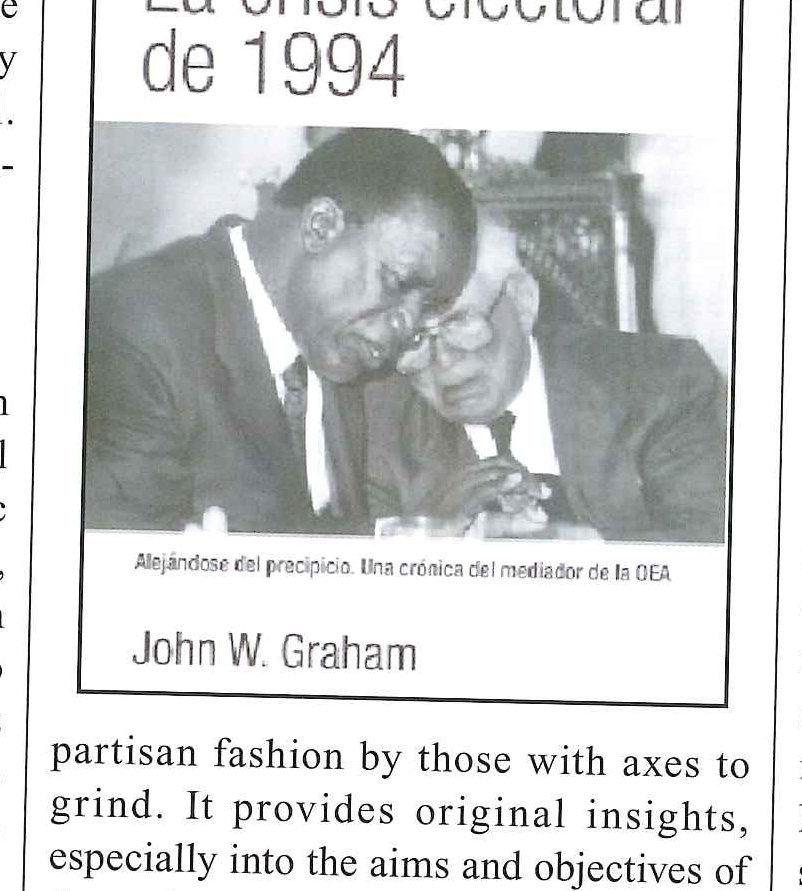
John W. Graham partisan fashion by those with axes to grind. It provides original insights, especially into the aims and objectives of the various protagonists. A keen observer of Latin American politics, Graham understands what is significant in both the Dominican and the regional context. For a short publication (101 pages, with notes and appendices) it packs a lot of punches and will be appreciated by the general public, but even more so by academics, practitioners and Latin America specialists. It will be of particular interest to those many Dominicans who are obsessed with their politics, their history and the shortcomings of their political system; this book offers a valuable addition to their political narrative.
Graham writes with the skill and ease of a lifelong professional, and the authority of one who knows his material well. Occasional humorous asides add colour and levity — a welcome addition to a tale of unremitting political malfeasance.
Overview
The author provides an insider’s view of the political crisis that erupted in the Dominican Republic following the fraudulent electoral process in 1994. He describes the attempts to ensure clean elections in the lead-up to the vote, and introduces us to the myriad characters involved on both sides of the fraud divide. His long acquaintance with the principal actor in this drama — the octogenarian President Joaquin Balaguer — provides a fascinating glimpse of a cagey politician and a master manipulator.
From the day of the election on May 16 — when the first indications appeared that something was seriously wrong — to the final resolution three months later, readers have a ringside seat to a messy, chaotic struggle for power. Balaguer was determined to retain the presidency using any means available, including character assassination, electoral manipulation and outright fraud. Graham describes all this in detail, as well as the allies who became friends, the murky behind-the-scenes operators, and the atmosphere of threat and recrimination. He puts the events into historical perspective — from the DR’s shaky recovery from the Trujillo dictatorship, to the concerns in Washington about instability in the DR vs removing the dictator from next-door Haiti. There are many more villains than heroes in this story.
Play-by-Play
The Setting and Signs of Trouble: The OAS team led by Graham arrived in early May 1994, just a few weeks before voting day; they were joined by a number of electoral observer groups whose presence and cooperation were essential. Although there were ominous signs (obstruction in the Central Electoral Agency [JCE]; vilification of the main opposition candidate for his Haitian roots; hints of rigging the electoral lists) it was not yet evident that this would be the most difficult election in the OAS experience and probably the worst in even the Dominican Republic’s chequered electoral history.
May 16 — Voting Day: Voting began deceptively well and with great enthusiasm — turnout was eventually calculated at an extraordinary 87.4% (a sad commentary on Canadian participation rates). By midmorning, reports were coming in that large numbers of citizens were being turned away because they did not appear on the JCE-prepared voters’ lists. Not coincidentally, the vast majority of these were supporters of the opposition PRD. A preliminary Balaguer had won by some 22,282 votes, yet it appeared that as many as 45,000 opposition supporters had been disenfranchised. Temperatures were rising, crowds were gathering and violence was expected. The observer teams issued statements pointing to irregularities while trying to avoid language that would further incite violence.
Post Election — Dangers and Dilemmas: As the press in the US and Latin America picked up on irregularities in the DR, talk began of the need for OAS sanctions. Graham’s challenge was to blow the whistle on electoral fraud without shattering the increasingly tenuous stability of the country. One of the unknowns was the position of the military —a significant force in Dominican politics — whether it would intervene, and if so on which side. Heightened security concerns caused the National Democratic Institute (NDI) to withdraw its observation team, which returned to Washington.
Pefia and Balaguer: Graham met frequently with the two main party leaders in the hours and days after the electoral debacle. Peña Gomez, leader of the PRD, restrained his followers from violence, but with difficulty and against the advice of senior party apparatchiks. Graham’s previous, positive relations with Balaguer were used to good advantage, as he appealed to the 87-year-old’s better instincts. This relationship kept Graham in the job, as Balaguer refused to allow him to be substituted by the former Secretary General of the OAS as proposed by the OAS.
Foreign Intervention? This possibility was always present in the Dominican psyche; the country had endured American occupation from 1916 to 1924 and military intervention in the civil war of 1965. Direct intervention, however, was not a serious option for Washington in this period; it was “out of fashion”, and they preferred to work through the OAS.
The Verification Commission — a Road to Nowhere: This credible and reasonably balanced commission conducted a technical analysis of the voting system and concluded on July 12 what was already known — that about 45,000 voters had been disenfranchised. Talk began of a negotiated solution to resolve the crisis, initiated by Leonel Fernandez, head of a smaller third party, the PLD. Balaguer, stalling for time, waited for the JCE to pronounce him winner; this took place on August 2 and “all hell broke loose”, with the prospect of a general strike and renewed civil disorder.
The US Role — Pressures and Suspicions: Graham’s experience as a career diplomat served him well in dealing with the US ambassador and other American diplomats, both in Santo Domingo and in Washington. They were able to approach issues with the same professional understanding, and developed a constructive collegial relationship. Despite more immediate concerns with Haiti, the US was on the right side of the issue and pressured Balaguer to show flexibility and negotiate a solution to the crisis. At this time Graham discovered that a sophisticated eavesdropping system was in place, and all telephone conversations had to be considered compromised. He also learned that Balaguer supporters (other Latin American ambassadors to the OAS) were pressuring the OAS to replace him, and here the US again stood its ground, insisting that he stay.
Deadlock and Extrication — Ten Days in August: Graham and his allies now focussed on arranging a face-to-face meeting between Balaguer and Peña. Peña and his supporters were reluctant, fearing that the wily old fox would somehow pull a fast one (a well founded suspicion). Peña insisted on fresh elections and would discuss nothing else. Balaguer, ever gracious and patient, waited. Choosing his moment, he reminded Pefia that the elections had ended in a virtual tie, and enquired, “Why don’t we split the cake — two years for me and two for you?”. They shook hands, and the meeting ended in confusion.
The following day Graham informed Balaguer that the OAS would not support the arrangement, as it was essentially undemocratic. Pefia then arrived and, after he informed Balaguer that the “agreement” was off, the two sat down with their legal advisors and hammered out a deal; its essential elements were two: new elections within 18 months, and non-reelection of an incumbent president (the 18-month period was subsequently changed to two years by the Balaguer-controlled senate). This “Pacto de la Democracia” would end the crisis, ensure Balaguer another two years in the presidency, and eventually prove tragic for Pefia, who lost the election in 1996. In a bizarre twist, he was defeated by a little-known leader of a small party, Leonel Fernandez — who won because Balaguer threw his support behind him. So the old fox, nearing the end of his career and his life, had found one final way to betray and defeat his opponents.
Epilogue
Graham defends the role played by him and the OAS mission as a balancing act between exposing the fraud and maintaining civil peace. It was a difficult challenge, but both of the main contenders criticized him for being too soft on the other which tends to validate his objectivity and the eventual compromise that ended the crisis. He ends by evaluating Balaguer through a Machiavellian lens, concluding with a qualified but positive assessment. (My own would be less generous — I firmly believe that Balaguer could have taught Machiavelli a thing or two.) The 1994 election continues to resonate in Dominican politics. Flawed as it was, it set the country on the path of the imperfect democracy that prevails today.
An update: the party of Leonel Fernandez, the PLD, easily won the 2012 elections; Leonel, who was constitutionally barred from seeking another consecutive term, put his wife on the ticket as vice-president. This ensured a PLD victory through his reflected popularity and established a place-holder for him to run for the presidency in 2016. Unfortunately, this means of circumventing term limits is all too common in Latin America — most egregiously in Argentina. Also, by connecting today’s political winners to the election of 1994, it demonstrates that, somewhere in the Dominican body politic, the pulse of Joaquin Balaguer still beats.
Paul Durand was a colleague of John Graham’s for many years. He served as Ambassador to Costa Rica, Honduras, Nicaragua and Panama, to Chile, and to the Organization of American States; he was also the resident representative of the OAS in the Dominican Republic.
View the original scanned pages →
Originally published in bout de papier, Vol. 26, No. 4 (2012) — Summer 2012 // Été 2012, pp. 37–38. Read the rest of this issue →



