
bout de papier, Vol. 12, No. 4 (1995-1996) — Winter 1995–96 // Hiver 1995-1996, pp. 47–48
“I say! I say! Aren’t you Liebnitz, the puzzle wizard?” The vacationing logician found himself face to face with a tall bluff man sporting a white walrus moustache, his red face beaming and his three-piece tweed suit totally unsuitable for the tropical climate (although not for the neo-colonial ambiance) of the Gilbert and Sullivan Islands. “Major- General Stanley. Delighted. I do believe we met at some conference in Cheltenham, years ago.”
“Quite possibly,” said a frankly baffled Liebnitz. “Well, this is a piece of good luck,” the General went on, rubbing his hands. “We have had a spot of bother with the results of the Scilly Regatta, and you are just the man to help. Would you mind awfully if I asked you to dinner tonight — just myself and my daughter Mabel, you understand — and explained the situation?”
Fathoms of flannel later, Liebnitz agreed to the invitation. Some hours afterward, a lavish meal under his belt, he sat in the General’s oak-panelled study with a cigar in one hand and a cognac in the other, as his host expounded. “Every three years, we stage the Regatta, a race for ships famous in the arts — you know, like the Flying Dutchman that bounder Wagner was so keen on. Well, we did have her in the race one year, but she never finished. Still trying, I believe. Skipper’s probably drunk, don’t you know.”
“And this year, father?” his daughter asked innocently.
“Well, this year we had a field of seven ships,” he replied. “No, the Dutchman was not one of them. It looked like a good race, though. Then, just before it was to begin, I was approached by my intelligence officer, Richard, with a telegram from Interpol. One of the contesting captains, it seemed, was a fraud! He was really an assassin-for-hire named Last — Thomas Henry Ewan Last. But Interpol didn’t know which captain it was. I set Richard on his tail at once of course. But everything went to pieces.”
“First, all the contestants got positively squiffed the night before the race. Come the dawn, most of them got on the wrong ships. We started anyway, but the race was a shambles. People colliding, getting lost among the islands, falling overboard — you name it. And Richard’s radio totally gave out. He tried to report the results at each stage of the race — the quarter, the half, the home turn and the finish line. And he tried to sort out who was in what boat. But all I got here was fragments through the static. Then at the end of the race, he must have discovered something, as he was apparently shanghaied by a boatload of orphans. Completely disappeared. So we know neither the results of the Regatta nor the name of the captain that this assassin person was impersonating.”
“Do you have anything to go on?” asked Liebnitz.
The General started rummaging in the many pockets of his suit, looking increasingly befuddled. Mabel swayed dreamily over to the desk, picked up a sheet of paper and handed it to Liebnitz. “These are the notes I took from poor dear Richard’s truly fragmentary reports,” she explained breathlessly, a hand pressed against her bosom. Liebnitz looked them over.
(1) Each ship has a single captain and one crew member aboard.
(2) Crewman Silver’s ship and Captain Bligh’s were tied for sixth (last) place at the quarter. The African Queen and Captain Smollett’s ship were tied for sixth (last) at the half. These were the only ties.
(3) The local entry, the Pinafore, was first at the home turn but was attacked by buccaneers and crossed the finish line seventh.
(4) Crewman Rackstraw’s ship was first at the quarter and finished one place after
Captain Hook’s ship.
(5) Captain Troop’s ship, the Jolly Roger, was second at the half, just ahead of Crewman Manuel’s.
(6) Captain Allnut’s ship, crewed by Miss Sayer, was third at the home turn, just ahead of the Pequod.
(7) Crewman Ishmael’s ship finished third, a better result than the ship of Crewman Smee (from whom he thereby won a piece of eight). (8) Captain Corcoran’s ship was first at the half but he was beguiled by mermaids and dropped to fourth at the home turn.
(9) The Bounty was second at the home turn but finished fifth due to a brief mutiny — still a better result than Captain Ahab’s ship, which was attacked by a whale.
(10) We’re Here, crewed by Mr Christian, was second at the quarter but seventh (after being chased off course by a ticking crocodile) at the home turn. (11) Scenting treasure, the Hispaniola finished second, having passed four ships since the home turn and being passed by one.
(12) Looking at the results for the quarter, half, home and final stages, no ship had the same numerical placing twice. No ship had a numerical placing that was adjacent to the placing it held at the end of the previous stage. And each ship had two even and two odd numbered placings.
“Well,” said the ace logician, “there’s probably enough here to work out the results, but as to the assassin… Isn’t there anything else from Richard?”
“Well, there might be.” began the General, “but we’re not sure. Where is that bottle, my child?” Mabel pointed to the weather-beaten container in his hand and said “You’ve been trying to pour another drink from it for the last five minutes, dearest papa.”
“Quite so, quite so,” chuckled her doting father. “Knew it all the time. Well, Liebnitz., this Madeira bottle — quite a decent year, really — floated into the harbour a few days after the race. There was a note inside, of course, unsigned but in Richard’s hand. He must have needed to hide what he was doing. Brave lad.” He pulled a crumpled note from the bottle and handed it to Liebnitz. On it was written NATIS WHATMET 19:30 GINNED.
“Hmmm,” hummed the ace logician. “Clearly anagrams, but what can it mean?” Said Mabel, reading over his shoulder with wide eyes, “Truly an enigma of biblical proportions!” Liebnitz appeared not to have heard her, but moments later murmured “Eureka!” and presented the General with the desired results. The General beamed, blustered his thanks and toasted him in bubbly. Mabel, who had advanced degrees in mathematics and engineering from Stanford, but who knew how far you could go in Victorian operetta, smiled demurely and resumed her consideration of whether to accept the offer from Los Alamos or the one from that grunge rock band…
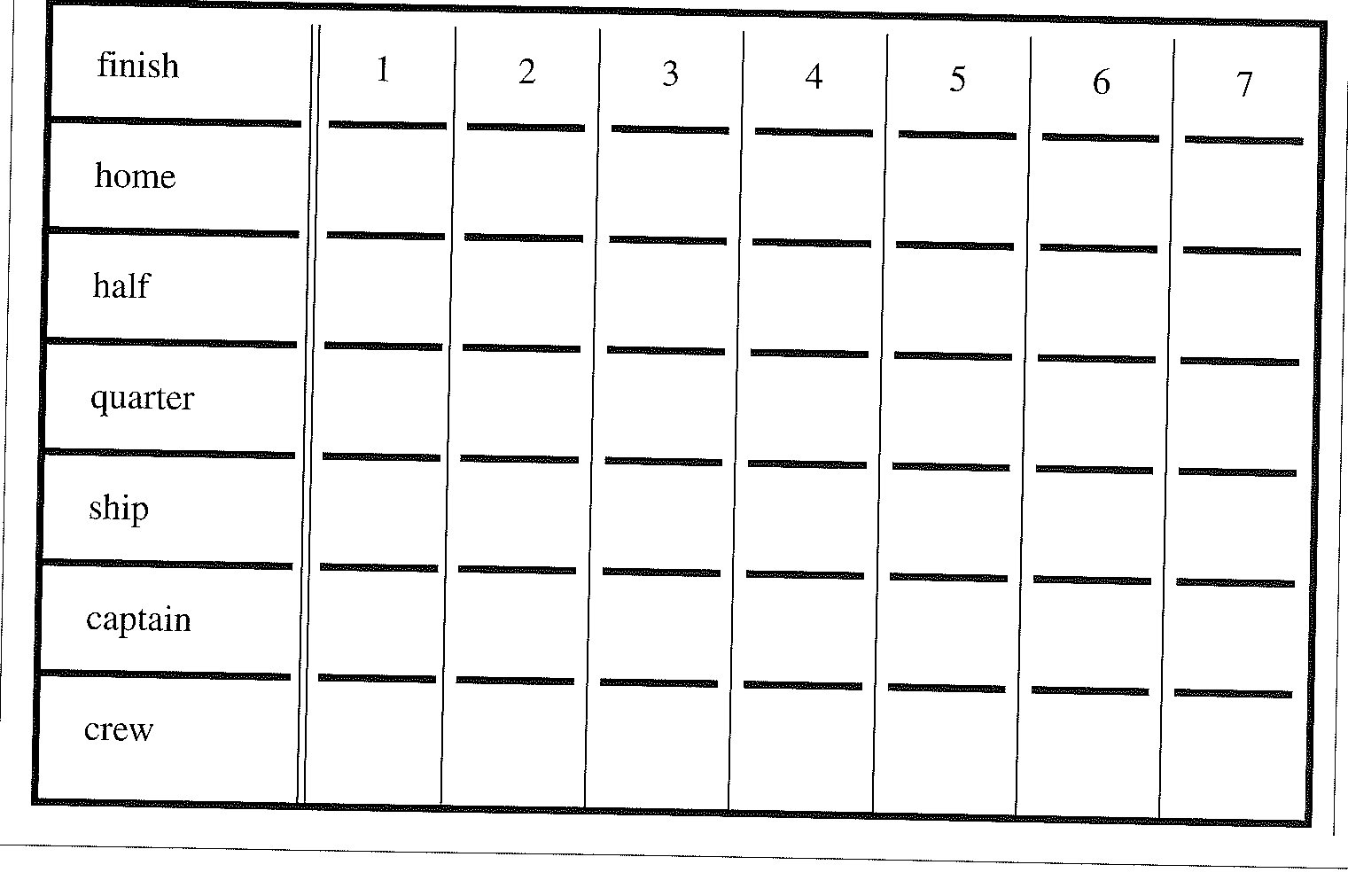
Can you duplicate this feat by filling in the appended table with the name of each ship, the captain and crew that sailed her in the race, and where the ship placed in each of the four stages? Can you also give the meaning of the anagram and name the false captain? Finally (not necessary to solve the puzzle), can you match up each ship with the captain and crew member with which she is normally associated, then give the author and name of the work from which each comes?
View the original scanned pages →
Originally published in bout de papier, Vol. 12, No. 4 (1995-1996) — Winter 1995–96 // Hiver 1995-1996, pp. 47–48. Read the rest of this issue →



