
bout de papier, Vol. 15, No. 3 (1998) — Fall 1998 // Automne 1998, pp. 33–35
“Are you very sure about the Methodists?”
This was in June 1980 in the office of the ambassador. In a dimly lit room framed by thick striped drapes and crowded with big red leather chairs, Robert Ford sat upright behind an imposing desk.
“Well, no, not absolutely sure. I will check.”
From what I had heard about my new ambassador, this first encounter could have been a lot worse. Mr. Ford was surely mellowing in his seventeenth year at the helm but I soon discovered the “real” Mr. Ford. He was in fact quite tolerant with junior officers and intent on passing on to the youngest arrival, the internalist, his “feeling” for things Russian.
Of course, he was right. The Soviet authorities were cleaning out Moscow in preparation for the Olympics. That summer, Muscovites got their holiday vouchers without problems and all manner of unofficial groups and dissidents were sent beyond kilometre 101 to prevent any “chance encounter” with enterprising visitors. The pentecostalists, baptists and lutherans were afforded special attention but not the methodists who were too few to present much of threat.
Robert Ford was already a legend by the time he left Moscow. His record of achievement is undeniable, as an interpreter of Soviet policy, dean of the diplomatic corps in Moscow and as a writer, recipient of a Governor-General’s award for poetry. He had strongly-held moral values, a deep respect for Russian culture and definite views about the Soviet system. These earned him the respect of his Russian friends but they also shielded him to a certain extent from the new undercurrents already perceptible at the end of his last assignment in Moscow.
Robert Ford was born in Ottawa in 1915 and studied at the University of Western Ontario and Cornell University. He was one of few to join the Department of External Affairs during the war, in July 1940. His association with Moscow began with a two-year assignment in 1946 which coincided with the Gouzenko affair, a suitable baptism of fire. It is essential to mention, as any diplomat who served under Ford will attest, that Robert Ford had just married Thereza Maria Gomes in New York. Michèle Allard, the seven year-old daughter of Général Jean Allard, the military attaché who lived in the Domik behind the main Embassy building in 1946, remembers her bubbly, effervescent personality. She had jet black hair and would often dress in black. Robert and Thereza Ford were one, fire and ice. He fed off her energy. She organized his life and asked the outrageous questions that the consummate diplomat could not.
Robert Ford returned to 23 Starokonyushenny Pereulok as Chargé d’affaires for the last years of the Stalinist era, from 1951 to 1953. After heading the European Division, he served in Colombia, Belgrade and Cairo before moving back to Moscow. He presented his credentials in the Kremlin on January 10, 1964.
After his departure from Moscow in October 1980, Ford kept a hand in Soviet affairs for a few more years as Special Adviser to the Canadian Government on East-West Relations and as member of the Independent Commission for Disarmament and Security Issues under the chairmanship of Olaf Palme (Palme Commission).
It would be fair to say that Robert Ford never ceased to follow Soviet affairs. It was sometimes a mixed blessing to read his telegrams on an issue that we at the Embassy would have just commented on. I am told that Ford had the same propensity to comment on Soviet affairs from Bolivia at the end of the fifties. It could not have been easy to follow in the footsteps of Robert Ford in Moscow!
How could it have been otherwise? Ford was at the center of Canadian-Soviet affairs for nearly twenty of the forty-nine years of Canado-Soviet relations — include his two other assignments and his tenure covered half of the existence of our bilateral relations. (Canada was rather late in establishing diplomatic relations with the Soviet Union, on June 12, 1942, and did so only because of the war. It had appointed trade commissioners to Russia in 1917) By virtue of the length of his experience and his entrée in the cultural establishment, Robert Ford was unique. Western diplomats were rarely assigned for more than three years and more dramatically, most were cordoned off in a well-defined space by the Soviet authorities. Very few gained a feeling for life beyond officialdom. Robert and Thereza Ford did, helped by his affinity for poetry and her flamboyant personality. At the same time, he abhorred the Soviet system. Ford put it this way in the introduction to his Personal Anthology: “My job in the many years I spent as a diplomat in Russia was political. But my interest in Russian poetry and my efforts at translations were passports to understanding. My love of their poetry made my unmistakable distaste for the system somehow acceptable.” This duality brought him close to Russians who put up with it daily.
Andrei Voznessensky is one of Russia’s greatest living poets. He was the “enfant terrible” of the sixties — the shestideciatniki, remembered today with avid nostalgia. He could pack hockey arenas with thousands of fans who would hang on his every word. Ford and Voznessensky struck a friendship based on mutual respect as much as appreciation of each other’s poetry. Ford translated several of his poems; many are found in his “Personal Anthology”
Voznessensky recalls that Robert and Thereza Ford were the centre of cultural life in Moscow. They visited the young poet and his wife, the writer Zoya Bogouslavskaya in Peredelkino. There they met Lily Brik, Nadezhda Mandelstam, Yevgueni Yevtushenko, Bella Akhmadulina and Maya Plissetskaya. These encounters at a Russian’s dacha were practically unheard of for a western diplomat. Ford also had some contact with the artistic world through George Kostaki, an art collector, who happened to be on the Embassy’s local staff until he emigrated at the end of the 1970s.
Voznessensky explains well why Russians were attracted to Ford. He was a handsome man, his deep blue eyes were striking. He had an aristocratic demeanour and lived his infirmity with dignity. Russians instinctively sympathize with an individual’s suffering and this only reinforced their respect for him. In addition, Ford was an idealist, not a materialist — another trait Russians readily identified with. He loved Russian poetry and considered the Russian language as the “second language of poetry” after English.
Voznessensky recalled how Ford would discreetly help him and in his way “beat the system”. Ford engineered an invitation from the Prime Minister to enable Voznessensky to visit Canada which, at the time, was what it took for the authorities to let him go abroad. He also called Voznessensky into his office one day to show him, without saying a word, an article that described how one of his acquaintances in the United States had helped the dancer Baryshnikov in his defection.
Georgi Arbatov is the founding director of the Institute of the USA and Canada; indeed he oversaw the creation of the department that added “Canada” to the Institute in 1972. He was considered the Soviet Union’s leading Americanist for close to a quarter century. Arbatov had been a top advisor to Leonid Brezhnev and remained a full member of the CPSU Central Committee until 1990 retaining his influence through to the advent of Mikhail Gorbachov and “New Thinking” in Soviet foreign policy.
His thoughts on Robert Ford reflect the duality described above (see box, message to the author, May 5 1998). One of his comments is particularly interesting, referring to their tenure on the Palme Commission in the early eighties: “We had many discussions, not always were we in agreement but our disagreements were not of a principal nature. We represented two different generations not only by age, but politically. I worked a lot to bring perestroika nearer, Ambassador Ford with all his knowledge of traditional soviet diplomacy was not easy to persuade that things really started to change. But soon this difference started to close.”
In the closing chapter of his memoirs, entitled “Our Man in Moscow”, Ford did not seem optimistic at all that the leaders of the system would deem it vital to shake it out of its stagnation. The difference with Khrushchev’s “thaw” which Ford well analyzed, is that, twenty-five years later, the rot had set in sufficiently for events to run their course out of the system’s control. Poland since 1976, and the invasion of Afghanistan, both for its alienating impact on Soviet society and the leadership’s misreading of the West’s reaction, had a profound effect on the coming generation of leaders, including Mikhail Gorbachov. Their outlook was somewhat different from their predecessors’, but this was not immediately apparent to Kremlinologists.
“Our Man in Moscow” describes the grind and the glory of pursuing Canada’s interests in the Soviet Union. There is the daily tedium of getting through to a thick bureaucracy firmly wedded to the principle of reciprocity. Records of Ford’s meetings at the Foreign Ministry (provided courtesy of Mr. Lebedev) deal with some momentous issues such as ministerial visits, Expo
67, and negotiations for a Soviet consulate in Montreal. They reveal Ford’s quixotic quest for a new Chancery (as early as 1965!) and deal with the perfectly mundane — such as Ford complaining about the laundress provided by UPDK (the state monopoly, sole provider of staff, services and accommodations to diplomats) who turned out to be more adept at paper work than ironing. The state of our bilateral relations tracked the overall pattern between the two superpowers. Canada used its position as a “bridge” between them in difficult moments and Ford was a conduit. The high point of his tenure was the exchange of visits of Prime Ministers Trudeau and Kosygin in 1971. The low point unfortunately came at the end of his stay. The Soviet invasion of Afghanistan in December 1979 put our relations in deep freeze. In his last months, Ford had to cope with a drastic reduction in locally engaged staff, an embargo on wheat sales to Russia and a boycott of the Moscow Olympics. A change in government in Ottawa in early 1980 did not affect our policy. I recall that Ford was bitter at having to end his career in Moscow on such a note. The Soviets extended him the minimal courtesies on his departure. He could have expected a farewell lunch hosted by Minister Gromyko; after all he was the dean of the corps. Instead, he was hosted by a vice-minister of the Foreign Ministry who thought it necessary at the lunch to remind us that Ford had been the second longest serving ambassador in Moscow. A Swedish ambassador after the war had served two months longer. Ford took subtle revenge in his toast by carefully choosing to quote some lines from his favourite poet, Serguei Essenine, not exactly a favourite of orthodox Soviets.
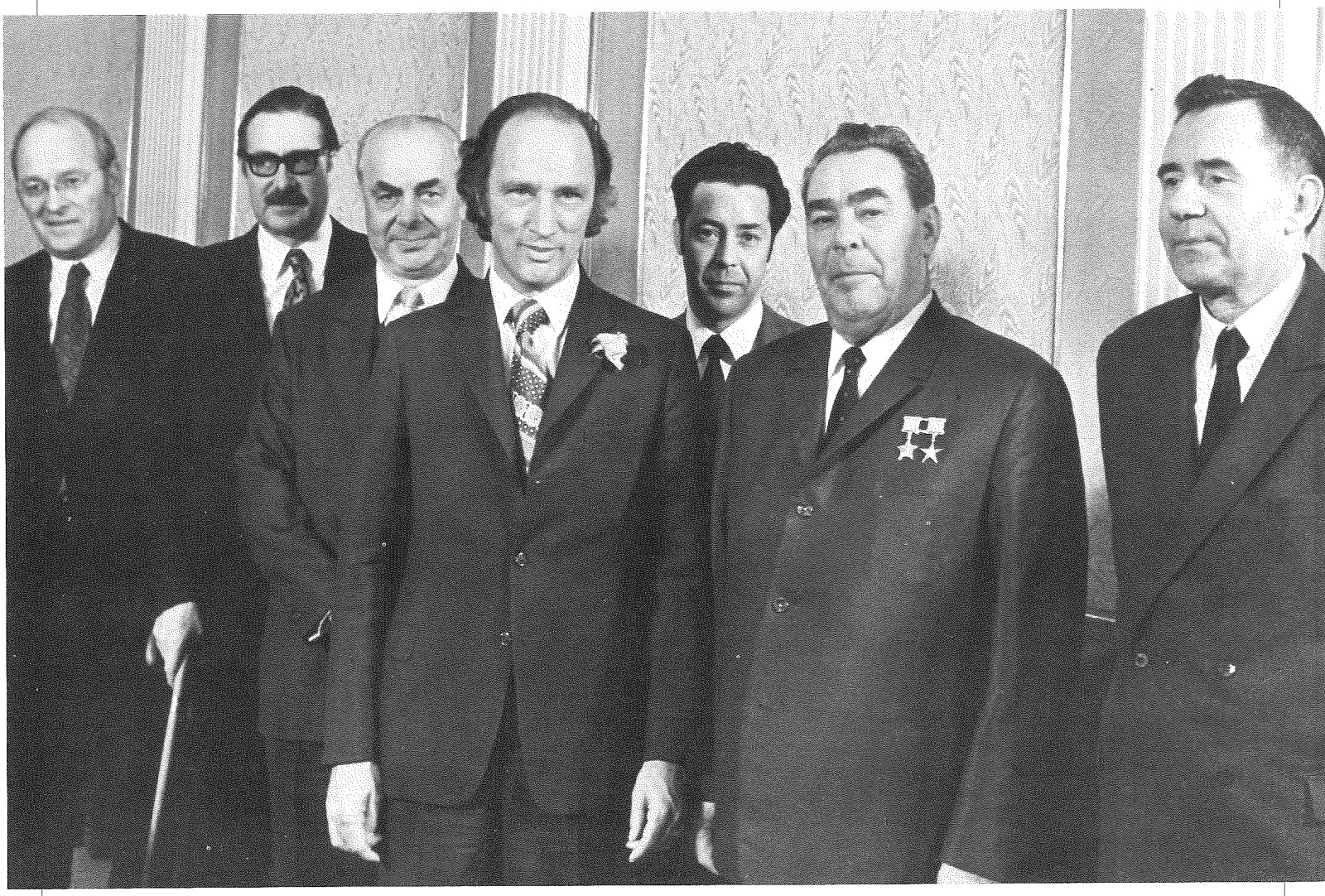
On an early October morning, the Fords said farewell to the staff assembled in the Red Room. Ed and Nina Stevens, old friends from the forties’ who lived around the corner, joined us. Ed had come to Moscow as an American correspondent and married a Russian who collected and introduced unofficial artists. The Fords left in an old Lincoln Continental and a Lada for France where they settled just outside Vichy.
Ambassador Ford left an indelible mark in the history of Canadian-Soviet relations. Robert and Thereza Ford also left their imprint on generations of Canadian diplomats and their spouses. Robert Ford was determined not to let his infirmity interfere with the pursuit of normal diplomatic activities. He would not stand for any sign of weakness and set exceedingly high standards for himself and his staff. In the eyes of members of our Russian staff who knew Ford, he represented an era that is fading away.
His legacy lives on. It is that of a man with strong views that were not always shared, such as on the pervasiveness of the communist system, but always respected. Several of my colleagues who have served earlier in Russia recalled how visiting ministers and officials would call on him as a matter of course. Robert Ford was a poet and he gained acceptance in Russia’s literary world. When I first saw Andrei Voznessensky on my return to Moscow, his first question was about Ford’s health. Robert Ford advised several Canadian Prime Ministers on East-West relations. Any analysis of our country’s relations with the Soviet Union will include Robert Ford’s significant contribution to their development.
Ambassador Robert Ford was the first Canadian Ambassador to the Soviet Union I got to know just at the moment when we decided to undertake our own expansion to include Canada in our studies and to rename the institute – Institute of the USA and Canada. He impressed us not only by his keen understanding of foreign policy and international relations, but also by his great interest in Russia including Russian poetry. As a memento of this interest I keep a book containing Russian poetry translated by him into English. He was a fine gentleman and at the same time a man with strong views on which he never compromised which is why he had sometimes strained relations with some of our officials. But he was liked in Moscow, especially by people interested in cultural dialogue between our two countries.
The chance to work with Robert Ford was presented to me by the “Palme Commission” at the very beginning of the eighties. We were both invited to work as its members. We had many discussions not always in agreement. We represented two different generations not only by age, but politically. I worked to bring perestroika nearer. Ambassador Ford with all his knowledge of traditional soviet diplomacy was not too easy to persuade that things really had started to change. But soon this difference started to close.
As a human being, as a professional, as a man of high culture he deserved high respect. And he will remain as a significant positive figure in our relations and in the hearts of many Soviets who knew him. In mine for sure.
Georgi Arbatov
View the original scanned pages →
Originally published in bout de papier, Vol. 15, No. 3 (1998) — Fall 1998 // Automne 1998, pp. 33–35. Read the rest of this issue →



