
bout de papier, Vol. 16, No. 1 (1999) — Spring 1999 // Printemps 1999, pp. 36–39
My ancient copy of the South American
Handbook had been brief and to the point in describing the charms of the Colombian banana port of Turbo: “This is the worst place in the world”.
Since arriving here by air from Medellín fifteen hours earlier, I had spent tense moments facing down an armed, possibly drugged and certainly megalomaniac member of the security police in a seedy back street restaurant. Then a short, hot and sleepless night swatting mosquitoes in the parish travelling companions, snored deafeningly. Now, — at 7 in the morning – I had already been squashed uncomfortably for a hour, with eighteen others, into a tiny launch that bobbed on the foulest-smelling and blackest waters imaginable, while we waited for The Man From the Ministry of The Interior. So far, Turbo was living up to its billing.
At the invitation of the 2500-strong community of Displaced Persons (“desplazados”) that had been living in squalor in Turbo since their forcible expulsion lands in the Darién peninsula by illegal right-wing paramilitaries (“Paras”), I was taking part in a multi-agency Verification Commission, charged with looking at whether the time might now be right for the desplazados to return. In that both the Paras and their enemy, the 57th Front of the rebel FARC, were both thought still to be active in Darién, my real role was that of a kind of unarmed bodyguard for the desplazados, the theory being that the presence of a Foreign Diplomat would deter “the actors” (as the rebels and the Paras are euphemistically known in this country from any hostile action. The Bogotá papers were still full of the kidnapping, one month earlier, of four American birdwatchers and an Italian restaurateur by another branch of the FARC, so I was not confident of the soundness of this theory. But it seemed churlish to point this out to my hosts at this late stage.
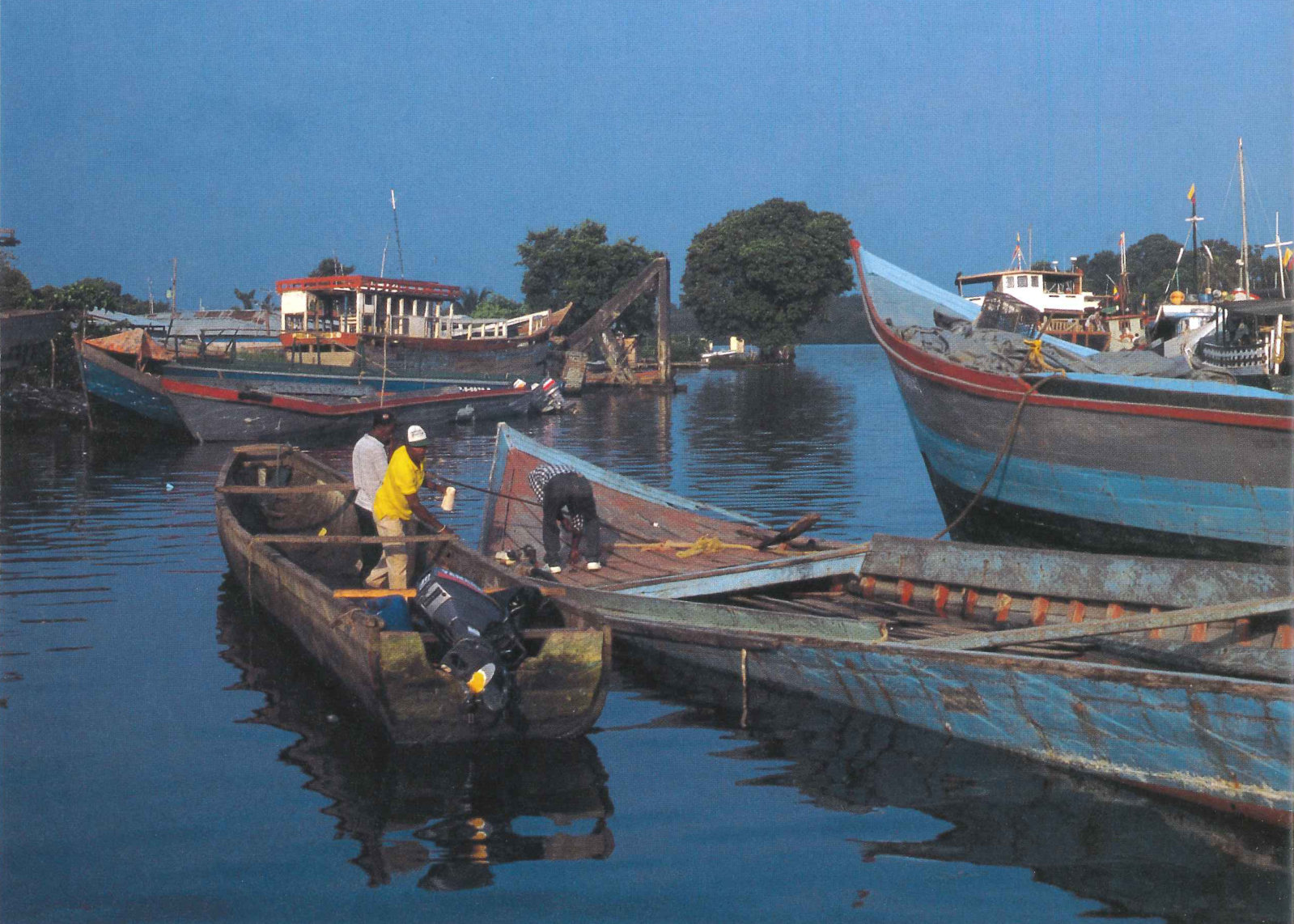
The Man From the Ministry of The Interior finally arrived, grinning sheepishly, having overslept. There was no sign of The Man from the Ministry of Communications, The Woman from The Welfare Department nor of The Red Cross. After much impatient clucking, shrugging and expressions of disappointment from the desplazados, we set off anyway, the first stop being a full body search by grim-faced Navy personnel at the harbour mouth.
As our two launches thudded across the Gulf of Darién, heading for the low mangroves that mark the mouth of the A trato River, Adán — one of the desplazado leaders recounted briefly to me the events of February 1997. Early one morning,
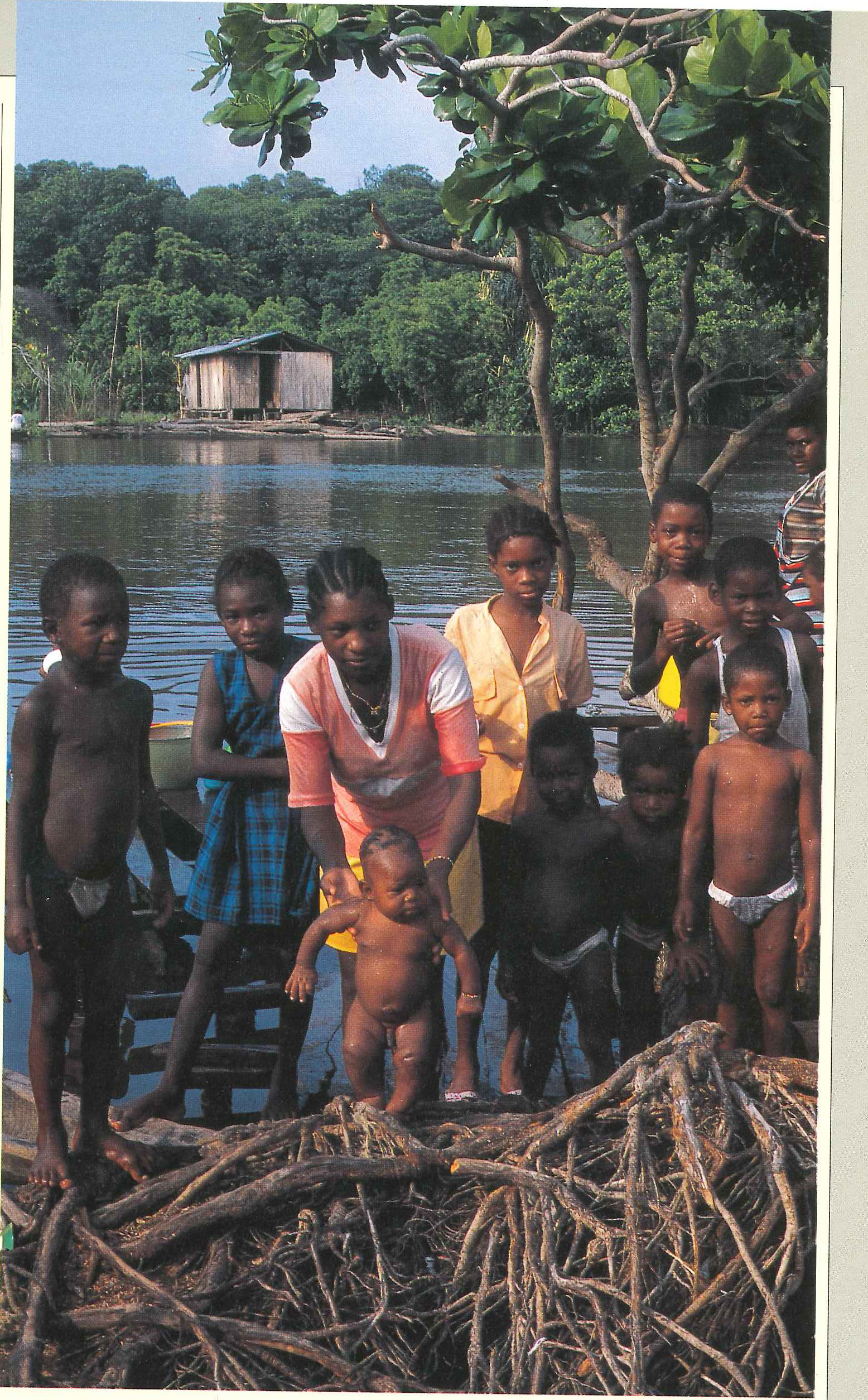
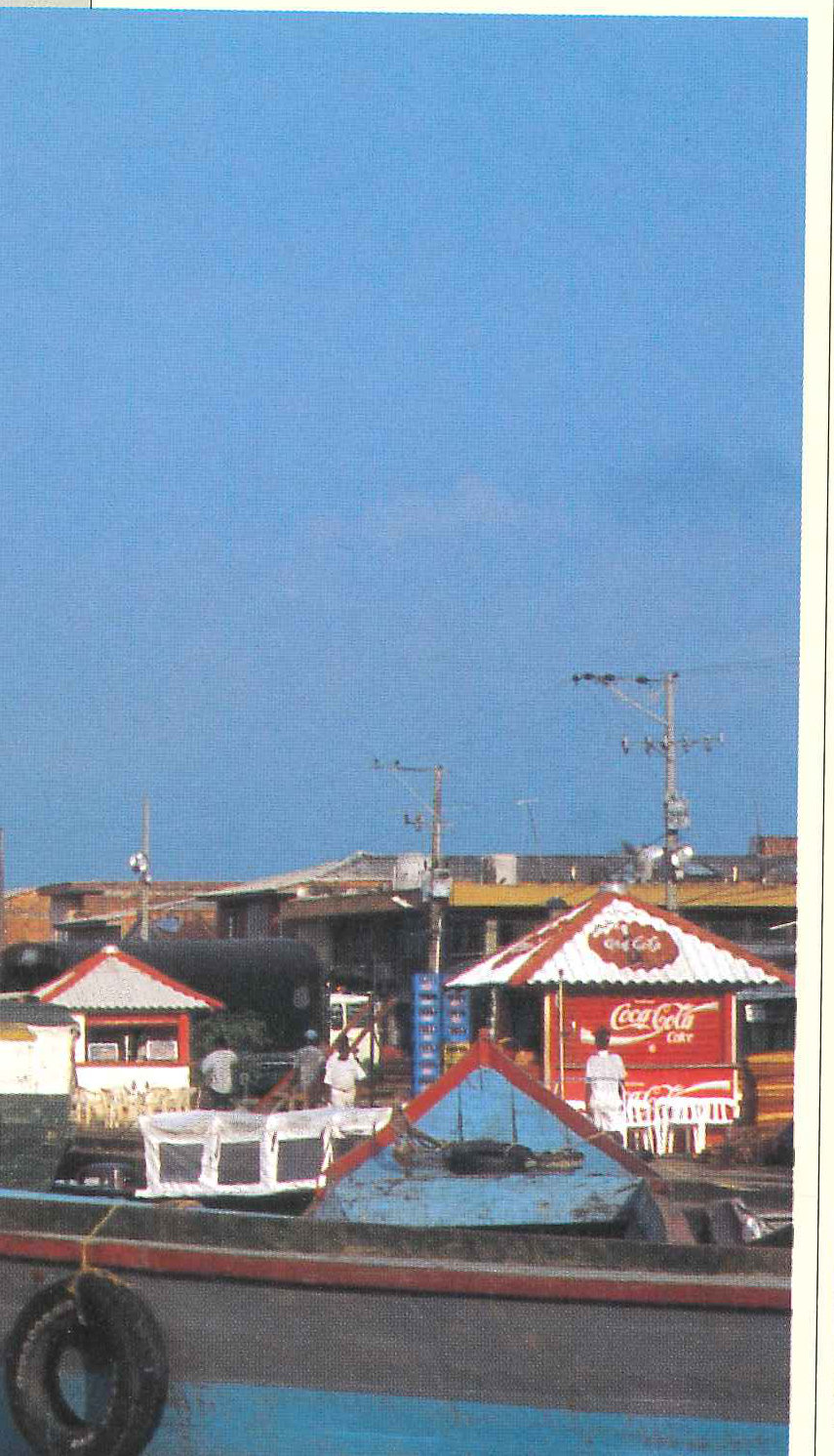
Left: The harbour – Turbo Above: Desplazado children at Bocas del Atrato five Army Hueys had swept low over his village, located on the Perranchito River, close to the border with Panama. Minutes later, the village was overrun with uniformed, heavily armed Paras. The entire population of the village was assembled and told that, on account of their “collaboration with the FARC” ’ they had three days to get out — for good. Over a period of several days, the same scene was repeated throughout the twenty or so remote riverside communities of the Cacarica watershed.
In some communities, the Paras did more than threaten: from behind my seat in the launch, a grizzled old black man broke in to tell me how his fifteen-year old son had been shot dead, in front of him.
The effect of the Para incursion was immediate: entire communities were evacuated in a matter of hours. Women, children, the old men – everyone fled down narrow jungle paths and waterways taking with them only what they could carry, piling into dugouts and onto homemade rafts. It took some families several days to drift down the Atrato then paddle their way in rough seas to Turbo.
Even in Turbo, where most crowded for shelter into the ramshackle sports stadium, safety was only relative: some forty of the desplazados were killed or simply “disappeared” during the displacement itself, but in the fifteen months of exile in Turbo, another thirty were forcibly dragged off, never to be seen again. A makeshift monument on a wooden fence outside the stadium tells the story: carefully typed on separate scraps or disappeared, some with Polaroid photos attached, others with laboriously penciled notes composed by their children or wives.
Three hours out from Turbo, we reached our initial destination, the tumbledown waterside settlement of Puente América, located at the strategic point where the Cacarica flows into the much wider Atrato. In spite of the settlement’s name, there is no bridge here; the community is optimistically named in the supposition or hope that when the Panamerican Highway is eventually pushed through from Panama into northwestern Colombia, then it will cross the Atrato at this point. While some attribute the arrival of the Paras in the region to a kind of idealism (i.e. a determination to cleanse the region of the guerrilla by depriving them of their supposed peasant support base, the legitimate Army having failed in this task), others say it is because this is a region of great strategic value to certain “powerful interests”: it is a principal route for the smuggling of arms, drugs and people between the Americas and, as and when the Highway is eventually put through, then land prices will presumably rise dramatically, the more so if that land is conveniently devoid of peasants.
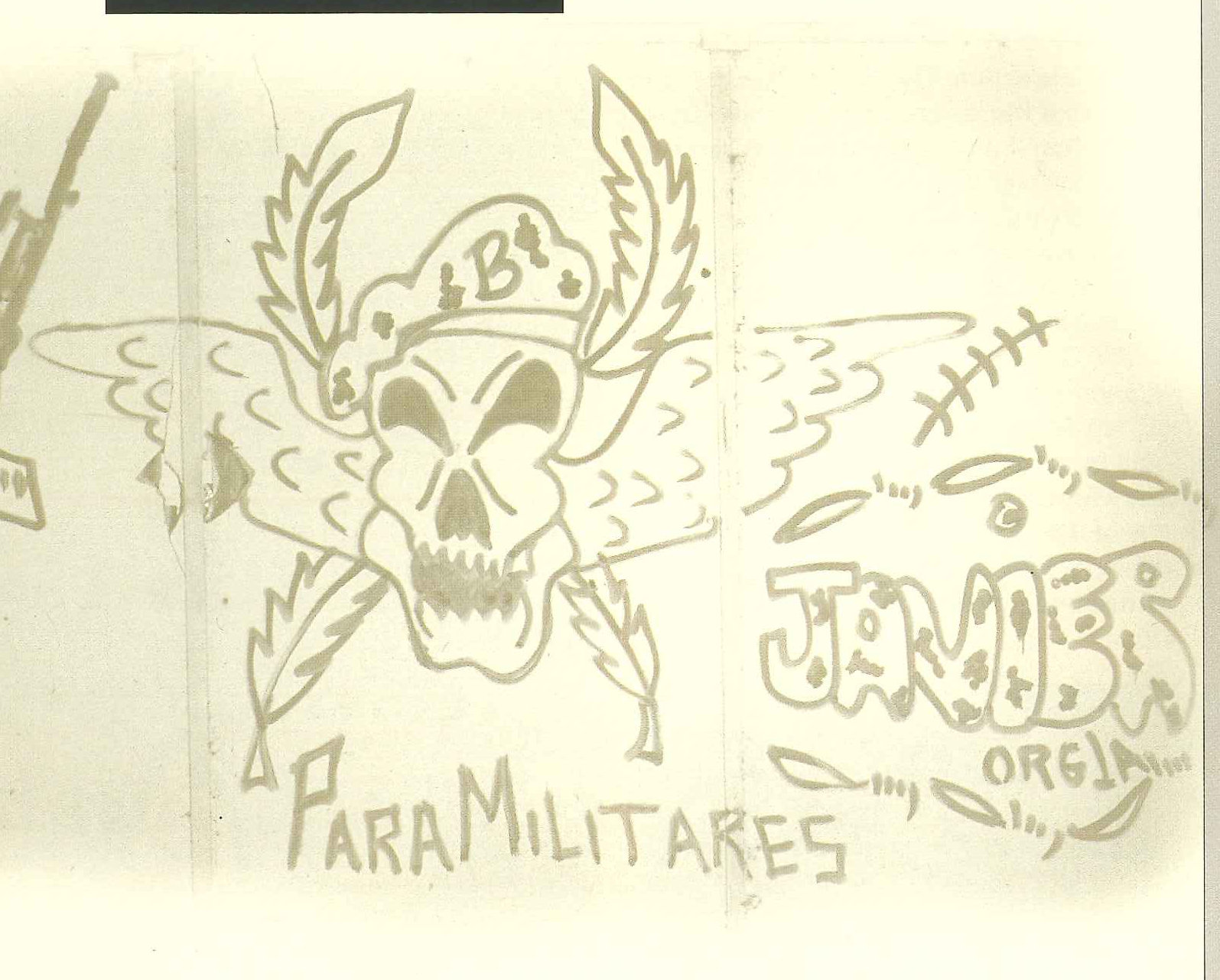
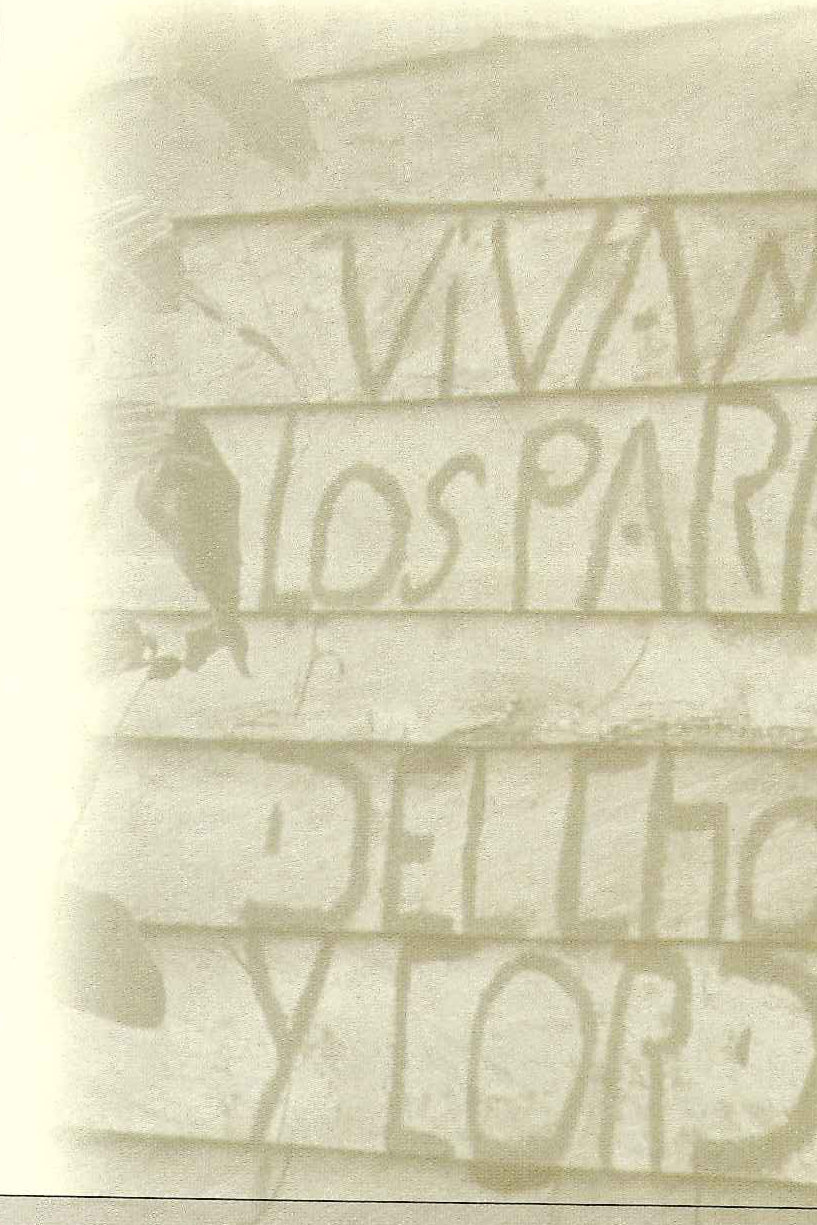
At Puente América, the recent passage of Paras was evident — Death’s heads and slogans were scrawled in paint on many of the buildings: “Death to Subversion” “Collaborators die”, all signed with the initials of Colombia’s principal Para organization. Half of the community’s thirty or so shacks-on-stilts had been burned but lush growth already covered most of the devastation. Two miles up the Cacarica, in a semi-ruined building on a hill commanding the river, there was worse. The ground around the building was littered with spent cartridges, its walls covered with crude paintings that ranged from the satanic to the obscene, AK-47s as phalli. The most recent artwork was dated one month prior to our visit. Evidently, this served as an occasional Para base.
As evening fell, there was an uneasy discussion. Given what we were seeing, shouldn’t we make a special effort to have the International Committee of the Red Cross (ICRC) with us? Several members of our group were delegated to take a fast dugout to the headquarters of the long-closed but still manned Los Katíos National Park, one hour away, to see if we could use the radio and call them up. The delegation came back at nightfall with good news and with bad. The good: the ICRC hoped to catch us up next day. The bad; there were some 30 Paras encamped at the National Park dock, who had blithely informed the delegation that their main force of 170 or so was close by, encamped at the Cienaga de Tumarado lagoon.
We spent our first night camping out on the floor of Puente América’s abandoned schoolhouse, black skulls painted on the doors, hornets nesting in the rafters. moon set over the Atrato, an unlit high-speed launch roared upstream and disappeared into the blackness. The howler monkeys growled restlessly from their treetop perches and the mosquitoes bit mercilessly. It was another uneasy night for me.
Next morning at dawn, we transferred from our light but speedy launches to a much bigger, heavier craft, known as a Chalupa. We would need this for, at this time of year, much of the upper Cacarica is choked with floating weeds through which only a Chalupa, with its great weight, power and pointed bow can drive. While the bow man pointed wordlessly to left and right, our equally taciturn “motorista” in the stern would deftly steer around the densest clumps of weeds, hoisting up his twin outboards whenever we needed to ride over them. Sloths watched us motionless from the trees and, as the sun came up, kingfishers and river hawks swooped under our stern.
We were coming near and nearer to the homes of the desplazados and, as the morning wore on, the feeling of impending doom that had seemed to hang over us the previous evening melted gradually away. Doña Rosalba — black, five feet tall and weighing 300 pounds — got things going with an initially tentative but rapidly more confident rendition of a song the desplazados had made their own during the long fifteen months in Turbo: “No nos moverán”, more or less to the tune of “We shall not be moved”.. The men in the boat followed suit with an hour of “coplas”, “, a kind of informal song contest by which, without hesitating, you must stand up and add an improvised four-line verse to an ever-lengthening narrative saga. The saga the men were singing today was no less than our own adventure, beginning with a meeting the desplazados had successfully sought with President Samper in Bogotá, carrying on through episodes such as the tardiness of The Man From the Ministry Of The Interior, and including the previous evening’s encounters with the Paras. There was even a verse for the Embajada de Canadá.
The mood was jovial, the humour increasingly ribald and yet I had the feeling I was involved in something of near-mythical proportions. Who could tell? If all went well, these verses might be sung again in fifty or a hundred years’ time by the descendants of the little girls sitting in the bottom of the Chalupa. Entranced, they were now clapping out the copla rhythm. Might The Great Displacement of 1997, by then, be a memory to be recalled in song, a sad but transitory moment in the collective memory of these brave people?
For two 40-degree days, we trekked along overgrown jungle paths and poked around in dilapidated wooden shacks, notebooks in hand. In one abandoned settlement an old man tugged me by the sleeve and asked me to take his photograph: I had not realised, but we were standing on the site of his burned home. The man who had seen his son killed made a formal request to the Commission, as we sat around the fire one evening, for permission to search for his child’s grave site. Firmly but kindly, his friends said there was no time. He nodded meekly and fell silent.
At La Virginia we met with the Indians — a dozen or so Katío women and three or four men. They had been in the Cacarica forever and clearly had every intention of staying here forever. In a pattern I had seen elsewhere, they had successfully negotiated with both the Paras and the guerrilla, deals by which, if one side suspected the Indian community of “dealing with” the other, then the community must “discipline” itself internally. I dared not ask, in this case, what that “discipline” might mean. The Katío women were painted head to foot in a deep blue natural dye. As they fingered their bright beads and the desplazados, — brandishing titles, maps and letters — confidently explained that they intended to return and take back “their land”. “, the women said not a word. The men just nodded nervously. Then, abruptly, the meeting was over. The Katios slipped off into the bush; the desplazados were left to shuffle their papers. I had the feeling that I had witnessed the meeting of two irreconcilable worlds.
Back in The Worst Place in the World when — sweaty, mosquito-bitten and tired — we finally returned, a welcoming multitude packed the dockside. They had no way of knowing when we would arrive and I supposed they had been waiting all morning. As our two launches sat slowly back from their bow waves and nudged the dock, the desplazado band struck up. One by one, every member of the Commission was feted in verse, and the special guests presented with traditional wooden canoe paddles. I am not ashamed to say that I had a tear in my eye as “El Diplomático” was called forward to accept his gift and a cheer went up for Canada. Turbo wasn’t so bad after all.
View the original scanned pages →
Originally published in bout de papier, Vol. 16, No. 1 (1999) — Spring 1999 // Printemps 1999, pp. 36–39. Read the rest of this issue →



