bout de papier, Vol. 12, No. 4 (1995-1996) — Winter 1995–96 // Hiver 1995-1996, pp. 34–36
Everyone has heard of the Great Wall of China; a massive structure, five metres high and almost as wide, originally built over 2,000 years ago, stretching in a continuous, unbroken line across the north of China for thousands of miles, protecting her from nomadic invaders, and serving as both a symbol and a central feature of the Chinese landscape and world view throughout history. This is just common knowledge, isn’t it? Every child in Canada can hardly get out of elementary school without getting a general impression of the Great Wall along these lines, so it would not be surprising if you also share this view. Unfortunately, most of my opening sentence is entirely erroneous. At the risk of destroying a cherished illusion, let’s examine each of the several misconceptions.
First of all, most people believe there is just one Great Wall, which has been continually restored over the centuries. Actually the Chinese have been building defensive walls for millennia, but they have not always been in the same place, and they often bore no relation to one another. The earliest recorded long border walls were built about 6-700 BC, long before China was unified as a single state, and were primarily constructed to separate the several Chinese states from each other. Some were built to keep out non-Chinese from the north, but most of them ran in a north-south direction, not the east-west configuration that we know today. In 220 BC Qin Shi Huang Di united all the Chinese states and demolished most of these walls. He built the first “Great Wall” to separate China from the northern barbarians. The Qin wall was quite far north, close to the modern state of Mongolia. Subsequent Chinese dynasties did not all build walls, but several of them did, particularly the Han, Jin, Sui, and Ming. However, each dynasty built its wall in different areas. While the Jin wall was further north than the Qin, reaching in places into modern Russian Siberia, the Ming wall lay far to the south of it. So we are left with the question, when we talk of the historical Great Wall of China, “Which one?”
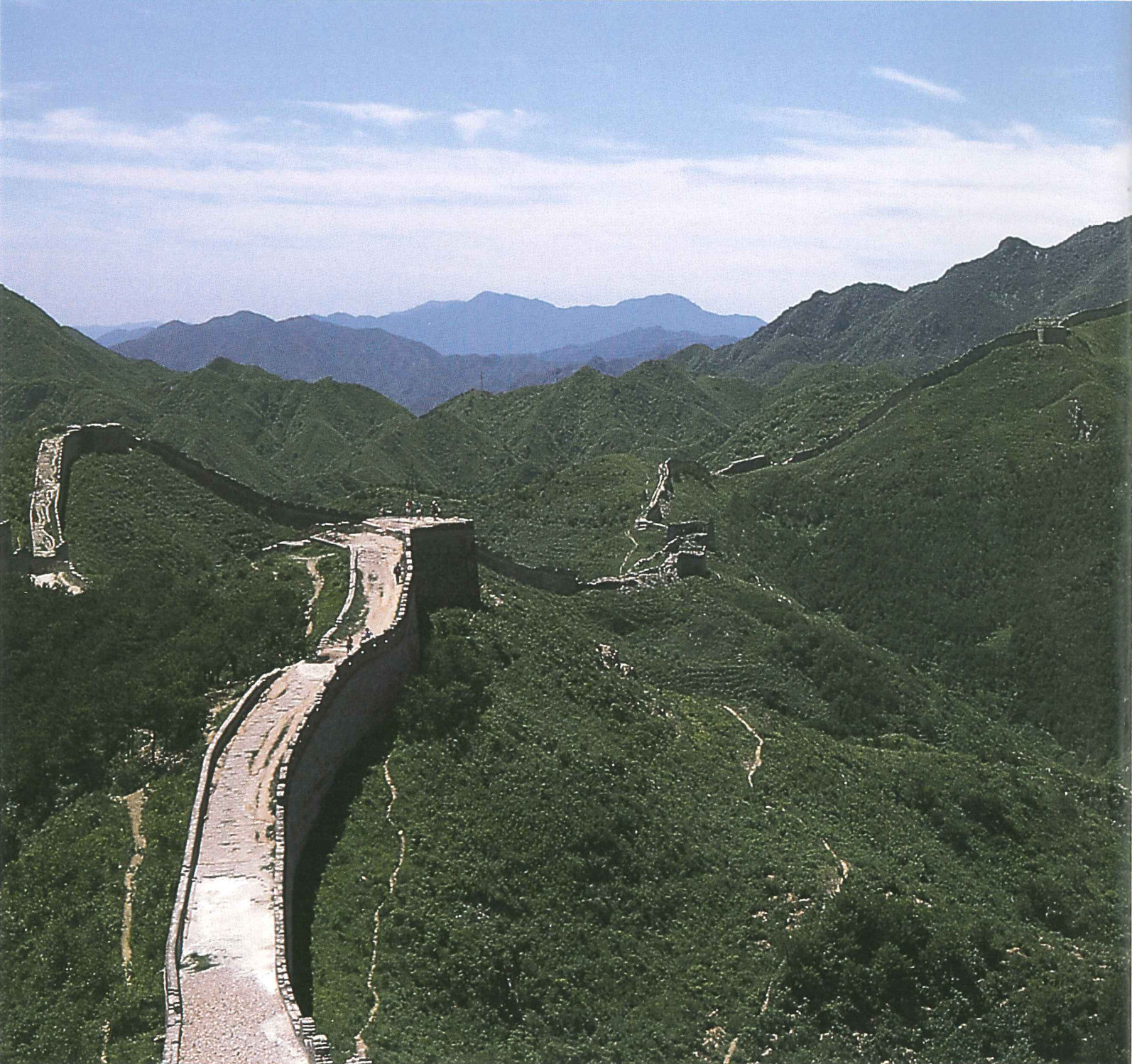
The most photographed site on the Great Wall is at Badaling, just an hour’s drive northwest of Beijing. It is here that all visiting dignitaries, including Canada’s Prime Minister recently, are taken for their obligatory photo. This spot is daily mobbed by tourists, both foreign and Chinese. There is a panel saying that the wall was originally built 2,000 years ago on this site, and has been continually rebuilt and restored down through the ages. This makes the tourist experience all that more impressive, but it is simply not true. The wall at Badaling is the Ming Wall, built about 400 years ago. Almost all the photographs or drawings one sees of the Great Wall of China are, in fact, of the rather recent Ming wall. Most of the earlier walls have disappeared, primarily through erosion, or have left only rather unphotogenic mounds of clay across the landscape. So how old is the Great Wall of China? One usually has the Ming wall in mind when the question is asked. The Ming dynasty only began in the 14th century, and did not become really diligent at wall-building until the 16th century, so the answer is about 400 years old.
Our mental image of the Great Wall of China is usually based on photographs or paintings of the most dramatic sections of the Ming Wall, such as Badaling. In fact that infamous panel at Badaling also states that the wall was built wide enough to allow several mounted horsemen to ride abreast across its top, and implies this was the case throughout its length. Badaling was probably the most militarily vulnerable section in the entire Ming Wall, as it is in a low mountain pass only a day’s march from the Ming capital city, so obviously it was particularly well-built. In the area of Badaling, there used to be several parallel walls across the pass, although only one of them has been restored for the tourists. However the Ming Wall was not nearly this massive throughout its length. In fact, there are large areas where there was no wall at all, and many where it is built only a few feet wide, more like a fence than a wall. These places are barely wide enough for one man to walk comfortably, and totally impassable for a horse. Also the materials used in the construction of the Ming Wall varied considerably according to the region, and although at Badaling massive carved blocks of stone are used for the foundation, in other areas the material was sometimes just tamped clay, or piled up, unfinished stones. The pre-Ming walls were almost exclusively made of these simple materials, and this explains their virtual disappearance over the years. Nevertheless a myth has developed about the massive proportions of the Great Wall throughout its length. The frequently-made claim that the Great Wall is the only man-made structure visible from outer space is entirely false. Try to spot it from your airplane window as you are landing at Beijing’s Shoudu Airport. It’s not easy, and you will only be a few thousand feet above the wall.
It is generally and correctly understood that the Great Walls of China were built as military, defensive structures to protect China from non-Chinese nomadic people from the north. But did they really provide protection? Probably some, but on a limited scale. In some cases, history shows that wall-building may have been counter-productive. The best example of this was the fall of the Ming Dynasty. Building and garrisoning the Ming Wall required the equivalent of billions of dollars of wealth, manpower, and resources, and inevitably this had to be financed by taxing the population. Near its end, the Ming Dynasty was being harassed by numerous peasant uprisings, probably the result of excessive taxation and misguided government policies. The Manchus, a non-Chinese people from the north whom the wall was built to keep out, offered to assist in putting down the rebellions. The gates of the wall at Shanhaiguan (near where the wall meets the Pacific Ocean) were swung open; the Manchus marched in unhindered, and took over the whole country, replacing the Ming with China’s last dynasty, the Qing.
Throughout her history, China has always vastly outnumbered the northern nomads in population, and was superior technically. When China was united under effective leadership, with a strong economy and contented population, the nomads could not hope to do more than harass the fringes of Chinese territory. China was only vulnerable when she was fragmented and weak, and then “all the walls in China” could not have guaranteed her security against determined northerners. Walls without guards, gates without watchmen, fortifications without troops, are virtually useless. Even when they are staffed, but if the people are demoralized, or easily bribed because of breakdowns in the social order, the walls could be easily breached. So did the Great Wall protect China from the northern barbarians down through history? Probably only marginally, on a small scale, in some local areas. In fact, it was rather a white elephant, never coming near to justifying the suffering and expense involved in its construction.
How could China allow such a fiasco to dominate and become the central feature of her military and foreign policy over the millennia? Well, she didn’t. Walls, even great long ones, have been around in China for a long time, but they only occupied a paramount place for very brief portions of Chinese history. Many of the most famous and powerful Chinese dynasties, including the Tang, Song, Yuan, Qing did not build any walls at all. Their strategy to deal with the northern barbarians was, at times one of aggressive military action, and at other times, one of co-existence and negotiated peace treaties. Their defence was their strengths, and walls would have simply been limiting and superfluous. In the 13th century, Marco Polo visited the fabulous court of the Yuan Dynasty at Kambalik (modern Beijing). He wrote of the many wonders of China, but never mentioned any walls, because there were not any to be seen. The Yuan, and the other dynasties that preceded it for almost a thousand years, did not build any significant walls. The orgy of wall-building during the Ming was an aberration in Chinese history rather than a typical feature of it.
But has not the Great Wall played a large role in traditional Chinese art and literature for millennia? Again, no. Although today it is difficult to find any book, or cultural display on China, which does not include a picture of the Great Wall, this is a recent phenomenon. Ancient Chinese literature does contain occasional and relatively rare references to walls, but these are usually cast in a negative light, focusing on the suffering of the people involved in building and garrisoning them. There is not even any Chinese term equivalent to “Great Wall” In Chinese it is either “chang cheng” (long wall) or “wan li chang cheng” (ten thousand li long wall). Ancient Chinese art, both in painting and porcelain, has virtually no depictions of walls until nearly modern times.
In fact, the glorification of the Great Wall of China is a modern import from the West. In the 18th and 19th century, the first European visitors returned from China marvelling at and exaggerating the Ming Wall they had seen near Beijing, probably at Badaling. The wall developed mythic proportions in the minds of Europeans, and eventually the Chinese, hearing of this appreciation and respect, identified the Great Wall themselves as a symbol of their own past national greatness. While their ancestors had little to say about the Great Wall, except perhaps to vilify its builders and mourn its toll of suffering, the modern Chinese, including the Communists, have adopted it as a national symbol. In our modern age of international tourism and nation-building, pictures of and references to the Great Wall are found everywhere. However, it would be quite wrong to draw conclusions about Chinese history and world view from this rather superficial and recent phenomenon.
The Great Wall of China may not be what it is generally thought to be, but it has captured the imagination of millions of people, and, in spite of my iconoclasm, I must confess to being one of them. When I was posted in Beijing, I never missed a chance on weekends to explore the unrestored sections of the Great Wall near Beijing, and whenever possible made trips further afield to Shanxi, and Inner Mongolia.
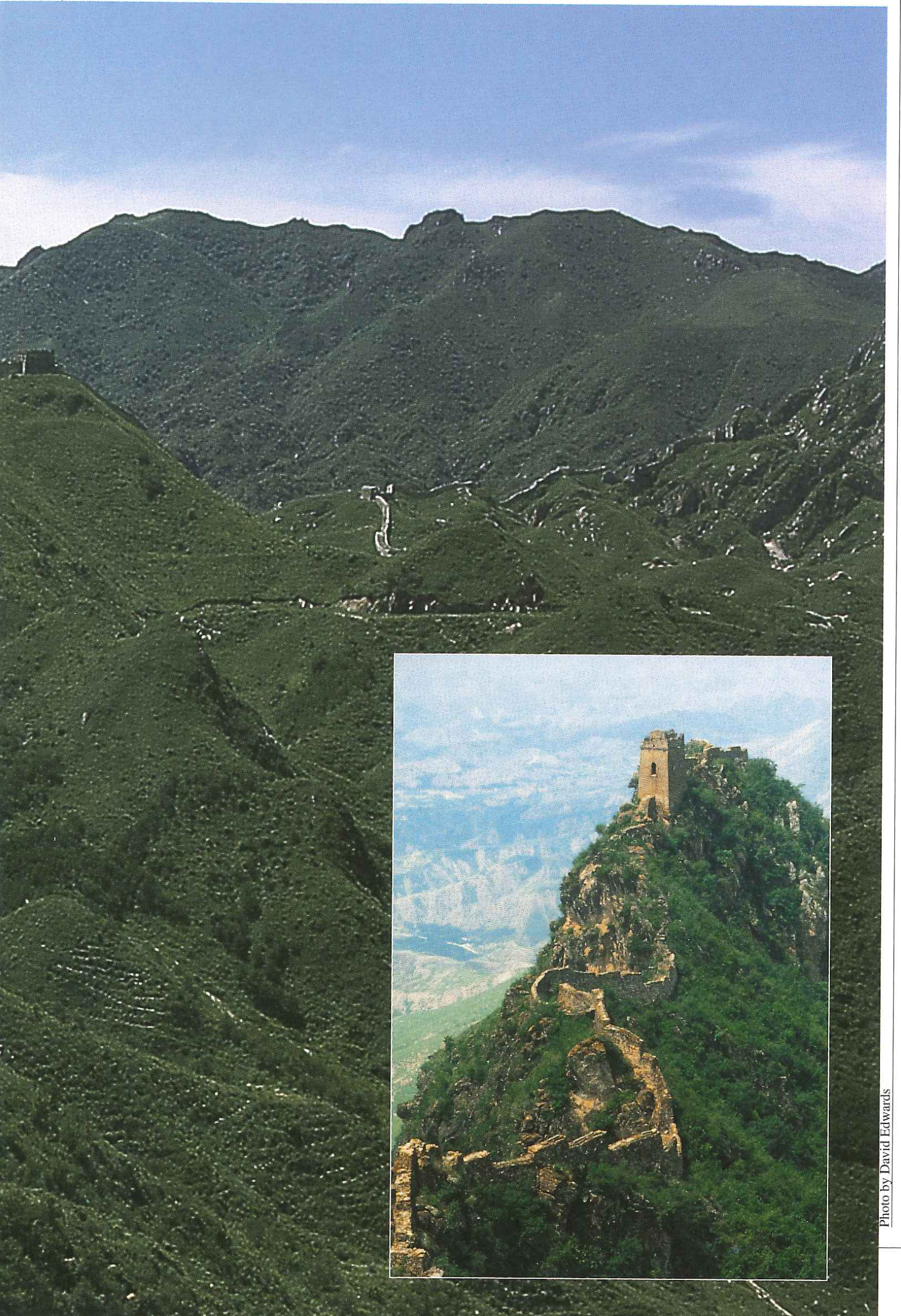
However mythical, the Wall is also very real, and away from the tourist hordes, in its natural hill top and ridgeline setting, it can sometimes be extraordinarily beautiful. The ruined towers, sometimes perched on summits, remind one of abandoned castles, complete with parapets and crenellations, almost floating in the sky. The wall itself twists and turns relentlessly up and down the mountains, sometimes standing proud above the landscape, and at others, almost hidden by trees growing right out of its body, like the ancient temples of Cambodia. In places there are giant staircases up hill sides like the steps of a Mayan altar. And the wall has ghosts, millions of them, their bones mixed with the mortar and in the foundations. One can still find partially intact towers and look out their windows to share the view of the lonely border guards who lived for years on these exposed hill tops. These views include the wall itself like a giant snake, winding its way across the landscape as far as the eye can see in both directions.
It is impressive, it is picturesque, but is it great? I would answer, yes. It is a wall like no other on earth, climbing mountains, bridging streams, crossing valleys, marching across the landscape for thousands of miles. The Great Wall of China as I know it, is only 400 years old, in places is little larger than a fence, is not continuous, did not perform its intended function very well, and is not a dominant symbol and feature of traditional China, but I love it anyway.
View the original scanned pages →
Originally published in bout de papier, Vol. 12, No. 4 (1995-1996) — Winter 1995–96 // Hiver 1995-1996, pp. 34–36. Read the rest of this issue →