
bout de papier, Vol. 22, No. 4 (2007) — Winter/Spring 2007 // Hiver/Printemps 2007, pp. 33–38
When Effie came to say that Jacques Noir was dead, I was looking at a 3-D version of Magritte’s “Trahison des Images,” Paradox always gives me a headache, but at least I could still feel the pain.
The crowd at the Festival de la culture française was turning the Palais into a down-market version of the Tokyo subway at rush-hour. Leaving the Magritte show,
. we passed a giant map of France in 264 cheeses,
• dedicated to General de Gaulle. To the left, the new head •*of the indépendantistes, Ségolène Riel, was regaling the crowd, across from a statue of Alexander Graham Cloche, inventor of the francophone. And up ahead, part of the film festival, were sets recreating great bars and clubs from. the movies, Jacques was in the Belle Aurore. “I guess he’ll always have Paris,” whispered Effie. He and Jacques had not been an item but they had been close.. When Jacques asked for our help, we agreed. His private life was threatening some hush-hush job — he wouldn’t say much. Now someone had pushed him headfirst into an espresso machine and he wasn’t saying anything. “It was one of those femmes de couleur,” said Effie harshly. I was surprised to hear such ugly words — a six-foot man in a ball gown and high heels, Effie was on the side of almost any oppressed minority. Then I realized what he meant. Jacques had been hanging with a set of lovelies he called his rainbow – Blanche Dubois, Carmine Écarlate, Chanson d’Azur, Émeraude O’Neill and Jaune d’Arc. Effie said, “I spotted Jacques and the quintette at that table over there, just before the lights went out. When they came up, all five had vanished and Jacques had been decaffeinated. You remember, he told us he’d fallen for one of them, but began to suspect that she was setting him up. But he didn’t want to tell his boss until he was sure — which is why he hired us.”
A voice behind me boomed, “If he had told us that two days ago, he’d probably still be alive”. I turned and saw a fat man with a white beard, wearing shades and an irritated look. Santa in a rumpled suit, light on the ho-ho-ho. I edged back and slid my hand closer to the gun under my left shoulder. Then I recognized him.
“Ludwig Liebnitz,” I said. “We met on the Kuhl-Ray case. You work for the government.” He nodded and looked at me silently for a moment. “I was Jacques’ boss. I think we may be able to help each other, but can I trust you?” A tall black woman in leather with a USBN port behind one ear stepped beside him. The look she gave Effie could have melted diamond. She said to Liebnitz, “Effie and I are partners, so I know Shamus. He’s a few transistors short of a motherboard but his parameters check out reliable.” Liebnitz nodded, “If Bugbyte confirms your honesty, that’s good enough for me. Shall we get down to business?”
We found seats in the Belle Aurore. “Here’s the situation,” Liebnitz started. “You remember the resolution the House passed last week about Quebec and Canada?” I nodded and he went on. “Well, you think wrong. What really passed, what the PM said at third reading was ’Canadians form a nation within a united Quebec! By the rules of procedure, it doesn’t matter that the paperwork read differently, or that the PM later argued it was not what he meant – that’s what the House voted on.”
I asked, “Why didn’t this get out?” Liebnitz replied, “The press missed it somehow. The clerks managed to catch it in the Blues — Hansard in draft. MPs have agreed to keep mum and the CCTV record was mysteriously wiped. But rumour has spread and the reaction is worrying the powers.” “Why?” I asked. “If someone did find out, you could just call it a simple error and revote.” Liebnitz smiled wryly. “Even as a rumour, the idea is catching on. Politicians on all sides hate the idea — the status quo suits them — but everyone else in angio Canada looks at a place with better food, livelier culture, smarter leaders, a more progressive social system – and says, “Beauty.” There’s a move afoot to hold a referendum…” He shook his head.
“So where did Jacques fit in this nonsense?” I asked. He said, “A policy of blank denial might have let the government ride out the storm, but it seems there is one record left. While the debate was winding up, a group from a sub-event of this Festival — a Jacques Tati retrospective — was in the visitors’ gallery. They all had those famous pipes of his. One was a disguised video camera, which recorded the whole vote. Yesterday the PM heard from someone who wanted to make a deal.”
I sat up. Blackmail was part of my turf. Liebnitz said, “The caller was Comrade Black, the well-known anti-socialist who traded his birthright for a title (Lord Mess of Pottage) but now wants it back. The government has not been sympathetic, but he apparently feels Ottawa will give in if the alternative is the recording going to that new scandal-sheet.” Effie asked Bugbyte, “What scandal-sheet is that?” “Harper’s Bizarre” came the answer. “If you say so, but what’s the name of the paper?”
Liebnitz harrumphed, “From a mole in his garden, we know the Comrade doesn’t have the camera yet but knows where it is — here at the Festival, where he can put his hands on it but where no-one would give it a second look. The problem is, those Tati souvenir pipes are everywhere. We sent Jacques to find the camera and he told us he had done so, but his cellphone cut out before he could explain. We hurried over from the hotel, but he was dead when we got here. I agree that one of the five women was the Comrade’s agent and Jacques’ killer — the motion detectors showed that four of them left after the lights went out but before he wound up in the java. But which one was left? And where did Jacques find the pipe?”
On the table in front of us, among empty coffee cups and well-filled ashtrays, was one of the festival’s thick brochures. I flipped through it idly while my brain turned over the few facts we knew. Then, in the margin of a puzzle on one of the last pages, I found a hand-drawn heart with “1-19-12-18-23-22- 21-8 18-7-9-12-8” written inside it. The puzzle itself had similar patterns of numbers, and the block of numbers at the bottom had some blacked out. I showed it to Liebnitz. “Jacques’ last message,” he said, “And I’ll bet I can read it.”
The following 26 clues relate to French-language films, actors and directors. The answers replace the linked numbers after each clue, letter by letter, with the same letter always replacing the same number throughout the puzzle. The 26 answers appear in alphabetical order, ignoring initial definite articles and counting people’s surnames rather than first names.
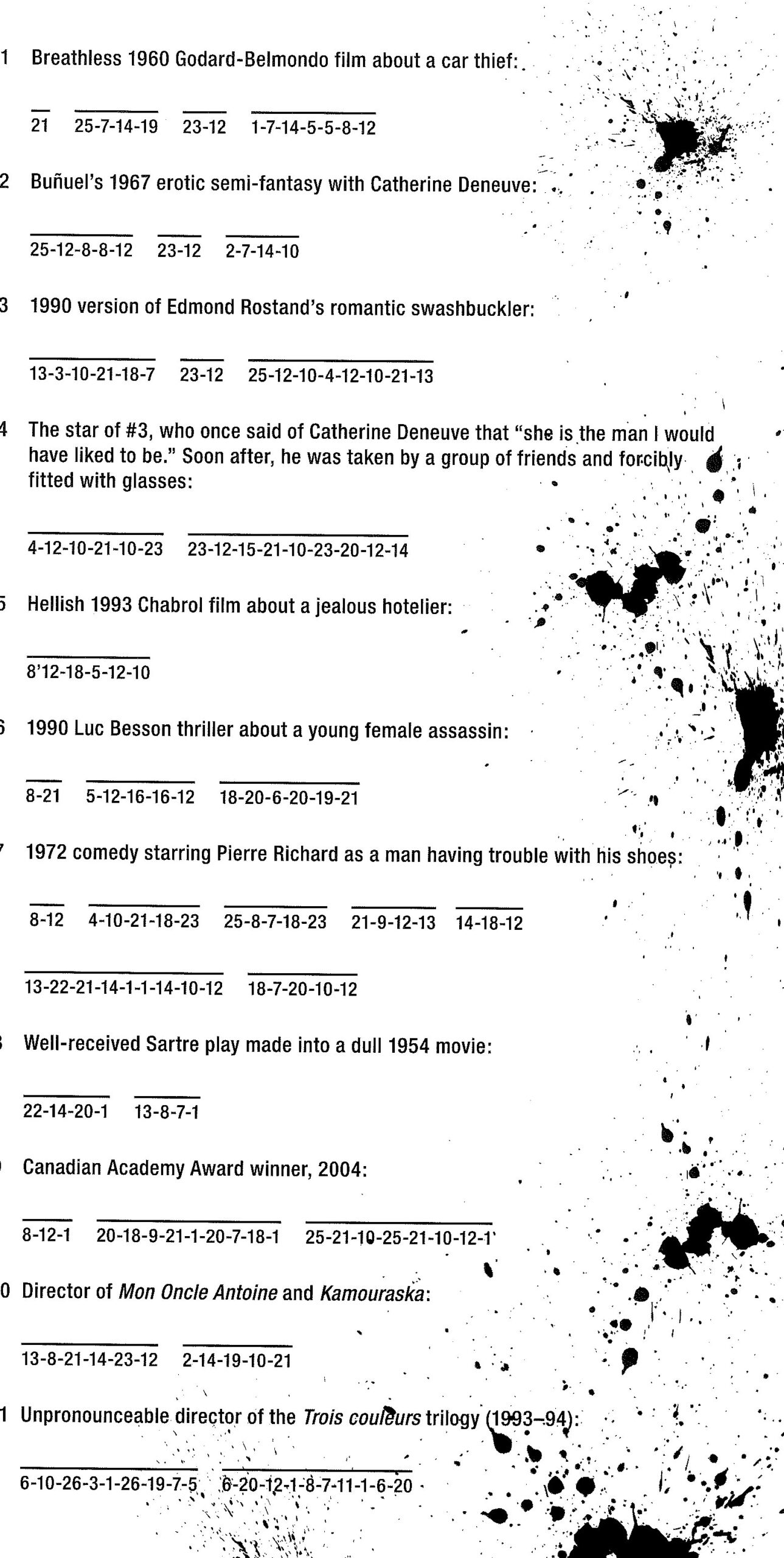
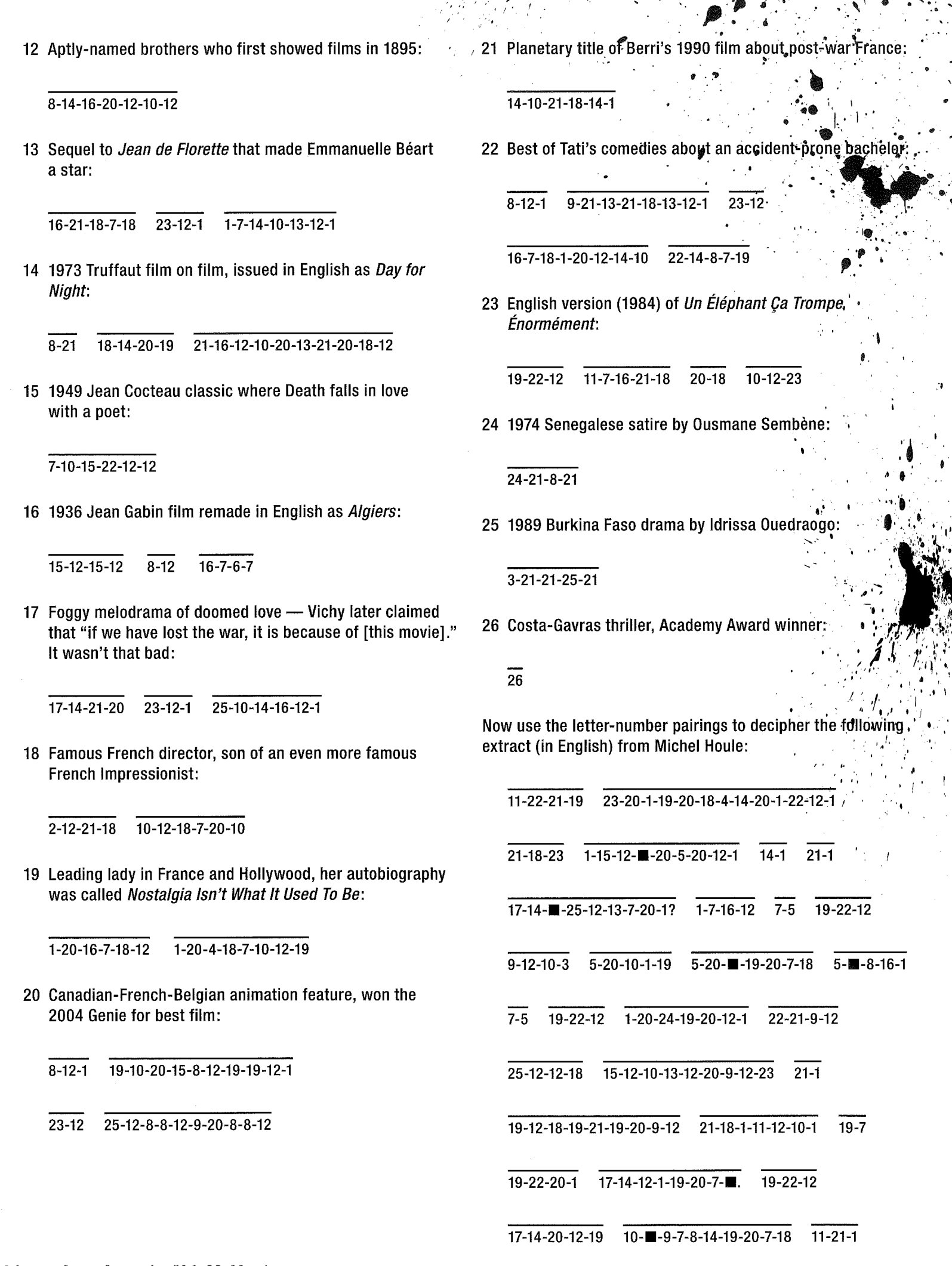
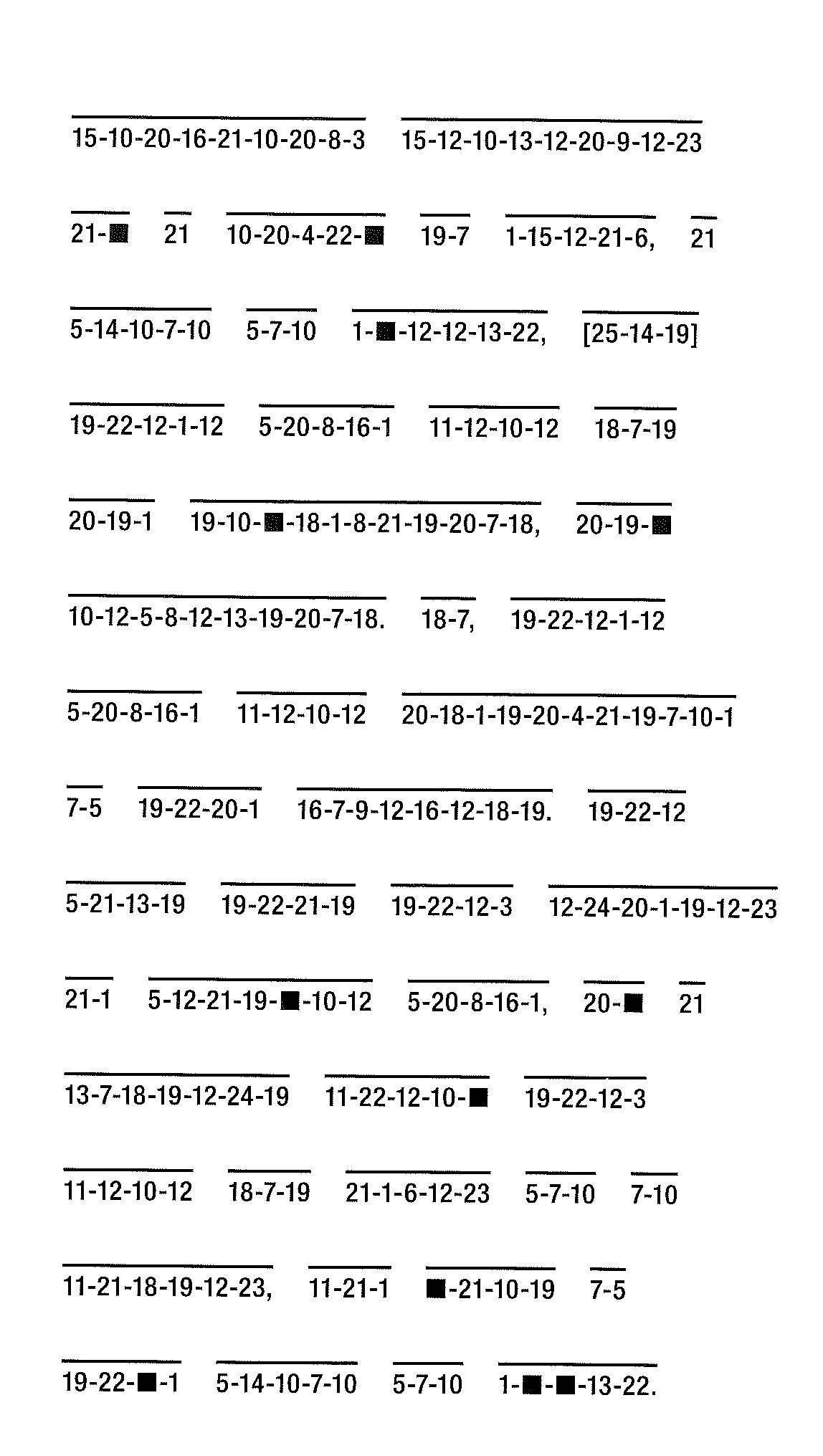
“The structure is obvious,” said the fat man. “Solve the puzzle and the letters that have been blacked out spell a message. The same letter-number pairings let you decipher the words in the heart. I’ll bet that one message tells where the camera is hidden and the other tells us the name of the killer.” I looked over his shoulder. “Some of those clues are pretty obscure. I sure can’t guess them.” He raised one bushy eyebrow and replied. “Neither can I. But this puzzle is highly redundant, which means there are many chances to get any given letter linked to its number, which then helps you across the board. So you only have to get a few clues to get the answer. You can also do a standard letter count on the cipher paragraph in English, although you couldn’t use that method on the 26 answers, which are proper names and/or French. And there’s always an Internet search.”
And he did crack the first part easily enough. The letters under the black spots did spell out a sentence, but we couldn’t figure out what it pointed to. Then I recalled something. “I can take you there,” I said, “but first tell me who killed Jacques.” Liebnitz snorted. “OK, I’ll fulfill my part of the deal.” He quickly deciphered the message in the heart and the two words lay revealed. “I wonder whether he meant her pairing with him or with Comrade Black,” Liebnitz mused sadly. “Well, we can easily find her now — but first, the camera!” Not a good move, as it turned out.
We ran back the way I had come. Then I spotted it, and knew I was right —Tati’s pipe had a straight stem. I turned to deliver the goods to Liebnitz but a beautiful woman in bright frou-frou stepped out from behind a bougainvillea — the woman we had fingered. She didn’t have an espresso machine with her, but her Glock looked up to the task. “Very good, Mir. Dikk,” she said. “Jacques said you were clever. But then he was clever too, too clever, and he had to die. The Comrade will be here soon to pick up the camera and he does hate loose ends, so fl have to kill you as well.” The look in her eyes was bright and cold as February noon in Iqaluit. “Now, if you’ll just all climb into this giant steaming fondue pot.” She gestured with the gun.
It was my only chance. Shouting “No, Liebnitz,” to distract her, I pulled my automatic and got off a shot. But she was too fast for me. My shot went wide but hers didn’t, smashing the gun from my hand “Sorry,” she apologized, “I hope I didn’t hurt you.” A real Canadian killer. Effie jumped her. He took a bullet in the torso and slammed to the floor, but toppled the killer in the process. Struggling out of the bougainvillea, she met a roundhouse left from an enraged Bugbyte, who then sank to the floor to cradle Effie’s head and staunch the flow of blood from her lover’s shoulder. The killer slammed into the giant cheese mosaic, ramming her head into the vast runny Brie that was Paris, ricocheted off the statue of AG Cloche and came to rest at the foot of a huge glacis of wine bottles, which slowly slid down and crushed her. A small man in a tight waiter’s jacket and pencil-thin moustache came over, plucked a bottle. from the pile over her prostrate body and sniffed. “Y’a rien là, not a very good year anyway.”
The Comrade never showed.
Can you duplicate Shamus’ and Liebnitz’s feat by providing the message hidden under the blacked-out letters and the one in the heart? For extra credit, what do the two messages say about the camera’s hiding place and the name of the murderer? bout de papier will decide the winner by drawing from a box containing all correct entries received by June 15, 2007. The winner will receive a book prize autographed by A Aalto. Not necessary to win the contest, but can you also provide the answers to the 26 clues? And can you cite the reference to the Belle Aurore? a
View the original scanned pages →
Originally published in bout de papier, Vol. 22, No. 4 (2007) — Winter/Spring 2007 // Hiver/Printemps 2007, pp. 33–38. Read the rest of this issue →



