bout de papier, Vol. 17, No. 1 (2000) — Spring 2000 // Printemps 2000, pp. 46–47
For a party in power, the timing of a change in leadership can be an awkward and vexatious question, particularly when the Prime Minister seems determined to use his discretion to choose the precise moment of his departure. Those contending for the succession must be careful not to alienate one who can still punish and reward the faithful (or otherwise). One of the more vivid demonstrations of the associated distinction between political and parliamentary leader was provided in 1948, when W.L. Mackenzie King stayed on as Prime Minister for three months after Louis St. Laurent had won the leadership of the Liberal Party. Since the last time the Liberals had chosen a leader had been in 1919, when the previous leader had died and the party was in opposition, some confusion about the handling of the transition may have been expected; however, the foibles and preferences of Canada’s longest-serving Prime Minister undoubtedly complicated matters.
St. Laurent had first joined King’s Cabinet in wartime out of a profound sense of duty and a similar motivation had prompted him to stay on in Ottawa at King’s urging. Thus, his unwillingness to campaign for the leadership of the Liberal Party likely had deeper roots than simply a desire not to offend King. Whatever the cause, St. Laurent’s calm attitude was not shared by others who were anxious to serve under someone
L.B. Pearson to N.A. Robertson, Top Secret and Personal
Ottawa, June Ist, 1948
Dear Norman,
I am leaving today for the realization of my life’s ambition, a visit to Vancouver [Robertson’s birthplace], to say nothing of San Francisco and Los Angeles. It is a combination of business and pleasure, the business part consisting of five speeches and inspections of our Consulates at Chicago and San Francisco, and a consideration of the translation of the Trade Commissioner’s office in Los Angeles into a Consulate. While in Vancouver, I will be attending the other than King – a mysterious and potentially delightful prospect for veterans and neophytes alike.
One of those who chafed under King’s leadership in his last years in office was a senior public servant whom King had earlier presciently identified as a possible future Prime Minister, Lester B. “Mike” Pearson, the Under-Secretary of State for External Affairs. Pearson’s return to Ottawa as deputy minister had coincided with King’s transfer of the external affairs portfolio to St. Laurent in the autumn of 1946. Since then, Pearson had developed an effective partnership with St. Laurent and a wary mistrust of King’s interventions on international questions. The prospect of continuing to work with St. Laurent undoubtedly swayed Pearson in favour of making the move to politics to which he alludes in the letter below.
Pearson’s predecessor as senior official in the Department of External Affairs had been Norman Robertson, who was Canada’s High Commissioner to the United Kingdom in 1948 (and who would himself return to Ottawa as Clerk of the Privy Council and Secretary to the Cabinet early the next year). Pearson and Robertson had been early recruits to the foreign service and their correspondence reflects that long and close association.
St. Laurent won the contest to succeed King as Leader of the Liberal Party at a convention in Ottawa on August 7, 1948, annual meeting of the C[anadian].I[institute of].I[nternational].A[ffairs].
I am very anxious, of course, to get away, and I am a little ragged, but, on the other hand, regret leaving at this particular moment when all is so uncertain, not to say confused.
The Prime Minister [King] seems to blow hot and cold on many things, including a grand farewell tour of Europe and Canada. At one stage, as you know, he seemed to think he would like to go over in June [there had been a proposal from the British government for the Commonwealth Prime Ministers to meet then], and he has now come out strongly against that. My own view is that his normal indecisiveness in these matters is increased by the fact that he is in with 843 votes to 323 for Gardiner and 56 for Charles G. “Chubby” Power. King was still Prime Minister when Lester B. Pearson was sworn in as Secretary of State for External Affairs on September
10, 1948 (St. Laurent had given up that portfolio to make room for his former deputy). However, Pearson spent most of the next few months away from Ottawa, first to fight a by-election in Algoma East and then to head the Canadian delegation at meetings of the United Nations in Paris. Pearson was in France when he was informed by telegram that St. Laurent had finally succeeded King as Prime Minister on November 15, 1948. As for King, his farewell tour of Europe was cut short by illness, so that he was unable to attend a final meeting of Commonwealth Prime Ministers in London. Instead, his colleagues and King George VI paid their respects to the dean of Commonwealth leaders in his hotel suite. For the first week of that summit, King’s place at the table was taken by High Commissioner Robertson. Perhaps appropriately, St. Laurent flew over to replace him for the second week. Whether or not Robertson heeded Pearson’s admonition about destroying the letter, Pearson kept a copy. It may be found in the Lester B. Pearson Papers at the National Archives of Canada.
Hector Mackenzie some doubt as to what his own position will be in August [after the party leadership decision at the convention]. I don’t mean to be unkind, but what I think he is doing is to create an atmosphere of general uncertainty about the immediate future which can be used later to get what he wants; what-ever that is. The general view in “informed circles” (Jack [Pickersgill] and Arnold [Heeney]) in the East Block is that he is manoeuvring so that he will stay on for the maximum length of time as Prime Minister after the Convention, and then try to maintain a position in the Cabinet as President of the Council. This seems so impractical as to be almost fantastic, but I feel quite certain it is in his mind. Of course, it would put [Louis] St. Laurent [then Secretary of State for External Affairs], if he succeeds, in a quite impossible position. It would be, I should think, false and embarrassing for him to be chosen and then not enter into his kingdom at once. It would be equally so if he had the Prime Minister in his Cabinet, even in a nominal capacity. Mr. St. Laurent is, as you know, decent and generous almost to the point of naivete, and I do not think he has any idea what is developing. If he has, or when he has, he should certainly put his foot down and make it quite clear that once he is elected leader of the party, he takes over at once and alone. You can imagine, however, the difficulties that will be created to prevent such a clear-cut decision as that. Mr. St. Laurent himself is not gaining in the leadership race, though he is still very much the favourite candidate. He is, however, doing absolutely nothing to secure support and, in fact, is leaning over backwards in this connection. This is all very admirable, but I think he is possibly carrying it a little too far. However, there is little doubt that, when the Convention is over, he will be the leader. He will not double as Secretary of State for External Affairs. There will be a separate Minister. If he is chosen from the present Cabinet, it will, I think, be Brooke Claxton [then Minister of National Defence], but there are other ideas, in which I am directly involved. However, in this regard at least, I am master of my own destiny, and feel that I should think, and think two or three times again, before abandoning bureaucracy for politics!
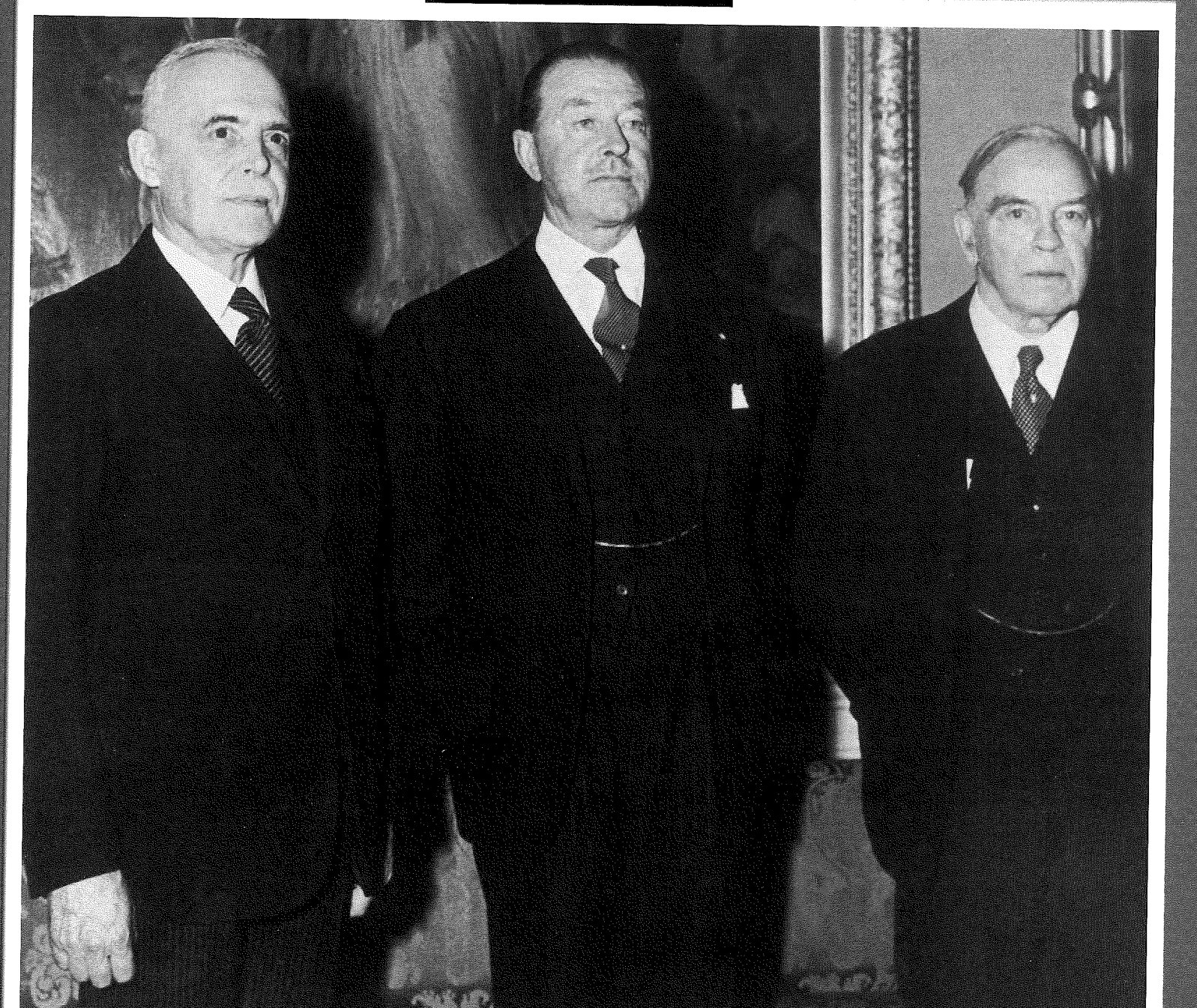
All this 1s, of course, highly personal and confidential, and, as we say in security circles, should be burnt after reading.
If, as is likely, I stay on here, I would be glad to go abroad after another year or so, but so much, of course, will depend on the new Minister and indeed the new Prime Minister. If, for instance, Jimmy Gardiner [the Minister of Agriculture, St. Laurent’s principal rival for leadership of the Liberal Party and someone with whom Pearson had clashed before] became Prime Minister, I would certainly want to go abroad long before the end of the year. That, however, is, I hope a remote contingency.
[(signed: L.B.) “Mike” (Pearson)]
View the original scanned pages →
Originally published in bout de papier, Vol. 17, No. 1 (2000) — Spring 2000 // Printemps 2000, pp. 46–47. Read the rest of this issue →