
bout de papier, Vol. 10, No. 4 (1993) — Fall/Winter 1993 // Automne/Hiver 1993, pp. 14–16
by Geoffrey Pearson
As Russia struggles to build a democratic system, images of the former, communist system are recalled or invented to justify new or old approaches. Gorbachev called the Brezhnev era a period of stagnation and corruption, but he did not question Marxist doctrine. Western observers then and now mostly believed that the doctrine led inevitably to bureaucratic tyranny and imperial outreach. Russian nationalists, on the other hand, look back with pride at Soviet authority and the fear it inspired abroad. Missing from these images are the people who were there, the rulers and the ruled. My own experience in the USSR before and after the death of Brezhnev in 1982 left me with a sense that Tolstoy and Gogol were better guides to life in that vast and varied empire than were Sovietologists. Both communism and capitalism are Western constructs that the Russians assimilate to their own experience of order and freedom, and so they will deal with democracy. What counts is security and the opportunity to do as well as the climate, both physical and political, will allow.
Certainly, there were true believers in the goals of communist doctrine, but they mostly contented themselves with implausible explanations of why these goals had not yet been met, explanations which few citizens appeared to take seriously. Public and private life were two different worlds, as our Russian cook admitted to us after one of her monthly meetings with the people who wanted to know what kind of household we were running. It was none of their business, she implied. We detected some common and genuine emotions, however — pride in Soviet military power (until Afghanistan), fear of a new war, and envy of Western standards of living. Humour salted the daily barrage of propaganda, although no-one dared attack the rulers by name. The Western image of an aggressive and reckless people out to conquer the earth seemed to me to be a caricature equal to that of the Pravda cartoons of Uncle Sam ready to pounce on Mother Russia.
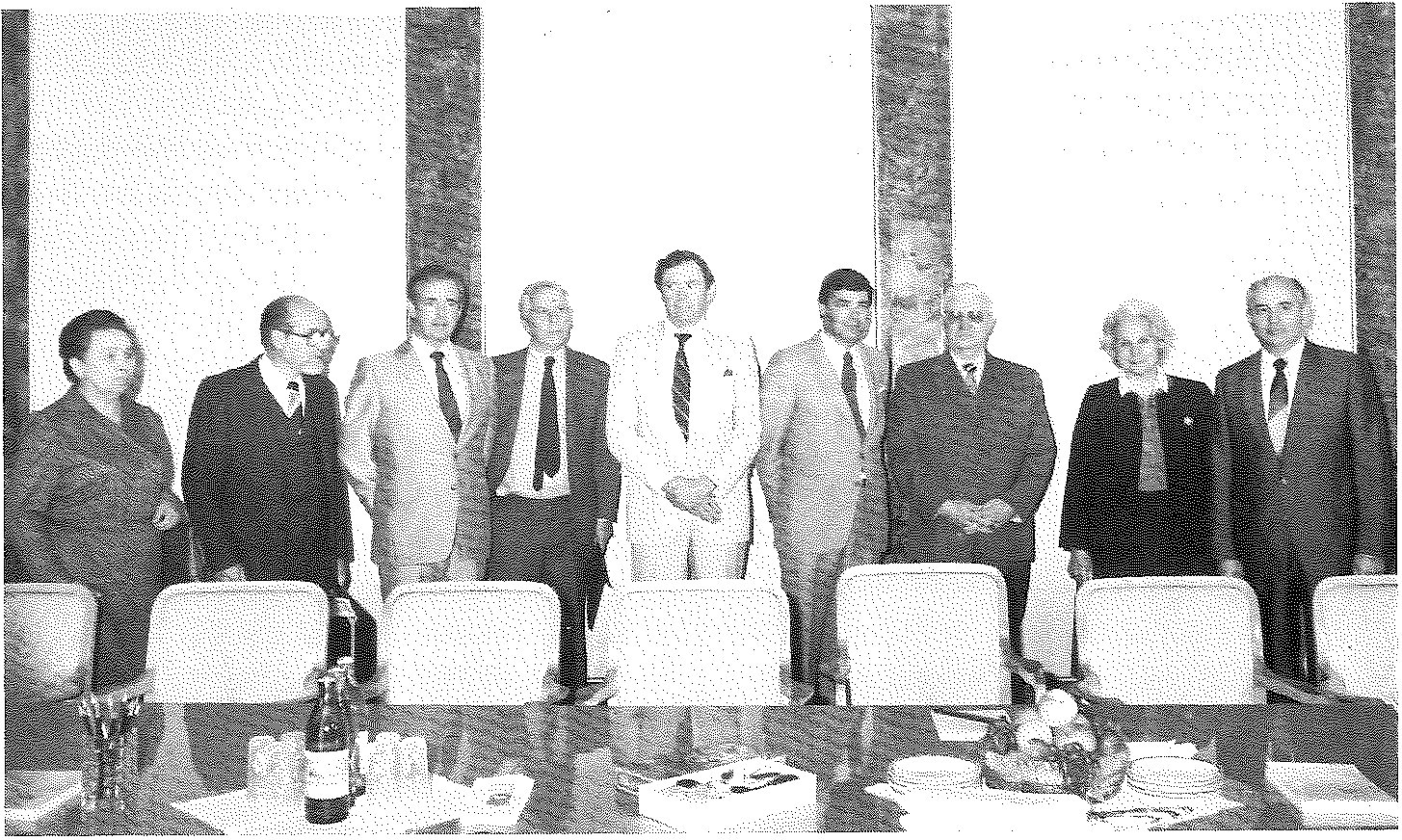
No doubt these and like questions will be raised as historians ponder the late Soviet years and why the whole edifice collapsed as soon as Gorbachev began to tinker with the foundations. In the meanwhile, here are some sketches of those in power as I went about my diplomatic rounds.
Leonid Brezhnev:
I first met Brezhnev in 1966 while in Moscow with an official delegation. He had been two years in power as the First Secretary of the Party, and was full of vigour and self-confidence, expensively dressed with a gold lighter in hand. The contrast with his unkempt and impetuous predecessor, Khruschev, impressed us. I did not meet him again until November 7, 1982 at the Soviet national day reception, five days before he died. He was barely able to stand, and very red in the face. As I filed by with my fellow Ambassadors, and when he heard the word “Canada” from the Chief of Protocol, he looked at me vacantly and murmured, “Trudeau”.. It was a sad, but perhaps appropriate ending to the Brezhnev era that, at his funeral, the coffin slipped and tumbled into the grave as the assembled heads of state and government looked on, Mr. Trudeau amongst them.
Andrei Gromyko:
Andrei Gromyko had been Foreign Minister for 23 years in 1980 and I expected a short, pro forma interview when I entered his office on the seventh floor of the Stalin-era building which housed the Ministry (the same floor that the Secretary of State occupied in Washington — a coincidence?). Not at all. After the usual preliminaries, I reminded him that Canada was still seeking compensation for the damage caused by the fall of a Soviet satellite in the Canadian north a year or two earlier. He professed ignorance of the subject and said he would look into it. To my surprise he then began to reminisce about how he had learned to speak English after I had remarked on his command of the language. He had studied English as a student at an agricultural college in Minsk and had been able to improve his knowledge when he went to Washington during the war. He had been stumped, however, when President Roosevelt used the word “discombobulate” at a meeting in the White House and had had to consult the Random House dictionary which he kept on a stand in his office before reporting the comment to Moscow. He told one or two other stories in this vein and I feared that my demarche about the satellite would be forgotten. But a few weeks later, agreement was reached on a settlement of the Canadian claim. Although I seldom saw Gromyko again (some Ambassadors spent years in Moscow without ever being in his office), I continued to regard him with respect. He was a man of his word, despite his ignorance of “discombobulate”
Mikhael Gorbachev:
Gorbachev was a rising star in 1983 as I completed by stay in Moscow, the youngest member of the Politburo by several years and a possible successor to Andropov, the ailing General Secretary who had succeeded Brezhnev. Accordingly, his visit to Canada in May of that year was an important event and, while I did not accompany him, I had several meetings with him before and afterwards. His portfolio was agriculture, but unlike most of his colleagues, except Gromyko, he was ready to discuss any and all subjects without referring to notes or surrounding himself with a coterie of advisers. I recall two occasions in particular. At the airport on his return from Canada he made a brief speech to those assembled to meet him, inserting a joking reference to one member of the party who had stayed in Canada to pursue opportunities for increased trade. He hoped, Gorbachev said, that his colleague would not be persuaded to defect. This sally produced a nervous silence from his audience and then, as the great man smiled, a spate of hollow laughter. Was it a coincidence that a year or so later this same official was jailed for corruption?
The second occasion was a meeting with a delegation of Canadian parliamentarians, who had no sooner taken their seats than Gorbachev launched into a fifty minute speech on the state of the Soviet economy. Later, in response to a question about east-west relations, he talked about the war when, as a boy of ten, he had had to cope on the farm after his father was wounded in the battle of Kursk. Gorbachev spoke to visitors in direct and simple language, conveying that air of authority and self-confidence that is the mark of leadership. His visit to Canada, I am convinced, was a turning point in his career, helping him to define the policies two years later that led to the end of the Cold War.
A.V. Romanov:
Gorbachev was a striking contrast with A. V. Romanov, the Leningrad Party boss who was also amongst the group of younger leaders thought to have a good chance at the Party leadership (in fact, it was the 72 year-old Chernenko, a Brezhnev crony, who succeeded Andropov in 1984 only to die in office a year later). It was not easy for Ambassadors to meet the regional Party leaders, but Romanov was an exception. He received me in the historic Smolny Institute, Party headquarters since 1918, seated at an immensely long table in a room of ball-room size. At his side was the mayor of the city, himself a future member of the Politburo, but allowed to say little in the presence of the boss. Seated along the wall behind him were ten or so men who reminded me of the henchmen I had seen in gangster films.
I learned nothing new about Soviet policies from Romanov, who read a prepared speech, but he spoke afterwards about the age-old rivalry with Moscow. The highway between the two cities was in bad shape because Moscow had not done its share of repairs. He preferred to fly. He had noted while in Canada for Expo 67 (I was always surprised to find how many of the people I met had been to Expo) the quality of highway 401. As usual, we compared hockey players. Romanov was reputed to have helped himself to the Romanov crockery in the Hermitage museum for his daughter’s wedding. Perhaps he had delusions of grandeur, a malady that Gorbachev did not suffer from until much later. At any rate, Romanov never made it to the top.
Alexander Yakolev:
Yakolev had been Ambassador to Canada for seven years when I went to Moscow in 1980. He was then the Dean of the Diplomatic corps, a position he disliked; it involved too much protocol. He was not a career diplomat, and it was said that he had been exiled for displeasing the Party hierarchy on some matter of Party doctrine. In any event, he did not act like a Soviet diplomat. He was down to earth, eschewing both communist jargon and diplomatic niceties, a feature that attracted Prime Minister Trudeau who would receive him alone at 24 Sussex Drive. Before we left, Yakolev recommended to us the names of Russian writers who wrote about life in the Soviet Union without political intent or bias. He was not an admirer, however, of North American culture and often spoke critically of the commercialization of politics and the arts in the USA and its influence on Canada. He was also a fierce critic of American foreign policy.
I don’t think he had known Gorbachev before he went to Canada, but there can be no doubt that his subsequent rise to power after 1985 was a direct result of Gorbachev’s visit to Canada in 1983, a visit that brought them together for most of the ten days he was here. They must have shared a common distaste for the atmosphere of the late Brezhnev period, and a desire for change.
I went to see Yakolev in 1986 during a visit to Moscow. He was now a member of the hierarchy and thought to be Gorbachev’s chief adviser on the new policies of perestroika and glasnost. He told me that the goal of these policies was to democratize the system by giving the people a larger voice in decision-making. He spoke about their skepticism of the regime and of the need to turn it around if economic reform was to lead anywhere. There must be greater “control from below”. Yakolev was giving priority to political change over economic renewal, a priority that most of us in the West had not understood at the time. Nevertheless he remained a typical Soviet official in another sense. Human rights in the Soviet Union was no business of the West. Why was the Voice of America stirring up trouble in the Baltic republics, for example? There would be change in the Soviet treatment of minorities, including the Jewish minority, and we should leave well enough alone. He obviously had no inkling of the cataclysm of revolt that was to sweep the Soviet Union four years later; but then, neither did anyone else. He and his boss were believers in incremental and rational reform. They were and are the Mensheviks of the second Russian revolution.
Officials of the Foreign Ministry:
One of the seven identical skyscrapers erected in Moscow during the Stalin era, the Foreign Ministry became a familiar place for diplomats anxious to conjugate the verbal nuances of Soviet rhetoric. One was greeted by a junior official at the door, escorted past the grim-faced militia man, and ushered to one of the three (out of six) elevators that were actually working. I once asked my escort on the way up to one of the top floors why the elevator never seemed to go beyond floor twenty, although there appeared to be twenty-two floors. He confessed ignorance (’I don’t know” was one of the first Russian phrases I learned), perhaps not surprising in light of information published later that these floors housed elaborate listening devices installed at the time of construction.
The official I dealt with most at the Ministry was a veteran who had served in London and New York and was listed by American spy watchers as a KGB agent. Perhaps he was, but his obvious loyalty was to Gromyko and his habit of mind was one I soon recognized to be diplomatic rather than interrogative. Once when I informed him that I had been instructed to seek an interview with Brezhnev’s assistant, rather than with the Ministry, over some looming crisis in east-west relations he said to me: “Who does your government think is running foreign policy in Moscow?” On another occasion he interrupted my routine delivery of a complaint about Soviet policies on human rights (a favourite subject for Canadian politicians) with the question: “Do you know what day this is?” It turned out to be the fortieth anniversary of the German surrender at Stalingrad. “Look at these hands”, he said, “they are covered in blood”. He had been an eighteen year old soldier at Stalingrad, and was not about to let the memory of that terrible time pass without ceremony. A bottle of brandy appeared (it was mid-morning) and the rest of our “exchange of views” took on quite a different flavour. I decided to return to the subject of human rights another day.
Most members of the Soviet foreign service were highly professional, like their boss. They were especially well trained in languages and in the big, technical issues like arms control and treaty law. The older members often lapsed into Marxist jargon, but this was rarely the case with their juniors. They were genuinely concerned with the danger of war in the early eighties, as indeed we all were, and I suspect they were not too comfortable with the imbroglio in Afghanistan. Many of them, including Kozyrev who was a middle level official at the time and is now the Russian Foreign Minister, have carried on in the new regime. Freed from the constraints of both dogma and empire, they are an important asset in the struggle to re-invent the Russian future.
But will they embrace parliamentary democracy and the market system? Not, in my view, if they believe these to be a threat to Russia’s status as a great power. All of them, from Brezhnev to Yeltsin, have enjoyed the authority that goes with power. They will not yield easily, either to people’s deputies or to Macdonalds
View the original scanned pages →
Originally published in bout de papier, Vol. 10, No. 4 (1993) — Fall/Winter 1993 // Automne/Hiver 1993, pp. 14–16. Read the rest of this issue →



