bout de papier, Vol. 16, No. 1 (1999) — Spring 1999 // Printemps 1999, pp. 18–22
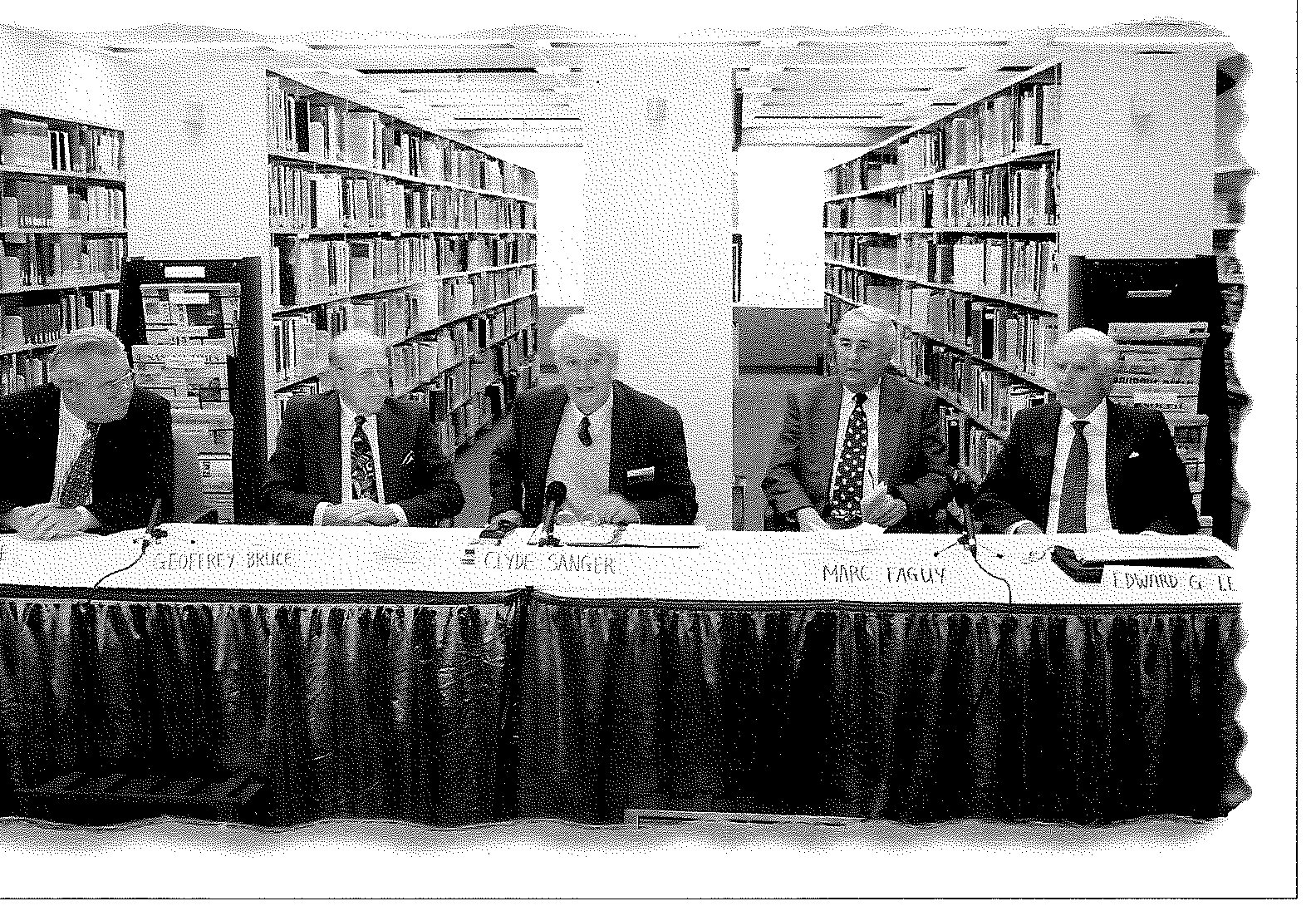
As a follow-up to the DFAIT Open House article in the last issue of bout, following are excerpts from the media round-table with former HOMs that took place at the Open House on November 2, 1998. Panelists were former Heads of Mission Marc Faguy, Geoffrey Bruce, Edward Lee and Paul Lapointe. The moderator of the panel was the Ottawa-based journalist Clyde Sanger.
MR. CLYDE SANGER: Thank you very much. My name is Clyde Sanger. I am an author and ex-diplomat. Actually I did have three months in this building, ending ingloriously by losing 12 MPs in Europe. (laughter). All right. One minute to tell you this story. I am the only one who has done foolish things there. John Crosbie was on this tour. We went to OECD, SHAPE, and Strasbourg, and so on. It was in 1980 and John Crosbie was keen to bring down the government, the new Trudeau government.
And when we got back to Strasbourg he was due to talk to everybody in the European Parliament about seal hunting and when Left to rig I knocked on his door that morning to get him to go to the European Parliament he wasn’t there, nor were two other Tory MPs. They had flown the coop that morning, headed off to Paris and were flying back to try to bring down the government. Well that set all the six Liberals in a terrible tremor, and they booked flights back and so did the two New Democrats, instead of pairing like that.
So I was left with two Senators and a whole lot of Euro MPs, and I had to tell this tale when I came back. Of course, they were still in flight at the time when the vote was taken, so it was all rather foolish. And that was the end of my career in this building.
Anyway, as a journalist, welcome to the age of transparency. Our panelists will talk about how the world looked like to them in 1973, when this building was opened, and how the world maybe has changed since then, and consequently, how Foreign Affairs has changed to meet the changing world. Let’s start with Paul Lapointe.
MR. PAUL LAPOINTE: All right. Well, in 1973, as far as I was concerned we were devoting all our efforts to getting ready for the third United Nations Law of the Sea Conference which started officially in December 1973, and the first substantive session in Caracas in 1974. But you can imagine that in ’73, already, we were quite active trying to convert people to some of our basic theories.
You will recall that at that time there was no such thing as a 200-mile economic zone, the statute of the continental shelf was rather vague and required a lot of work. So we spent quite a lot of time, as a matter of fact not too much in this building, I must admit, because we were on the road quite often touring the world, trying to get allies in preparation for what became a 10-year effort to produce a major convention which we now have and which means that nowadays we, as far as the oceans are concerned, are certainly in a much better legal situation that we were at that time.
So, that for me, 1973 was the year of the sea. That is what kept me busy.
MR. GEOFFREY BRUCE: I would like to provide a picture which can only be a snapshot in the time available, of some of my impressions of Canadian foreign policies in the early 1970s. Canada, which had not been damaged by World War II and, indeed, emerged with a healthy economy, entered the 1960s and 1970s as one of the leading middle powers in a growing world community of independent nations. Which were the more important developments with which Canada was concerned in those years?
First, the Cold War forced Canada and other Western countries to design their foreign policies to respond to the threat from the Soviet Union and its Warsaw Pact allies. It influenced deeply not only Canada’s defence policies, but also its relations with Third World countries which were exposed to Soviet influence and domination.
Second, there continued to be a number of sources of violence and potential war throughout the world -— in the Middle East, Cyprus, Asia and Africa which were of great concern to the UN and thus to Canada. The Vietnam war had ended and it opened the way to bring the USA and China into a modest dialogue which was indispensable to the development of a more peaceful and secure world.
Third, the population explosion continued with its unrelenting force on Third World countries which were trying desperately to build their economies and societies.
Fourth, foreign aid became an increasingly important element of Canadian foreign policy, as was the case in most other developed countries. The aid target was set at 0.7% of GNP. Canada reached about 0.5% in the 1980s.
Fifth, international trade and investment continued to expand and, consequently, became an important element in Canadian foreign policy and its participation in the development of international institutions to regulate trade and commerce.
Sixth, the United Nations and its Specialized Agencies continued to expand, which had its impact on Canada and other nations around the world.
Seventh, a parallel and closely related development was the continuing evolution of international law and the negotiation of new conventions designed to guide, regulate and systematize international relations in many fields of national and international interest.
Eighth, and this as an innovation of tremendous importance, was the addition to the agenda of governments and the international community of a wide range of challenges concerning the preservation of the world’s natural environment and the conservation of its resources. The Stockholm Conference on the Environment in 1972 was the UN’s first major global step along that road.
Ninth, and this is a rather negative feature, Canada paid very little attention to its Latin American neighbours, and it was some years before its relations with these countries became a foreign policy objective. Canadians and their successive governments were content, for a number of reasons, to stay out of this region in which the Americans had such a dominant interest.
There were, of course, other important elements in Canadian foreign policy, but that, in essence, is an account of my recollections of the early 1970s.
M. MARC FAGUY : Si j’ai bien compris le thème de cette journée anniversaire du Ministère des Affaires «étrangères» — il y a 25 ans nous parlions encore du Ministère des Affaires extérieures — le thème de cette journée est celui du «changement». Et bien, en ce qui me concerne, j’ai l’impression très nette que mes différentes affectations au sein des Ministères du Commerce et de l’Industrie, des Affaires extérieures et de l’Aide ont accompagné de près ces changements profonds.
Des changements profonds et nombreux ont en effet eu lieu depuis 25 ans. A mon avis, les deux domaines où ces changements d’idée se sont surtout fait sentir sont ceux de l’environnement et des droits de l’homme. Dans ce dernier domaine en particulier j’ai vécu, encore tout dernièrement, une expérience très spéciale avec les Nations Unies au Burundi, en Afrique Centrale. C’est à ce moment que j’ai pu mesurer la place importante qu’occupe cette idée relativement nouvelle des droits de l’homme au sein de la politique internationale. La présence même des Nations Unies au Burundi était, par exemple, entièrement fondée sur le thème de la sauvegarde et de la promotion des droits de l’homme. La poursuite de ces objectifs est devenue la principale «raison d’être» des Nations Unies dans la région.
Il est intéressant de noter également que le concept de respect des droits de l’homme en politique étrangère constitue l’un des points forts de l’opinion politique canadienne. En un sens, ceci reflète ce que disait Mitchell Sharp ce matin lorsqu’il soulignait l’importance d’intégrer les préoccupations et intérêts de la politique domestique canadienne dans la politique étrangère du Canada.
Par ailleurs, dans ce domaine très controversé des droits de l’homme, il nous faut bien constater que les Nations Unies et la communauté internationale en général n’ont pas encore tout à fait réussi à implanter ou intégrer cette grande préoccupation de l’opinion publique dans leur gestion quotidienne des affaires internationales.
J’aimerais en terminant ajouter que d’autres changements d’idées sont survenus depuis le début des années 70, que certains n’aiment pas. Je pense entre autres à l’idée d’aide ou de coopération entre pays développés et pays en voie de développement qui semble, depuis une bonne douzaine d’années, en perte de vitesse. La chose est regrettable.
MR. CLYDE SANGER: Thank you very much, indeed. As we go on to the Security Council in January, there are some challenging leads there. And also Burundi. Burundi gets forgotten doesn’t it? With all the concentration on Rwanda, but it was as hellish a time for the people there as the people further north. Ted Lee.
MR. EDWARD (TED) LEE: To help my memory, I looked up in the Canadian Yearbook of International Law for 1973 — there is a whole section at the back which reports on all the questions and answers in the House of Commons for that whole year that relate to Foreign Affairs.
And it is true, as Mitchell Sharp mentioned this morning, that there were very few debates per se on international affairs, but there were a tremendous number of questions that were raised in Question Period — British entry into the Common Market and how Canada, thereafter, moved away from its Commonwealth connections to some extent, and put a little more of its efforts into the institutionalized relations with “francophonie” countries. The momentous rise of Japan from its total defeat in 1945 — by 1973 it was the second industrial power in the world which it still remains but we all know the problems they are facing now.
But over all, living with the United States, as Geoff mentioned, was and is the most important single source of anxiety in our foreign relations. There were debates in 1973 on foreign ownership and investment from the U.S; on the impact on Canada’s cultural integrity — and here we have it again, now, with protection of Canadian magazines. There were questions raised about the economic vulnerability of Canada to U.S. decision-making.
Some of that has been ameliorated by the NAFTA. We now share more information with the United States via NAFTA as to what they are planning and what some of their economic concerns are — and we do have a dispute resolution mechanism that modifies, to some extent, the potential destructive unilateral action that the United States can take at any time against us. Then there were questions of Arctic sovereignty. Rather quiescent now, but in 1973 we were engaged in a tremendous battle with the rest of the world attempting to gain international recognition for our Arctic Waters Pollution Prevention Act which created a 100-mile pollution zone north from the land into the Arctic waters. Nuclear testing in the atmosphere. Big issue in those days, now we have the Test Ban Treaty, but the French were exploding bombs in the atmosphere, testing bombs near Tahiti, we had that whole Greenpeace III problem and Captain McTaggart being beat up by the French, and we were laying claims against the French. That was a big issue in the House of Commons. The Vietnam War was going strong then, and that sure raised a lot of issues for Canada because we did not back the United States 100 per cent. Arab-Israeli conflict. The Yom Kippur War was in 1973. When I left Israel after serving four years as Canadian Ambassador, in 1979, you always sent in a valedictory message to headquarters, sort of predicting what you see for the future. And I said then, in 1979, that we were engaged in a 100-year war and we were just halfway, that we had had, since 1922, Arab-Israeli conflict. Well, so far I have been proven right, unlike in South Africa, where when I left I said this is a hopeless situation. Because when I left there in 1986, P.W. Botha had declared himself President for life, and it was at the depths of apartheid. I would never have guessed then that this man de Klerk, whom I knew, I could not believe he turned out to be the man who gave up apartheid, or that Mandela would be released from prison.
Human rights — a much bigger issue now than then. We weren’t talking about an international criminal court. We had the UN declarations on human rights but we had no convention that you could actually enforce. And it was in 1973 that we were just drafting the first international convention on human rights. We had never thought of separate conventions for women or children or anything like. Great developments since in that area.
And Law of the Sea. We were fighting then with the Americans about fishing in the Fraser River, there were negotiations going on just as now, and we were worried about depletion of fish stocks in the North Atlantic. We were worried about tankers, American tankers coming down through the inner passage of British Columbia bringing the oil into mainland United States because 1973 was the year that OPEC also brought in its drastic restrictions and price increases on oil, which had a devastating effect on the economies of the industrialised countries.
Lastly, international terrorism: We had aircraft hijackings practically every month — another aircraft was being hijacked somewhere. We embarked in 1973 on the drafting of several conventions that have been quite effective against national terrorism and aircraft hijacking.
CLYDE SANGER: Thank you, Ted. Now let’s turn to the audience for a few questions.
Q. Can the panel see any one supreme achievement, one abject failure (in the past 25 years?)
MR. PAUL LAPOINTE: Well, I would certainly rate the Law of the Sea Convention as one of our great successes. There are roughly a million square miles of jurisdiction — that is about a third of Canada, and it is a massive thing because it not only includes the continental shelf, it has the environment, as Ted Lee mentioned, where we did get the blessing of the international community for our anti-pollution legislation in the Arctic.
We won on the salmon. We may still have trouble with our neighbour over salmon, but vis-à-vis the rest of the world we won. Nobody is challenging the rights of the coastal states to it too. So I think that was a major victory.
MR. TED LEE: I think on the minus side is the Arab-Israeli problem. Canada is in a very difficult position there, and as a result of that I don’t think we can say that we have helped very much to settle the problem. It is a very huge problem. We were far more successful in South Africa where we did take a lead position. Not as much a lead as we did on Law of the Sea, but the Mulroney government took a strong stand, particularly on sanctions, which many criticized — I was brought home to go across the country and talk to editorial boards. All the editorials were against the imposition of sanctions and I tried to show why it made sense, and that it would help the black community. We were really the champions of the black community.
The Americans were suspicious. The British — South Africans wouldn’t pay any attention to the British because of their past history, and we were one of the few western countries left in Pretoria that could get to the black community in a big way and bolster them, try and keep up the morale, get some aid into them, which we did quite effectively, and I think that was certainly an achievement.
MR. MARC FAGUY: As I was saying earlier, there is one question that the international community has not come close to tackling, and this is the question of human rights, especially in developing countries. The UN is paralyzed on the issue, probably because the Security Council is paralyzed. You have, at the present time, in Africa, extraordinarily violent situations which are not really addressed at all. You have, for instance, the President of the United States going to Rwanda and saying, perhaps we were wrong in not moving earlier. You also have the Secretary General of the United Nations going to Rwanda and saying, well perhaps we could have done better.
But at the same time as these mistakes are recognized by many leaders of the international community, we are witnessing, 50 miles away, major genocide. There are tens of thousands of people being killed now in the Congo, for instance, and nobody is doing anything about this. The same in other parts of Africa or even Europe.
MR. GEOFFREY BRUCE: In response to your question about “abject failures and supreme achievements” in the 25-year period of our review, there have been many failures. One obvious great failure has been the inability of the countries in the Middle East to reach a peace settlement in the Arab- Israel conflict. As we look back over the 51 years since the creation of Israel, we see so much violence and war that have caused so much suffering and destruction in the region. The continuing hostility between these states and the indoctrination of hatred and mistrust among their peoples will remain for generations.
As for “supreme achievements” “, there have been many in the 25 years we are reviewing, but two or three stand out. The first “supreme achievement” was the fact that the Cold War remained a cold war. We can be profoundly thankful, especially when we recall the confrontations between the massively armed countries of the East and West over nearly 40 years. The peaceful ending of that war was a “supreme achievement”
Another important achievement, and it may appear supreme in 25 years, is the recognition by many governments and their countries around the world that we now face serious challenges to the preservation of our natural environment and the preservation and management of our natural resources. Governments and their peoples are beginning to respond with effective national and international policies and programs.
MR. CLYDE SANGER: Just to pick up on what Paul said earlier about the Law of the Sea, I think there is a lesson in how we gathered the group of like-minded states together, in that to transpose it to today when Foreign Minister Axworthy talks about soft power which, as I see it, is a coalition of middle powers that haven’t got big military power. You see, in the Law of the Sea we were not with the maritime powers who wanted freedom of navigation, we were with the coastal states, we were with people worried about pollution, and we were with the copper producers for that matter. And we made these different coalitions of special interests like that, and I think that is what foreign policy is heading towards.
We have talked soft power with land mines, with small arms and with child labour. So, personally, as a journalist I welcome the resurgence of this idea.
Q. I would like to know the opinion of the members of the panel on why the morale in the foreign service is so low, it is alleged to be so low today, and what steps should people take, should the government be taking, or the foreign service itself be taking to improve morale?
MR. PAUL LAPOINTE: Well I think that (in 1973) resources didn’t seem to be too much of a problem. We were opening up new embassies, we were joining all kinds of new clubs. There seemed to be enough money for us to travel quite substantially, we made more contacts, saw more people, and so on, and so forth. We were relatively well paid. There was no hiatus like the last six or seven years, when nobody got anything at all. The system seemed to allow for promotions after so many years, whereas now there seems to be a blockage, an absolute blockage at the FS-2 level and nobody can seem to go beyond this.
MR. TED LEE: I was just going to add a balance to that to say that we also grumbled about the low salaries. We managed but we grumbled. Also we had a lot of officers leaving, going to Québec, a lot of the francophone officers were going to the new Québec after the quiet revolution. We were quite worried about that at one point. I was Director of Personnel in the early ’70s, and there was lots of grumbling then too. I would mention one thing: we didn’t dare go to the media in those days, but now it seems like everything is more open, and the media likes that kind of a story, so it is maybe overplayed a bit too.
From the viewpoint of the work, the young officers I talked to, I get the impression that they really like the work. It is interesting, and when you get 5,000 people applying for 65 jobs, there must be some reason why even today they are interested in the work.
I think one of the problems about salaries is that we never thought of taking in people at 32 years of age, 35 years of age who had already had several children. So of course, they can’t live on the beginning salary. But the salaries were darn low for us as beginners too. It is just that we didn’t have the same kind of family responsibilities.
Q. Mr. Bruce you mentioned the intrusive influence of the U.S. policy on Canadian foreign policy. Could you elaborate on that?
MR. GEOFFREY BRUCE: The United States has had, and continues to have, a profound influence on Canadian foreign policies; in, for example, the development and the operations of the international trading and financial organizations, in its leadership in the Cold War, and in many dimensions of Canada’s relations with the Third World. Certainly in the pursuit of Canadian interests in the Cold War, our government generally walked in step with Americans because it and the Canadian people held much the same view about the potential threat of USSR influence in the Third World.
View the original scanned pages →
Originally published in bout de papier, Vol. 16, No. 1 (1999) — Spring 1999 // Printemps 1999, pp. 18–22. Read the rest of this issue →