
bout de papier, Vol. 18, No. 2 (2001) — Summer 2001 // Été 2001, pp. 17–19
Entrepreneurial Spirit — by Alan Bones
In the late 1980s, the Malaysian Automobile Association periodically staged road-rallies-cum-treasure-hunts. The goal of the exercise was to decipher cryptic clues en circuitous route from Kuala Lumpur to distant points (in this case, Penang) while participating in a scavenger hunt. An added complication was that you were to reach your destination in minimum time while respecting traffic laws. These rallies are both common and popular in Malaysia, so it probably came as little surprise to passersby to see a rather posh diplomatic Volvo (well, it would have been posh if it wasn’t covered with road rally stickers) lurch to a stop, and four people start rooting in a field in a desperate search for a grasshopper.
One of the other items we had to find, while traversing a fairly lonely stretch of rural Kedah, was a lotus blossom. Given the sizeable ethnic Tamil population in the area, one would have thought that t with the clock ket, and Malay we could find.
As we were the pack, a d whether we c the point pen lotus blossor route in sear middle of thi ted a pond of amazingly er to be a lotus t and a reverse brought us t deserted but ing in age fre
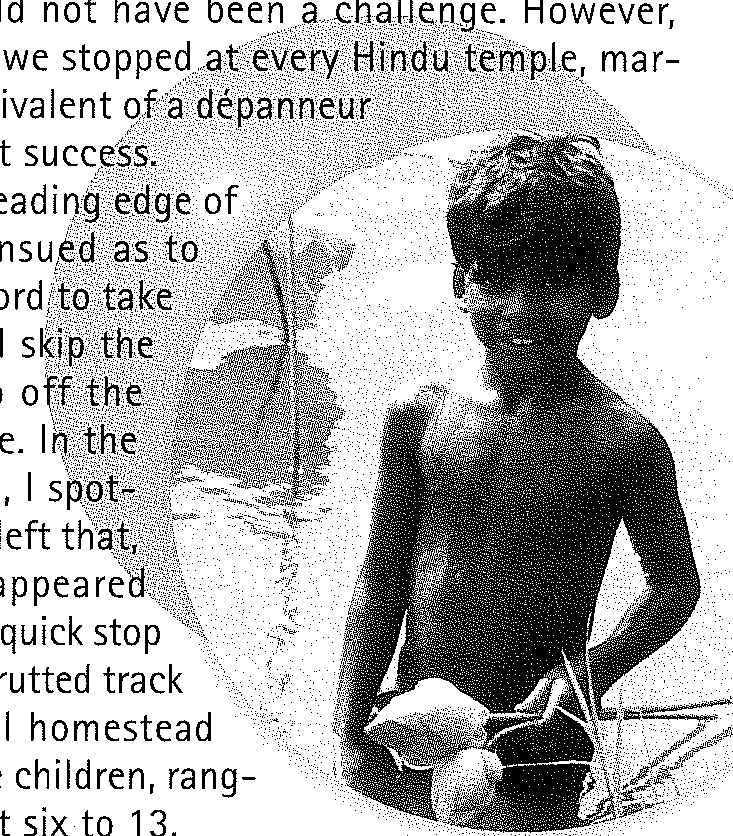
When aske a lotus blossom, the children were momentarily nonplussed. Unused to a carload of city folk making such unexpected demands, they had no idea how much to hit us up for. “Fifty sen?” ventured one of them, shyly. This was about 20 Canadian cents – a sum we figured we could spring for. The six-year-old enthusiastically leaped into the pond, and returned triumphantly with not one, but two, lotus blossoms. Off we went, though unfortunately not fast enough to avoid being spotted by our arch-competitors, a Pajero full of Germans.
At the rally’s closing dinner the next evening, we compared notes with fellow competitors. It appears that within an hour of our passing, the enterprising children had set up an impromptu roadside stall, selling lotus blossoms to rallyists at eight Ringgit a pop (a 16-fold markup) – and doing land office business.
The Case Against Hitchhikers — by Ian McKinley
In service officer and friend on posting to Nextdoora when she ould come visit for the weekend. This friend often drove and ould at times pick up hitchhikers in order to break the tedium : the route.
One Friday evening, my friend arrived on my doorstep in a tizzy. he explained that she had picked up a couple of backpackers on he way. As they continued on their drive, the backpackers had loticed a car ahead and had encouraged her to pass it. Evidently he hitchers had a pair of backpacking friends who had caught a ride with the car ahead and my friend’s hitchers wanted to pay their respects.
My friend did indeed overtake the other car and was shocked to see her passengers press against her back window and moon the passengers in the rival vehicle. The driver of the other car understandably took offence that someone would insult him and his passengers with such a barbaric display; he sped up, drew even with my friend’s car and tried to force her off the road. She, in turn, accelerated and tried to outrun the angry driver. A highspeed chase ensued over the next 150 kilometres that only ended on the outskirts of Capital City when my friend was able to lose her tail. She dumped her hitchers at the local youth hostel.
I did not particularly sympathise with my friend (the incident struck me as silly and dangerous) but made her welcome nonetheless. The story took on a different dynamic the following Monday, however, when work resumed. I learned that the Bulgarian ambassador had been called in to the Brandexian Ministry of Foreign Affairs and raked over the coals for engaging in behaviour on the highways that fell far beneath the standards of both diplomatic representation and civilization.
The offended driver had obviously taken note of the diplomatic licence plate number but had not noticed that the plate, though very similar to those issued in Brandexia, actually came from Nextdoora. The country number on my friend’s Nextdooran plate, which was assigned to Canada, happened to correspond with the Bulgarian country number in Brandexia.
A final thought: there were only two Bulgarians serving at their embassy in Brandexia. Each one of them probably still knows, with 100 percent certainty, that the other is responsible for dragging their country into disrepute.
The Bridge of Imminent Death (and how Archimedes saved me from singlehood) — by Michael Kaduck
In retrospect, it was probably a bad idea. Videotaping my wife’s almost-demise, that is. But what’s done is done, and that short and shaky sequence now has an uncatalogued place in the family video archives.
The occasion of Leslie’s near-transformation to dearly-departed was a trip to the Northern Areas of Pakistan, where we to t were visiting health care and education projects supported by the Canadian Government. One of our stops was the village of Ahmedabad on the Karakoram Highway that leads to China, to see a school established by the Aga Khan Education Service (after a bone-crunching trip down a steep series of switchbacks to reach a track near the bed of the Hunza River).
I first saw the Bridge of Imminent Death just a few seconds before we drove over it. At the time, I was busy reorganizing my spine, so there was no chance to turn on the camcorder, let alone experience one-ness with the Universe. Our driver and guide were quite unruffled by the bouncy, swaying structure – not so much a bridge as a virtual bridge, put together from a few cables, a few boards and some extra-strong Scotch tape. We rattled across in our 4×4 with the agility of a lobotomized hippo, some twigs and string offering the only visible barrier between us and the chasm below. Leslie gave me that look that wives give husbands when husbands forget to tell wives things that are kind of important, for example things involving chasms.
Our drive up the crumbling road to Ahmedabad was faster than walking and safer than step-dancing on the turnpike, so we were fully relaxed for our visit to the school, perched as it was on a rock promontory a hundred metres above the Bridge. After tea and the school inspection and tea, we buckled in for the return journey tea). A couple of young lads clambered into the back of the truck for a free ride as far as the highway, unperturbed by the prospect of switch-backs, chasms, etc. In a moment of uncharacteristic insight, or perhaps it was undigested mutton, I got out of the truck with my camcorder just before we crossed back over
Death. ’Twould be a fun sequence to show to my mother-in-law.
Whạt ho, thought 1, when the truck began to travel through rather than over the bridge, with one wheel coming to rest on a bare cable and the other hanging in the air. The wooden planks stacked up nicely in front of the bumper, affording the passengers a bird’s eye view of the chasm, unimpeded by the bridge’s twigs and string that had given us such comfort the first time we went across. The yawning gorge yawned as only a gorge can, while water the colour of chocolate milk rushed over razor-sharp rocks.
I stopped to ponder the indistinct viewfinder image, which seemed fuzzily to portend impending disaster. For an instant I was struck by the commercial potential of this footage, saleable to the producers of Lifestyles of the Chubby and Wifeless.
Clearly our Pakistani colleagues knew all about levers and fulcrums and how to get pick-up trucks unstuck from virtual bridges. One plank resting on two others, plus a rock and some elbow grease might give enough traction to the front wheel that the truck could be reversed off the bridge. A rope was tied to the back of the truck, and I was posted there, alone, to stay out of the way. This part of the plan worked admirably, though it was only my catlike reflexes that saved me from being wedged between the lurching pickup and a non-lurching, Zamboni-sized boulder.
The extraction of our vehicle from the Bridge of Imminent Death took about a half-hour, during which we went entirely without tea. Only the driver was on board when the second attempt was made to drive back across. We made our last trip over the bridge on foot, amid the spray of the rushing waters, occasionally exchanging those looks that wives give husbands and husbands give wives when yawning gorges and near-extinctions are involved. At least we have a permanent video record of the incident, with striking visual images knitted together by the witty and knowledgeable banter of M. Kaduck, minor official. When the truck went through the bridge, my literate and courageous statement, captured for posterity on the soundtrack of the fateful videotape (available on VHS or DVD), was this: “Oh.” Brings a tear to your eye, doesn’t it?
The Antiques Road Show — by Jim Bartleman
In 1969, during my posting to Colombia, I accepted an invitation from the German cultural attaché to accompany him on a road trip from Bogota to Lima in his little Volkswagen car. His goal was to purchase as many antiques as possible; mine was simply to see more of Latin America.
We departed Bogota in high spirits, descending through the clouds to enter the so-called “hot country” close to sea level near Cali, later to become infamous as a centre of international drug trafficking. From Cali, we proceeded via the beautiful colonial city of Popayan, destroyed several years later in an earthquake, to Pasto, the isolated capital of the Department of Narino.
Pasto, my colleague took me with him as he visited members of the German community, most of whom had left Germany in a hurry at the end of the Second World War. He was welcomed enthusiastically but I was treated with wariness.
The route from Pasto to Quito was ter- fro rible, often one lane only with numerous but markers indicating the spots where speed- tie ing cars, trucks and buses had plunged over alm the edge into deep mountain valleys, killing ter: the passengers. In Quito, colleagues at the a ti tiny Canadian Embassy took us in hand to can show us the sights and extend hospitality, the overjoyed to have visitors at their quiet to f remote outpost. We then pressed on to Guayaquil, the hot, insalubrious port city of the Ecuador, where the road ended.
Undeterred, we took the ferry to the bul southern bank of the Guayas river and fol- my lowed back roads and trails to the border of Peru where we found ourselves on the paved coastal highway running through the Atacama desert. Two days later we were in Lima, capital of Peru, still retaining its charm as a small colonial city before the massive movement of the rural poor seeking a better life in the coming decade changed its personality forever.
So far, so good. My colleague had found antiques, in particular wooden carvings of saints which apparently were worth a fortune in Europe, and was satisfied with himself and the trip. Shortly after arriving in Lima, however, he burst into my room to say that a coup d’état led by the military was in progress; we had to leave before road blocks were set up around the city or we could find ourselves in the Peruvian capital indefinitely. He pulled out a revolver and said that it was to be used for our protection. The rules of engagement, as he described them, were simple: whoever was not driving (we were taking turns at the wheel), would ride shotgun and shoot anyone who tried to rob us.
We departed for the Ecuadoran border in a hurry, his precious antiques under a blanket in the back and the revolver in the glove compartment with our passports. He didn’t appreciate my sceptical attitude. His mood further deteriorated when I forgot that sand drifts on the highway along Peru’s coastal desert were not as easy to plow through as snow drifts in Canada. I hit one at 100 kilometres an hour; his car bounced high in the air and nearly overturned. He became downright nasty, however, when I almost drove his car off a railway bridge into a deep gorge after we crossed the border into Ecuador.
About 200 metres in length, it was for trains although limited road traffic was allowed over two narrow planks precariously laid along the tracks. Distracted by my colleague’s backseat driving, I allowed the front wheels to leave the planks. The front end of the car plunged downwards but fortunately was caught by a railroad tie. My travelling companion became didr almost apoplectic with rage. To make mat- Jam ters worse (and I’m not making this up), dog a train was coming. Fortunately several 35-1 campesinos had been watching and lifted the car back onto the planks allowing us to escape just in time.
I redeemed myself several miles down the road. We were travelling on a dirt track with poor visibility from dust and burning refuse from banana plantations; my colleague had taken the wheel and was no longer talking to me. Suddenly, out of the haze, a band of about15 men, who looked like actors from an old Pancho : Villa movie, armed with shotguns, pis-
– tols, machetes and bandoleers of ammuy nition wrapped around their shoulders, confronted us. My companion had no choice but to stop the car; I was riding shotgun and had the duty to shoot our way free. I therefore reached into the of glove compartment and pulled out our diplomatic passports. I did not know where the safety catch was on his pistol and had no intention of engaging wild-eyed my Ecuadoreans in a gunfight. I think my companion was relieved cave that I had not taken literally his injunction to use firepower to blast our way out of trouble. The gang could not have cared less for the diplomatic passports and told us to get out of the car with age- our hands up. My colleague was torn aple: between saving our lives and saving his iking antiques. The antiques won. He put the tgun car into gear and pushed the crowd aside with the bumper.
We left behind a gang of outlaws so surprised at our stupidity that they did not open fire. When we reported this encounter to the Ecuadorean authorities, they told us that the area was frequented by criminal bands. We were lucky not to have been killed.
We returned to Bogota in silence and didn’t make further trips together.
The Case for Hitchhikers — by John Noble
At the 1977 London Economic Summit held in Downing Street, the Americans brought over a bullet-proof stretch Lincoln limousine for President Jimmy Carter. On the opening day of the Summit, as the leaders were coming out of Number 10, Prime Minister Trudeau turned to Prime Minister Jim Callaghan and said, “Let’s walk” to Lancaster House for lunch. That put the security forces in a tizzy, but the delegates did walk across Saint James Park to Lancaster House, much to the amusement of onlookers.
Coming out of lunch, I was about to get into a black Daimler with Secretary of State for External Affairs Don Jamieson and his Departmental Assistant, Derek Burney. All of a sudden, somebody yelled out, “Can I all have a ride with you?” Jamieson immediately pushed Burney and I out of the back seat and welcomed President Carter and one very surprised and anxious member of the Secret Service. Carter and Jamieson drove back in the Daimler flying the Canadian flag, with the empty Lincoln in tow!
View the original scanned pages →
Originally published in bout de papier, Vol. 18, No. 2 (2001) — Summer 2001 // Été 2001, pp. 17–19. Read the rest of this issue →



