
bout de papier, Vol. 16, No. 3 (1999) — Fall 1999 // Automne 1999, pp. 21–27
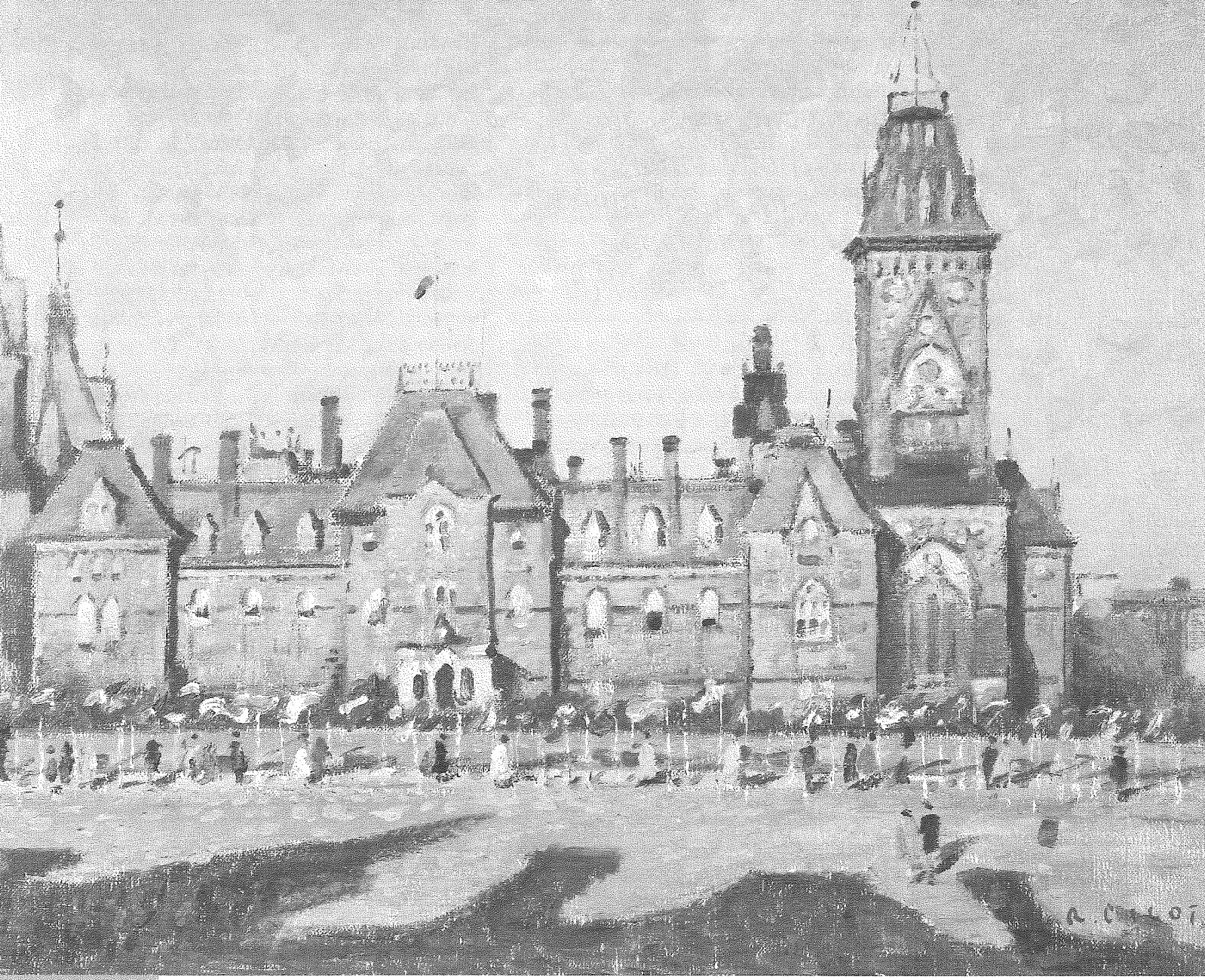
by Arthur Blanchette
The Department of External eign ministry was called not so long ago, was a small but rapidly expanding unit as Canada emerged from the Second World War.
DEA was not an easy department to join, even though the academic qualification for recruitment was lower then than now. The minimum requirement was simply a bachelor’s degree from a recognized university; most of us did not have more than that. But the subsequent hurdles were high. The first obstacle confronting the applicant was a lengthy (two days) and difficult written examination with essays on general knowledge and Canadian history as well as international political and economic affairs. In 1949, for instance, the first day of the written examination began with an essay in which candidates were given three hours “to discuss in not more than 2,000 words” the proposition that the “necessary balance between the need for revolution and the rights of the human person … can only be found in a Christian philosophy of life”. No limitation was imposed on the “point of view” employed in the answer, as the purpose of the question was “to test your capacity to analyze a theoretical problem with lucidity”. The 2,000 word limit, by the way, was crucial. Fewer words were acceptable. Many more were not. Those who made it past the written ordeal then were summoned to an oral examination conducted by a board of senior officers that generally lasted several hours. Provided that one passed these examinations successfully and survived the probationary year — some did not — a career was launched.
Indeed, the notion of a life-long career was prevalent at all levels of the Civil Service, as it was then known. Such a commitment was certainly fundamental to our outlook and it gave rise to strong feelings of loyalty and esprit de corps. Some of us did move to other departments, either on secondment, promotion, or otherwise, but always with the expectation of a career in public service. Departures for the private sector were very rare. This notion of career — linked with the rapid growth of the post-war Foreign Service — was basic to the Foreign Service’s promotion structure and outlook. That structure was based on a pyramid concept: ten officer ranks narrowing upward from FSO (Foreign Service Officer) I to FSO 10. For an ESO 1, the annual salary range was $2,400 to $3,000.
In their career, SOs could anticipate fairly regular promotions until retirement at 65. A few reached the highest echelons as deputy ministers or heads of government agencies or crown corporations. More rose to the senior ranks (FSO 9/10), but most could expect to end their careers at the FSO 7 or 8 levels, roughly equivalent now to EX2 to EX4. Promotion boards consisting of senior officers met quarterly to review ratings. The appraisal system was certainly not transparent. Officers were not allowed to see their reports. Although superiors were encouraged to discuss their annual ratings with their subordinates, many did not. Thus, we could often be left in the dark for quite a long time about how we were viewed in DEA. Promotion appeal procedures were nonexistent. These flaws persisted until well into the 1960s.
In fact, the most reliable gauge of appraisals for an officer was the pace of advancement, with the most outstanding FSOs rising rapidly, some with promotions every two years or so. However, most of us tended to go up every three or four years until we peaked, usually in our mid 50s, at which level we stayed until we retired. What was important — psychologically and • otherwise — was the concept of regular ; progress through the ranks, a factor which, seems to have disappeared. Today, junior : officers seem to be squeezing through a narrow gap rather than ascending a pyramid, which cannot help morale. Of course, DEA was a much smaller place then than now, with something of a family approach to its personnel, particularly its new recruits. Most senior officers went out of their way to help newcomers to settle in. There were the seminars of the so-called University of the East Block for a basic introduction, but senior officers also guided neophytes through the intricacies of the government bureaucracy as well as Canada’s increasingly vigorous approach to foreign affairs. Clearly, they saw themselves as our mentors, with some going beyond strictly professional guidance to invite us to their homes for tea, a drink or a meal, to meet their families and friends. eteran/recruits believed that Canada had Both pre-war senior officers and postwa to change its hesitant, isolationist outlook on international affairs of the past and actively help to make the world a better, sater place in which to live. Most new officers, particularly those who had served in the armed forces during the war, considered that they had a personal and valuable contribution to make in this regard. In their view, promotion through the ranks would help to ensure that Canada would remain on that path. Other than the war, the experience that had shaped the views and moulded the concerns of most post-war recruits was that of growing up during the Depression. While the scions of some of Canada’s most eminent families were recruited after the Second World War, most new recruits did not have such privileged backgrounds. In many instances, our fathers were railwaymen, miners, primary and secondary school teachers, government translators or clerks, newspaper reporters, and so on. With Prime Minister King as its minister, DEA had had considerable clout during the war and its immediate aftermath. When he became Secretary of State for External Affairs, Louis St. Laurent lived quite close to the East Block and he would regularly walk to work. The minister would recognize us, also walking to work, and start chatting with us on the way, asking how things were going with us, how our work was coming along, and so on. The influence of DEA persisted when St. Laurent became Prime Minister, as he gave his full support to his successor, L.B. Pearson. DEA took the lead in the formulation and conduct of all aspects of Canada’s foreign policy. Thus, even as junior officers attending inter-departmental meetings where most participants were older or more senior than us, we were heard and heeded. Prime Minister Diefenbaker certainly had his views about what he would sometimes call the “Pearsonalities.” But his second minister for external affairs, Howard Green, was a powerful figure in the cabinet. Green protected DEA’s overall position, including its control over foreign affairs. Incidentally, when in Ottawa, Green met all officers on posting abroad regardless of rank. During Prime Minister Pearson’s years in office, relations between officials and politicians were close and steady.
For a significant period after the Second World War, we found ourselves working in an atmosphere of generally cordial and trusting relations on both sides of the divide between the politicians and the civil servants and in a department with considerable influence in government circles. One consequence of this was that DEA acquired a reputation for being rather elitist and somewhat aloof. DEA’s pre-eminence and the stature of its officers, as well as its relationship with the political leadership, was called seriously into question with the advent of Pierre Trudeau.
External’s relations with the politicians began to be marked more by wariness than by intimacy and the role of the Prime Minister’s Office and the Privy Council Office in the formulation and conduct of Canadian foreign policy grew steadily at DEA’s expense. Junior officers now found themselves with little or no exposure to the political level.
At least one change was, however, more positive: the improvement in the status of women in the Foreign Service. Before the war, women were ineligible for the Foreign Service. The vast majority of women in DEA were stenographers, as secretaries were then known. The basic pay of a Stenographer 1, by the way, was about $660 per year. A few women, with qualifications equivalent to male colleagues, were hired during the war to work as desk officers, but they had been classified as clerks (even that level in government had been predominantly male in the past). After the war, some of these women eventually became ESOs.
Women in the Foreign Service faced a particularly unpleasant situation if they were rotational and wished to marry. They could not be both at the same time. If married, they were forced to resign from the service when they were posted. Thus, those very few who stayed on remained unmarried, unless non-rotational. There was no question of a woman officer or secretary being posted abroad with her husband as a dependent. However preposterous that may sound today, that prohibition was strictly applied until well into the 1960s.
Those married women who served abroad did so without pay in a conventional family setting. Such was the paternalism of the public service generally that all ESOs had to seek the permission of the department if they wished to marry. Moreover, a male officer’s wife did not go unscrutinized in the annual rating process. Entertainment abroad was done primarily at home in those days, with the burden falling heavily on the spouse, for whose work there was, of course, no remuneration. Rating reports carried an item about the wife’s effective contribution to her husband’s representational duties, and those of the post generally. This wife-rating feature disappeared only a couple of decades later.
Our secretaries, or “stenos”, as we called them, were of great help to new recruits. Many of them had far more experience in DEA than we did and they were thus able to guide us along some of its more arcane and obscure pathways. The ratio then was roughly one stenographer for every two officers whether at home or abroad. Divisions had a divisional secretary with some administrative duties to perform as well. Work for the stenographers was long and hard, as they typed our memos in multiple copies, without photo-copying facilities until the late 1950s. Officers were not expected to know how to type and very few could.
Once typed by our stenos, our work went on its way up with far fewer hierarchical hurdles to be overcome than now — two at times or three at the most, e.g., from division through an assistant under-secretary and/or the under-secretary depending on the subject, up to the Minister. Sometimes urgent work went from the division directly to the Minister; on occasion even from desk officer straight to the Minister’s office. Thus, though there were no computers or other I year $16.00/ 2 years $30.00/
I an, 16 $* 2 ans, 30 $* •/ New/ • Renewal/
Nouveau Renouvellement Mr./Monsieur Mrs./Madame
Ms Miss *International + $6.00/yr/année *USA $4.00/yr/année
Name/Nom:_
Address/Adresse:
City/Ville:
Prov.: Code::
Mail to: bout de papier 412- 47 Clarence Street Ottawa, Ontario KIN 9K1 Adressez à, bout de papier
412-47 rue Clarence Ottawa (Ontario) KIN 9K1 bout de papier Vol. features of high technology, things tended to move up quite fast.
Even shortly after we arrived in DEA, we found ourselves doing quite substantive work. For example, we might — under direction of course — be preparing the first drafts of studies or preliminary recommendations regarding elements of the UN system then being developed or doing initial work on certain formative aspects of NATO. As the Cold War intensified, the agenda in international affairs was crowded, so that there were exceptional opportunities for new recruits to turn their attention to major issues: the East-West confrontation in Berlin grew, war broke out in Korea, in the wake of the break-up of Palestine, Arab- Israeli relations necessitated early peacekeeping operations in the Middle East, the Colombo Plan took off and the Indochina Commissions came into being. With GATT and the UN economic system developing, as well as the implementation of the Marshall Plan in Europe, there was no absence of creative and challenging work to be done. That the international community was paying a good deal of attention to Canadian views gave encouragement and stimulus to our work. as those methods and procedures were in place, despatches and memoranda were the norm: memos within the department, despatches to and from the posts. In the 1930s, despatches of 25, 30, or more pages from posts abroad had not been unusual, with the pace of government then evidently rather unhurried. Prime Minister King, our minister, had time enough to read and carefully annotate those long reports, with their elevated and archaic formality of address. That leisurely pace was another casualty of the war.
The shorter version of the despatch continued to be a basic form of communication throughout the 1950s and well into the 1960s, though automatic cyphers eliminated the tedium of classified messages. Telegrams became the norm during the 1960s as a result of improvements in the department’s communications and encyphering facilities, adapted from those in the Department of National Defence. While the use of telegrams increased the speed of departmental communications to and from the posts, it was certainly at the expense of style and often lucidity!
DEA was certainly a smaller place at mid-century. To give but one example, the American and Far Eastern Division then had only six or seven officers all told to deal with relations with the United States, Latin America, post-war Japan, hostilities in Korea and problems with China, mounting difficulties in Indochina. Not surprisingly, we were very busy. Hours were long and weekend work normal, with no provision whatsoever for overtime pay. Virtually the only fringe benefit available then was the sturdy brown leather briefcase with “Government of Canada” stamped on it in gold letters that recruits received. I still have mine.
In such a setting, structures and procedures could get quite informal. For instance, my first political assignment was to what was then the Political III Division (later the American and Far Eastern Division). Though a neophyte, I was put in charge of the Latin America Desk where – all alone with a stenographer shared with another new recruit — I was responsible, on a routine basis, for Canada’s political relations with the entire continent south of the Rio Grande. If a problem arose concerning Antarctica, I had to look after that continent as well, since, as my head of division put it when he asked me to do so, “it was so close to Latin America.” Mercifully, relations with Latin America were good and there were only seven posts there, all relatively small compared to most of those there now, but In those days, drafting was almost entirely done in English and meetings invariably conducted in that language. This could be a considerable handicap for recruits whose first language was French. In fact, bilingual officers and staff at the time were almost exclusively francophones. It was only during the mid-1960s that French came into increasing use.
As for the means of communication, telegrams were initially rare, unless unclassified. That was simply because encyphering and decyphering messages was a slow and tarinue proceee involvino comnlex the flow of resulting activity was sufficient to keep me busy.
Security then was relatively lax. During the early postwar period classified documents were often left on desks overnight. Security abroad was perhaps even laxer. For instance, one ambassador at a post behind the Iron Curtain had the habit of leaving classified bag material in his residence for further study. When it was pointed out to him that this was very risky, he replied that there was no risk at all. He fully trusted the servants; what is more, the documents were safely hidden under his pillow in his bedroom! The intensifying Cold War changed that.
Transfers among assignments or additions to mandates were common, indeed deemed to be normal. We were expected to be flexible and versatile and, for our part, we viewed this as making our work more interesting and more challenging. The idea behind this was that just about all of us had been recruited as generalists. As such, we were supposed, in theory at least, to be able to handle almost any problem that might arise. Only those with economic or legal backgrounds might receive assignments more in keeping with their qualifications or training. However, as energy problems (especially with the United States), questions related to fisheries and oceans, complications from rising air travel, development assistance under the Colombo Plan, among other subjects, became an increasing part of the mandate, the path of the generalist became narrower. When Canadian representation expanded in regions such as the Middle East, with languages and cultures unusual or not commonly found in Canada, or when international scientific or nuclear questions arose, specialists became necessary, with obvious consequences for recruitment and training.
While there were a few very large posts such as London, Paris, Washington, most missions were smaller than now. The Embassy in Mexico City, for example, had five officers, including the Head of Post, from 1944 when it was founded until the late 1950s. Two were from the Trade Commissioner Service (TCS). This staffing pattern was not unusual. Most missions in Europe and elsewhere in Latin America were that size or smaller. Canada was represented in only two African countries, Egypt and South Africa, where the same officer staffing pattern prevailed, as it did in Asia, where posts particularly those in South and Southeast Asia tended to focus on Colombo Plan activities then beginning to take off. The rapid expansion of Canada’s representation abroad after the war could at times place a good deal of responsibility on junior officers. For example, most of us received no special training in how to set up a post. We just arrived, usually with a secretary and an administrative officer or clerk. We did our best to find suitable quarters for the post, as well as our families, to hire good local staff, and generally prepare things for the incoming head of mission, frequently doing so in unfamiliar languages. Not an easy task. As a result of posting circumstances, some FSO1s and 2s might find themselves alone as chargé d’affaires of some of the smaller more distant posts for lengthy periods.
Professional life abroad was fairly straightforward. Missions dealt primarily with political and consular affairs: in some countries almost exclusively so. Depending on the country, trade would be included in the post’s mandate in cooperation with the TCS, which in some countries had older and separate posts. The growing number of consulates in the United States dealt primarily with trade, information, tourism and, of course, consular problems. In some Western European and Latin American countries, as well as the United States, information and cultural affairs were also a part of the mandate. Immigrants to Canada were arriving almost exclusively from Southern and Western Europe at the time.
Immigration services abroad – some quite large — were administratively distinct from the mission itself although under the overall jurisdiction of the head of post. Some immigration offices antedated External’s and were housed separately. Canadian tourism abroad was light, but growing. There were no drug problems to cope with, but a small percentage of visiting Canadians could usually be counted on to get into trouble of some kind.
As the Foreign Service expanded in the mid-to-late 1940s, it became necessary to radically alter the posting system. The few prewar missions were all in healthy, developed, countries with lengthy postings abroad. After the war, this pattern was shifted towards assignments involving greater rotationality as is prevalent today. Postings have always been accompanied by what – for want of a better term — might be called the career hazards of the Foreign Service. Traditionally, these have been related to alcohol, money and/or sex, with drugs as a more recent addition. DEA has reacted to these hazards with varying degrees of severity. For instance, the outlook on excessive drinking, facilitated by access to duty-free spirits, has on the whole been more lenient over the years than towards sex or money difficulties. The problem has generally been viewed less as a transgression than as an illness, with management willing to help to find a remedy. Depending on how much drinking impeded work, careers could be sidetracked or stalled, with postings stopped while it lasted, but generally that did not prompt dismissal from the service. Irregularities involving money, on the other hand, were viewed extremely dimly and still are. Most often, these have been connected with foreign exchange transactions, particularly profiting from differences between official and unofficial currency rates, the sale of visas and travel documents and fraudulent travel claims. Such transgressions have usually been quite severely punished: by outright dismissal at times, demotions, blocked promotions and postings, fines, and lesser penalties depending on the nature and extent of the abuse. The departmental outlook on sex has varied a good deal over the years. Divorce, for example, was viewed very severely during the 1940s and 1950s; certain ESOs contemplating a second divorce were warned about possible dismissal from the service. Some wartime and early postwar recruits, including a few brilliant ones, were homosexuals. As the Cold War intensified, they were deemed to be security risks — an attitude consistent with the perception of homosexuality then — and forced to leave the service. Such strictures eased as the state left the bedrooms of the nation and the outlook on sexual orientation broadened.
However, one feature of External’s life has not changed that much over the years: political appointments to heads of post. Depending on the Prime Minister of the day, their numbers have varied a good deal, though no Prime Minister has resisted the temptation to reward the party faithful. Though the numbers may vary, the quality or lack of it among such appointees has not changed that much. Some were absolutely outstanding. Others were virtual nonentities. And some turned out to be the worst kind of martinet or prima donna. I write with authority as I served under four of them.
DICESA Great Whatever else one may say, for good or ill, about the department and the Foreign Service, whether or not DFAIT is as congenial a place in which to work as was DEA, they are certainly different institutions. Perhaps one might add that one change, arguably the most positive one, remains incomplete. Though the relative position of women in DFAIT may be better than in years gone by, it still lags behind other departments and the appointment of a woman as deputy minister of foreign affairs (or deputy minister for international trade) is long overdue.
Who knows what changes the next fifty years may bring to the Foreign Service and to the foreign ministry? Perhaps other readers and contributors to bout de papier will turn their thoughts (and keyboards) to that notion as the millennium (whenever it is dated) advances.
View the original scanned pages →
Originally published in bout de papier, Vol. 16, No. 3 (1999) — Fall 1999 // Automne 1999, pp. 21–27. Read the rest of this issue →



