
bout de papier, Vol. 18, No. 4 (2001-2002) — Winter 2001/2002, pp. 41–43
M despots, had ent givem up her plans a dame Hussein, the mother of all for world domination. Thwarted by the UN’s Non-negotiable Yearly Admission of the Naughtiness of Your Actions in Nuking Your Adversaries (UN NYA-NYA-NYA) and forced to dismantle her weapons of mass deconstruction, she sought new ways to bring the world to its knees. But her plan to crush world textile production through genetically modified cotton borers with nano-hatchets on their legs (the “Axes of Weevil” program) was bush-whacked by Washington. The poisoned poutine approach was scuttled when she found that the recipe involved curds and concluded they wouldn’t cooperate. Her proposal to kidnap and hold hostage all the world’s talk-show hosts and fundamentalist preachers was rated by world leaders as conceptually appealing and thus seemed unlikely to yield much geo-political leverage. In desperation, she turned to Canada’s expert deployment pool and was put in touch with a pair of free-lance villains named Paridy and Sleazewagon.
Yes, that Paridy and Sleazewagon. Papa Jack was still going strong with the Gothic Zydeco Band, gaining reviews from “appalling” to “illegal”. (“GZB’s latest album makes Wagner seem like Puff the Magic Dragon. One cut sounds like Tannhauser sung by Donovan. All parties involved should be ashamed — if not arrested.”) Rialto had retired from provincial politics, devastated to discover that even stones run out of blood eventually. With his departure, his party executed a long-prepared turn to a “kinder, gentler plutocracy” “ Formalizing their longstanding partnership, the two former premiers took out a Scoundrels-A-Us franchise and bought identical white linen suits with panama hats, bamboo canes and spats. They were in great demand among right-wing lunatics with no sense of chic. But it was not until they were hired by Madame Hussein that their collaboration came to the attention of the Centre.
Picture the lobby of the Babylon Palace Hotel: oil sheikhs in flowing robes, furtive-looking foreign businessmen hot on the scent of a sanctions loophole, women in veils and bikinis, women in Armani power suits, spies from a dozen nations crowding inconspicuously behind the potted palms and trying to keep their mustaches glued on in the heat. Off in a corner, four apparent tourists sit around a low table drinking maple syrup milkshakes…
LDC Liebnitz congratulated Attila McGee and Emeralda Beluga for having discovered the details of Madame Hussein’s imminent coup. “Diabolical,” he whispered. “That new ziggurat downtown contains enough electronics to take over every satellite in space, subverting their original purpose and substituting a continuous broadcast of GZB’s Ancestral Warthog Blues.” Bugbyte O’Nanotek blanched and said: “My God, she’ll be able to demand anything she wants from the world. If anyone’s left sane enough to negotiate with her.”
“Indeed,” replied the ace logician. “We knew about her plan before we knew about the ziggurat. We tried to talk her out of it. Her price was getting Ariel Sharon to sing Yasser, He’s My Baby on Larry King Live. Our analysts doubted this was a serious offer. So we sent in a trio of assassins — codenames Shadrach, Meshach and Abednego — to take out Sleazewagon and Paridy. But one of the killers turned out to be a double agent — his real name is Hananiah but we don’t know which of the three he is – and that attempt was thwarted as well. Thanks to Attila and Esmeralda, we now know that the satellite takeover happens at midnight tonight. These fiends must be stopped, and we are the only ones in position to do it.”
Attila objected: “But how will we get past the guards?” His wife patted him on the arm and said, “Leave that to me, sweetheart. I’m more worried about the ziggurat itself. It’s a maze and we won’t have much time to get to the top and disable the antennas. We also need to find the identity of the double agent among the three assassins. The truth is in there, but we have no idea where.”
Bugbyte broke in: “I can handle finding our way around the building. I’ve brought along three of the new French knock-offs of the Apple hand-held, the ones with builtin global positioning that can create a map as we explore the building. It’s the company’s latest series — named after great bureaucrats of history!?” “How very French,” commented Liebnitz. “Well”, Bugbyte replied, “the Pomme Pilate is proving very popular in this part of the world.”
That evening, the guards outside Babylon’s latest ziggurat were surprised when a pair of street performers strolled up and broke into a medley from Fiddler on the Roof. While the guards would have preferred Kismet, they applauded despite the heavy Canadian accents of the singers. Bugbyte, looking fetching, if furious, in houri garb, served them coffee — coffee from the Centre’s cafeteria, specially flown in. Instantly incapacitated, the guards were bound, gagged and strapped to an express camel caravan leaving for Outer Mongolia. Liebnitz stepped out of the shadows and the team entered the building.
Ten minutes to midnight saw the team in a dimly-lit room near the top of the ziggurat. A sturdy ladder rose to a trapdoor in the ceiling, with a complex locking device. Liebnitz examined the mechanism closely and traced it to a series of niches in one wall arranged in rows of four, four, five and eight (top to bottom). Turning to Attila, he asked: “Those tiles you picked up as we explored the building, how many do you have?” “I kept them all, Ludwig,” the agent replied. “There are exactly twenty-one.”
“Then the lock on the trapdoor can be disengaged if we can figure out what order to put the tiles into the niches,” mused the ace logician. “A quick analysis of letter frequencies indicates that the words are in ancient Aramaic, so a standard anagrammatic or cypher decryption is not going to help us. Maybe the way they were distributed in the building can tell us the answer. Let’s pool our knowledge — and quickly. What do we know, Bugbyte?”
Bugbyte’s report
The interior of the ziggurat is divided into a total of thirty-six rooms on three floors. We went into them all. The floor-plans are identical on each floor, so the rooms fit exactly above and below each other. On this chart, I have labelled each of the rooms according to the following scheme: all of the rooms on the top floor begin with A, all the rooms on the middle floor with B and all the rooms on the bottom floor with C. The rooms in the northernmost row of each floor are bout de papier Vol. numbered I through 14 (west to east), the rooms in the middle row 21 to 24 and the rooms on the southernmost row 31 to 34.
The only exterior entry to the complex is through a door in the east wall of room C14. The only exit is in the ceiling here in room A11. With four exceptions, all the rooms have two ways out, made up of archways in the middle of the walls and/or stairways up or down, and including the entry door and the exit trapdoor. The exceptions are rooms A32 and C21, which have three archways each, and the two dead-ends — B31, which has a single archway in its east wall, and C34, which has only a stairway leading up. Exterior windows are found in all rooms on the exterior walls of floor A, but they cannot be opened. There are no stairs down from the bottom floor and no stairs up from the top floor, except for the exit itself. There is no more than one opening in any given wall, floor or ceiling.
With three exceptions, each room has a plaque on the wall with a single name on it. These names are marked on the chart. The exceptions are the entry and exit rooms, which have no plaque at all, and room C32, where the plaque has been utterly defaced.
Liebnitz then turned to Esmeralda. “You were keeping track of the archways and stairs along the route we took. Can you fill in Bugbyte’s chart?” The Latin beauty looked annoyed. “My Pomme Pilate just crashed
– at least I think that’s what happened. Instead of General Protection Fault, the blue screen reads I Wash My Hands of This Application. But I still have a few notes that might help.”
Esmeralda’s report
(a) Entry room C14 has an archway on the south wall.
(b) B34 is the only room with stairs both up and down.
(c) One of the rooms with north-facing windows has an archway in its east wall and stairs leading down.
(d) Solomon is connected directly to both
Isaiah and Ecclesiastes.
(e) The room named after a woman has an archway in the south wall and stairs leading up.
(f) A32, C31 and C33 are the only rooms from which you can see through archways into four other rooms on the same level.
(g) Jonah has an archway in the north wall, as does the room with south and east windows.
(h) All of the rooms with 9-letter names have an archway in the south wall. (i) This exit room, as you see, has an archway in the east wall.
Finally, the ace logician asked Attila where each tile had been found. Taking a dramatic step forward to deliver his report, McGee tripped over a passing centipede, dropped the entire load of tiles onto his handheld and knocked himself momentarily senseless against Bugbyte’s steel-toed boot. Struggling to his feet and immediately keeling over again, he delivered from the floor the fragments he could summon.
Attila’s report
There was at most one tile per room. I worked out the placement of the tiles row by row according to Bugbyte’s chart, taking the rooms in each row west to east and also recording when a room had no tile. I remember the tiles in each of the nine rows, but not where in the chart each row belongs. The rows are as follows:
H, no tile, no tile, E
P, N, E, N
A, 1, no tile, no tile
E, no tile, K, no tile
no tile, no tile, no tile, no tile
U, E, T, no tile
R, S, no tile, no tile
no tile, N, M, E
L, no tile, E, M
I remember a few other things. Both A12 and C13 had tiles in them, but the entry room, the exit room and the two dead-ends had none. The R tile was in a room whose number was prime. In two of the northernmost row of rooms on B floor, the tiles had letters that duplicated either the first or last letter of the name of the room. The only other two rooms where this happened were a pair one above the other at the far west end of the building. These tiles in these four rooms were all different. The room with the defaced plaque had no tile, but in a corner was a piece of paper, on which was written “Chapter one: seven”
“Well”, ’, Liebnitz snorted, “I think we have enough information here, if somewhat disordered. Once we have our route and the placement of the tiles, we should have the words and their order. The names of the rooms also provide a clue, of course.” With that he quickly filled in Bugbyte’s chart, then placed the tiles in their proper niches. With a dry rumble, the mechanism engaged and the trapdoor swung open. At one minute to midnight, the team swarmed out onto the roof.
As Bugbyte tapped in the commands that began the self-destruct sequence of the mighty antenna array, the others spotted a pair of white-suited figures scurrying away along the nearby riverbank. Pulling a directional microphone from the watch-pocket of his suit, Attila heard Papa Jack say: “If I’ve said it once, I’ve said it a thousand times, mon cher. Ziggurats are bad for your health. I of course had nothing to do with this absurd idea”. Sleazewagon’s riposte was to topple his confederate into the river, with the snide comment, “Deep in denial again, eh?” Papa Jack replied, “It’s not the Nile, you fool, it’s the Euphrates. “ So saying he hooked his cane around Sleazewagon’s ankle, tripped him into the stagnant water and proceeded to pummel him with his spats. Exeunt, pursued by a hippo.
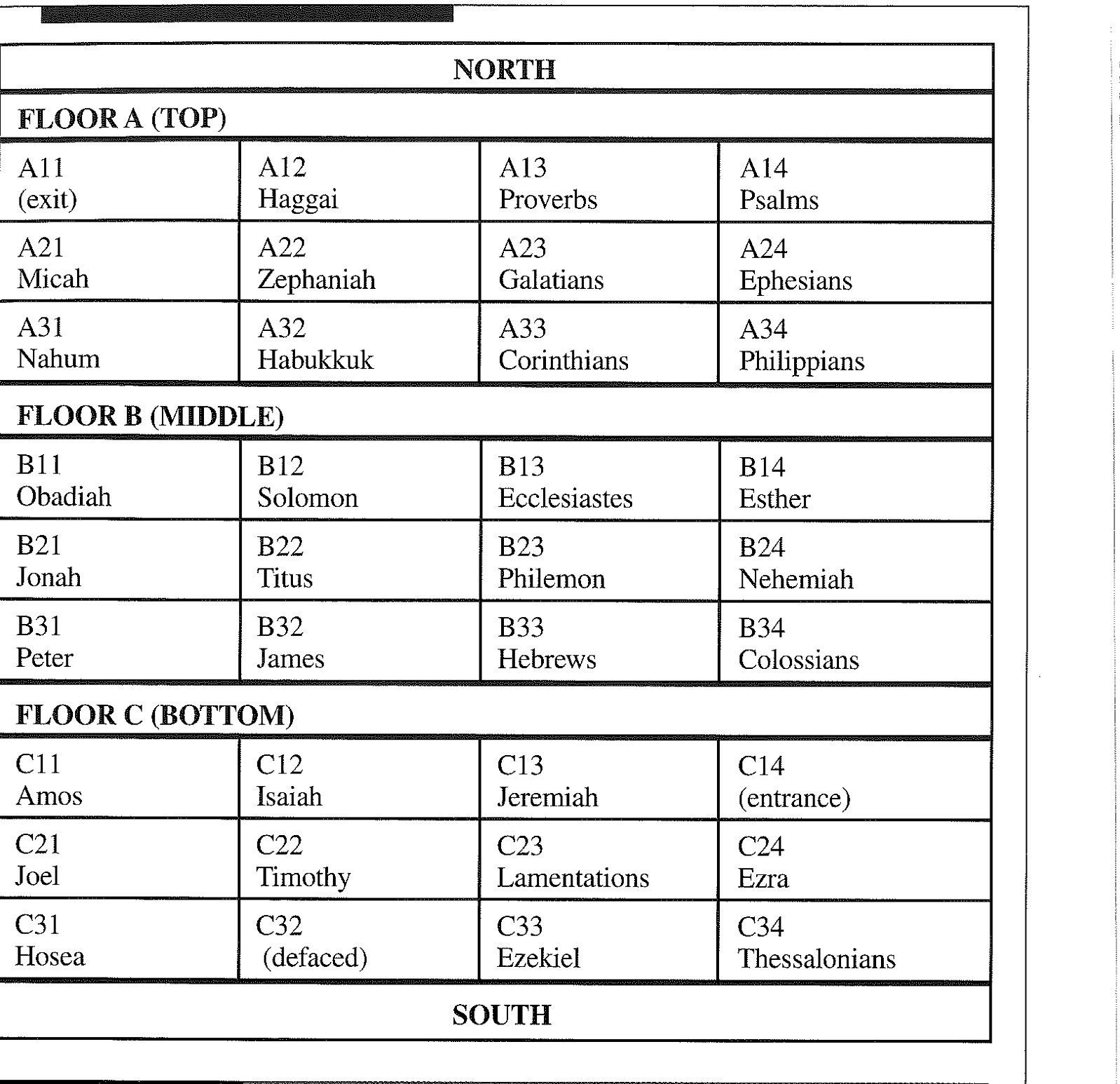
Can you duplicate Liebnitz’s feat by providing (a) the four-word key to the ziggurat exit and (b) the cover-name of the double agent? bout de papier will decide the winner by drawing from a box containing all correct entries received by July 8, 2002. Not necessary for the contest, but can you also say what the keywords mean, and provide the sequence of rooms in the direct path from the entry to the exit of the ziggurat? How about tips on getting panama hats out from inside a hippopotamus?
View the original scanned pages →
Originally published in bout de papier, Vol. 18, No. 4 (2001-2002) — Winter 2001/2002, pp. 41–43. Read the rest of this issue →



