
bout de papier, Vol. 21, No. 3 (2005) — Summer/Fall 2005 // Été/Automne 2005, pp. 31–33
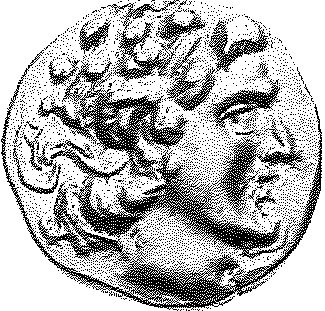
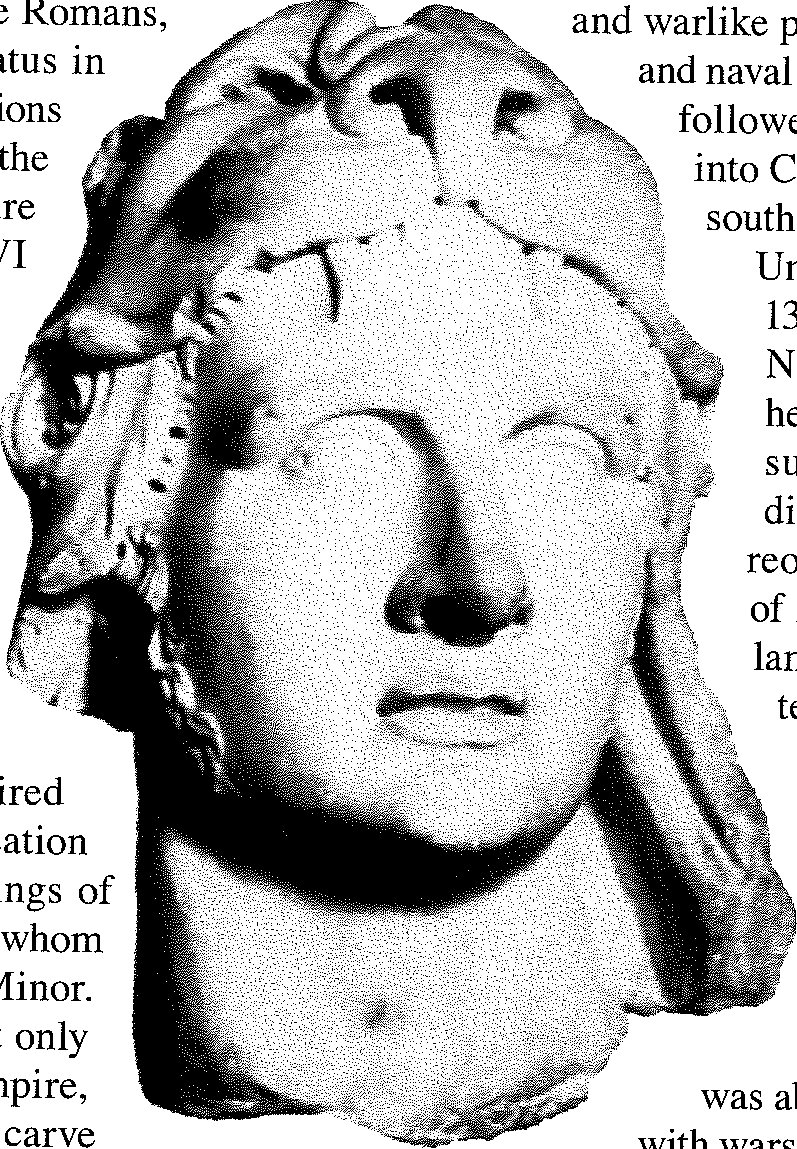
Great Empires do not always have it their own way. Opponents will appear on the periphery who rally the opposition and resist all efforts to remove them. The British were faced with various elusive madhis and mad mullahs on the North West Frontier and in the Horn of Africa. Saddam Hussein — for a time – and bin Laden are the American Empire’s manifestation of the type. Even in Canada, we had our very own Louis Riel. The Romans, of course, had their share of these — Caracatus in Britain, and Arminius, who destroyed three legions and threw the Romans back to the Rhine. In the last century of the Roman Republic, one figure stood out – the king of Pontus, Mithradates VI Eupator. A sworn enemy of Rome, he exploited and indeed exacerbated the weaknesses of its highly competitive, avaricious political system. In doing so, he made, and helped break, the careers of many of Rome’s most influential figures, setting events on a course that would shipwreck the Republic and lead to the emergence of the Imperial system.
Pontus was a rugged but fertile, well-forested and mineral-rich region, on the south shore of the Black Sea. While they had acquired over the years a veneer of Hellenistic civilization and used Greek as their official language, kings of Pontus were descended from minor aristocrats whom the Persians had ensconced in western Asia Minor. The dynasty’s founder, Mithradates I, had not only survived Alexander’s wreck of the Persian empire, but had exploited the chaos which followed to carve out a kingdom. The first five Mithradates had gradually extended their domain until it encompassed most of what is now northern Turkey. Mithradates’ father, Mithradates V Euergetes (the benefactor), was particularly skillful in achieving territorial rewards by playing loyal ally to the Romans. Where gratitude did not suffice, he discovered a few well placed bribes could also win the favorable consideration of Pontine claims by Senatorial commissions.
Unfortunately Euergetes died prematurely of poison in 120 BC, when young Mithradates was only 11. His mother favoured his younger brother, Pharnaces, and Mithradates fled to the hills. There he reportedly spent seven years doing physical training, learning the many languages of the Pontic interior (reportedly he knew over 20) and — by taking homeopathic doses of poison — building up his immunity, to avoid his father’s fate. In due course he returned to overthrow his mother in a coup. He then imprisoned and eventually killed her and his brother. Mithradates spent the next 20 years following the family tradition of territorial aggrandizement. Parisades, king of Bosporus (the Crimea and neighbouring regions), asked Mithradates to help him fight off nomad attacks. Soon after, Parisades conveniently died and Mithradates annexed the kingdom. He also conquered Colchis (the coastal region of Georgia) and enclaves along the western coast of the Black Sea. These regions, rich in natural resources and warlike peoples, strengthened Pontus’ military and naval capacities. In Asia Minor, Mithradates followed the family tradition of expansion into Cappadocia, Galatia and Phrygia to the south, and Bithynia to the west.
Unfortunately things had changed. In 133 Eumenes III of Pergamon had died. Not liking any of his potential heirs, he willed his kingdom to Rome. After suppressing those Pergamines who disliked this development, the Romans reorganized Pergamon as the province of Asia. Ensconced on the Asian mainland, the Romans had little time for the territorial ambitions of local dynasts. Indeed, during Mithradates’ minority, the Romans had repossessed parts of Phrygia they had granted to his father. Mithradates, undaunted, continued his encroachments, promptly retreating whenever the Romans bothered to protest. Was able to exploit Roman preoccupations with wars in Spain and North Africa; the threat posed by the barbarian Cimbri and Teutones to northern Italy; and the so-called “Social War” — a revolt of Rome’s Italian allies, which only ended in 88 BC after the Romans conceded citizenship to them.
Mithradates’ depredations came at the cost of growing Roman irritation. In 89 BC the Senate sent Marius Aquilius, a former consul, to Asia to ensure Mithradates withdrew from territories he had occupied. While Mithradates, as usual, complied, Aquilius decided to profit from the occasion by asking the Kings of Bithynia and Cappadocia to pay for the privilege of being liberated. (There is some question as to whether this reimbursement was actually intended for the Roman treasury.) When the kings pleaded poverty, Aquilius suggested they get the money by attacking Pontus. Aquilius offered to provide support for this effort, although the Senate had not authorized him to take military action. The result was a disaster with incalculable consequences.
Mithradates demolished the Bithynian army. He then defeated Aquilius, who had few actual Roman troops under command, but many less than enthusiastic local levies. Aquilius was captured and brutally executed. In the face of these defeats, other Roman-sponsored forces deployed around Pontus’ borders fell back, abandoning most of Asia Minor to Mithradates.
Mithradates spent the year 88 BC consolidating his rule, offering a five-year tax holiday to those cities of Asia which submitted to him. On hearing that the Roman Senate had formally declared war on him, he then went for broke by ordering the slaughter all Romans in Asia Minor. Most cities were happy to comply. Rome’s revenues from the province of Asia had been collected by Publicani, private contractors who agreed to provide a fixed sum for the Roman treasury while keeping whatever extra they could collect. Their extortionate ways had done nothing to win hearts and minds. In the ensuing massacre, some 80,000 Romans and Italians are said to have perished. Even if this was — as such figures usually are — a gross exaggeration, the cities of Asia Minor were now utterly compromised, with seemingly no choice but to fight for Mithradates. The only hold-outs were privileged cities such as Troy (Rome’s legendary homeland) and Rome’s loyal, if much abused, ally Rhodes (See All Rhodes Lead to Rome, bout Vol. 18, No. 4). The revolt spread across the Aegean to Greece. Juntas in Athens, Sparta and Thebes overthrew pro- Roman regimes and rallied to Mithradates. Rhodes, now refuge to many Roman fugitives, held fast in an epic siege. Some other cities in southwest Anatolia also remained loyal and resisted Mithradates. Less fortunate was the free port of Delos. Having resisted Mithradates’ immediate attack, it was captured by the Athenians. Again the large Italian merchant community there (reportedly some 20,000) was put to the sword
While the normal Roman response to a revolt was to counterattack — as quickly as possible — pressing until the rebels submitted unconditionally, more than a year was to pass before anything happened. Two generals, Cornelius Sulla and Gaius Marius, demanded the honour and glory of commanding the war against Mithradates. Both had had past dealings with him; Marius had once warned Mithradates that unless he could make Pontus more powerful than Rome, he had better do as he was told. Sulla, as governor of Cilicia in the southern Asia Minor had been involved in earlier efforts to ease Mithradates out of Cappadocia. Marius and Sulla had long been bitter rivals. Marius, a self-made man, had won an unprecedented five consulships, largely by exploiting the perceived threat posed by the Cimbri and Teutones as they blundered around Gaul. Sulla, the scion of an ancient but noveau pauvre Patrician family, was a hero of the Social War.
Republican Rome’s constitution was what the historian Polybius called a “mixed” one. The popular assembly elected the annual magistrates and could vote on legislative proposals (plebiscites). The oligarchic Senate, comprising former magistrates, normally decided on questions of peace and war: the assignment of provinces and the ratification of treaties. The Senate awarded Sulla, one of the Consuls for 88 and still in command of an experienced army, the command against Mithradates. But while Sulla was out of Rome organizing his army, Marius rigged a plebiscite to award himself the command. Sulla’s reaction was unprecedented (but oft to be repeated) — he staged a march on Rome. Finding the presence of five legions insufficient to induce Marius and his supporters to back down, Sulla forced his way into the city. Legally magistrates could only enter Rome with their troops if awarded a triumph. Marius fled, and after not a few adventures, reached North Africa, where he brooded among the salt-strewn ruins of Carthage (destroyed by the Romans in 143 BC). Sulla purged Marius’ supporters, packed the Senate with his own, and rewrote the Constitution to ensure only the Senate could initiate laws. Assuming his home base was secure, Sulla then departed for Greece, arriving in the fall of 87.
Sulla’s first objective was to secure Athens and its port Piraeus. The latter, held by Mithradates’ general Archelaus, was the tougher nut. As Sulla had no fleet, Mithradates could reinforce and provision the base by sea. Meanwhile Athens starved, while Sulla ravaged the sacred groves of the Academe and the Lycaeum for wood to build his siege engines. Sulla also plundered the great temples of Delphi, Olympia and Epidaurus for ready cash, while his quaestor, Lucullus, was dispatched to scour the eastern Mediterranean to assemble ships for a war fleet. On March 1, 86, Sulla stormed Athens — by now its population reduced to cannibalism – and, as is the wont of rising powers whose cultural mentors have not measured up, subjected the city to massacre and a brutal sack. He did refrain from burning it. A fortnight later, Mithradates’ general Archelaus abandoned Piraeus and sailed off with his fleet. Sulla devastated the port, destroying its famous naval installations. The pro-Mithradatic junta held out a while longer on the Acropolis, but eventually surrendered and was executed. Athens’ days as a would-be power were forever over. Its future under Roman rule was to be that of university centre and tourist trap.
Sulla now found himself facing a double threat. While he had been able to pack the Senate, he had failed to rig the Consular election. Cinna, one of the Consuls for 87, was a Marian and while he pledged good behaviour in Sulla’s absence, he soon reneged and staged his own march on Rome, recalling Marius from Africa. Sulla’s supporters were in turn purged. Cinna and Marius had themselves elected as the Consuls for 86. A month into his sixth term, Marius died. Flaccus, his successor, was dispatched to Asia, with two legions, to confront Mithradates and, should the occasion arise, Sulla. Meanwhile Mithradates had sent a large army under his son Ariarathes overland from Asia. Ariarathes brushed aside the Roman garrison in Macedonia and in the summer of 86 descended on central Greece. When he died of fever, the former commander at Piraeus, Archelaus, took command. Sulla marched north, decisively defeated Archelus and penned him up on the island of Euboea.
Archelaus opened negotiations and persuaded Sulla to offer generous terms so he could get on with dealing with Cinna. Sulla saw the logic of this. Rather than requiring that Mithradates unconditionally surrender, he was willing to accept 2000 talents (60 tons of silver), the hand-over of 70 fully equipped ships, the surrender of Roman prisoners and deserters, and evacuation of all territories Mithradates had occupied. In return, Mithradates would be confirmed as King of Pontus and even recognized as a Friend and Ally of the Roman People. Mithradates, still hoping to hold on to his Asia conquests, was reluctant to accept. His mind was soon concentrated. Ignoring Sulla, the Marian army (now under Fimbria, who had assassinated Flaccus) traversed the Balkans and crossed over to Asia, sacking cities as it went. Mithradates only escaped capture because Lucullus, sailing to Byzantium with his borrowed fleet, refused to cooperate with Fimbria. Lucullus now conveyed Sulla’s army across the straits, even as many of the city states of Asia, regretting their support for Mithradates rose in revolt. Bowing to the inevitable, Mithradates met Sulla at Dardanus, near Troy, in the autumn of 85. After a free and frank appraisal by Sulla of Mithradates’ future should he not accept his terms, the two war criminals (even by the standards of the first century BC) sealed their agreement with a kiss. It was a verbal agreement, which, to Mithradates’ later regret, was to give the Senate valid grounds to refuse to ratify it.
Sulla spent the next two years restoring Roman rule in the region, demanding the up-front payment of five years’ worth of back taxes, and levying a war indemnity of 20,000 talents. City leaders who had backed Mithradates (and the massacres) were relentlessly purged. Cities which resisted were sacked and their populations massacred or enslaved. Greece and western Asia Minor were beggared for a generation. Fimbra’s troops deemed it prudent to assassinate their commander and rally to Sulla, who left them to garrison Asia. In 83 Sulla sailed back to Italy to deal with Cinna. While Cinna’s troops assassinated him rather than face Sulla’s legions, others of the Marian faction opted to resist. Once again, Sulla had to take Rome by force. After the usual purges of leading citizens, on an even greater and more systematic scale than ever before, Sulla was appointed Dictator in perpetuity. Having rearranged the Republic to his liking, he retired to write his memoirs and died – in bed – in 78.
Once Sulla had left Asia, his legate Murena decided to try his luck with Mithradates. Interpreting Mithradates’ tardy withdrawal from Cappadocia as a material breach of the treaty, he invaded Pontus in 82. Murena, however, was no Sulla and was soundly defeated by Mithradates. Sulla ordered Murena to desist and had him replaced. Mithradates had no illusions that peace would persist, particularly after Sulla’s death. He began to rearm and rebuild his fleet, building an alliance with the pirates who, in the wake of Sulla’s depredations, were infesting the eastern Mediterranean. He also sought to make common cause with Quintus Sertorius, a Marian who had escaped to Spain and set up a shadow republic. In exchange for military advisors to modernize his army on Roman lines, Mithradates sent Sertorius 40 ships and 3,000 talents. This provocation – the Senate lived in dread of grand designs to encircle Rome — and the death of Nicomedes III of Bithynia, who willed his virtually untenable kingdom to Rome, made renewed war inevitable.
In 74, the Senate appointed both consuls to Asiatic commands, an almost unprecedented move. Marcus Aurelius Cotta got Bithynia, while Sulla’s protégé, Lucullus, received Asia. Mithradates, in pre-emptive strike, bottled Cotta up in Cyzicus on the Sea of Marmora. Lucullus, however, was able to outmaneuver Mithradates, and, over the next few years, eased him out of Pontus, and into Armenia. Tigranes of Armenia, who while an ally of Mithradates had so far done little to help, refused to surrender him. In 70, without Senatorial authorization, Lucullus invaded Armenia. Greatly outnumbered (Tigranes described Lucullus’ forces as “too small for an army, too big for an embassy”), Lucullus destroyed the Armenian army in a pitched battle.
Lucullus spent the next two years trying to dismantle Tigranes’ kingdom, amassing much booty in the process. Mithradates, meanwhile, crept back into Pontus, and in the summer of 68 inflicted a major defeat on the occupation force left there by Lucullus. When Lucullus attempted to counter-attack, his troops, worn out by fruitless campaigning, went on strike. Lucullus and Mithradates each tound themselves back where they had started in 74. When not pursuing Mithradates and Tigranes, Lucullus attempted to undo some of the damage Sulla had wrought on Asia, particularly by reducing the crushing debt burden many cities had to bear to meet their reparations payments. This struck at the interests of the Publicani, who, despite the massacre of 88, had come flocking back. They lobbied the Senate to have Lucullus removed, his setbacks providing the excuse to relieve him of his command.
In 67, a plebiscite had awarded Pompey, another of Sulla’s protégés, an extraordinary command to sweep the seas of pirates, who had grown from a nuisance to a serious threat to Rome’s food supply. When Pompey succeeded in record time, a new plebiscite gave him Lucullus’ command, including Armenia and points east, as well as massive reinforcements. Lucullus was sent on gardening leave (indeed the fish ponds he built with his booty became the stuff of legend). Failing to persuade Mithradates to make a formal submission, Pompey, more by weight of numbers, than by military skill, chased him out of Pontus. In 65, after an adventurous retreat through the tribal lands of the Caucasus, Mithradates reached the Crimea, held by his son Pharnaces. For the time being, Pompey was content to leave him there, while he went marching through Georgia and Armenia. Rumours, however, started to circulate that Mithradates was hatching a grand design to raise an army of Celts and Scythians that would sweep around the Black Sea and up the Danube to invade Italy. The Romans let his son Pharnaces know that he could expect to be reinstalled in Pontus as a Friend and Ally of the Roman People if he would do the right thing. In 63 BC, after a reign of 57 years, Mithradates realized the end had finally come. He tried to take poison, but the immunization course taken in his youth was still effective. In the end, a Gallic bodyguard put him to the sword. Pompey gave him a state funeral and then set off to conquer Syria and Judea.
Mithradates had recognized and skillfully exploited many of the weaknesses of the Roman system: the tendency of Roman politicians to subordinate long-term goals for short-term gain; the resentment among subject peoples caused by the rapacity and venality of their provincial administration; and the distractions created by events in other theatres. He made good use of Pontus’ central position and effectively mobilized its human and material resources. He was persistent, tenacious and able to overcome crises. However, he was all too prone to overreach himself. His officials proved as rapacious as any Roman Publican and, unable to provide the peoples of Asia Minor with an acceptable alternative to Roman rule, he soon lost much of their support. Blinded by his hatred of Rome and overly impressed by his own successes and the seemingly invincible forces he was able to muster, he was unable to grasp the sheer overwhelming magnitude of Roman power.
Pharnaces II ruled Pontus in relative peace for the next 20 years, until his patron Pompey went to war with Julius Caesar. In 42, having finished off Pompey and established Cleopatra in Egypt, Caesar invaded Pontus. He defeated Pharnaces, in a one short but savage battle, and summed it all up in that most famous of despatches: Veni, Vidi, Vici – I came, I saw, I conquered.
Roger Lucy recently retired after 33 years with External/Foreign
View the original scanned pages →
Originally published in bout de papier, Vol. 21, No. 3 (2005) — Summer/Fall 2005 // Été/Automne 2005, pp. 31–33. Read the rest of this issue →



