
bout de papier, Vol. 14, No. 3 (1997) — Fall 1997 // Automne 1997, pp. 16–17
by Jennifer Daubeny
The last two years have seen an increased number of Canadian diplomatic missions comprising a single Canada Based Officer. In 1995, seven of these satellite offices or mini missions were opened in Latin America alone, adding to long-established single-officer posts throughout Africa and in the US, and more recently established offices in such locations as Vietnam, Japan and Croatia.
Unlike the experience chronicled by “Our Man in Zagreb”, Sam Hanson, in the Summer 1996 edition of bout, the majority of these missions do not involve lone officers camped out in a hotel room with a laptop and a modem, in place to deal with a supposedly temporary crisis. In Guadalajara, the Canadian Consulate is an attractive and modern office of a permanent nature, or as permanent as anything is in these days of perpetual change in DFAIT… There are three LES positions assigned to the office, including a Commercial Officer, a Commercial Assistant and an Administrative/ Consular Assistant, as well as a part-time contract receptionist. Moreover, we don’t operate under crisis conditions (most days at least), but rather try to deliver services to our commercial and consular clientele in a rational and strategic manner.
So why does Canada have an office in Guadalajara, what exactly do we do, and how do we do it differently from bigger, multi-program posts?
The roots of our current presence in Guadalajara stem from dramatically increased interest in the Mexican market on the part of Canadian exporters and investors, following the negotiation and implementation of the NAFTA agreement. The tremendous opportunities of Mexico City and the surrounding states provided challenge enough for the Commercial Section of the Embassy, leaving them with little time to focus on the regions of Mexico.
Like Canada, however, Mexico is very much a country of regions, with states such as Nuevo Leon and Jalisco, and the respective capital cities Monterrey and Guadalajara, representing significant export and investment opportunities for Canadian companies. Consequently, a satellite trade office was opened in Monterrey (Mexico’s third largest city) in 1993, and in the summer of 1995, Treasury Board approved funds to open a similar office in Mexico’s second city, Guadalajara. I arrived in Guadalajara in late November, and spent December making initial calls (at least until the local paralysis caused by the Christmas season set in), and assembling the basic tools needed to perform the trade promotion function (eg. a CD-ROM copy of the WIN database). By January of 1996, ready or not, we were faced with our first trade mission, first information booth at a local exhibition and first high-profile visitors.
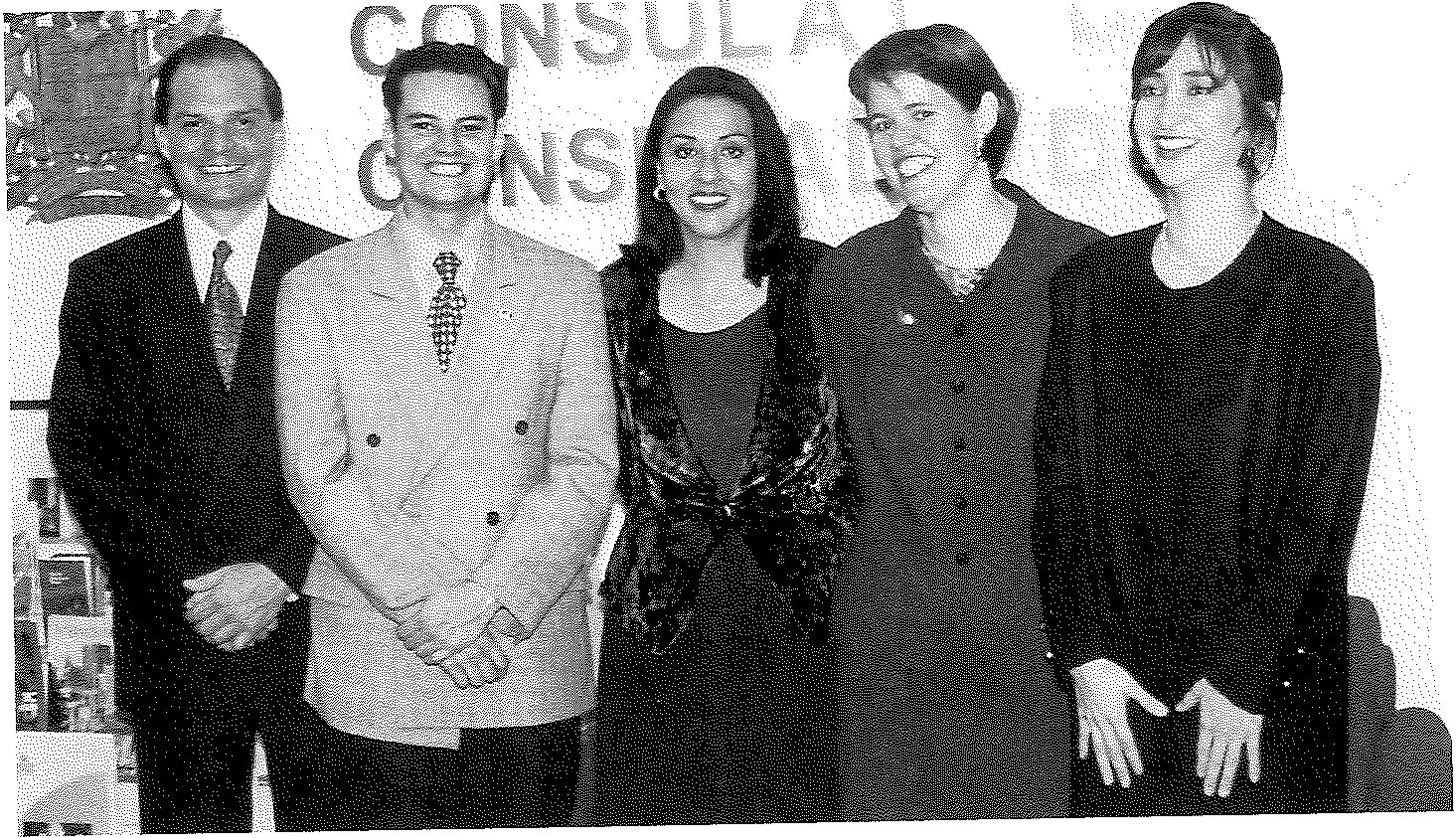
Unlike such satellite trade offices as Rio or Hamburg, which have specific sectoral responsibilities, the Guadalajara Consulate handles all commercial matters relating to a specified geographic area, in our case five states in Western Mexico. At the same time, we offer consular services to a not-insignificant community of Canadians. Although no definitive statistics exist, an extremely pleasant year-round climate has attracted 5,000 or more, primarily retired, Canadians to Guadalajara and the surrounding Lake Chapala-Ajijic region. Fortunately, Canada’s Honorary Consulate in Ajijic, approximately 50 kilometres from Guadalajara, absorbs some of the volume. Nonetheless, the Guadalajara office handles a steady stream of consular issues, be these renewals of lost or expired passports, citizenship applications for Mexican-born children and, in light of the average age of members of the Canadian community, a significant number of deaths.
Prior to arrival in Mexico, I was told that my work in Guadalajara would be primarily commercial. I treated this assurance with some scepticism, and hence have been surprised to find that the first year of my assignment has indeed focused predominantly on commercial matters. Part of this focus has resulted from a very selective approach to the requests and invitations which cross my desk. This focus may also be facilitated by what some might consider the “provincialism” of Guadalajara, a provincialism which — given Mexico’s highly centralized political system — is essentially shared by all of the country outside of Mexico City. In any event, the number of “must attend” events of debatable professional payback (national days spring to mind) are limited in a city of relatively modest political egos, and in which only the United States and Canada have full (as opposed to honorary) consulates.
Despite the Guadalajara Consulate’s concentration on commercial matters, single CBS missions are unlikely to suit someone who is interested solely in one area, be that commercial or general relations. For example, duties related to promoting Canada-Mexico relations in a general sense will continue to occupy at least some of my time. Moreover, my stated job responsibilities include contributing to the delivery of other Embassy programs in our territory. In addition to consular duties, this has included such activities as organizing press conferences to announce Canada Fund projects, opening the “Pacific Currents” photography exhibit in Guadalajara (bout of Autumn 1996), and hosting lunch for 200 plus Canadian academics (and a Minister) in town for a conference.
Administrative duties are another aspect of a mini-mission which differ considerably from the situation in a larger mission. In some limited aspects the administrative function may be less onerous. For example, in our case the commercial section of the Embassy in Mexico City takes a first cut at drafting country input for the trade planning exercise, which is then provided to both Guadalajara and Monterrey for comments. For the most part, however, my experience suggests that officers in mini-missions are likely to spend significantly more time on administrative functions than their counterparts supervising a similar number of staff within an Embassy environment.
As with most mini-missions, a “mother mission” (in our case the Embassy in Mexico City) has overall responsibility for administrative matters related to the Consulate in Guadalajara. Our annual operating budget is established by the Commercial and Administrative sections in Mexico City and we share Mexico City’s allocation for items such as language training or capital expenditures. At the beginning of each month the Consulate receives an accountable petty cash advance. Upon request, additional funds are provided to cover major purchases or expenditures.
Given the apparent simplicity of the above, and the fact that the Consulate has received generally good support from the Administrative section in Mexico City, particularly with relation to our start-up, I am unsure why administrative matters seem so onerous at times. Perhaps it is the fact that Admin is not just down the hall in the event of questions, or the lack of a layman’s guide to administrative issues within DFAIT, or that I lack even basic training on dealing with financial/administrative issues in the DFAIT context. The training issue is one which I believe DFAIT should be examining more closely in light of the proliferation of mini-missions. For the sake of both of the individuals involved, and that of the Department, any officer going to a single- CBS post should be provided with a basic grounding in administrative and financial management, perhaps drawing on some of the modules presented in the existing Heads of Mission course.
An underlying principle of mini-missions is that they should be low-overhead offices.
For example, most of the mini-missions staffed at the Ambassadorial level do not have an Official Residence and accompanying staff. In our case, low overhead means no LES driver, or car for that matter. As a result, I seem to have become well-known to Guadalajara taxi drivers — so much for anonymity in a city of four million people! Taking taxis in a country where the economically or politically significant almost invariably have drivers has led to some interesting reactions among Mexicans. Then again, maybe it sends a message of some sort.
The Consulate also lacks a handyman or a messenger, resulting in an informal contracting out of these functions. Over the past year one of the hotel maintenance staff (the Consulate being located in the commercial annex of a local hotel) has received 65 pesos (about 12 dollars) a week (plus any necessary busfare) to deliver papers to the bank, go to the post office, pay bills, etc. in his “spare time”. This has proved a very satisfactory arrangement for us, (if perhaps less so for the hotel).
In line with Guadalajara’s status as a low-overhead mission, we also lack the latest in “standard” DFAIT technology. Our acronym-free zone means no SIGNET (although this is rumoured to be on the way), no MITNET, no CAPEX, and no FINEX, among who knows how many NETs and EXes. To date I have rarely bemoaned our lack of the latest “toys”. ’, probably because we have alternatives. For example, while we cannot receive incoming calls on MITNET, a 20 digit code (or two buttons on the auto dial) patches us into the Mexico City MITNET line for phone and fax calls, eliminating at least some of the cost and much of the problems of Mexican telephone lines. As for e-mail, all direct messages are received by the receptionist, whose computer has the Consulate’s sole Internet connection, (thereby eliminating the pleasure of receiving desktop notification that the lines in the parking lot of the Lester B. Pearson Building are being painted yet again).
Currently all SIGNET messages are transmitted through a departmental faxlink connection. This is less than ideal, since our fax machine seems forever tied up with 60 page missives on a Canadian bid to host the headquarters of an international organization, the latest in geo-political developments, or a list of the statutory holidays being observed by Harare or Islamabad. While these are not particularly relevant to our day-to-day operations, the frequent need to replace fax toner cartridges, at over $100 a shot, seems very relevant to our efforts to keep costs down. According to the S-Branch these all-mission messages cannot be received through e-mail because this could compromise security, an explanation which confuses me given that Guadalajara (and I thought SIGNET) deals only in unclassified material.
It is not only the Department’s electronic tools that occasionally have difficulties dealing appropriately with mini-missions. It seems that the human side of DFAIT does not always recognize the special circumstances of mini-missions either. As a result some instructions from headquarters can only be ignored, including those indicating that communication equipment such as our computer modem should be placed in a locked and “secure” room, to which only the CBS have access. In our office, the supplies cupboard and the bathroom emerge as the only possible options …
Not recognizing our special circumstances is one thing. Not recognizing our very existence is another. At least initially, it seems the acronym GJARA did not mean much in the mailroom, and hence Christmas mail my first year trickled in until mid-May, arriving via such diverse locations as JKRTA, GTMLA and Tegucigalpa, Honduras (you figure out the last one). A more serious issue is publicizing the new Consulate’s existence not just within DEAIT, but ensuring that the Canadian business community is aware both of our existence and of the commercial opportunities available in the Guadalajara region.
Small offices are certainly not for everyone. For example, those who thrive on the Canadian community aspects of Embassy life, such as regular Friday after work get-togethers or organized Embassy excursions, may find this lacking in a mini-mission. Although we certainly do socialize as an office, our get-togethers follow a somewhat irregular schedule, and for obvious reasons there is no Community Coordinator on site to organize events.
Personally, however, I am enjoying my small mission experience and, after a year in Guadalajara, highly recommend the challenges and rewards of running a satellite office, and particularly the opportunity to start-up such an office. I will note, though, that despite being the only Canadian in the Consulate, I still have a windowless office. Then again, living in the world’s second best climate (as selected by no less an authority that National Geographic), maybe it is a good thing I cannot see what I am missing outside!
View the original scanned pages →
Originally published in bout de papier, Vol. 14, No. 3 (1997) — Fall 1997 // Automne 1997, pp. 16–17. Read the rest of this issue →



