bout de papier, Vol. 12, No. 2 (1995) — Summer 1995 // Été 1995, pp. 47–48
DeToombs called from the west coast at 3:00 a.m. Liebnitz fell out of bed, groped in the dark for the phone, managed to put the cat to his ear (with predictable results) and eventually connected with the Chief Inspector. Mrs. Liebnitz, convinced by a long series of previous such late-night alarums that her husband’s colleagues were either too dense to keep track of time zones or too insensitive to care, pulled a pillow over her head and plotted revenge.
Several hours later, the ace logician stepped from a helicopter onto the windswept foreshore of Farago Island. Waiting for him near the massive granite lodge that made up the only habitation on the tiny isle was the grim-faced DeToombs. “A real puzzler, Liebnitz,” he said. “Let me just show you what we have, and you tell me what it means.”
So saying, he led Liebnitz inside the chilly mansion. “Last night about midnight,” the Chief Inspector told him as they climbed the baronial staircase, “we got an anonymous tip about murder on this island. When we arrived, the place was deserted, except for the late gentry upstairs. Step in – the forensics people have already done their work, and the coroner still hasn’t got here.”
He took Liebnitz into three bedrooms ranged with many others along the upper hallway. In each of the three was a corpse, stabbed through the heart with a ruby-handled stiletto that had been left in the body. “They’re letter openers,” said DeToombs, “and there’s one just the same in every bedroom. Death in each case was instantaneous.”
The first corpse was that of a handsome young man in a crimson dressing gown, who lay on the floor with a small red blossom by his outstretched hand. “Anagallis arvensis, according to our expert,” said the Chief Inspector, “which does us a fat lot of good.” The second corpse was that of a beautiful woman in a scarlet nightgown, who lay in bed with a small red carving on the pillow by her head. “A chess piece,” said Liebnitz, “the most powerful on the board — but they usually come in black and white….
The final corpse was that of a gray-haired middle-aged man, sitting in an armchair by an elaborate wooden desk. In his hand was a paintbrush charged with bright green paint — and painted in bold green letters on separate pieces of paper on top of the desk were the inscriptions: “SHELMO”, “EVA TURNED”, “RED RITE” and “OR A COLUMN” respectively. “Anagrams, perhaps?” mused Liebnitz. Outside the door from this room, near the top of the stairs, was a pair of blood-smeared cotton gloves of common pattern. “Doubtless the murderer’s,” said DeToombs, “since the only fingerprints we found on each stiletto were those of the person it had killed. And the doors of all three rooms were closed when we arrived.”
The Chief Inspector then led Liebnitz downstairs again into the red-draped dining room, where the table was littered with the remains of an elegant dinner. “Pinned to the middle of the table with another of the stilettos, we found this letter,” DeToombs explained. “No fingerprints, of course. Go ahead and read it.”
Farago Island 7 June 1995
The prospect of death concentrates the mind wonderfully, to paraphrase Samuel Johnson. The doctors give me only a few months to live, and I have become strongly aware of the many people whose death would enrich the world far more than my own. As a detective, I have known such people, some well. And I thought, why not throw them a little farewell party?
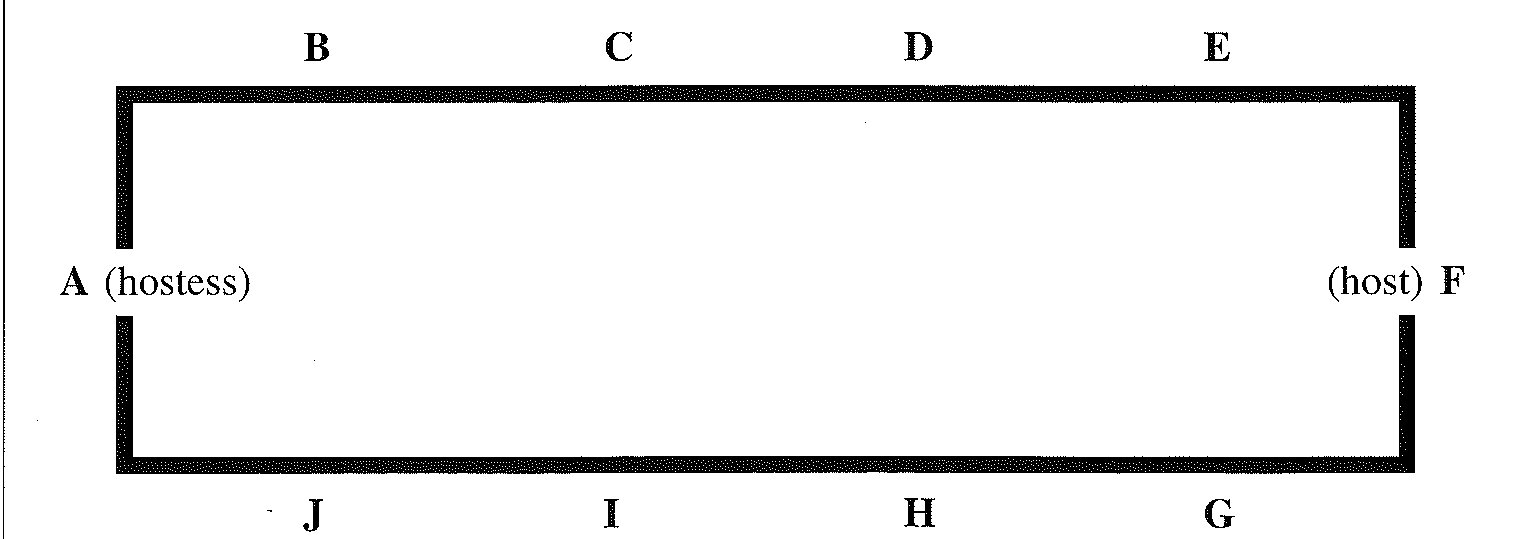
So I arranged a fancy dinner, a costume party on a blood-red theme. Given the nature of my own death warrant — complications from scarlet fever — it seemed an appropriate choice. I brought my targets here, by promises of money or threats of exposure. Around this table, earlier, sat ten people, including tonight’s killer and his or her prey. All evening, I needled them on the evils some had perpetrated on the others, while they seethed in fear and anger. I was sure that bringing together such a mass of greed and betrayal would result in at least one murder. And so it has.
Now some of them lie dead in their chambers and the others have all fled in panic. Soon I will take my leave as well. Enigmas will remain, of course — and given my profession, I admit that my sense of justice is stronger than my taste for mystery. So I am giving you a chance, in the clues upstairs and in the following points.
Each of the ten of us was assigned a different “persona” of his or her own gender — either the author or the protagonist of a story or a leading actor/ actress in a movie. The title of nine of these stories or movies contained the word “Red” or one of its synonyms or translations, while the tenth referred to colour without mentioning one. In the clues below, personae will be placed in quotation marks.
(b) Each place at the table had two cards in front of it, linked to the persona seated there. One card gave the year the story was published or the movie released. The other gave the name of the movie’s protagonist, the story’s author (if the persona was the protagonist) or the story’s protagonist (if the persona was the author). No two cards were the same.
A seating chart of the table is attached. I as host sat at place F, while Mrs. Liddell sat at place A. The other two women in the group sat directly opposite each other, but neither sat next to my wife. The two movie personae sat next to each other. The three author personae sat next to each other. There were three pairs of guests with marriage or parental ties; in no case were the members of such a pair seated next to one
(d) Samuel Converse, a wealthy retired stockbroker, swindled both Edgar Winter’s brother and the husband of “Dorothy Sayers”, leading in both cases to their bankruptcy and suicide. He had the Stephen Crane card at his place, while the man clockwise from him had the Arthur Conan Doyle card. bout de papier Vol.
(e) “John Steinbeck” was the persona of James Tuffnell, who sat in seat G. Although he got off on a technicality, he was the hit-and-run driver who killed the infant son of Richard Lowe, the man with the Pao Yu card.
(f) Frank Ray, a bachelor, had seduced each of the three women in the room; he was still having an affair with one of them and the other two were passionately jealous. He was sitting at one corner of the table, with the 1905 card at his place and “Jose Ferrer” on one side of him. “Sir Percy Blakeney” was seated beside Martin Coyne. Martin’s mother Alice Coyne had the 1931 card at her place. Alice Winters (Edgar’s daughter) had the 1934 card at her place, while my wife (also named Alice) had the Nathaniel Hawthorne card.
“Josiah Amberly” had “Henry Fleming” on his right and the man with the Jody Tiflin card on his left.
The people with the earliest date cards — 1791/1830/1850 — were seated next to each other in that order clockwise.
(i) The man with the Stendhal card was seated to the right of “Hester Prynne” and across from the man with the Baroness Orczy card.
(k) ’Ts’ao Chan” sat beside “Julian Sorel” and across from the man with the 1952 card, who sat beside the woman with the Catherine the Great card.
(1) “Marlene Dietrich” was seated across from the place with the Peter Wimsey card. She was blackmailing the man with the Toulouse Lautrec card (a crusading politician with a criminal past), who in turn was extorting money from the man with the 1895 card.
(m) The man on my left had the 1938 card, while the man on his right had the 1926 card.
Not a very edifying group, I think you’ll agree. But then that was the point, after all. Good Hunting.
Hart Liddell
“So whose are the bodies?” asked Liebnitz when he finished reading. ’That’s our big problem,” replied DeToombs. “No-one saw any of these people. All the arrangements for renting this place were done by mail, the renters insisted that no-one be on the island to greet them, no servants were hired and everyone came and went on their own boats. We don’t even know where the Liddells came from, much less any of the guests. there is nothing in any of the rooms – those with bodies or those without — to indicate whose was whose. So we’re stumped.”
“Oh, I wouldn’t go that far,” replied the ace logician. “The letter and the other clues give us a place to start…. Is there a decent library in this place, by any chance?” Some time later, his face sombre, he rejoined the Chief Inspector. “I can identify the victims for you, and the killer — assuming that Liddell was playing square and that the simplest explanation is the true one. Ingenious really, but a sad story nonetheless.”
Liebnitz was later proved right. Can you duplicate his feat by: (a) assigning the name, the persona and the two related cards to each place at the table; (b) naming the story or movie linked to each place; and (c) identifying the victims, the killer and the motive? (For a little extra challenge, but not necessary for the puzzle, try solving (a) without making use of your knowledge of literature or the cinema.)
View the original scanned pages →
Originally published in bout de papier, Vol. 12, No. 2 (1995) — Summer 1995 // Été 1995, pp. 47–48. Read the rest of this issue →