
bout de papier, Vol. 11, No. 1 (1994) — Spring 1994 // Printemps 1994, pp. 8–10
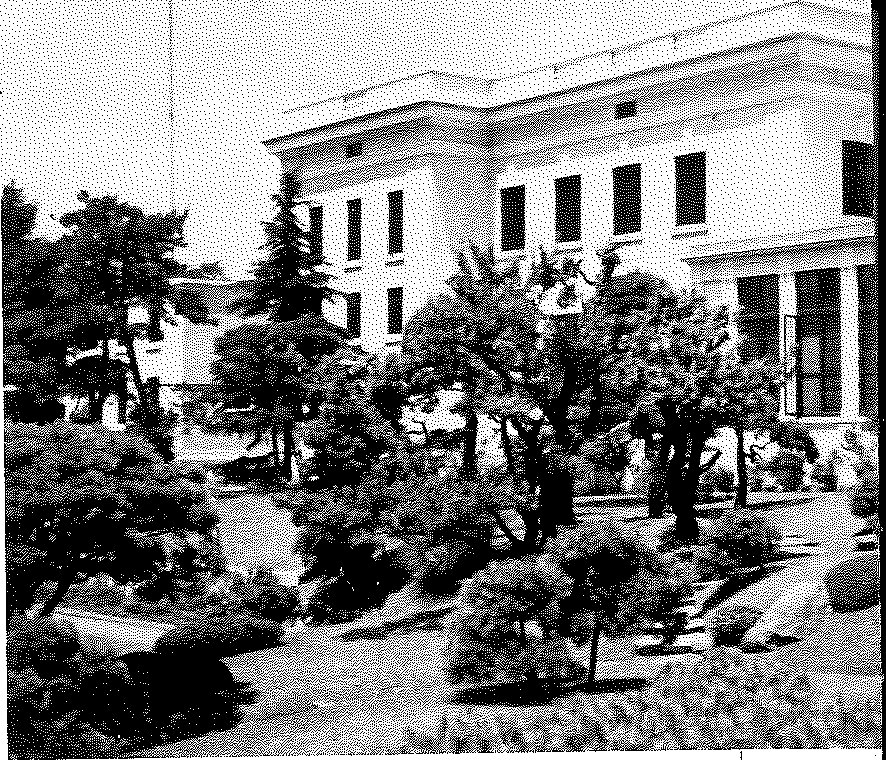
On 27 May, 1991, Prince Takamado, a cousin of the Emperor, met the Prime Ministers of Canada and Japan in Marler House in Tokyo to sign a document commemorating the opening of the new chancery. If ghosts could return, the spirit of Sir Herbert Marler would have been pleased to watch the guests sip champagne in this, the oldest and possibly grandest, Canadian residence abroad, before they crossed the yard with their wives to enter the splendid new building.
It was just over sixty years ago, on November 2, 1933, that the Marlers moved into their new home, a neo-classical building with a pillared portico. The adjacent chancery opened two days later. Actually, Lady Marler moved by herself for as luck would have it, and luck had not always blessed this project, Sir Herbert was in bed with pneumonia.
No sooner had he been offered the appointment as minister to Japan than obtaining suitable accommodation became one of Marler’s chief concerns. Indeed only six weeks after he had agreed to go he received drawings for an embassy from Kenneth Rea, the Montreal architect who had built his house in Westmount. These plans showed the chancery joined to the residence. Marler also drew up a detailed list of the china and silverware necessary for entertaining in appropriate style. This preoccupation with household matters might seem unexpected in a prominent man of his generation but in fact planning houses was one of his hobbies. He had already built several in Québec, one of which, at Senneville, was somewhat similar to the proposed residence in Tokyo.
Planning was one thing; persuading the government was another. Instructed to rent premises when he first arrived in September 1929, Marler established himself in a house in Nishi-machi previously occupied by the Romanian minister — an interesting indication of how the countries’ relative status has changed. From the very start he was anxious to build a suitable embassy since “the people of Canada expect to have their legation as a source of pride.” But Prime Minister Mackenzie King, who had been deeply shocked by the $500,000 required for the legation in Washington, was unsympathetic as was his successor, Prime Minister Bennett. Marler’s assurances that the total cost would not exceed $200,000, of which he would pay $25,000 himself and would lend the government the rest, enabled Bennett to obtain Cabinet approval. Fortunately the yen had fallen and after some hard bargaining by the commercial attaché, James Langley, an agreement was reached with Viscount Tadayoshi Aoyama to purchase the property his family had owned since the 16th century.
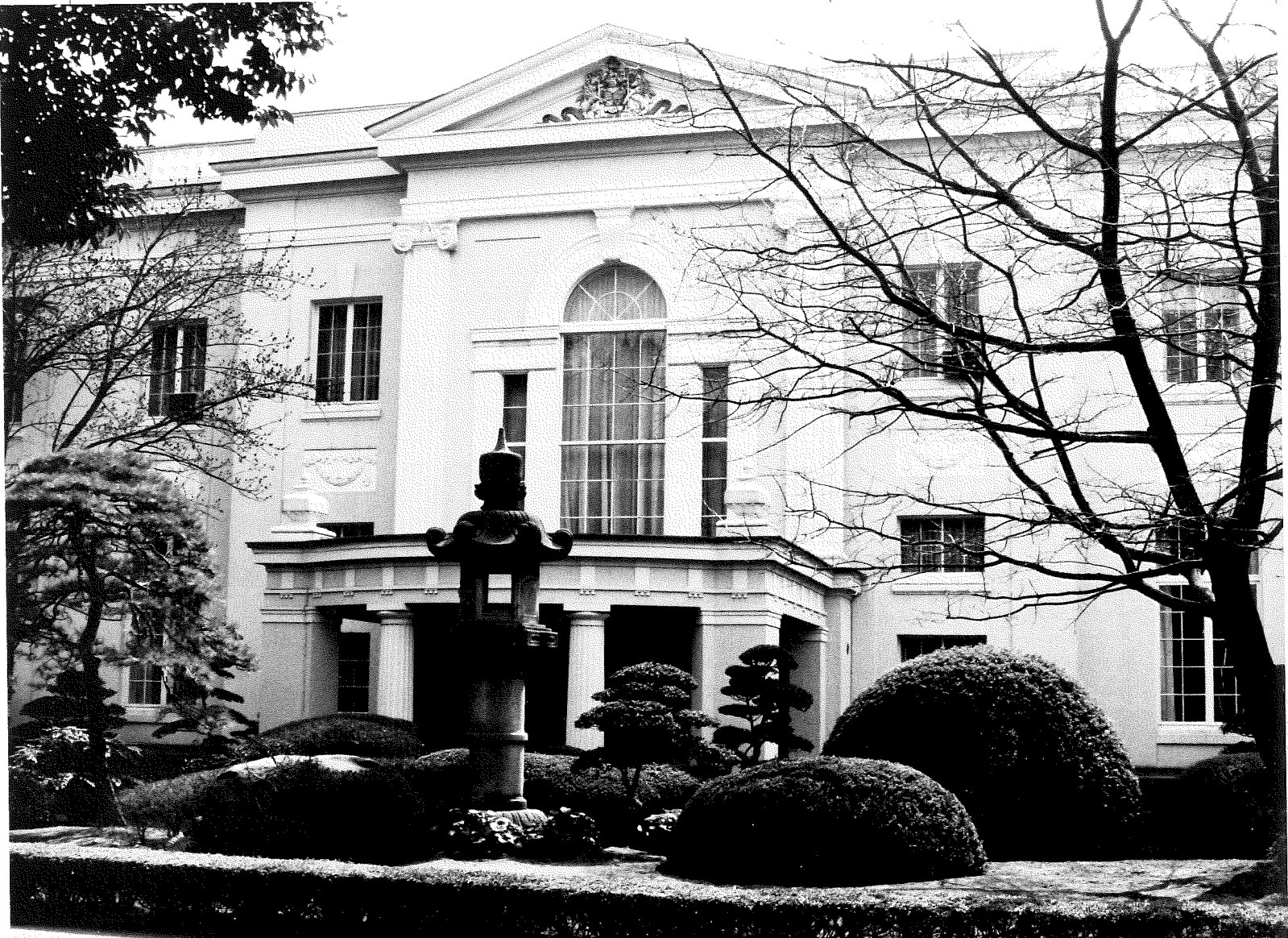
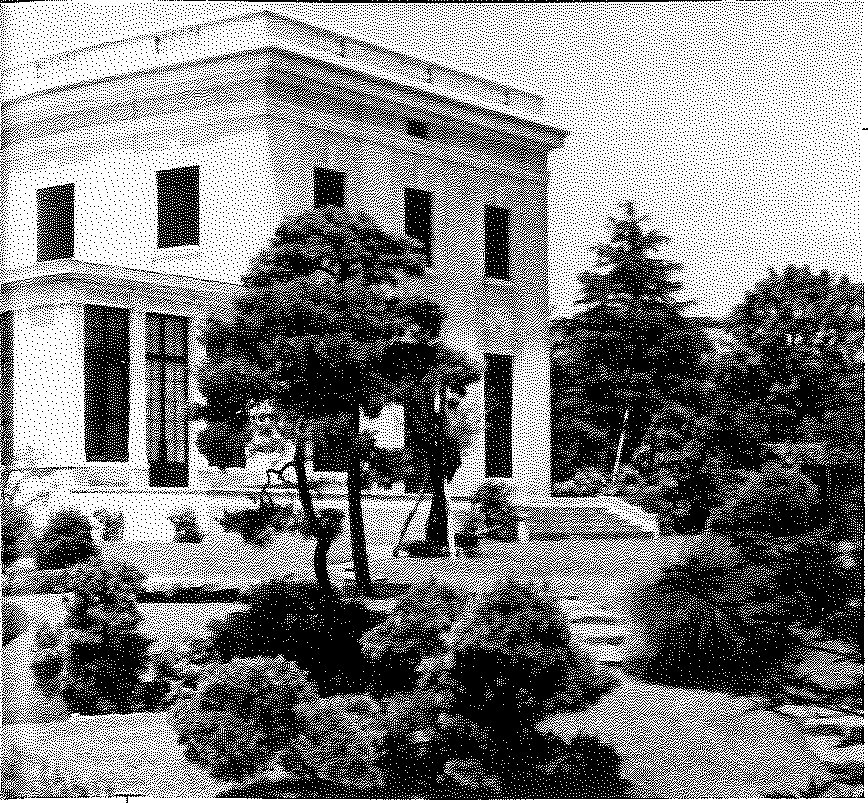
The location has proved to be superb. The land lay in what was then a residential suburb and is now part of central Tokyo, close to the main hotels and opposite the Akasaka Palace in the grounds of which live most members of the Imperial family. Construction was supervised by a Czech architect living in Tokyo, Antonin Raymond. Raymond who was a pupil of Frank Lloyd Wright had built the US residence which is still in use today but was unflatteringly referred to at the time as Hoover’s folly. Work had just begun when Marler was instructed to defer the project because of the international financial crisis. He did cancel plans for a cornerstone-laying ceremony, much to the annoyance of the local Canadians who were keen as ever to have a party. Marler, however, took the gamble of going ahead since delay would have added to the expense. Fortunately the government soon changed its mind.
According to one theory, the land was a bargain because it was haunted by the ghost of a housemaid drowned in the well and no Japanese would buy it. Certainly a famous legend of this kind was associated with the Aoyama family but the incident was usually thought to have taken place elsewhere. Whatever the facts, the story has been a source of amusement to many Canadian ambassadors and their guests.
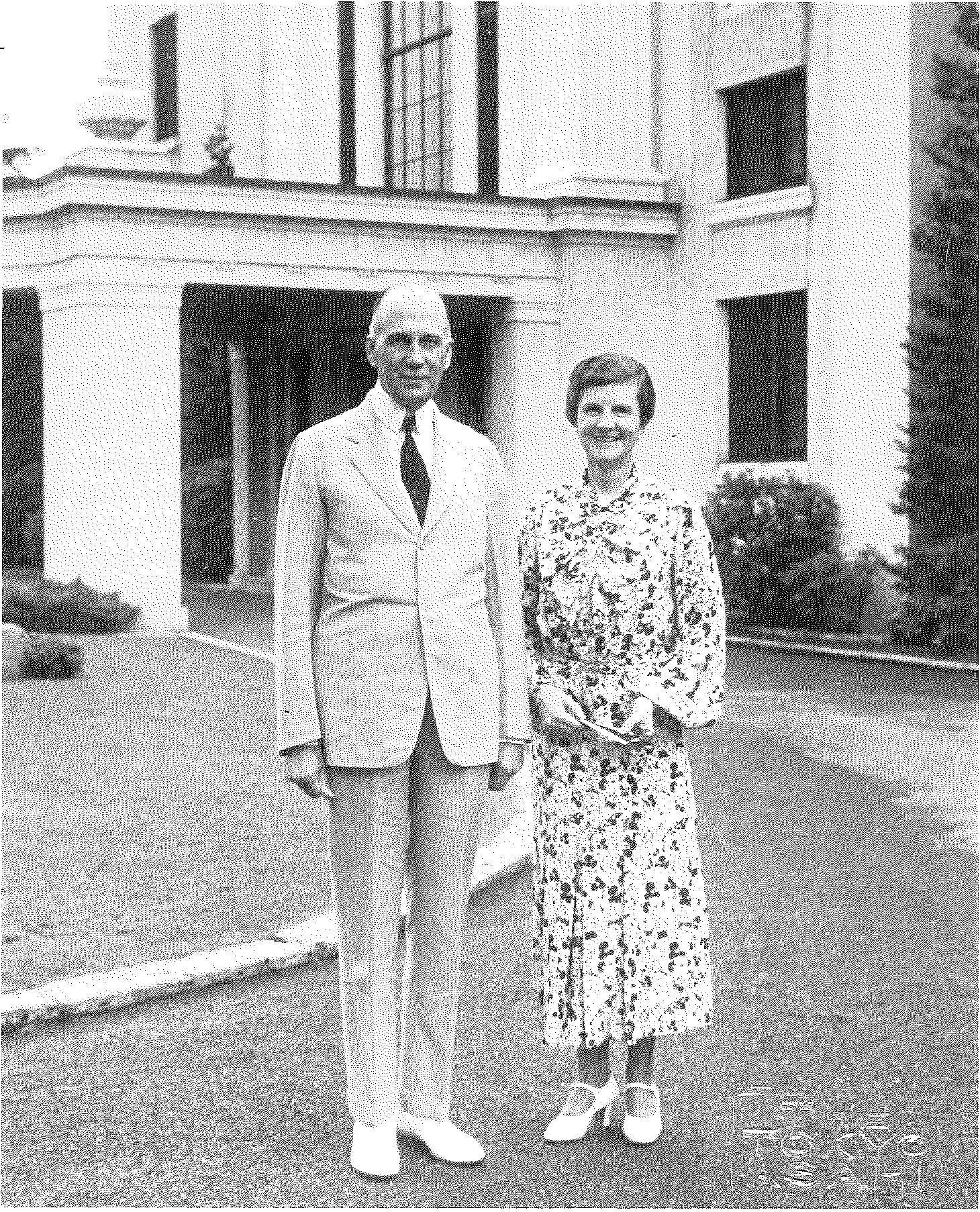
If ghosts haunted the premises, they might well be those of the Canadian diplomats who were placed under house arrest on the day after Pearl harbour and kept in the residence until an exchange took place the following summer. The Japanese officials were not entirely heartless; the Foreign Ministry arranged for those incarcerated to have a Christmas turkey. The house, built of ferro-concrete and designed to withstand earthquakes, survived the firebombing when most of the neighbouring buildings were burned to the ground. The Swiss Minister, representing the protecting power for most of the Allied governments, chose to reside in the Canadian legation during the war so his staff doused the flames that penetrated the property. Mr. Yagi, the son-in-law of one of the original servants and himself butler for many years, remembers coming at the end of the war and seeing from quite far off Sir Herbert and Lady Marler, 1935. The white house standing alone amidst the surrounding devastation.
The Marlers devoted a great deal of attention to furnishing the residence. Lady Marler went on shopping expeditions to both Montreal and London. One of those enlisted to help her in London was a young military attaché who would later become ambassador to France and Governor General, Georges Vanier. There was also a trip to China where the beautiful silk carpets were acquired. Many of these purchases have survived not only the exigencies of war, when the Swiss were responsible for the property, but also sixty years of use. Much of the porcelain remains, including a beautiful Royal Doulton set of gold and green dessert plates and matching demi-tasses. On the back they are marked Canadian Legation and on the front they bear the coat of arms now only used by the Governor General. An attempt some years ago to have them despatched to Rideau Hall was mercifully averted. The Marlers bought many magnificent mirrors which fit well in the large rooms with their high ceilings. Long before I went to Tokyo, I had heard of the gilded ceiling in the drawing room, little thinking that its upkeep would ever be of interest to me. The most magnificent piece, however, was a pair of six-panel gold screens showing mountains and waterfalls. These were the work of Tanni Bunsho, dating from the early 19th century. A slightly less impressive pair by the same famous artist is in the nearby Nezu museum. When and how these extremely valuable screens were acquired no-one seems to know.
The whole purpose, of course, of this lavishly appointed twenty-room (18,000 sq. ft.) house was to entertain. And entertain the Marlers did, as have their successors ever since. Lady Marler’s niece, Toppy Wade, stayed with her aunt for five months in 1935. When she returned to visit us in 1990 she told tales of dances and dinners interspersed with weekends in the country and games of golf. In those days there was a course further down Aoyama Dori The ballroom then served its original purpose though rather surprisingly Lady Marler also used it once a week -every Friday at 8:00 a.m. so the story goes — io teach her Japanese friends bridge and poker. There were many contacts with the Japanese but the diplomats also seemed to see more of each other than is the case today. In those halcyon days there were no official delegations though a fair number of missionaries seemed to have dropped by and signed the book.
The happy events which have taken place in Marler House are legion. One man who has seen most of them is Yuasa Masaki, known to innumerable Canadians as Tony-san, who has worked in the residence for nearly forty years, twenty-five of them as butler. If the house really belongs to anyone it is to him. When I asked him his most memorable occasion, he spoke of the wedding in 1962 of Ambassador Bull’s daughter, Freddy. It was attended by a number of very distinguished guests, including the late Emperor’s sister-in-law, Princess Chichibu, and Chief Walking Buffalo from Alberta, the latter in full Indian regalia. The bridal party processed down the long corridor to the sitting room where the ceremony ended with a blessing from the Anglican Primate of Canada who happened to be in Tokyo.
Quite a few wedding receptions have taken place. The first was probably that of Beatrice Carter, Lady Marler’s private secretary who married an English businessman. Another party was given by Lady Marler to celebrate the marriage of a daughter of a close friend, Mrs. Kawakomi. Nearly sixty years later Mrs. Kawakomi’s granddaughter, Chise Mita, brought her father to revisit the scene. The most unusual affair must surely have been the Shinto ceremony in April 1991, when Brian and Mikko Wilkin were married by the local priest. He had already officiated at several ceremonies connected with the building of the new chancery so he came as always accompanied by his shrine maidens and equipped with a portable altar and the necessary sake. My husband and I felt slightly out of place as official go-betweens since we had done nothing to facilitate this happy match. Our predecessors, the Steers, however, had contributed to bringing about a marriage and a very important one at that.
The present Empress before her marriage and a friend modelling traditional wedding garb, Marler House, 1967.
Photo courtesy Mrs. Frederika Fleming.
It was at a dinner in the residence that Prince Takamado, who had studied at Queen’s, met his future wife, thus creating a very special bond between the Canadian embassy and this branch of the Imperial family.
Over the years many princes and princesses have come to lunch or dinner, to listen to music, even to square dance. Shortly before her engagement to the former Crown Prince, the present Empress took part, as a member of a young women’s group, in presenting a show of kimonos. She wore the wedding kimono, a coincidence which did not go unnoticed. History repeats itself. One of the guests at our Christmas party in December 1992 was Masako Owada who, as we were later surprised to learn, had just agreed to marry the Crown Prince. I like to think that she enjoyed what must have been one of the last parties she attended as a normal citizen.
There has been a fair amount of music played though with the concert hall in the new chancery there is now less need to use the residence. Guests have enjoyed listening to the piano, the violin, even the harp and those lucky ones who attended a national day reception given by Ross Campbell heard the Sado drummers before they became so famous. On one magic evening in May a pipe band from Halifax happened to be passing through Tokyo when there was a reception for Canadian businessmen. The pipers came marching down the hall filling the house with the skirl of the pipes and out into the twilight garden where they continued to play till darkness fell.
Unlike the house, the garden which the Marlers planned is a traditional Japanese one with flowering shrubs, elaborately manicured trees, winding paths and many stone lanterns. Both Canadian and Japanese maples grow there and three new cherry trees were planted to commemorate the opening of the chancery in 1991. The rather old-fashioned swimming pool, a blessed relief to so many in Tokyo’s hot humid summers, was built during the occupation with labour paid from Occupation accounts. Arthur Menzies, then Head of the Canadian Liaison Mission to the Supreme Commander for the Allied Powers, paid personally for the materials.
It was in this garden that Nadeshiko Kai, a women’s organization to bring together Japanese and foreigners living in Japan, celebrated its fortieth anniversary on May 19, 1992. Thirty black garbed ninja — assassins who also served as secret agents for the feudal lords — were led in by two splendidly attired samurai. They then performed James Bond-style antics with ropes and poles and various fearsome weapons to the amazement of the one hundred and twenty women gathered on the lawn. Some had come from far away to watch them including two of my predecessors, Mona Rankin and Martha Steers.
Marler House had a narrow escape in the 70s. It was proposed to tear it down and replace it with a penthouse built on top of the chancery. Fortunately the protests this proposal evoked won the day. Japanese friends of the embassy were relieved that at a time when many old residences were being destroyed the Canadians had decided to preserve this building which had such an interesting history. It will soon feature in a book on Western-style houses in Tokyo.
May that celebrate the beginning of another sixty glorious years for Marler House.
View the original scanned pages →
Originally published in bout de papier, Vol. 11, No. 1 (1994) — Spring 1994 // Printemps 1994, pp. 8–10. Read the rest of this issue →



