
bout de papier, Vol. 32, No. 1 (2022), pp. 38–40
WHEN MARK ARRIVED IN OTTAWA in 1973 as a 22-year-old new recruit on the steps of the Lester B. Pearson building, he could not have known that this was the start of a calling to public service.
In one of his earliest assignments at the UN General Assembly in New York, from 1974—75, Mark began addressing some of the world’s thorniest issues, including the Arab-Israeli dispute, apartheid in South Africa and other conflicts around the world.
His first posting was slated to be to Addis Ababa, Ethiopia, but this was changed to Rabat, Morocco, where Mark served as Third Secretary and Vice Consul. A fortuitous change, as it was in Morocco that Mark not only cut his teeth on difficult consular cases, but most importantly, met the love of his life, Raja. The two returned to Canada, and after a few years, and the birth of two daughters, Mark and his family moved to Abidjan, Céte d’Ivoire. His exposure there to political reporting and some representational duties led to a cross posting to Jeddah, Saudi Arabia in 1982, where they welcomed a third daughter.
While in Jeddah, Mark became the first (and possibly the only) Canadian diplomat to complete the Islamic Hajj as a religious participant, on which he subsequently prepared a briefing. This report, written in 1982, stands today as the only report of its kind.
In addition to Saudi Arabia, the Embassy was also accredited to the two Yemens, and memories of his travels through both countries remained some of the fondest of his career. He spoke of climbing to the top of the minaret of the Tarim central mosque, “taking in the land of frankincense.”
His time in Saudi Arabia and Yemen planted the seeds for Mark’s love for the Middle East, a region he would return to with enthusiasm and dedication later in his career. Before then, he began honing his expertise in trade and economic policy: in International Economic Relations in 1984, then as Director of the International Finance Division in 1986, participating in Canada’s delegation to the Paris Club, working on the reorganization of the debts of countries in economic difficulty. Mark felt that this role gave him a bird’s eye view of a country’s governance, not just its economic policies, and it shaped his thinking on what policies would most effectively pull these countries out of the economic quicksand in which they found themselves. Mark’s presentation to the Paris Club on a new way to approach this (namely, reducing debt rather than rescheduling it), was subsequently endorsed at the Toronto G7 Summit, and became known at the “Toronto Terms.”
His work on international finance grew into expertise on economic policy, international development and trade in his posting as Economic Counselor in Geneva, Switzerland (UNCTAD, UN ECE, GATT and Uruguay Round) in 1989, and then through a cross-posting to Washington, D.C. in 1992, where he worked on G7/8, Investment Affairs, Transportation, Science & Technology and Macroeconomics.
While those assignments were meaningful ones to Mark, it was his return to Middle East issues that captured his passion for the remainder of his career. In 1996 Mark returned to work on the Maghreb and Arabian Peninsula, a role which saw him return to Yemen, as well as travel to Oman, the United Arab Emirates, Kuwait, Qatar and Algeria.
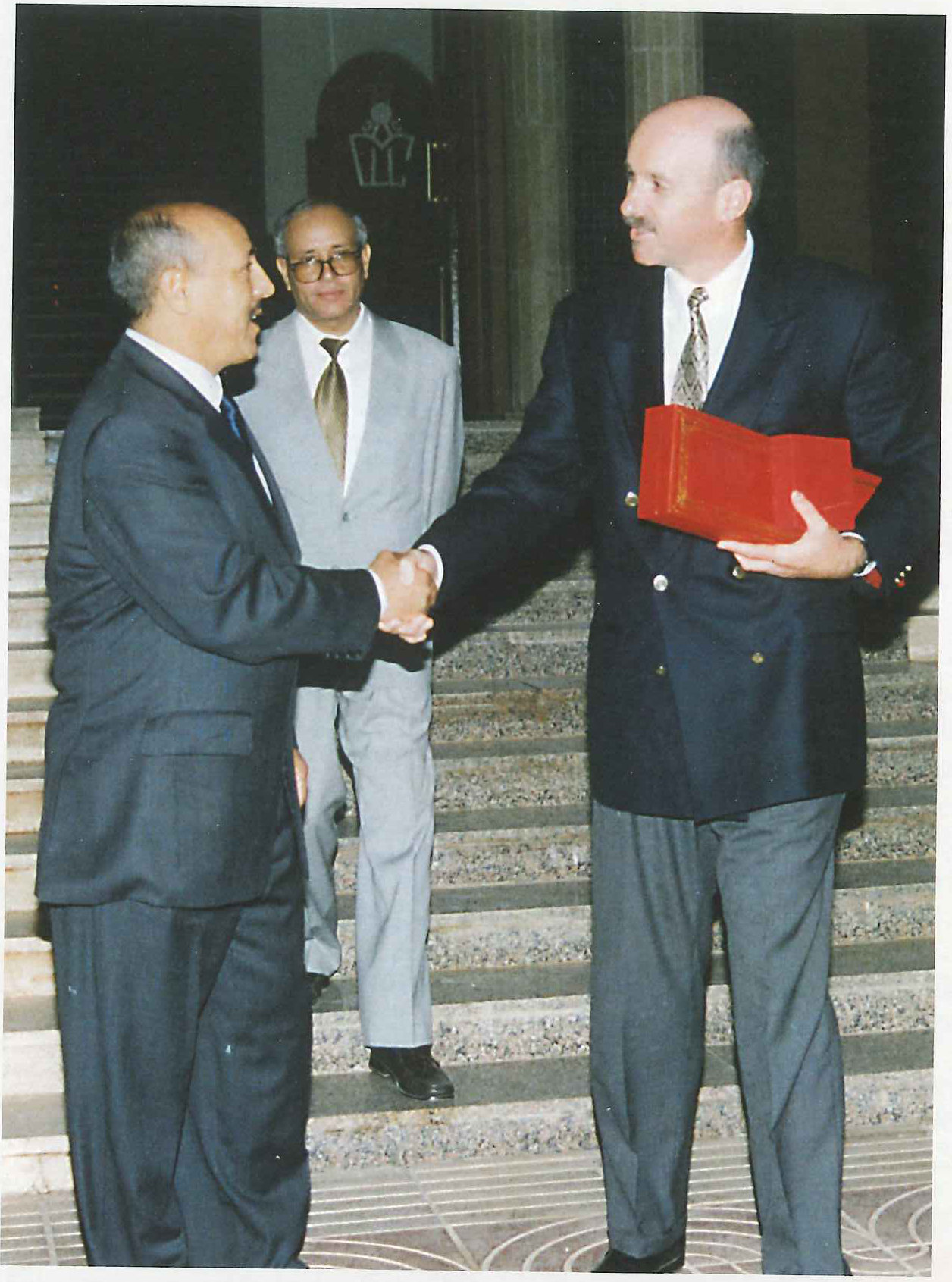
In 1998 Mark was chosen for his first post as an Ambassador — a return to Morocco. Mark’s work concentrated on the embassy’s development aid program, travelling throughout the country to visit aid projects, and recommending continued support from Canada. A popular destination at the time for trade missions, Mark hosted several Canadian Ministers, and later, received Governor General Romeo Leblanc for a state visit.
A brief stint as Director of the Assignments Division led to his assignment in 2003 as Director General, Middle East and North Africa. During this time, Mark threw himself into a profound study of the region, its culture, history, religion and people, wading into the deep waters of the Palestinian-Israeli conflict, Iran’s nuclear weapons program, and other geo-political challenges. Mark acted as the senior DFAIT official accompanying the Canadian Delegation to the Madrid Conference on the Reconstruction of Iraq in 2003, at which $13 billion was pledged. His travels extended to Libya, Syria, Lebanon and Iran during this time — ensuring that by the end of this period, Mark had visited all the countries in the Bureau’s purview except Bahrain and Mauritania.
In 2006, Mark and Raja, accompanied now only by their dog Beacon, as their three daughters were all in university, arrived in Damascus after accepting Mark’s nomination as Ambassador. While this period brought them many happy moments, and a real love for the country, it also led to deep frustration and regret. In 2006, a young Canadian woman, Nicole Vienneau, disappeared after leaving her hotel in Hama. Despite significant, prolonged efforts to search for her, she was never located. This case stayed with Mark long after his departure from Syria.
Mark subsequently accepted a cross-posting to Turkey, with responsibility for Turkey, Georgia, Azerbaijan and Turkmenistan, a country and region he and Raja both loved dearly. Towards the end of this posting, as he and Raja prepared for a potential cross-posting, Mark was asked to lead the efforts to liberate the two Canadian hostages who had been captured in Mali. A challenging assignment, with lives at stake, and months of worry and silence for his family, the mission ended successfully, to the enormous relief and elation of all involved.
Mark resumed his position as Director General of the Middle East Bureau in 2012, before accepting his final nomination as Ambassador to Austria, Slovakia and PermanentRepresentativetotheinternational organizations in Vienna. Whilst assuming many responsibilities, the most critical would be to pursue Canadian objectives relating to Iran’s nuclear programme. This posting proved a highlight of his life as a diplomat, and a culmination of his previous experiences: securing support for the long-negotiated CETA agreement, participation in the complex nuclear arms negotiations with Iran, and representing Canada with pride and enthusiasm. Mark retired on September 30, 2017, ending a brilliant career of just over 44 years.
Mark’s retirement did not see him leave diplomatic life. He remained engaged on many policy questions, providing his expertise and insight in a number of forums, mentoring young diplomats, and even contemplated assuming a teaching position. In June 2020, he helped organize and signed a public letter, along with 57 former Canadian diplomats and politicians, calling for Prime Minister Justin Trudeau to show stronger resistance to a proposed Israeli annexation of the occupied West Bank. Mark passed away on August 22, 2021.
The world is poorer without Mark’s measured, informed and humanist diplomacy. He held the rare gift of holding onto both pragmatism and principle, of leveraging a deep expertise to permit high level understanding. Of embracing his responsibilities as a representative of his country.
Mark was remembered at a Memorial event hosted by his wife and three daughters at his home in Ottawa on October 2, 2021. Certificates of his many assignments hung in a long row, and photos reflecting his decades of service lined the walls of the tent. Moving speeches from dear and long-time friends and colleagues, including Louis Guay, Carmen Sylvain, Brian Northgrave and Philippe Cousineau, brought tears, laughter and memories. Masud Husain supported the family closely both before and after Mark’s passing. And finally, Denis Comeau, a dear friend of the family, helped ensure the ceremony ran smoothly.
His wife and children offer sincere and heartfelt gratitude to the Ministry of Global Affairs Canada for the incredible, challenging and inspiring life Mark, and by extension his family, lived. We hope his legacy inspires future diplomats.
Originally published in bout de papier, Vol. 32, No. 1 (2022), pp. 38–40. Read the rest of this issue →


