
bout de papier, Vol. 22, No. 2 (2006) — Summer 2006 // Été 2006, pp. 36–39
It was late spring in Havana in 1969 when there was a knock on our door. There stood a short, elderly grey-haired gentleman whom we recognized after a moment as the doorman from the hotel we had stayed in some months earlier on the Isle of Pines. In his hand he carried a satchel from which emanated a gentle murmur of small voices. He unzipped the bag just a bit to give us a peek, and inside to our surprise we saw a collection of some five or six baby green parrots.
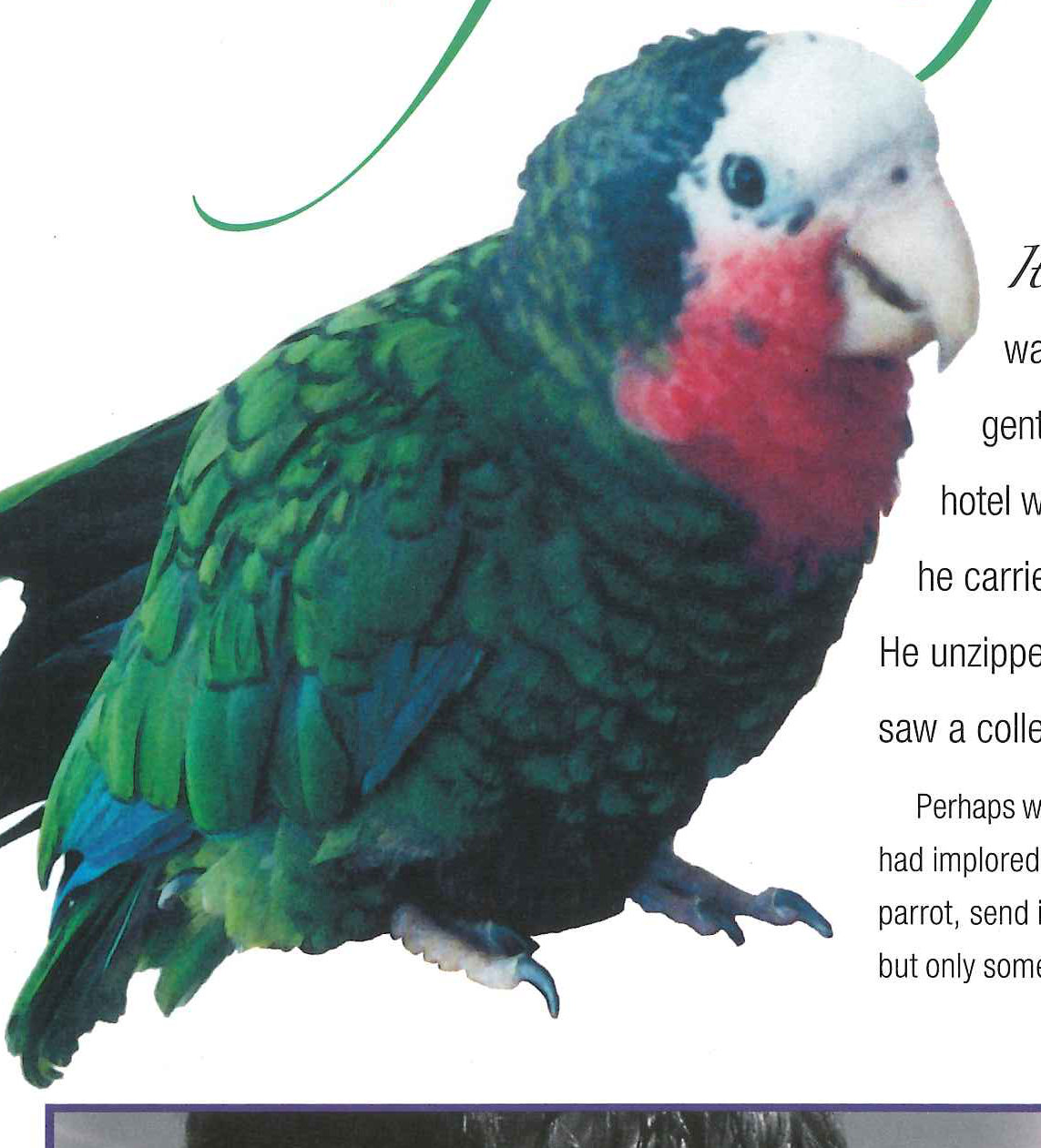
Perhaps we should not have been surprised, because before setting out to the Isle our children had implored us, “Bring back a parrot!” In jest, we had said to the doorman, “If you ever find a parrot, send it to us!” And there he was. Of course there was a catch. He did not want money, but only some medicine for his wife who was very ill. We would have gladly gotten the medicine for him without any payment, but did not demur at the suggestion that we help ourselves to one of the occupants of his satchel.
Josefina joined our family that day and quickly established herself as the household matriarch. She bonded immediately to my wife Laine. Today, some 37 years later, Josefina continues not only to sit on her roost, but also to rule it.
But I am getting ahead of myself. This is a story about diplomatic pets. Some day the full tale must be told of all the dogs, cats, snakes, spiders, and what have you, who served Canada loyally and sometimes with greater distinction than their masters and mistresses.
Just before Christmas 1963 in Moscow, I was frantically searching my unimaginative mind for a family gift idea when a Russian contact suggested that I visit the Sobachi Club (Dog Club). This I did and the result was the furry ball of a unquenchable energy that bounced around the Christmas tree that year. Since we had noted many Soviet dogs with names such as Bill, John, Teddy, Peter, and so on, we thought it only right to provide some balance and so named our s Airedale, Sasha. While doting Russian parents didn’t mind in the least calling d their dog by my name, many were rather insulted when they heard us addressing our pup by the same appellation as their precious son or grandson.
Sasha livened up our sometimes dreary environment immeasurably. She hi greeted visitors to our humble abode with a total lack of discipline. She bestowed ta particular canine enthusiasm on anyone who differed in appearance from th us. Thus, whenever she managed to get loose in the courtyard and spotted a w Japanese, Chinese, Sikh or Nigerian, she would roar her greeting and make ar a concerted rush, much to the dismay of the target. The surly militiamen at the Cl gate to the complex were singled out for special treatment. These she universally despised and distrusted. Thus began her lifelong antipathy, reflected in a symphony of snarls, growls and barks, directed at all forms of uniformed beings, of from posties to generals.
Sasha came back to Kanata with us in 1966 where she experienced a sort WE of liberation, after the close confines of Moscow, as she roamed the woods and broad meadows on our daily walks. She was extremely proud and held her head WE a little higher when the Canadian Kennel Club finally awarded her a certificate be of purity. Her joy of living was disrupted only infrequently when a thunderstorm would sweep across the land, and she would end up a quivering mass of fur wh and fear under the nearest bed.
It was in Havana in the late 1960s where Sasha really came into her own. thr Our house in the tropical Havana suburb of Cubanacan was ideally suited to bri setting up the Animal Kingdom. From our earliest days we collected rabbits, nig geese, guinea pigs, and Suzy the goat. And this list, of course, did not include we the multitude of frogs, lizards, snakes, crabs, and the secretive rat pack, already wa elp in residence. With no power most of the time to drive the air conditioners, the house doors were usually left open and the critters pretty much had the run of as the place. Over all these, Sasha exercised undisciplined control, chasing Suzy into ay, neighbouring houses occupied by Viet Cong students, occasionally dispatching a rat to rodent heaven, and frequently provoking the three geese into retaliatory attacks. Suzy and the rabbit, even if uninvited, regularly graced our diplomatic dinners with their presence. We mourned the demise of Herman the hermit crab on many occasions only to discover that the supposed cadaver had been merely a shell and that Herman was continuing to pursue life vigorously in some hidden drawer or pile of clothes in the bedroom.
Sasha’s reign came to an abrupt end one day, that is, the day of the arrival of the chick from the Isle of Pines. Josefina lost no time in dethroning the pretender, administering solid pecks as necessary, pursuing the rabbit with ferocious zeal, and through various forms of intimidation making clear to the rest of us that the only creature in the kingdom who merited her respect and affection was my wife. She dwelt in a fine wrought iron cage in the garden and welcomed each glorious day with her shrieks and laughter.
Josefina, we eventually discovered, was an endangered species and, as such, unable to emigrate legally. And so began the only illegal conspiracy in which I have ever engaged — to say nothing of the incredible journey through the red tape of numerous bureaucracies thereafter as we moved around the world. Since the treaty banning movement of such creatures had not yet been signed, we were able to obtain import permits for Canada and transit permits for Mexico and the US as we planned our move back to Ottawa. But how to get her out of Cuba? Cuban regulations were clear. No export permit.
At the same time, various sympathetic Cuban officials bent over backwards in an attempt to come up with solutions. The director of the National Museum offered to give us a permit to export a stuffed parrot! Somehow or other, we doubted that Josefina would go along with this gimmick. A vet suggested that we drug her and exit the country with a comatose parrot in our valise. But which drug to administer? The vet said we should experiment with chickens the same weight as Josefina. And so, to the great amusement of the Cuban staff, Laine began borrowing chickens, taking them to the embassy to weigh on the postage scales. The first two unfortunate chickens thus drugged went to paradise — at which point the idea of drugging was definitively dropped!
Departure day arrived in July 1966. The moment of truth! We had determined through trial and error that if we kept Josefina up all night on her perch under bright lights, she was very drowsy the next day. And that is what happened the night before we were to leave. She was duly installed in a small airbag, and off we went to the airport. Unfortunately, a hurricane was threatening and after a wait of six hours in the diplomatic lounge we were told to go home and come back the next day. This we did, with Josefina much disturbed at the prospect of another night under the lights. The lounge wait the next day was not so long, but nonetheless even more nerve-wracking, due to the fact that the Chief of Protocol, a graceless product of the Revolution whom many considered to be Fidel’s joke on the diplomatic corps, had come to see off some of his colleagues. The tension was heightened when he sat down to chat with me, Josefina slumbering peacefully at his feet in the airbag. Laine meanwhile was motioning to our young gently in the manner of lulling a baby to sleep.
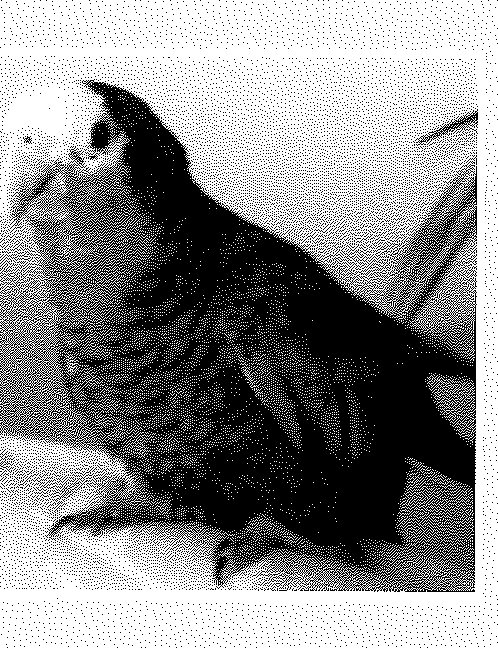
What a relief, finally, to board the Cubana IL-18 and take off for Mexico City. I had nightmares for sometime after, as I envisaged the headlines: “Canadian diplomat discovered in plot to kidnap parrot!” The flight unfolded uneventfully, except for the odd Aaargh! occasionally emanating from the bag, at which a Finnish colleague seated just behind us, and who happened to be a white-knuckle flyer, would anxiously peer out to see if the wings were still attached. Back in Canada, Josefina was placed under house arrest, an Agriculture Canada inspector visiting monthly to ensure that the terms of her detention were being observed.
The rest of our Havana zoo met various fates. Herman the hermit crab accompanied us back to Kanata, where she eventually underwent an authentic demise and was laid to rest, both the shell and what was inside. The rabbit was stolen and undoubtedly ended up in someone’s pot. Suzy and the geese were retired to the country plot of a Cuban friend, while Petunia the guinea pig was accidentally exterminated by someone brought in to clear weeds from the garden. The ever faithful and loving Sasha did not long survive the return to Kanata. She was diagnosed with cancer shortly after our return and with many tears was laid to rest in the back yard of our Kanata home.
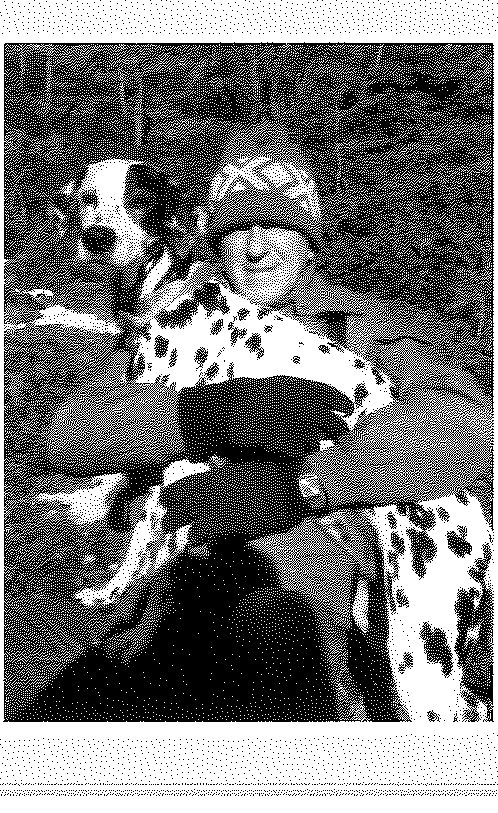
The next challenge to Josefina’s authority was Daisy, a brave-hearted and feisty Sealyham terrier. Josefina settled that power struggle by arranging for the authorities in Hong Kong, our next post, to deny Daisy entry on quarantine grounds while letting her in without condition. Daisy went off to keep my elderly mother company. Fully ensconced in Hong Kong, Josefina had not the slightest problem in dominating our next canines, Pirate the Dalmatian, whom we adopted, and Freddy the Great Dane (a female) who came as a long-term guest and guardian at the residence. And what a pair they were. The dragon pot bout de papier Vol. industry was kept in business, as they raced around the premises, systematically demolishing the large urns. Many were their adventures. They even managed the unlikely feat of coupling on one occasion, the result of which was five pups, difficult of description, who unfortunately did not survive infancy, much to the disappointment of our Chinese amah who had her eye on the black one. We discovered later that a black dog was much favoured as a delicacy. Pirate lived up to his name, shamelessly making off, usually by stealth, with various pies, cook and, with us, an invariably sweet accommodating gentleman, often could be heard from his domain uttering unrepeatable Chinese curses as he sharpened his chopper and in moments of virtual ecstasy imagined dispatching Pirate to meet his ancestors. Pirate also came close to meeting his destiny on the occasion that he chose to remove from the picnic table two large, freshly barbecued T-bone steaks prepared by the communicator and his wife, my secretary, who were babysitting the residence at the time. People who knew me well became accustomed to the periodic “Aw sh-t!” emanating from my lips, signalling the discovery of yet another case of piracy.
Yet Pirate was a genuine coward. The neighbourhood was full of ferocious guard dogs, and Pirate would tremble as we took our evening walk — with Pirate keeping as close to the centre of the street as possible. The other dogs despised Pirate, and us by association, and did not hesitate to show it, as on one occasion when our daughter stopped to say a kindly word to one of the tormentors. The dog’s response was to raise his leg and direct a yellow stream at her through the bars.
In Pakistan, our next post, people did not much keep dogs around, the result being that Pirate was pretty well the only dog on the ranch. He particularly enjoyed the early heady days because Josefina had been left behind in Hong Kong, awaiting her entry permit. This changed after Laine made a special journey to collect and conduct her to Islamabad. Josefina, as usual, quickly took charge of household operations, organizing the sweepers and malis, cook and bearers to cater to her every wish. She did not hesitate to unleash a stream of invective, pertectly intelligible in any language, in response to insults, teasing, or any other form of misbehaviour. Her already catholic diet quickly expanded to include raita, kebabs, and various forms of curry. Pirate for his part was content to continue stealing any form of meat within reach, when he was not otherwise occupied in roaming the wooded, jackal-infested areas around the residence or joining us on hikes into the green Margalla hills that rise above Islamabad.
In 1983, Josefina and Pirate joined us to make the long trek by car down the storied Grand Trunk Road from Islamabad to Delhi. Pirate, who demonstrated his aversion to cars by throwing up all over our daughter on his very first ride from the kennel in Hong Kong, insisted on a leisurely pace and frequent stops. Josefina bore the tedium well, taking in the sights of Lahore and Amritsar’s Golden Temple from her perch on Laine’s shoulder, drawing incredulous stares from passersby.
It was in New Delhi that Josefina’s self-importance was momentarily breached. From being the only parrot in the universe, she observed with shock the thousands of green parrots that every morning passed directly above the residence, screeching with exuberance as they made their way to their daily chores, and which every evening returned through the gathering golden dusk of Delhi to their nesting trees in nearby Lodhi Gardens. The second blow to her ego was the reappearance a year later of Daisy, my mother’s good companion right to the end. Daisy was having none of the divine right of Parrots, and the territorial dispute continued “till death do us part.” Sealyhams were bred as small dogs with brave hearts to hunt badger, and she was not about to acknowledge the dominion of a small bundle of green, red and blue feathers. Pirate was relegated to bottom dog on the ladder, where he acted as a sort of apologetically smiling mediator between the other two.
Spacious as the Delhi residence was, the critters all took for granted that they were as much entitled to inhabit the master bedroom as we. At one point, the place became infested with voles. In the dark we could hear them racing est reaction on their part. Laine set live traps and caught these small creatures daily, releasing them at the far end of the large garden. Just as regularly, they would reappear in the bedroom, gaining access by some unidentifiable means. This game of “catch me if you can” continued for some weeks until one day we espied one entering through an impossibly tiny crack beneath the door into the courtyard, a chink in our armour rapidly remedied.
The family temporarily increased by one, when we were presented with a fine peacock, which was given the run of the garden. His life, alas, was not long, as a passing mutt took advantage of a briefly opened gate to dash in and dispatch poor Rajah. Similarly short-lived was a small puppy with a broken leg, which our daughter Lisa picked up in nearby Khan Market. Duly repaired and pronounced fit by the local vet, we nonetheless kept Jehangir segregated from other members of the Kingdom. Occasionally, he would dash out to greet visitors to the residence, but contented himself mainly with nipping and springing on Lisa in her bedroom. Too soon he began to act strangely and shortly thereafter died a painful death. Sent to the lab for testing, Jehangir to our consternation was discovered to have had rabies. This led not only to immediate vaccination of all of us in the residence, but also to a reconstruction of the list of all visitors over the preceding weeks who might have had contact. Included in the list of those who were advised to have shots right away were such notables as the Commissioner of the RCMP. It was several weeks before we could rest easily, particularly because Lisa had borne the marks of scratches and nips all over her neck, arms and legs. The definitive pronouncement on the matter was finally made by the head bearer: “Neveer pick up roadway dug!”
Delhi proved to be the end of this diplomatic saga. From India we moved to Calgary, expecting to be there only a year. That, however, was 20 years ago. We flew back to Canada, accompanied by Josefina, who this time had to endure the humiliation of two months’ quarantine. Pirate and Daisy followed by air, barely surviving the long flight and less than first-class service. Daisy was the first to say goodbye, filled with cancer but brave and determined right to the end. Pirate filled our lives with pleasure for another five years, before taking the last and hardest journey of all to the vet who gently gave him his final rest.
Josefina is still with us, these 37 years later, more mature but still master of all she surveys. Her recognizable vocabulary has not increased much since the early days when she answered the telephone with a hearty “Hello!” or let her desires be known with “Wanna go for a walk!” Communication, however, is no goes through her parrot head as she looks out over the foothills of the Rockies, watches the winter snows and the flowers of summer come and go. She has a faraway look in her eye and lives, I think, as do we, with precious memories of days long ago in the land of her birth, of parties attended in Hong Kong, of searing heat in Islamabad and the relief of monsoon rains in Delhi. Hers, I think she would say, has been a life in a gilded cage, a privileged experience of travel and making new friends. Who would ever have thought, she must ask herself, that a simple chick from the Isle of Pines could have come all this way? a
View the original scanned pages →
Originally published in bout de papier, Vol. 22, No. 2 (2006) — Summer 2006 // Été 2006, pp. 36–39. Read the rest of this issue →



