
bout de papier, Vol. 21, No. 2 (2005) — Spring 2005 // Printemps 2005, pp. 17–23
The following is an illustration of how what looks good on paper at the Centre may not necessarily reflect the realities on the ground. Any resemblance to institutions living or moribund is purely coincidental.
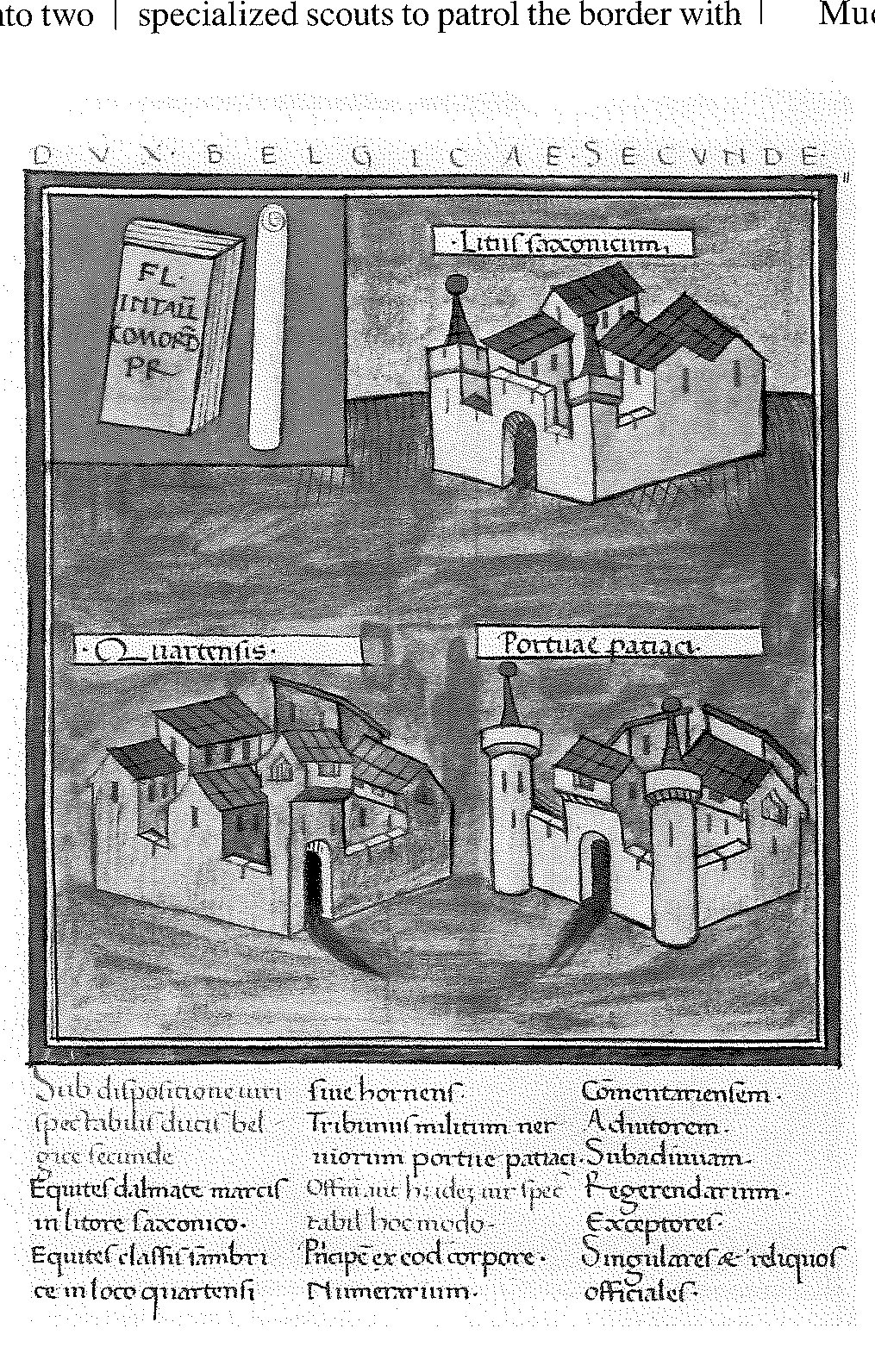
Time has not been kind to Roman government documents, but there is one glorious survival from the early fifth century which provides a snapshot of the organization of the Roman government and its armed forces as it was circa AD 400. Perhaps more accurately, we should say it shows the organization that the central agencies of government believed existed. The document is the Notitia Dignitatum, or to translate the title in full: “The Register of Dignitaries, both Civil and Military, of both halves of the Empire.” Essentially what we have is the Roman Government Directory of all EX-equivalent positions in the central government, provincial administrations and the armed forces. From the Master of Offices to the head of the Greek Correspondence Unit; from the Praetorian Prefect of the East to the Governor of Lower Belgium; or from the Master of Soldiers of Both Services to the Prefect of the Tigris Bargemen stationed at Newcastle on Tyne It lists these posts both by order of precedence and by nominal reporting relationship.
The central agencies of the Roman government had grown up somewhat haphazardly, some of its components still reflecting the time when it was largely an extension of the Emperor’s personal household; others had emerged from seconded military staff — their personnel were nominally enrolled in a military unit, bore military titles, wore military uniforms and shared similar tax and judicial exemptions as members of the armed forces. Since the late third century there had usually been at least two emperors, and consequently all central agencies were duplicated, one set in the East, one in the West. In order of precedence, the central agencies of government were as follows:
• The Master of the Offices. This was perhaps the most important ministry in the Roman government. The incumbent was truly a sort of “Minister of Everything”. Responsibilities included: the Imperial Guard; the Corps of Domestics and Protectors – the army and Public Service’s executive pool; the central government’s correspondence bureaus; the ushers who controlled access to the palace (they were also used on confidential missions); a network of state-run armament factories; the Inspectorate of the Public Post; the Inspectorate for the Provinces; the Interpreters for all Peoples (i.e. the Ministry of Foreign Affairs); and last, but far from least, the Agentes in Rebus. While technically the Agentes’ job was to act as postal couriers and inspect postal warrants, in practice the School of Agentes in Rebus acted as a sort of Office of the Auditor General cum CSIS. Most government offices had a resident Agent to keep an eye on things, and on retirement, Agentes were usually assigned as a Chief of Staff to one of the senior Provincial offices. A number of senior clergy of the period were also ex-Agentes.
• The Quaestor was, in effect, the Minister of Justice, responsible for drafting legislation and legal opinions. The Quaestor’s office had no permanent staff; personnel were seconded, as needed, from other
I bout de papier Vol. 13. No. 3, Fall, 1996 branches, usually from the Master of Offices’ correspondence units.
• The Count of the Sacred Largess was Minister of National Revenue. He was responsible for collecting, storing and distributing taxes. These were rendered both in cash and in kind (mostly agricultural produce). Collecting and distributing the latter required an extensive network of store houses and transport services. He was also responsible for the factories which produced clothing for the army and ceremonial garments, and for the mints. Circa 400 the western mints included Trier, Lyon, Arles, Rome, Aquila, and Sisca. By 425 only the mint at Rome was still in operation.
• The Count of the Private Domains was responsible for administering a wide network of estates which belonged to the Crown. Much of this property had accrued through confiscations of the property of wealthy citizens condemned for treason.
• The Chief of the Notaries was responsible for issuing official documents such as the codicils for Dignitates (for which a handsome fee was charged). More than mere clerks, Notaries held — in view the perks they could accrue – a very coveted position and were often employed on sensitive security or diplomatic missions.
• The Count of the Sacred Bedchamber was in charge of a sort of combined Government House cum PMO. He and most his staff were usually eunuchs.
Counts controlled direct access to the Emperor, and, as we saw from Mission to Attila,’ sometimes tried to run their own foreign policy.
• The Master of Bureaus was in charge of handling and filing official correspondence and petitions. As with many of the other ministries this involved a certain amount of duplication with some of the functions of the Master of Offices.
There were three levels to the provincial administration. At the top were the four Praetorian Prefectures: the Gauls (actually Britain, France, Spain and Morocco); Italy (Italy, the middle Danube and Algeria and Tunisia); Illyricum (the Balkans); and the Orient (everything east of Constantinople). The Praetorian Prefects had originally been the commanders of the Praetorian Guard, but over the course of time the office had become less a military and more a judicial and administrative one. Each Prefecture comprised a number of Dioceses, headed by a Vicarius. For example “the Gauls” comprised Britain, two Gallic dioceses and Spain. The Dioceses were in turn subdivided into provinces, much smaller than they had been in the early Empire. Where Britain had been a single province in 200, it now comprised four or five. The provinces were headed by officials bearing the title Praeses or Consularis. Their main function was judicial; they had been deprived of the military functions at the end of the third century, while most fiscal matters were handled directly by officers reporting to the Count of the Sacred Largess. Provincial governors also had to ensure that the municipalities within their province – which were responsible for collecting taxes and carrying out public works — were properly run, and that their Municipal Councils were up to strength (no easy task – few wanted to be a Councillor, as they were personally liable for any shortfall in tax collection).
The armed forces were divided i branches: the mobile Field Army (Comitateneses) and the Frontier Army (Limitani). The former were meant to be a rapid reaction force, the latter were strung out along the border in fortresses and strong points. Larger Field Army formations were commanded by a Master of Soldiers (Magister Militium) who either served ’in the presence” of the Emperor, or commanded one of the regional armies (Gaul, Illyricum and the East). Smaller regional forces were commanded by Counts (Comes); for example, in Britain there was the Count of the Saxon Shore, in charge of maritime forces, and the Count of Britain, who commanded a number of cavalry and light infantry units. The Border troops were divided into regional sectors and the command of Dukes (Dux). Field Army units were better paid and usually had the pick of recruits. Increasingly they drew these from barbarians recruited either from outside the Empire (both volunteers and re-badged PoWs) or from barbarian communities settled on deserted lands inside the Empire. The border troops were raised either by conscription (with ever harsher penalties being issued against those who mutilated themselves to avoid service) or from the sons of veterans (who were required to follow their father’s career).
On paper it all looks like a very well balanced force; the frontiers appear strongly guarded by a balanced mix of infantry, cavalry and, where appropriate, naval units. Many of the names of the legions and auxiliary units are ones well known from 300 to 400 years earlier. Indeed, the majority of the legions that existed in AD200 still maintained some sort of corporate existence in 400. Many other units were more recent, but this reflected both the massive expansion of the army, which had taken place around 300, and its changing operational requirements. For example, numbers of specialized light cavalry regiments were raised to serve on the Syrian frontier, and modern Scotland. Archaeology seems to paint a similar picture of a strongly held frontier – since the late third century the Empire had undertaken massive work reinforcing border defences from the Tyne to the Tigris.
The order of battle of the Field Army likewise displays a balance of heavy infantry drawn from the old legions, elite light infantry battalions levied from various German and Celtic tribes, specialized field artillery units, and a variety of cavalry units ranging from lightly equipped horse archers to heavy armoured cavalry. Formations in the East tended to have more cavalry, those in mountainous regions such as the Balkans more light infantry. If all these units were up to strength, the Roman Empire must have fielded over 500,000 soldiers, almost 200,000 of them in the Field Army.
On paper, it looked very nice indeed; but something was seriously wrong with the picture — over the course of the fifth century the Western Roman Empire fell apart. h ink has been spilled trying to interpret the Notitia, particularly the order of battle. From the allocation of prefectures and provinces it shows, the version of the Notitia we have was drawn up after 395, with some haphazard revisions down to about 420. There are curious anomalies. Provinces recently subject to major barbarian incursions (indeed some provinces may still have been occupied) show apparently heavily manned border defences, often with units which had been there for centuries. On the other hand, there was a huge gap where the Roman Army of the Rhine should have been; this could reflect the aftermath of recent civil wars or the catastrophe of 31 December 406, when the Vandals, Swabians and Alans crossed the frozen Rhine and overran first Gaul, then Spain, and finally North Africa.
Another anomaly is the apparent strength of the British Army. In 407, finding the Continent isolated by the barbarian invasions, Britain, for the third time in 100 years, declared its own emperor, Constantine III. While no doubt leaving some sort of garrison behind to ward off Picts, Scots and Saxons, Constantine gathered what troops he could and marched off to liberate Gaul. He was quite successful in dealing with the barbarians, but the central government, far from welcoming this initiative, concentrated its efforts on fighting him, not the Goths (threatening Rome) or Vandals. Indeed, the central government was happy to encourage even more barbarians to enter Roman territory to help defeat him. By 411, Constantine’s head was decorating a gatepost, the army he had led to the continent was dispersed or destroyed and Britain had effectively renounced its allegiance to the Empire. Yet, on paper, the British Army appears alive and well and still at its appointed stations, as do the Vicar and governors for the Diocese and provinces of Britain, and the officers in charge of revenue collection and storage in Britain and the imperial workshops there.
Estimates of Roman troop strengths are calculated by totting up the presumed manning levels of known units. In the early Empire, these tend to be confirmed by the size of the fortresses the units occupied.
However, in the third and fourth centuries most forts were heavily remodeled to harden them against barbarian attack. These new model forts could not hold more than a fraction of the nominal forces they contained, particularly when the Notitia shows many fortresses hosting more than one unit, often brigading an infantry battalion and a cavalry regiment together. Moreover, archeology shows that despite a flurry of fortification up to the 370s, by the early fifth century many forts in the West were showing signs of falling into disuse. Units may have been parceled out to outpost towers along the frontier – many strong points have been discovered which are not in the Notitia. Some have suggested that many border units may have become little more than a rural militia, receiving lands for military service and called to arms only when under attack. Corruption may also have eroded many units. If positions were left unfilled, the commander could pocket their pay; in fact such perks were, to a certain extent, recognized and regulated. One early fifth century writer castigates the commander of a unit of horse archers: “He sold off their horses, so now they are simply archers.” Even on paper one thing is clear: the status of Rome’s once famed Legions has fallen markedly. Units tracing their origins back to Augustus or Julius Caesar are now parceled out in small detachments along a stretch of river. On the Danube, many were converted to naval flotillas. Other detachments had been assigned to distant Field Armies, never to be replaced and often losing their identity in the process. Greater status was accorded to relatively new units, often bearing the name of some barbarian people. Some Field Army units were, in fact, little more than renamed barbarian war bands. These lacked the training, ethos and commitment of the units of the old army. One such group, dubbed the Honoriaci after the Western Emperor, Honorius, was sent to guard the passes of the Pyrenees to keep the Vandals out of Spain. Instead, they literally “sold the pass” and the Vandals overran Spain, before moving on to seize the richest province in the Western Empire
– Africa. Despite their nominal military status, the civilian bureaucracy, which was responsible for collecting the taxes and supplies needed to maintain Rome’s armies, often had little sympathy for the troops in the field. Their attitude was typified by the famous quip uttered by one Finance Minister, Ursulus. Surveying the ruins of the fortress town of Amida (Dyirbakir) where in 359 several thousand Roman soldiers had fought to the death trying to fend off an Iranian attack
– the town fell, but Iranian losses were so high that their king, Shapur II, called off his offensive – Ursulus commented: “Look at the courage of our troops, whose pay exhausts the Empire.” Ursulus did not survive the next coup d’état. The super rich senatorial class, from whom much of the senior bureaucracy came to be drawn, were particularly skilled in delaying their tax payments until the government granted an amnesty. They were also loath to release their tenants for military service. The signs of a decline in the western defences may reflect a growing lack of resources being committed to their upkeep and manning. This was exacerbated by losses suffered in a number of costly civil and foreign wars in the late fourth century.
Civil war may have had another effect, at least in the Western Empire. Between 305 and 407 there were no less than six major attempts by commanders of regional armies to seize the Imperial throne – three mounted from Britain, three from Gaul. Two of these usurpations succeeded and in three other cases the legitimate emperor was killed in the process. Not only did these civil wars erode Rome’s military resources, they further deepened the central agencies’ distrust of the army. Rather than entrusting the defence of distant frontier provinces to costly and turbulent regular army units, a cheaper solution was to out source it to barbarian warlords, who were assumed to have no imperial ambitions.
Increasingly, therefore, fifth century Roman generals in the West had to rely on barbarian “contract employees” to fight their battles. In exchange for their military support, barbarian bands were settled inside the Empire and allotted land or tax revenues for income to support them. Almost invariably the barbarian leaders would eventually seek to expand their area of control. As more and more territory fell under barbarian control, the Western Empire’s ability to raise taxes and support its regular military establishment declined even further. Starved of men and pay, the Roman Army of the West withered away. By 476, the western government controlled little more than Italy, and even there mostly relied on various barbarian bands for its defence. Odovacar, their Commander, himself a barbarian, had a falling out with Orestes, the Master of Offices (and father of the nominal emperor, Romulus) over pay and conditions. Odovacar decided to end the charade, Orestes was executed, and Romulus packed off to a country estate. His insignia of office was sent to Constantinople with a note stating that there was no further need for a Western Emperor.
Amazingly, even as the Western Empire withered away, a few units of the old Roman Army were still clinging to the upper Danube, in what is now Bavaria and western Austria. The last remnant of the IX Batavian Cohort — which 400 years earlier had helped conquer Britain – remained at its base in Batavis (Passau). This was partly because a holy man, Saint Severinus, had rallied them into staying on. Writing in the early sixth century, Severinus’ hagiographer describes the end of the Roman Army in the West:
So long as the Roman dominion lasted, soldiers were maintained in many towns at the public expense to guard the frontier. When this custom ceased, the squadrons of soldiers and the frontier were blotted out together. The troop at Batavis, however, held out. Some soldiers of this troop had gone to Italy to fetch the final pay to their comrades, and no one knew that the
barbarians had slain them on the way. One day, as Saint Severinus was reading in his cell, he suddenly closed the book and began to sigh greatly and to weep. He ordered the bystanders to run out with haste to the river Inn, which he declared was in that hour besprinkled with human blood; and straightway word was brought that the bodies of the soldiers mentioned above had been brought to land by the current of the river.
And so they learnt – the Centre had fallen apart and things no longer could be held.
View the original scanned pages →
Originally published in bout de papier, Vol. 21, No. 2 (2005) — Spring 2005 // Printemps 2005, pp. 17–23. Read the rest of this issue →



