
bout de papier, Vol. 10, No. 1 (1993) — Winter 1993 // Hiver 1993, pp. 4–5
We much enjoyed Hugh Stephens’ account of his 1991 trip to Pyongyang, North Korea (bout de papier, Vol. 9 No. 4) and congratulate him on it. Particularly interesting were his observations about Kaesong and the truce village of Panmunjon. As he says, he is probably the first Canadian official to have gone “through the looking-glass” and seen Panmunjon from both South and North Korea.
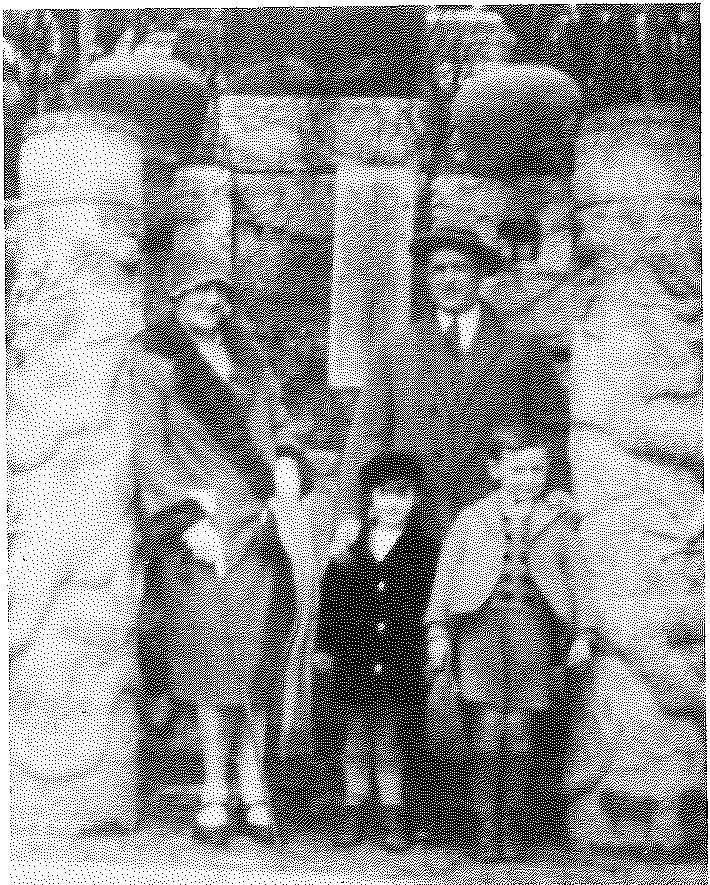
We can add a small historical note in that, contrary to his speculation, Canadian officials from Tokyo did visit Korea in the 1930s. Sir Herbert Marler, then Canadian Minister to Japan, did so in 1930, accompanied by James A. Langley (the Trade Commissioner), as did Hugh Keenleyside (see the latter’s memoirs, Vol. I pp. 380-81). Somewhat earlier, Langley (then Trade Commissioner in Kobe with responsibility for Korea) visited that country, on one occasion with his family. In case you have space, we enclose a photo of the Langley family on their travels about 1928. (The little boy on the right followed in his father’s footsteps in the foreign service).
J.A. Stiles J.C. Langley Ottawa
Editor:
Re Transfer of Social Affairs Stream to CEIC — bout de papier vol. 9 No. 3, in spite of the excellent coverage of the transfer/ expulsion of the Social Affairs Stream from EAITC to CEIC by Manila, Shenstone and Simpson, one major issue remains to be emphasized:
This transfer, including the essential staff capabilities, involves a major shift of the foreign policy function. It may well be that, for reasons not immediately apparent, the Canadian Government wishes to decentralize its foreign policy responsibilities in Ottawa. It seems to have decided that aid policy, including emergency and disaster relief and international aid to refugee programs should be administered separately from EAITC, immigration policy separately from EAITC, cultural policy separately from EAITC, and trade policy, at least to some extent, independently of its Foreign Affairs Minister.
Practically every government department in Ottawa has some major foreign policy interest. It appears these departments are being allowed or even encouraged to develop and to expand these interests independently of EAITC. The result will certainly be to diminish the concentrated application of Canadian foreign policy.
It is strange that this is happening at a time when most or many other governments, particularly those in Europe, seem determined to establish coordinated national and regional foreign policies. It will certainly not be to Canada’s competitive advantage if the trend to disintegrate our foreign policy is maintained.
John Hadwen Ottawa, Ontario
Editor:
The feuille de chou Award of the summer of 1992 goes to the bout for the reminder in “Pardy’s Corner” that, before the mid-sixties, ESOs were selected from those of the Upper Class who had attended Upper Canada College.
It’s nice for us oldies to have our pedigrees made known to the current crop of the democratic foreign service, especially now that few of us can find our UCC diplomas or what’s left of our UC inheritances and trappings. Thank goodness that, even 25 years on, “Pardy’s Corner” can recall those elite days of yore….
Gordon Brown (Class of ’47) Victoria, BC
Editor:
The last issue of bout de papier in 1992 certainly made interesting reading as the final hours of Canada’s one hundred and twenty fifth year drew to a close.
In particular, on page 3, I was highly intrigued by the analogous comment of Mr. Arthur Andrew that a contemporary public servant who takes an aggressive stance against opponents of his/her employers policies and also has the gall to articulate those views in writing, signalled to him that the assimilation of Canada with the United States is “going on apace”
That snippet of questionable logic was followed by another article written by a self professed FTA agnostic, ex senior Canadian public servant Mr. Peter Johnston. Upon applying a subtle brand of his own polemical prose Mr. Johnston neatly took Mr. Michael Hart to task then led the reader into a compendium of “loaded” FTA and NAFTA related questions.
Finally, I would answer yes to Mr. Johnston who despite the devoutness of his negative posture in the use of the wonderfully descriptive word “gobbledegook” uses it himself with considerable aplomb. I refer of course to his querying whether certain of the views of Mr. Mel Hurtig and former US Secretary of State Mr. George Bell could be considered as constipated nonsense.
Paul C. Hubbard Trade Commissioner ITC, Calgary, Alberta
Editor:
As the Department has been encouraging Heads of Mission over 60 to retire, you might like to look back at the early days of the foreign service.
In 1884, the 62 year old statesman Sir Charles Tupper was appointed as High Commissioner in London. Apart from a brief period back in Canada as Minister of Finance, he remained there for 12 years. He finally returned to Canada in 1896 in his mid-70s not to retire but to reenter politics. He became the fourth of the Conservative Prime Ministers who tried in rapid succession to fill the gap left by the death of Sir John A. Macdonald.
In London, the 74 year old Sir Charles made way for an older man, Sir Donald A. Smith, 75, later raised to the peerage as Lord Strathcona. He is probably best known to most Canadians as the bewhiskered gentleman photographed driving home the Last Spike in the Canadian Pacific Railway at Craigellachie in 1885. He had risen from his first job as a fur trader in the Labrador to become Chairman of the Hudson’s Bay Company and President of the Bank of Montreal, as well as a leading financier of the CPR. He served for nearly 18 years as High Commissioner, while in Canada power passed from the Conservatives to the Liberals and back again. Lord Strathcona died in office in 1914 at the age of 93.
An early, hostile biographer suggested that Lord Strathcona had managed to hold office under successive Conservative and Liberal governments because both parties were equally afraid of the political consequences of having him back in Canada. He speculated that for Lord Strathcona, London was an ideal point from which to thwart the plans of rival railway magnates to raise money on the international bond market. Unlike today, neither age restrictions nor conflict of interest regulations then applied.
J.R. Francis Ottawa, Ontario
Editor:
I would like to comment on Andrew Griffiths’ article in the Spring 1992 issue: The Trade Commissioner Service: A Different Second Century.
I think it is very important as we approach the Second Century of the Trade Commissioner Service in Canada that we start to think about the relationship of the Trade Commissioner Service to the private sector and how best to ratchet up our total trade volumes.
As a private international management consultant working with exporters around the world I have become acutely aware of the capabilities and weaknesses of both government and the private sector in our international trade and investment strategy. My firm has worked with numerous national government trade representatives at the provincial, state, regional, municipal and federal levels. The Canadian Trade Commissioner Service is truly unique among government trade officials worldwide. We have managed to achieve excellence in our overseas representation.
While this is cause for celebration and EAITC should be congratulated on a job well done, aptly Mr. Griffiths identifies the need for reflection. I have a few questions myself.
Why is it that we now have more international marketing capability in the public sector than in the private sector? In my own work the goal of creating an export and trading nation beyond our traditional North American market will require a strong strategic alliance between the public and the private sector.
What will be required in my opinion is a commitment to working smarter and [in] some cases harder to make companies and products and services international possibly even company-by-company, sector-by-sector, sub-sector-by-sub-sector. The country needs an active and aggressive trade policy to manage and negotiation our positions in NAFTA, GATT and the EC, but [this] cannot be at the expense of trade development. As aid development gradually shifts from an unhealthy occupation with welfare dependency in the Third World to an investment strategy where the returns are greater both financially and for the development of human resources, we will increasingly need skills in the Trade Commissioner Service to package capital projects; access financial and capital markets; and increasingly integrate merchant bankers, investment bankers, and international marketing professionals as we search for new markets and export successes.
The Trade Commissioner Service does make a difference when they are able to bring resources of the private and the public sector to bear on a target project or new market. Where they fail is when they rely too heavily on concessional financing, listen to the whining of the aid groupies who lobby Ottawa and CIDA Inc for every nickel and dime they can squeeze out of the system, and support mega-projects that Canada ends up losing after years and years of subsidy. As a country, we will be less and less able to justify and spend money on international mega-projects. Our focus will require constant renewal of existing companies and nurturing of export-ready companies and individuals to maintain a constant exporting edge.
So, for the second century, I hope we will see a Trade Commissioner Service that is lean and nimble, multi-skilled, knowledgeable about trade and include more skills in investment banking and project management that will make the country more competitive. At the same time we need EAITC to get involved in encouraging infrastructure development in Canada that will make us prosper and capture the essence of NAFTA and managed trade agreements. Better logistics and distribution, communications, cargo facilities, port development and transportation will help and the private sector is ready and waiting.
John H. Walker President Mihaly International Canada Ltd. Oakville, Ontario
View the original scanned pages →
Originally published in bout de papier, Vol. 10, No. 1 (1993) — Winter 1993 // Hiver 1993, pp. 4–5. Read the rest of this issue →



