
bout de papier, Vol. 24, No. 2 (2009) — Spring 2009 // Printemps 2009, pp. 9–14
In the spring of 1947, the year after Mike Pearson returned from his glorious American summer, he turned 50. There is no suggestion that he suffered a mid-life crisis — if such an
identifiable state of mind existed before the pop culture era — or had any doubt about his progress at a half-century. Then again, his life was full. While he always insisted he had
no grand design — no consuming desire to build skyscrapers, cure cancer, or become prime minister — things were unfolding purposefully.
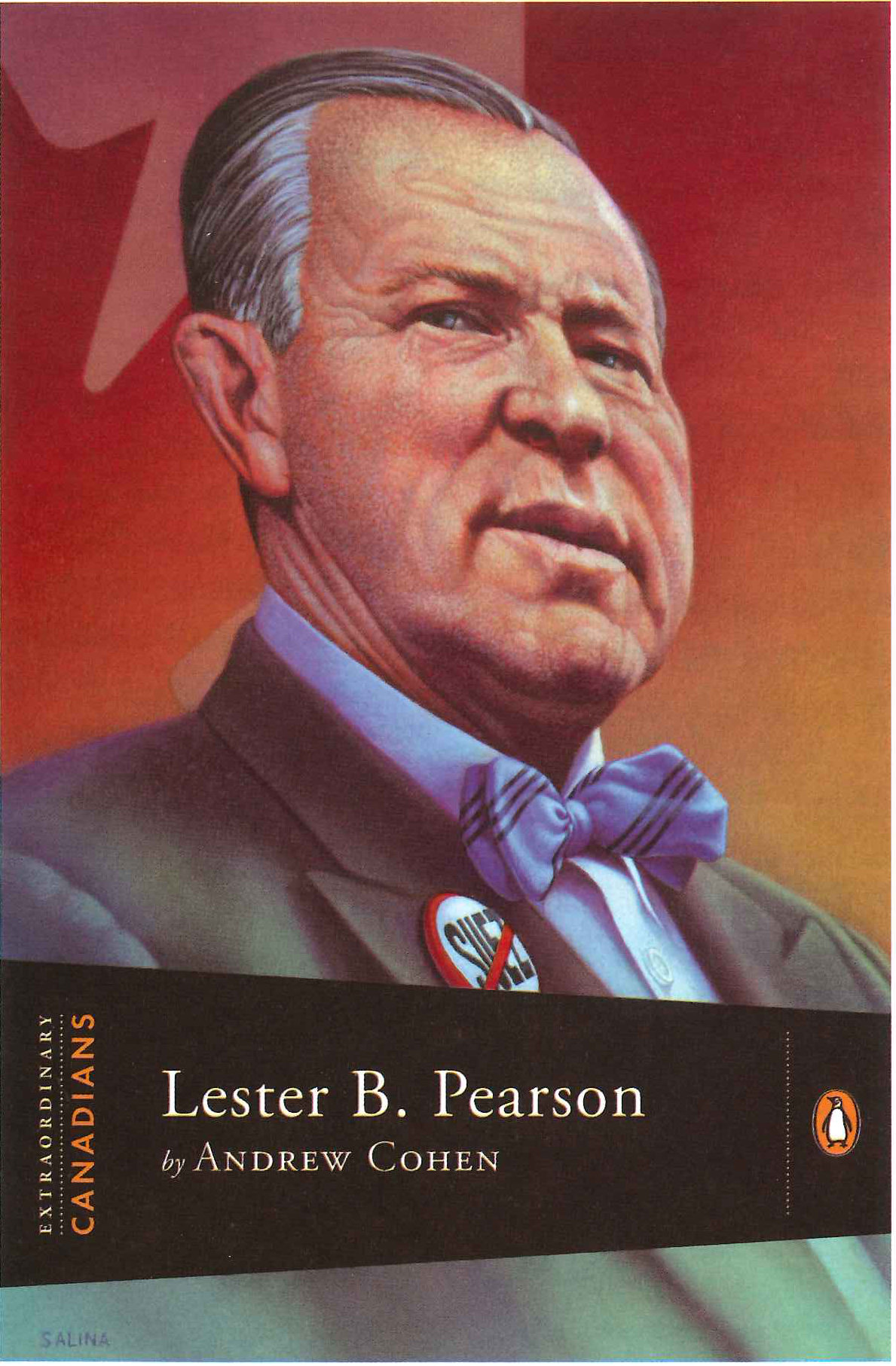
By any measure, his two score and ten were successful. He had gone to war and survived it, he had tried business and left it, he had studied at Oxford and loved it, he had taught history and lived it. He had married and raised two adoring children to adulthood. Unlike other extraordinary lives, he always had choices, and each time he chose wisely. Connections helped. Judgment and timing did too. In 1928, he wisely traded a seat in the Ivy Tower for one by the Peace Tower; later on, instead of serving in Japan in the 1930s or Brazil in the 1940s, he went to London and Washington as the locus of power shifted from the old world to the new. At just the right moment, he had joined a legion of Renaissance men who believed that Canada could make a difference in the world, recognizing, as Shakespeare put it, that “tide in the affairs of men, which taken at the flood, leads on to fortune.” Surely it did for him. Pearson rose in the Department of External Affairs until he came to run it. In his memoir, he explained that he had advanced without outside influence or wealth: “I had done it by hard work and long hours, by making it evident that I was available for whatever was to be done; by welcoming every opportunity for new and more responsible duties; and by accumulating all the experience possible in all the varied aspects of my profession.” Now, after nineteen years of late nights and lost summers, the first secretary was undersecretary. He was the High Priest. Lord knows, he’d earned it.
He had become the indispensable man in that travelling carnival of conclaves of the 1940s. When the Allies began planning the peace, he was the face of Canada, recognized and applauded everywhere. A profile in Maclean’s in 1944 typified the adoring press notices, cooing that Pearson had “a finely-trained mind, a solid-built rock-ribbed physique … and almost boundless energy” making him, as a diplomat, one of Canada’s very best.” He was disarming, funny, boyish, a regular guy who chopped wood, played tennis, and defiantly wore short sleeves among the stuffed shirts of the staid diplomatic world. It’s hard to find a discouraging word about him in those days. Pearson liked reporters and they liked him. He was one of the most popular and accessible sources, happy to share selective information with journalists such as Bruce Hutchison, Grant Dexter, and Blair Fraser. “Maybe that’s one of the reasons we like him — he trusts us.” wrote Fraser in 1951. They returned the favour with valentines in pink envelopes marked “Dynamic Diplomat” and “Canada’s ‘Boy Wonder.’”
Whenever Pearson’s work was celebrated in these years — that glorious season from the early 1940s until the late 1950s called “the golden age of Canadian diplomacy” — Canada was celebrated too. He was representing a country that had broken with the isolationism of the 1920s and 1930s and embraced a spirited internationalism. This was no small thing for a thinly populated, parochial nation with a colonial mentality. For Canadians, it was a dramatic new way of seeing themselves beyond their shores.
Well before Pearson came back to Canada in October 1946 to run the Department of External Affairs, there was talk that he would enter politics. Mackenzie King had raised the prospect with him during a carriage ride through the Bois de Boulogne in Paris the summer before. King thought highly of Pearson (“very modest, unassuming. He is going to be valuable to Robertson,” he told his diary in 1941) and imagined him as prime minister one day. Pearson wasn’t interested. Serving in King’s cabinet was impossible for him. It wasn’t just that King was a fussbudget, self-absorbed, and excessively cautious; their views of the world were different. His adventurism worried King, who told his diary in 1948: “The truth is our country has no business trying to play a world role in the affairs of nations, the very locations of some of which our people know little or nothing about. So far as External Affairs is concerned, they have been allowed to run far too much on Pearson’s sole say-so, and Pearson himself [has been] moved far too much by the kind of influences that are brought to bear upon him. He is young, idealistic, etc. but has not responsibility.”
One reason that Pearson agreed to leave Washington for Ottawa — he anticipated going on to London as High Commissioner, which would have taken his career in another direction — was that Louis St. Laurent was succeeding King at External Affairs. Pearson revered St. Laurent (“I have known no finer gentleman, or one who had a greater sense of public duty”). It meant, as his deputy, that Pearson was free to pursue a muscular foreign policy. He knew, even as King balked at his rashness and dismissed his belief in “the parliament of man,” that he could rely on the support of his minister. It was, as Pearson notes, a perfect relationship. Pearson offered St. Laurent loyalty; St Laurent offered Pearson latitude.
no finer gentleman, or one who had a greater
So, in 1948, when Pearson wondered how the West would respond to Soviet aggression, he wasn’t inhibited by King’s conservatism. The Soviets had invaded Czechoslovakia in February, and Pearson doubted that the United Nations could respond. He saw the necessity of a regional organization that would marshal the moral, economic, diplomatic, and military power of the West against communism. The first expression of this idea as government policy came in a speech by Louis St. Laurent on April 29. He told the House of Commons that “the organization of collective defence … is the most effective guarantee of peace.” Without sacrificing “the universality of the United Nations,’ he proposed that the free nations of the world form their own association of collective defence, under Article 51 of the UN Charter. Creating such an organization, he said, would not be “a counsel of despair but a message of hope.” Pearson had written the speech.
Whether Canada was the first nation to propose the North Atlantic alliance, as some suggest, or not, Pearson believed absolutely in the idea and pursued it vigorously. Yet he thought of NATO as a short-term solution — not a second United Nations — which would fade away as it became unnecessary. Of course, it didn’t. At the same time, he was passionately committed to Article 2, which Canada proposed in order to make the organization an economic, social, and political alliance. Dean Acheson called this idea “typical Canadian moralizing.” That NATO didn’t become the Atlantic community that he had envisioned was a disappointment to Pearson. Yet NATO was a seminal achievement, and it owed much to Pearson, as well as to Escott Reid, Norman Robertson, and Hume Wrong. It was no surprise that Pearson was asked to be NATO’s first Secretary-General. Although he declined, he felt that NATO was his greatest achievement in foreign affairs. “It was not the most exciting thing with which I was associated, nor the most dramatic,” he told a friend. “It was not even the most immediately important thing. But in the long run I think it was the most important.”
There would be challenges aplenty for Pearson in those stirring years. In the spring of 1947, for example, he watched as the United Nations agonized in a special session over the future of Palestine. The British were withdrawing, leaving the problem to the United Nations. As one of the newly elected non-permanent members of the Security Council, Canada was appointed to the special committee of the General Assembly to decide Palestine’s fate. Ultimately, it sided with the majority, which proposed the partition of the territory into Jewish and Arab states, with an economic union and a demilitarized Jerusalem. Pearson proposed a four-nation working group, which eventually drafted the terms that produced the State of Israel on May 14, 1948. He was chosen to be its chair, Geoffrey Pearson says, because he was a civil servant, was seen as impartial, knew the United Nations, and because “they needed a chairman and he was available.” But while he knew the land and its history, Pearson was not a committed Zionist. Contrary to what some suggest, he wasn’t predisposed to a Jewish state. He was under more pressure from Jews than from Arabs, to be sure, but he was, as usual, a pragmatist. Pearson’s work was seen as pivotal, even as it was discouraged by Mackenzie King, who complained to his diary: “He [Pearson] likes keeping Canada at the head of everything, in the forefront in connection with UN affairs”’ When Pearson embraced partition, he was denounced by the Arabs and called “Rabbi Pearson” by the Israelis. To his underlings at External Affairs, biographer John Beal notes, “he was ‘King of the Jews’ behind his back.”
In the summer of 1948, Mackenzie King was succeeded by St. Laurent. This meant that Pearson would have to address the question King had put to him two years earlier: would he leave the civil service, where he had security, for elective office, which he could lose tomorrow? “I was now faced with the most difficult decision that I had ever had to make,” Pearson recalled. Actually, it wasn’t that difficult. He had risen as far as he could in the department and he knew that the real decisions were made by ministers, not public servants. Moreover, the personal risk was minimal. The party had promised to find him a safe seat, and the government was likely to be returned with a majority. In the unlikely event that the Liberals should win and Pearson should lose, St. Laurent could reappoint him to the public service, as King suggested he would. If all went according to plan, as it always did in those days in Liberal Canada, Pearson would follow the example of St. Laurent, who had been recruited by King in 1941, named minister of justice, and had then found a seat in Parliament.
Once again, the stars were aligned for Pearson. As minister, he would be running the department he knew inside out, he would be joining a majority government in the least partisan of portfolios, and he would have the confidence of the prime minister. And if it went terribly wrong for him at home, the supernova who had been courted for the top jobs at NATO and the United Nations would not be looking for work for long; in 1947, he had turned down a lucrative offer to become president of the Rockefeller Foundation in New York. Risk? What risk? Once again, in what would have been a perilous passage for others, the ever-buoyant Mike Pearson was kissed by the winds of fortune.
Of course, there was the little matter of being elected. His biggest opposition here was Maryon, who disliked politics. Another worry was money, should he be defeated one day. But Maryon was persuaded, and the faithful Walter Gordon and other anonymous donors established a “modest” trust fund of $100,000 in Maryon’s name to supplement their income. Now all Pearson needed was a riding. No problem there; it would be Algoma East in northwestern Ontario, a party stronghold. The sitting member would be made a senator, a by-election would be called, Pearson would be nominated and elected. And so he was, even if the Liberals had to pull out an electoral map of Ontario to show their cosmopolitan carpetbagger his new constituency.
When Pearson became secretary of state for external affairs on September 10, 1948, six weeks before his election to Parliament, he inherited a foreign service that was much bigger than the one he had entered twenty years earlier. In 1939, the department had just six legations employing sixteen officers; in 1948, there were forty-four legations (including the United Nations in New York and Geneva) employing some 216 officers, with many more staff at home. The growth of the department reflected a growth of responsibility. This was no longer a diffident diplomacy for a country content to say nothing; it was a diplomatic service for a country that wanted to show up and speak up. At a time the government was cutting back other departments, External Affairs was expanding, a commitment that seems to be forgotten today as the department again absorbs budget cuts in a country throwing off huge annual surpluses. “His country’s foreign policy is largely Pearson-inspired,” remarked the Montreal Standard on November 13, 1948. That was largely true. Now the department would be Pearson-presided. He was choreographer, director, and producer.
For the next nine years, until the Liberals lost power in 1957, this would be Pearson’s show. So significant was his contribution in this decade that even had he never become prime minister, his life would still have been considered an unquestionable success. Diplomacy would have been his monument. It was here, in the 1950s, that his star shone brightest. As chair of international bodies, including president of the UN General Assembly in 1952-53, he was swept into the eddies and whirlpools of international crises and asked to find a way out. It was here, in one maelstrom after another, that he developed what became known as Pearsonian Diplomacy.
Distilling events, we see how Pearson used agility, imagination, patience, and empathy — all qualities of the diplomat that he had in great supply — to cool tensions and advance peace. As the world split between East and West, as decolonization dismantled old empires and the United States displaced Great Britain, there was a call for cool heads and experienced hands. Pearson had both. In the establishment of NATO, he ensured that Canada was the first, or among the first, to give voice to a regional pact. When the twelve member states gathered in Washington to sign the North Atlantic Treaty on April 4, 1949, they established an alliance that would help to keep the peace in a divided Europe during the Cold War. NATO would be among many roles Canada had in a starring season on the world stage, as the country contributed in big ways and small to the world’s institutional architecture.
The British Commonwealth of Nations, which grew out of the British Empire, twice engaged the attentions of Pearson early in his tenure as minister. The first time was in 1949, when India, having won its independence two years earlier, decided to become a republic. The question was whether, no longer having any link to the monarchy, India could remain in the Commonwealth. Australia and New Zealand balked; Canada sought a compromise. A Commonwealth heads of government meeting was called for London in April 1949. With an election to be held that June, Louis St. Laurent declined to go and sent Pearson in his place. He was the senior spokesman for Canada, the senior member of the Commonwealth. The meeting lasted six days. Once again, Pearson helped broker a compromise that led to a change he called “one of the most important landmarks in the history of the Commonwealth.” India would recognize the role of the monarchy in the Commonwealth, but not in India itself; it would have no king. Because of the change, the Commonwealth reconstituted itself, admitting new members from Africa and Asia and becoming a multilateral, multiracial organization.
Pearson faced a second momentous decision in the Commonwealth the next year. The occasion was a meeting of the foreign ministers in Colombo, the capital of Ceylon (now Sri Lanka), which took place in January 1950. The foreign ministers met for a fortnight and committed their countries to help the peoples of the southern hemisphere lift themselves out of poverty. The Colombo Plan, as it was called, was the world’s first aid program for the developing world. Pearson was sympathetic but unenthusiastic, as was St. Laurent. Giving away money was a new concept to a pinched Canada in 1950, poorer, relatively, than it is today. Pearson also worried about the effectiveness of the plan and whether Canada could afford it, being the only non-sterling nation. But just as NATO was a bulwark against communism in Europe, economic development, in Pearson’s view, was a bulwark against communism in Asia. And as the process gained momentum, his enthusiasm grew. Escott Reid, an early supporter, recalls how Pearson struggled, almost single-handedly, to persuade his colleagues, including St. Laurent, that foreign aid was the future. Cabinet met six times to discuss the question. The meetings, recalled Douglas LePan, Pearson’s economic adviser, were “difficult and contentious,” some of them “stormy in the extreme.” On February 15, 1951, Pearson announced that the government had agreed to commit $25 million (U.S.) a year for six years. Reid called it the most revolutionary of changes in Canada’s foreign policy, an aid program driven by little more than anticommunism and an idea of a multiracial Commonwealth. Yet Colombo marked the beginning of Canada’s program of international assistance, which would, for a period, make it social worker to the world.
Six months after Pearson returned from Colombo, fighting broke out in Korea. The expectation in 1950 was that war would come in Europe, not in Asia, and it underscored the necessity, said Pearson, of assuring the peoples of the East of “our interest, our sympathy and our support.’ Economic development would take time. Meanwhile, Pearson worried about the escalating tensions on the Korean peninsula — actually the first conflict of the Cold War — which threatened to bring the United States on to the battlefield against China. When the Communists crossed the thirty-eighth parallel and entered South Korea on June 25, Pearson thought it was a civil war. He didn’t expect the United States to intervene, and he didn’t see Korea as a question of collective security. But when the United States announced on June 27 that it would send forces to Korea, and the Security Council asked the members of the United Nations to help “restore international peace and security to the area,’ Pearson agreed. When the resolution was passed, the Soviets were out of the room, so there was reason to doubt the spirit of collective security. But once the United Nations was involved, Pearson instinctively thought Canada should be too. For him, it was critical for this to be a collective police action under the authority of the United Nations, which Geoffrey Pearson called “the leitmotif of Canadian policy in the months ahead.”
As its contribution to the proposed UN force, Canada offered transport planes and three destroyers. Pearson worried that this would be an American force, and made the first of his entreaties to Washington — which would define his effort there — to accept a “UN commander” and the concept of “UN forces.” It refused, and placed the force under the command of General Douglas MacArthur. Because the Canadian Army numbered only about twenty thousand at the time, Canada had limited resources to offer after Britain, Australia, and New Zealand said they would send troops. Pearson suggested establishing a volunteer brigade, inviting member states to earmark a part of their military for the United Nations. Eventually, Canada did this, joined by a few others. Over the next three years, Canada sent 26,791 soldiers to Korea and suffered 516 deaths.
The war was becoming dangerous. Having made a spectacular landing at Inchon in September, MacArthur had pushed the North Koreans over the thirty-eighth parallel and was driving toward the Yalu River, which separated Korea from Manchuria. The South Koreans and Americans crossed in October, the Chinese counter-attacked and repulsed them. Pearson feared that if there were a war with the Chinese, the Korea mission would no longer be an exercise in collective security. As Pearson and others saw it, there was a division between the military ends pursued by MacArthur and the political ends espoused by Washington, which was unable or unwilling to control him. In November, MacArthur had launched an assault “to end the war,” which brought a Chinese response, ending in a stalemate on the thirty-eighth parallel that lasted until the armistice in July 1953. As Canadian forces were arriving in mid-December, tensions were rising. “Apocalypse was in the air,’ said Geoffrey Pearson.
The only response, Pearson thought, was to try to bring the war to an end. In December he was asked to serve with representatives of India and Iran on a three-member ceasefire committee established by the General Assembly. They agreed on principles for a ceasefire and hoped to bring along China, but then the Americans introduced a resolution in the General Assembly in early 1951 that called the Chinese the “aggressor.” Pearson’s response shows his deft diplomacy. He agreed with the sentiments — the Chinese were aggressors to him — but worried that the impact of the resolution would be to make the Chinese even more intransigent. As political scientist Denis Stairs reminds us, he also did not believe in empty gestures. Posturing had its uses, but not here. When it came to voting on the resolution, which Pearson called “premature and unwise,” he voted in favour. He did so reluctantly but artfully, to preserve his stature with the Americans, whose respect he would need in he future. The war went on for two more years, but the settlement looked much like what the commission had proposed. Along the way, Pearson mediated effectively but delicately between Dean Acheson and Krishna Menon on the repatriation of prisoners.
In 1952, Pearson was elected president of the Seventh Session of the General Assembly, with the support of 51 of 60 members. Neither his personal esteem nor the prestige of his office was enough to move the United States or the other side toward a settlement on Korea, but Pearson kept trying. He never broke with the United States, but he privately feared that MacArthur’s aggressiveness would trump Truman’s authority. His fears crystallized in a highly publicized speech he gave in Toronto on April 10, 1951, in which he warned that the United Nations must not be a servant of the United States and that Washington was not beyond criticism. “It would also help if the United States took more notice of what we do and, indeed, occasionally, of what we say.” Then, memorably, he added: “The days of relatively easy and automatic political relations with our neighbour are, I think, over.” They were, and Korea was the first rupture.
It is easy to say, as some historians do, that Canada sided too quickly with the United States, did its bidding too often, wasn’t independent enough. But Pearson worried greatly about American excesses as the world’s lone atomic power and tried to contain them. He was so persistently skeptical of the Americans that his attitude strained his friendship with Acheson, who came to dismiss those “moralizing, interfering Canadians.” Acheson never forgave Pearson. Pulling the tail of the eagle was always risky — but Canada was respected and so was Pearson. It is no shame, and some praise, to call his modus operandi “the diplomacy of constraint.” In Korea, his foremost impulse was to moderate American power. In doing so — prodding, pushing, petitioning — he became the image of Canada as broker and fixer.
View the original scanned pages →
Originally published in bout de papier, Vol. 24, No. 2 (2009) — Spring 2009 // Printemps 2009, pp. 9–14. Read the rest of this issue →


