
bout de papier, Vol. 26, No. 4 (2012) — Summer 2012 // Été 2012, pp. 11–14
rUIlidilt UI d VULY UdlidaUldll VDIPIVITIdal
by Patrick Starnes
Note de la rédaction : Il y a plusieurs mois, John Starnes, un des membres siégeant depuis le plus longtemps au comité supérieur de rédaction de bout de papier, a annoncé qu’il démissionnait. Sa raison est simple : du fait qu’il sera bientôt centenaire (dans sept ans) et qu’il est presque sourd, il estime que sa contribution en est amoindrie. Bill Barton, autre légende d’une génération passée, a lui aussi quitté le comité à la même occasion. Nous avons accepté leurs démissions à regret et nous avons décidé de souligner la contribution de quelques-uns de nos diplomates possédant les plus longs états de service et les plus talentueux par une célébration d’une vie bien remplie. Nous avons mis l’accent sur John, mais l’hommage vise tous les Starnes et Barton qui ont tant contribué à la force et à la fierté du service extérieur du Canada. Le fils de John, Patrick (avec l’aide de son frère Colin) a bien voulu relever le défi de rédiger cet hommage…en outre, un centre de ressources de l’École Norman Patterson de l’Université
Imagine: London, May 1944. The Allies are daylight-bombing German cities with increasing impunity, and there are persistent rumours of an impending invasion of Continental Europe. Somewhere in a hangar in West London, a young Canadian Army officer is performing important but tedious intelligence work. Cue to Canada House. Norman Robertson, the legendary Canadian diplomat, in London with Mackenzie King for a Commonwealth meeting, repeats a previously made offer to the officer — secondment to the Department of External Affairs as third secretary to the Canadian Legation to the Allied Governments-in-Exile in London. The offer is accepted, and so begins the distinguished public service career of John Starnes.
John Kennett Starnes was born in Montreal on February 5, 1918. His father, Henry, was a successful grain broker whose banker grandfather had been the Mayor of Montreal in 1867. His strong-minded mother, Altha, was a daughter of Frank McCrea, a prosperous businessman and federal Member of Parliament for Sherbrooke. Starnes attended Selwyn House School in Montreal where he claims to have been bullied by the future federal minister Bud Drury and where he (Starnes) failed to shine academically but was a keen athlete. Trinity College School in Port Hope and a year at the Institute Sillig in Switzerland where he acquired decent French and played defence for the local hockey team, followed. While gaining a BA from Bishop’s University, Starnes spent the summer of 1936 at the University of Munich wrestling with German and successfully developing a marked distaste for fascism.
With the outbreak of war, Starnes put aside ideas of joining External Affairs and enlisted in the Royal Highland Regiment of Canada (the Black Watch) with the rank of second lieutenant. After training stints in Quebec and Ontario, and the longer-term commitment of getting married to Helen Robinson in May 1941, Starnes was sent to attend a German interrogation course in Cambridge, England. Thus began John Starnes’s passionate and lifelong engagement in his relatively young country’s foreign and intelligence affairs.
Starnes’s overseas war was eclectic and involved inter alia: the Cambridge interrogation course, liaison with MI6 and the Special Operations Executive (SOE), seeking out possible candidates in Canadian Army units for special services, the strange affair of an ultimately fruitless plan to recruit Canadian Indians to make use of
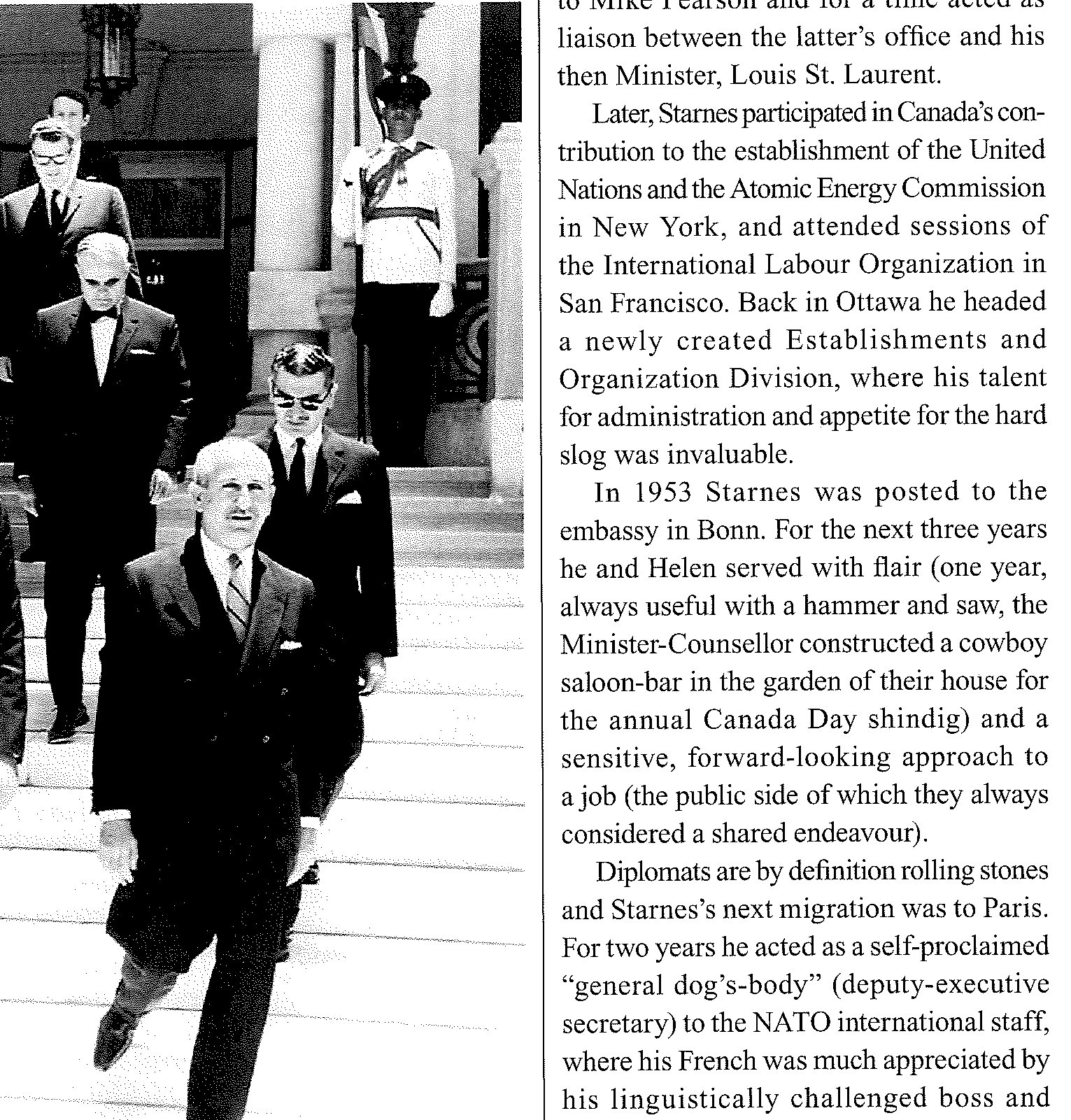
The Ambassador and his team — to his right: Am to his left: Egypt’s Grand Chamberlain, with Art and Ken Merklinger at the top of the stairs. their little known (at least to the Germans) dialects, complex dealings with the British authorities over how to deal with Canadian volunteers for espionage work abroad, and a mercifully unsuccessful attempt to get himself dropped into France as an agent. After secondment, he became involved, for a time as Chargé d’Affaires, in the multifaceted task of liaising with representatives of various governments-in-exile in London. All this against the kaleidoscopic backdrop of wartime London: blackouts, rationing, bombing, pubs and clubs and parties, friends and acquaintances going to and (not always) returning from war. Striking about this period is the sheer volume of people from all walks of life with whom he interacted. Indeed, we have here the genesis of the tradecraft which was to serve Starnes so well in the years to come: an unvarying interest in other people and ideas, a robust sense of humour coupled with a keen appreciation of life’s absurdities, and an unsentimental (read pragmatic) eye for the interests of his country.
Post-W WII Ottawa was a fine place to be for a freshly minted Foreign Service Officer with a small family fuelled with a healthy desire to learn and to thrive in his chosen profession. Importantly, he had dealings with talented and singularly dedicated public servants such as Arnold Heeney, George Ignatieff, Marcel Cadieux, Charles Ritchie, Hume Wrong, Pierre Dupuy, Hamilton Southam, Robert Ford, Jules Leger, Jack Pickersgill, Gordon Robertson. During the immediate postwar period Starnes worked as a personal assistant first to Norman Robertson, later to Mike Pearson and for a time acted as liaison between the latter’s office and his then Minister, Louis St. Laurent.
Later, Starnes participated in Canada’s contribution to the establishment of the United Nations and the Atomic Energy Commission in New York, and attended sessions of the International Labour Organization in San Francisco. Back in Ottawa he headed a newly created Establishments and Organization Division, where his talent for administration and appetite for the hard slog was invaluable.
In 1953 Starnes was posted to the embassy in Bonn. For the next three years he and Helen served with flair (one year, always useful with a hammer and saw, the Minister-Counsellor constructed a cowboy saloon-bar in the garden of their house for the annual Canada Day shindig) and a sensitive, forward-looking approach to a job (the public side of which they always considered a shared endeavour).
Diplomats are by definition rolling stones and Starnes’s next migration was to Paris. For two years he acted as a self-proclaimed “general dog’s-body” (deputy-executive secretary) to the NATO international staff, where his French was much appreciated by his linguistically challenged boss and where he and Helen enjoyed the delights of the City of Light minus the heavy representational responsibilities of regular embassy FSO’s.
Defence Liaison (2) may not be the most resonant of titles for the External Affairs division which dealt with matters of security and intelligence. But, at the height of the Cold War this banal moniker belied the deadly serious duties carried out by the men and women of the branch which was to become Starnes’s bailiwick on returning to Ottawa in 1958. While naturally less than enthusiastic about the seamier aspects of the job (including personnel security breaches, real or putative, sometimes involving old friends), Starnes was lucky in that he reported directly to Norman Robertson, the then Deputy Minister and a much admired chief. Furthermore, chairing the pivotal Joint Intelligence Committee, interacting with the likes of the CIA’s Allen Dulles and the future head of MI6, Maurice Oldfield, along with some stimulating “junkets” certainly had their rewards; the work proved interesting, challenging and a definite eye-opener.
In the summer of 1962 at the age of 44 Starnes was appointed Ambassador to the Federal Republic of Germany and Head of the Canadian Military Mission in Berlin. This was a good time to be a “player” in Germany: Wirstchaftswunder, Germany’s remarkable economic recovery, was in full swing, the obscene Berlin Wall (aka the hilariously named “Anti-Fascist Protection Rampart”) had sprung up virtually overnight in 1961, and with it a host of seemingly intractable problems to be confronted by the West Germans and their Allies. The Canadian mission, quite apart from the normal complex business of being a largish embassy in a strategically vital country, had the responsibility of dealing with the multifarious needs of Canadian military personnel and their families still stationed on German soil. This latter aspect of the job was both demanding and seriously unglamorous, and it serves as a reminder (if any is needed) that not all of a diplomat’s life is played out against the backdrop of grand houses, “high-level talks”, clever cocktail parties and Lucullan banquets. Still, it was during his time in Bonn that Starnes, through the good offices of his close friend Bill Crean, joined the London-based International Institute for Strategic Studies, a number of whose conferences and meetings he attended over the years to come.
Few diplomats would deny that a significant portion of the success (or occasionally failure) of their postings can often be ascribed to what might inelegantly be termed “spousal support” and this is perhaps the place to draw attention to the supportive role of Helen, Starnes’s (unremunerated) consort.
Consider a typical summer’s day in the life of Her Excellency: a Minister and his wife are staying in the guest-room, check that their breakfasts are served (a substandard boiled egg is replaced) and inquire as to their health and spirits. Breakfast with John and their two sons (both at university in Canada). A suggestion that they wash the family car is rejected on the bewildering grounds that neither Kierkegaard nor John Donne was ever required to perform such a menial chore. The princelings repair to the pool. John leaves for work. HE confers with Klaus the cook. A dinner for twelve in the Minister’s honour looms, one of the racks of lamb is tainted, Otto the butler may be coming down with a cold, and the matter of his BO must be addressed. The Minister’s tiresome wife wants to shop so she has to be driven downtown. Back home the flowers must be arranged. A quick call to Heidi, the embassy’s social secretary confirms HE’s worst fears, seating will be a protocol minefield due to confusion re the seniority of two ambassadors. John’s suggestion that they be seated one on top of the other is not helpful. At the hairdresser, HE dashes off an aerogram to her ailing mother-in-law in Canada and makes a list for tomorrow’s luncheon party. A quick Caesar salad at the American Club in Bad Godesberg with the home-sick wife of the First Secretary. HE changes clothes and attends a “duty” tea-party given by the monoglot wife of the Peruvian Ambassador. Another change of clothes and it is 8:00, the guests will soon be arriving and the work begins.
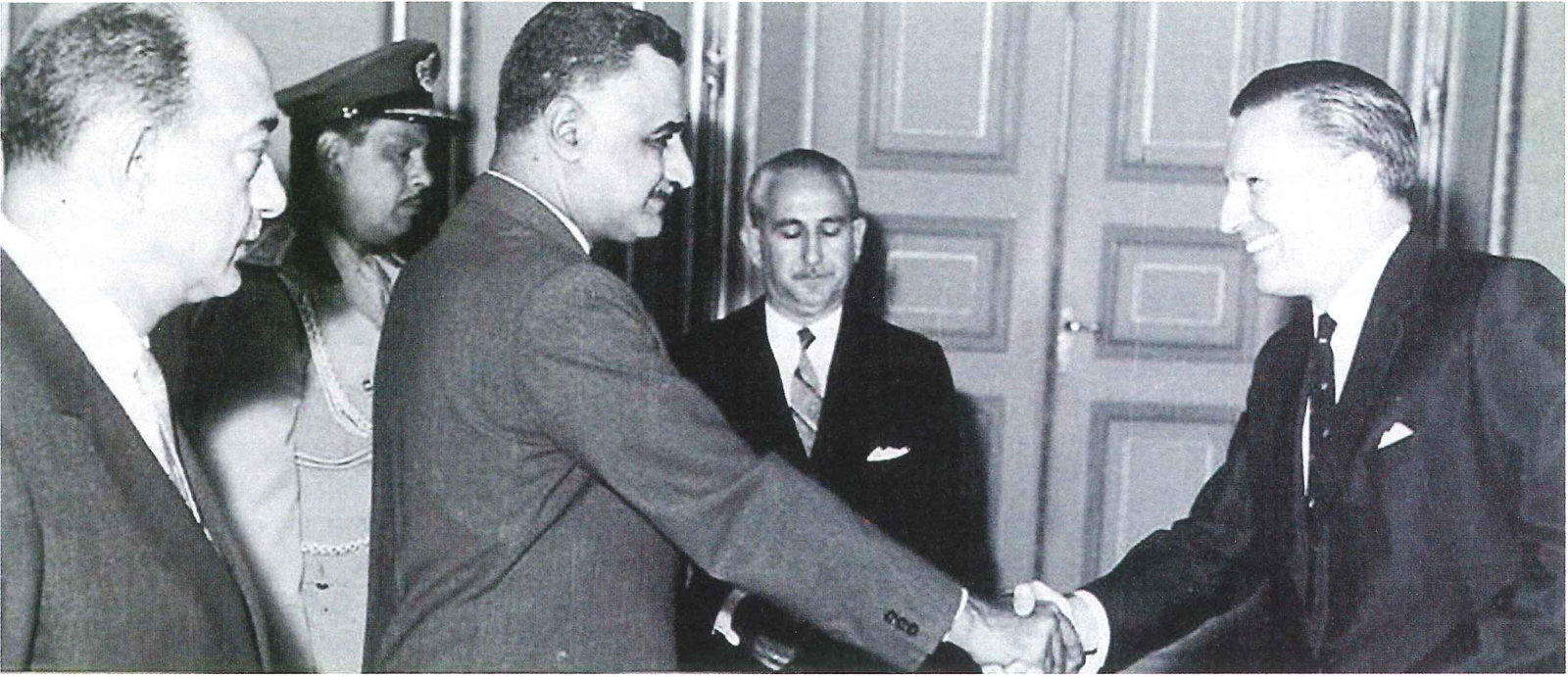
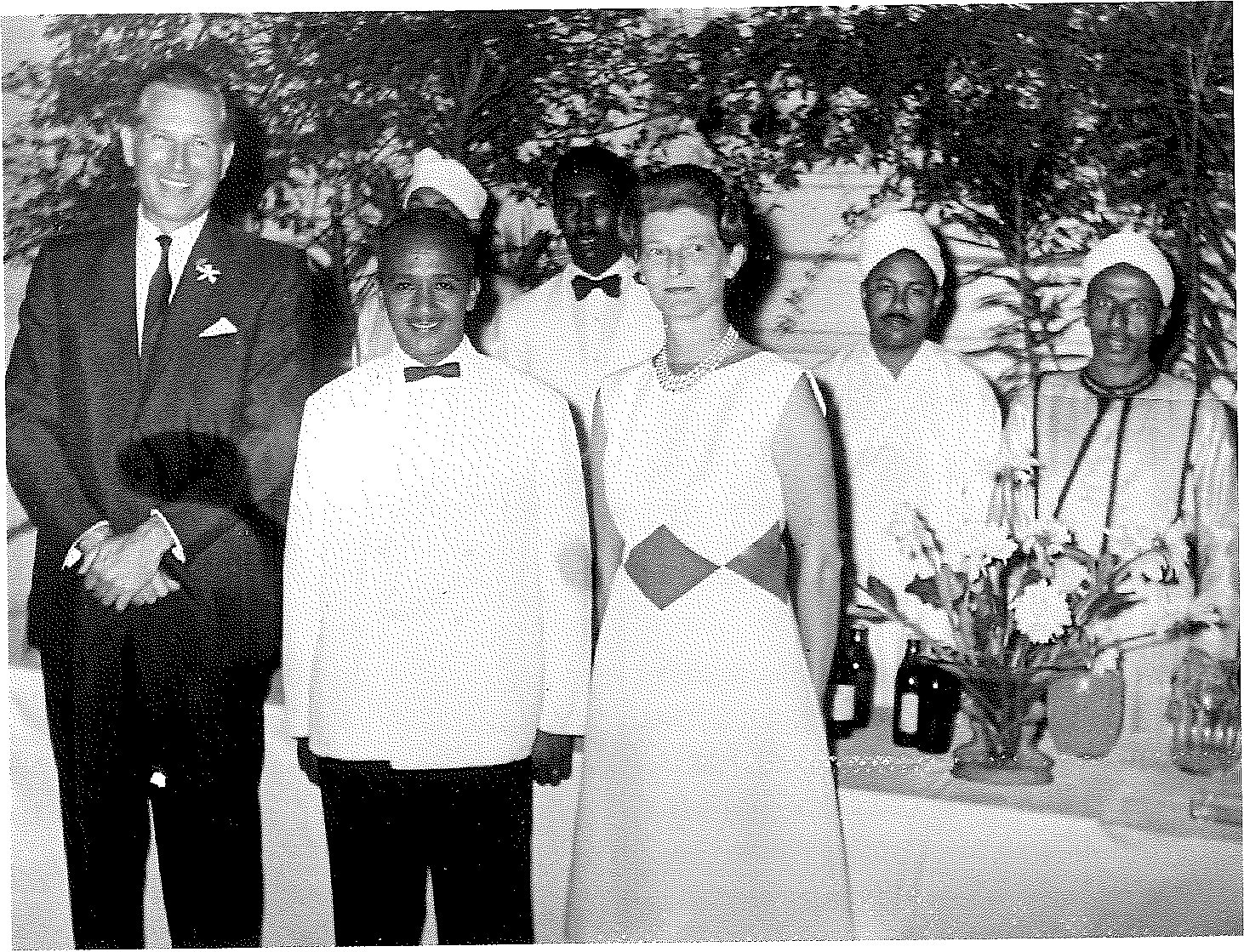
No diplomat is immune from the “less-than-perfect-post-syndrome”, whereby for a number of reasons (usually timing) a plum posting is followed by a less desirable Canada Day 1966: The Starnes, Abdul, and other one. So it was that in 1966 Starnes was posted as Ambassador to the United Arab Republic (Egypt) and Sudan. However, Arab-Israeli politics conspired to morpha s seemingly bathetic posting into a fascinating, difficult, and potentially dangerous one. In addition to seeing to the daily bus-it ness of the Cairo embassy, Starnes and t his extremely able staff were kept busy monitoring and reporting on a very volatile situation not only to Ottawa but also to Britain for whom Canada had been acting as protecting power since relations between that country and the UAR had ° broken down. This may have been helped I by the unusual private interview Starnes managed to wangle with President Nasser where the two men appear to have had a « frank and useful dialogue.
After the Six Day War was so humiliatingly lost by the Egyptians, Starnes and ° the skeleton staff remaining in Cairo witnessed the chaotic and at times frightening aftermath to the conflict as bewildered and maddened crowds rampaged through the darkened streets of Cairo following Nasser’s resignation speech. On one occasion the ambassador, displaying considerable sang-froid, managed to “liberate” a number of embassy staff being held at gunpoint by an ugly rabble of “citizen volunteers” in a suburb of the capital. So much for a dull posting.
In the spring of 1967 Starnes was summonsed to Ottawa where he took up his duties as assistant under-secretary in charge of administration and personnel. He undertook this delicate and frequently thankless task with his customary senses of humour and duty until September 1967 when “out of the blue” he was made an offer which anyone with his experience, let alone understated but very real patriotism, would have found difficult to refuse. Prime Minister Trudeau asked him to become the first civilian Director General of the Royal Canadian Mounted Police’s Security and Intelligence Directorate. In short, to become Canada’s chief spook. After some soul-searching about leaving External Affairs and admittedly a few misgivings as to the nature of the new job, Starnes accepted.
By his own admission Starnes’s time as Director General of Security and Intelligence, while certainly stimulating, was also frustrating and confusing. As the first civilian to do the job he was in uncharted waters, and after only nine months in post had to deal with the 1970 October Crisis. Nevertheless, Starnes attempted to resolve some of the very real problems inherent in establishing a viable civilian security operation in some form of symbiosis with existing structures. The aggravations of this increasingly unrewarding task led him to resign in 1973. After retiring, though, Starnes spent approximately a hundred and twenty hours testifying under oath at various Royal Commissions inquiring into the RCMP’s role in the events of 1970. Not your ideal coda to a public service career spanning more than thirty years.
However, never one to cry over spilt commissions, Starnes consulted for a number of Government departments and then — as “therapy” when testifying — turned his hand to writing, producing a trilogy of spy novels, all successfully published by an small Ottawa-based imprint. Some time later he was approached by the University of Toronto Press with a view to writing a book for them. Leery of adding to the ever-growing canon of “memoirs”, Starnes wrote Closely Guarded, a thoughtful reflection on his life and career which was published in 1998 and makes charmingly unpretentious reading.
Apart from travel, extensive and eclectic reading, writing letters-to-the-editor, and creating gourmet meals, Starnes was always a keen participant, and at times a convenor, of the celebrated Press Club lunches where he kept up with former colleagues and checked out the current “new blood”.
For the record, John and Helen currently live in an apartment overlooking the Rideau River with a splendid view of Parliament Hill, where he produces elaborate breakfasts, reads other people’s obituaries and keeps in touch with family and friends via the internet.
Montreal-born Patrick Starnes studied at Bishop’s and Cambridge University focussing on the works of Samuel Beckett. Widely travelled, he has worked as a deck hand, librarian, aid administrator, journalist, and long taught English at John Abbott College. Patrick, spouse Christine and Border Terrier now live in Tuscany.
View the original scanned pages →
Originally published in bout de papier, Vol. 26, No. 4 (2012) — Summer 2012 // Été 2012, pp. 11–14. Read the rest of this issue →



