bout de papier, Vol. 13, No. 2 (1996) — Summer 1996 // Été 1996, pp. 4–5
Every generation at DFAIT creates its own legends. A legend for my generation was John Holmes. It may stimulate efforts of the current generation and those of others in and out of Government, to consider the enduring values of some of the best of the “Golden Age”
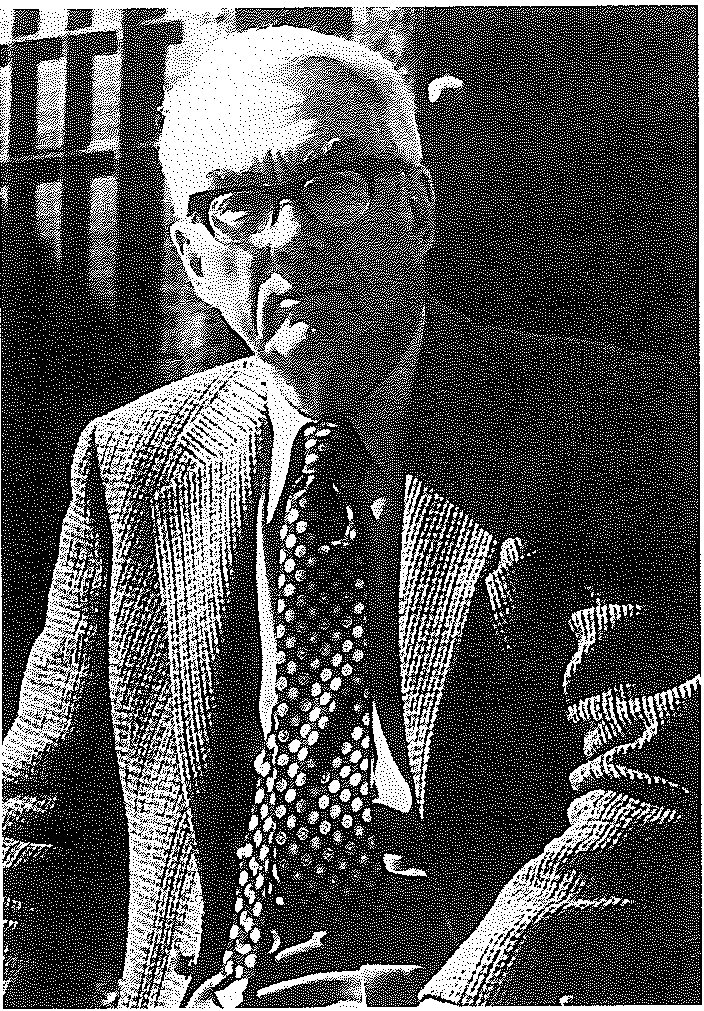
In 1996, perhaps more than in other years, we will miss John Holmes. What follows is an attempt to imagine how he might have responded to some of our current challenges. More than any other public analyst in our post-World War II history, John Holmes was the figure who represented Canada best, and probably most often, in interpreting Canada’s position in world affairs. He would however, be amongst the first to say that new situations require new answers, and that neither himself nor anyone else should be valued excessively. He ensured that the politicians got their rightful place in the sun and believed strongly that the public servant’s role should be a supportive one. In or out of government he was clear and forceful when it came to principled argument. His views were objective and frequently very original and humorous, so that his presence at any occasion guaranteed substance and good cheer. He would urge us now not to take ourselves too seriously.
One of the principal influences John Holmes would bring to bear in 1996, would be to remind us that in times of great uncertainty, there will always be opportunities to advance long term interests if we search them out imaginatively. It was a great experience to watch Lester Pearson, John Holmes, R.A. MacKay, Geoff Murray and Allan McGill, in 1956 at the General Assembly, as they tried to turn disaster on Suez to advantage. This was not done as a formal, established policy, but as a natural inclination to respond to insecurity (or earthquake or terrorism, or civil war) with constructive invention. John Holmes did not believe in rigid policies. In his view, there would always be a wide variety of factors to be taken into consideration, none of which should be given an artificial priority over the others. Human rights, the representation and promotion of womens’ issues, population, the environment, demography, the management of nuclear weapons, immigration, trade, and many other subjects were to be pursued but not at the expense of each other or as separate goals. The national interest for him was the objective, however hard to establish.
We will certainly miss John Holmes as Canadians and others are obliged to adapt to a new temper in the US Congress. Perhaps John Holmes’s finest writing was on the nature of Canada-US relations. At a time when those supporting a major role for the United Nations in international politics will be in despair at the current direction of US policies, John Holmes would have been sure to counsel patience. In his view there would be more to be lost than gained by confrontation. John Holmes knew that on many issues, irrationality might well temporarily be the victor, but he always assumed that by the judicial application of pure reason, there was a chance of achieving progress towards international, including UN objectives. Setbacks should not prevent us from continuing our efforts. He might well have approved our recent actions to preserve Canadian fishing stocks but he would not have fired the shots.
John Holmes never became a prisoner of his own style or language, nor did he try to enforce it on students or colleagues. His intluence came mostly by example. He did not have faith in the much laboured great paper, and he preferred that foreign policy documents be directed at the requirements of the time for action. He was reluctant to prepare major studies on Canada and the United Nations, and so on, which might be outdated almost as soon as they were completed. In some ways he almost regretted the effort put into his two volume work: The Shaping of Peace. His main contributions, we would now recognize, are to be found in the essays he wrote and the speeches he gave, and which contain so much wise assessment. He had a great gift of language himself, and was stimulating and provocative as a lecturer. He seemed always capable of drawing on his literary and deeply varied background to illuminate current problems in a way which was persuasive.
Of course, he was a believer in quiet diplomacy, but he was also ready to speak out when the circumstances required it or when there was no alternative. We remember that after a lifetime of confidentiality and restraint as a public servant, he became almost immediately on retirement a favoured commentator on the CBC. He was able to respond to crises in a way which stimulated usable policy. He would urge his successors to speak out today.
Many have spoken of his willingness to live with paradox. He knew that problems could not be completely resolved. He was suspicious of visions and accepted the importance of national sovereignty at a time when many people were looking forward to the disappearance of national boundaries and the development of “one world.” He was like other academics of his generation, a believer in “the art of the possible,” and would not allow himself to be diverted into the idealistic pursuit of unrealistic goals. He might well have considered that today’s financial restraints could help us to better focus our minds on priorities.
In purely Canadian terms, he was a constant believer in the French fact. He taught at Glendon College where French and English were both used. He would have opposed any form of fanaticism in the development of positions on Quebec’s place in Canada. He would have favoured gradual improvement in the work of federalist institutions, believing that when you can not achieve everything at once, you should at least do what you can, thoroughly and well. In this respect he was a pure Pearsonian. He would have been a calming influence on the separatist debates.
At a time when the federal public service in Ottawa is being eviscerated and its reputation and influence greatly reduced, John Holmes would have held out for recognition of the importance of public servants giving loyalty and service to political leaders. He would have been horrified and ashamed at the record revealed in “On the Take,” but somewhat ironic. He would have strongly opposed the politicization of the Canadian bureaucracy and done whatever he could to encourage the provision of courageous advice. On the basis of experience with the CIIA, the UN Secretariat, the Academic Council on the United Nations System, and a surprising number of universities, he would also have been a good man to help with new administrative challenges.
For the fiftieth anniversary of the United Nations, he would have supported the view that a permanent UN police force could not be established but that the UN’s ability to respond to crisis could and should be strengthened. He would not have spent much time on charter reform. His ideas on relations with eastern Europe, on north/south relations, on the way development assistance should be re-structured, on how universities should be treated in a new fiscal atmosphere, and on many current issues are badly missed.
A biography is in course of preparation. That may help, and we have his writings. The friends of John Holmes are legion and no one of us can speak for the collectivity. We all had separate experiences and there are many different vantage points from which to assess his contributions. What we miss most is his style and spirit. He worked hard. His productivity was awesome. He gave generously of his time and of himself to his students and friends. Our response to his life and works will be to do our best for Canadian foreign policy interests. However, we must be allowed from time to time, to mourn his absence.
View the original scanned pages →
Originally published in bout de papier, Vol. 13, No. 2 (1996) — Summer 1996 // Été 1996, pp. 4–5. Read the rest of this issue →