
bout de papier, Vol. 13, No. 1 (1996) — Spring 1996 // Printemps 1996, pp. 47–48
When last we checked with ace logician Ludwig Liebnitz, South Pacific pseudo-debutante Mabel Stanley was considering a career move. On his return to the Centre, Liebnitz got word that she had indeed joined the infamous grunge rock band, Edible Granite, on an Eastern European tour long-awaited by western listeners. Meanwhile Rialto Sleazewagon, associate managing editor of the Centre’s in-house journal, aide-mémoire, was the surprise winner of the off-cycle election in an unnamed central province. Premier
Sleazewagon immediately began implementing policies based on the core belief that the poor were subhuman and so shouldn’t be allowed to eat. In this he was assisted by the out-of work ex-Premier of another central province, Papa Jack Paridy, whose core belief was that the rich were unpatriotic and so shouldn’t be allowed to vote. They found much in common.
The two threads came together in Sleazewagon’s passion for Mabel. As soon as he became Premier, he sent word that she should join him in Princess Gardens, there to darn his socks, top up his rye and ginger and generally assuage the cares of office. Mabel, who had done far too much of the same for her father in the Gilbert and Sullivan Islands, and who in any event saw Sleazewagon as a life form somewhat lower than gangrene, sent back an intemperate reply in Pig Latin. Sleazewagon, who as a politician knew pork, got the message but not her drift. Convinced that she was playing coy, he sent Papa Jack east to bring her back, no matter how.
Liebnitz soon received a second letter from Mabel, reporting that the band was being sabotaged. Misdirected tour buses (Nairobi was lovely), missing music (not that the band noticed), suspicious fires (how do you ignite a papaya?), mysteriously frostbitten fingers (in a sauna?), nights when the whole band stayed sober — nobody knew where it would stop, but Edible Granite was on the verge of packing it in. The last chance for a turn-around was Tannu Tuva, where Edible Granite was playing the Yak Palace. Expecting further disaster above and beyond the musical, Mabel contacted a local shaman, whose visions showed an avuncular stranger collapsing a hundred-metre yurt onto the heads of a strangely grateful audience while (from the sound) someone inside was strangling hyenas.
Liebnitz reacted immediately. Guilty over his part in Rialto’s political success (“How could you sink any lower?” he had shouted one day while Sleazewagon was still at the Centre, not realizing the words would be taken as a challenge), he asked veteran field agent Jimmy “the Turk” Flecker to step in. Jimmy quickly determined that Papa Jack was indeed behind the band’s problems, having disguised himself as one of the band’s four roadies: Bonzo MacHinery, Nozeguard O’Venus, Zylky Kazoo and Conor Cruze Control.
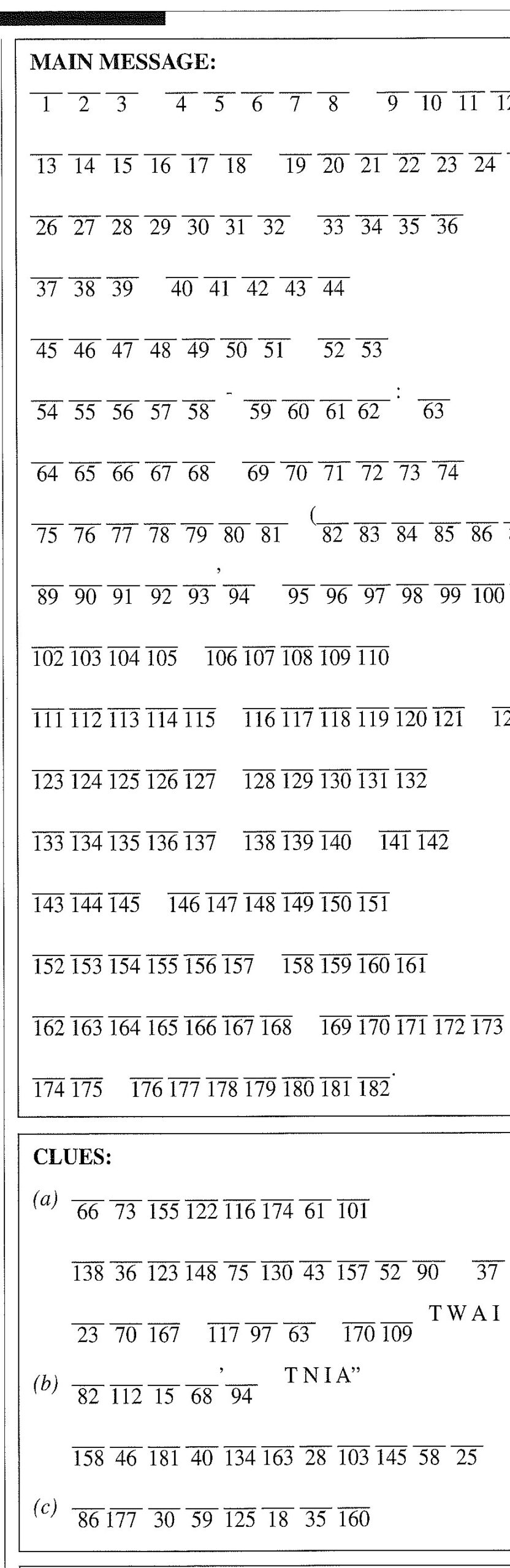
But which one? The Turk’s final report was, as always, in the form of a puzzle, as follows:
The following definitions relate to Russian history and geography. The answers should be placed in the numbered spaces beside each definition, one letter per space. The right answers will be in alphabetical order. Using the numbers under the spaces, the letters in the answers can then be transferred to the spaces numbered 1 through 182 in the MAIN MESSAGE box, where they will form a complete sentence. Each number is used only once.
1. Capital of the former
Kazakhskaya SSR 57 67 158 7 108 40 153
2. Imitation fleece
or southern 20 94 1 78 30 35 110 70 159 168
Volga port
3. Trotsky at birth
54 124 84 155 13 37 145 119 77
4. Pre-revolutionary Duma party
or soldiers in training 66 138 162 27 1 97
5. Dzerzhinsky’s secret police,
later the KGB 45 144 17 166115
6. Caesar in Russia
58 111 4 163
7. Stalin,
originally 116 21 92 152 50 98 38 171177 59 79
8. Alexander
Nevskii 134 48 130 156 101 146 74 22 125 80
director
9. Revolution of
8-11 March 1917 33 167 123 90 117 67 34 133
10. He and
his grand- 139 150 165 19 105 129 95 82 Z 122 175
son Batu
conquered
13th century
Russia.
11. Russian greeting
83 41 121
12. Foreign Minister and
incendiary cocktail
13. Treaty ending
Great Northern War
with Sweden 1721:
Russia gains
14. Catherine the Great’s son and
successor, possibly Romanov
15. Famous Moscow Circus clown
16. Prince, battleship and 93 142 14 96 36 127 6 109
and village
17. Composer of Peter 113 62 85 182 29 53 76 25 42
and the Wolf
18. Treaty ending the Soviet
Polish War 1920: Russia loses
19. Peasant tied to the land
20. Where they sent you
21. Merchant family 32 104 136 65 78 TO 120 52 128
and beef in sour
cream
22. Crimean Muslim, intractable
person or sauce for fish
23. Soviet news agency
24. Treaty with Napoleon 1807:
mutual benefit
25. First constitutional Prime
Minister, 1905
26. White leader in the
Russian Civil War
27. He stormed the White
House in October 1993
“Well,” said Liebnitz when he had read Flecker’s report, “that should be straightforward, as far as it goes, with a little help from the Britannica and the Oxford Concise. But how do we get from there to a name? Jimmy usually gives supplementary clues…” A careful examination of the report revealed a microdot disguised as a period in the instructions to the puzzle. This revealed a second box marked (what else?) CLUES. “Right,” murmured the ace logician. “The numbers will relate to the same letters as in the puzzle, but what do the letter groups — TNIA” and TWAI — mean?”
“If numbers mean letters, then letters probably mean numbers,” suggested Mabel when he phoned her. “I expect that the numbers 1 to 9 in the puzzle are replaced by the letters above them — and that A” means the second A. Does that work?” It did indeed, and shortly thereafter Mabel turned a snarling Papa Jack over to the Russian police. Rialto claimed a broken heart, but Mabel reminded him he’d lost it years ago in a poker game.
Can you duplicate this feat by providing: (a) the 27 answer-words; (b) the text of the MAIN MESSAGE; (c) the text of the CLUES; and (d) the name of the guilty roadie?
View the original scanned pages →
Originally published in bout de papier, Vol. 13, No. 1 (1996) — Spring 1996 // Printemps 1996, pp. 47–48. Read the rest of this issue →



