
bout de papier, Vol. 16, No. 2 (1999) — Summer 1999 // Été 1999, pp. 36–38
Glenn Gould (1932-1982) was unquestionably one of Canada’s most gifted and renowned musicians. Before Gould turned his back on touring, his piano recitals and concerts consolidated the worldwide reputation for brilliance and individuality which his early recordings had established. Gould’s first European tour was arranged by Toronto impresario Walter Homburger with the co-operation of the Department of External Affairs (DEA), which displayed an interest in a nascent form of cultural diplomacy, but which had no funds for the purpose. The highlights of the tour were performances in Moscow and Leningrad. Apparently, the Soviet Ministry of Culture was so uncertain about the appeal of this Canadian visitor that it packed the hall for the first concert by distributing complimentary tickets. From the enthusiastic response to Gould’s appearances, it became obvious that this tactful (or tactical) generosity had been unnecessary.
The departmental file on Glenn Gould’s European tour reveals a growing appreciation of the potential value of such recitals and concerts as antidotes to the usual clichés about Canada and Canadians. As well, demonstrations of cultural achievement and international distinction were seen as useful instruments in the multi-faceted cold war. That broader political context almost scuttled the tour. The suppression of the Hungarian uprising prompted a chill in the West’s dealings with the Soviet Union and its allies. Only after DEA received clarification from the State Department that the American authorities would not bar Gould from entry into the United States as a result of his travel behind the Iron Curtain did the pathbreaking journey begin.
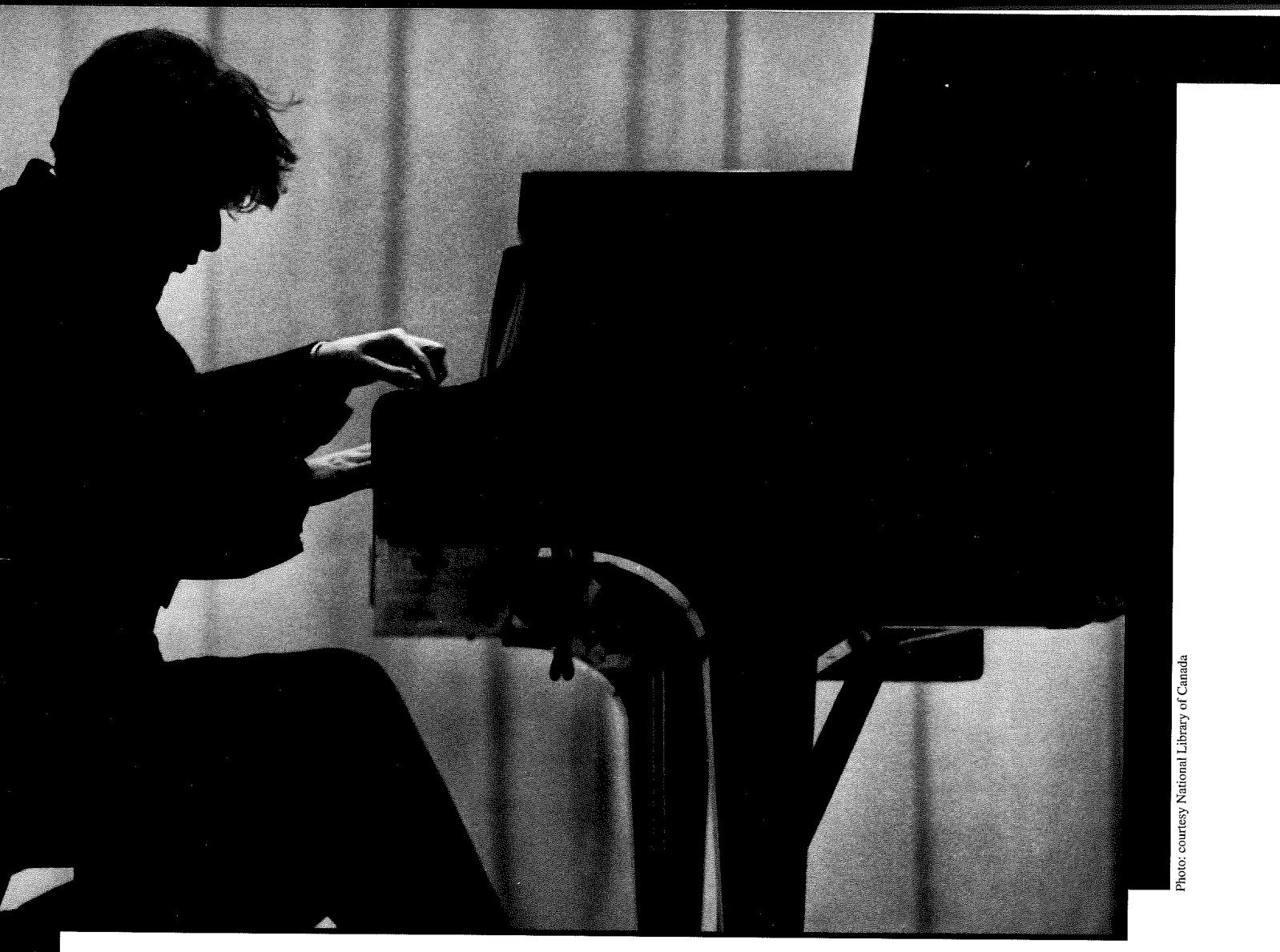
The Canadian Embassy in Moscow struggled to devote scarce roubles to hospitality to honour Gould, with headquarters unhelpful and the Ambassador, David Johnson, more generous. However, the Embassy was able to make available the singular services of an attaché, Captain (retired) John Fast, as translator. Fast had joined DEA in December 1956 and he had been promptly posted to Moscow. Fast’s brief entry in the department’s biographical register indicated that he was born in Neu-Halbstadt, Russia, and that he had been educated by “private schooling, including music.” Those who knew Fast later in Ottawa, where for a time he was in charge of the departmental archives for the Historical Division, recalled that he was both interested and well-informed about music and history. The memorandum reproduced below demonstrates Fast’s talents as a reporter and it offers a unique glimpse of a remarkable moment during Gould’s tour. This topic was suggested by Robert Desjardins. The memorandum is on departmental file 10417-S-40 at the National Archives of Canada (RG25 Box 7271). The photograph which accompanies this article was located and copied with the generous help of Tim Maloney of the Music Division of the National Library of Canada and the image of Glenn Gould is reproduced here with the kind permission of the trustees of the Estate of Glenn Gould.
Hector Mackenzie
John Fast, Glenn Gould, May 21, 1957. Restricted.
Perhaps the most interesting of all recitals which Glenn Gould gave in Moscow was his last one, the one given on Sunday morning, May 12th for the Piano Faculty and students of the Moscow Conservatory. He was asked several days beforehand whether he would consider playing for the students (I understand the concert was gratis), leaving to him the choice of programme. In my conversations with him, prior to the concert on Friday morning, he was frankly unenthusiastic and somewhat at a loss of what to play. He finally expressed the opinion that the [Alban] Berg Sonata [Opus 1] and some Bach should fill the bill. The suggested time for the concert was a little awkward. The recital was to begin at 11:00 o’clock in the morning, and at 1:00 p.m. of the same day, he was due at the Hotel Metropole for a luncheon given in his honour by the Ministry for Culture.
2. On the evening of May 10th, at a reception for Mr. Gould at the Embassy, I met the Russian cellist [Mstislav] Rostropovich, with whom I had quite an interesting conversation on the sad state of Soviet symphonic orchestras, which was particularly evident at Mr. Gould’s appearance as soloist with the Moscow State Philharmonia, in Beethoven’s 4th Piano Concerto. (During the playing of a passage in the first movement, one of the flutes came in several beats ahead of the rest and stubbornly continued playing to the bitter end despite the pronounced scowls and gymnastics of the conductor.) In the course of our conversation, I mentioned to Mr. Rostropovich that Mr. Gould shall be playing for the students of the piano faculty and that he is somewhat at a loss of what to choose for them. Rostropovich became rather interested in the “problem” and suggested that it should be something unfamiliar. I then told him that Mr. Gould had expressed to me the desire to present a programme which should include not only some Bach, but a composition, or two, of near-atonal and atonal work. However, I added, Mr. Gould was just a little apprehensive how such a programme would be received here. Rostropovich’s reaction to my remarks was quite amazing, to say the least. It was his opinion that he could not choose better than suggested and he concluded his remarks by saying “as much as possible of contemporary music from which they are, unfortunately, removed.[“] (His exact words were: Kak moshno bolshe sovremennoy musyki ot kotoroy oni k sozhaleniyu otorvany). I was later told by Mr. Gould that he repeated substantially the same sentiments to him while leaving the Embassy.
3. The following Sunday, on arrival at the Conservatory, Mr. Gould was received at the entrance of the hall by a group of enthusiastic young students, headed by the young and very talented pianist, Lev Vlasenko [who later taught at the Moscow Conservatory]. The reception which they gave him foreshadowed what was to come.
4. The recital took place at the Small Hall of the Conservatory, with a seating capacity of 400. It was jammed to the rafters, with standers taking over every available space, and overflowing into every exit and down the staircase. Youth heavily predominated.
5. Mr. Gould’s recital was rather unorthodox. He prefaced it with a few remarks explaining what he intended to do. The Alban Berg Sonata was to form the focal point, however, leading to it he demonstrated with a number of short excerpts, the influence of early Arnold Schoenberg in this Sonata. The excerpts were taken from two Schoenberg song cycles: Opus 2, “Kes Knaben Wunderhorn” and Opus 3, “Verzweitflung”; still strictly diatonic and heavy with Wagnerian overtones. This was followed by Berg’s Sonata, where tonal and atonal music meet, with the former perhaps dominating.
6. After the playing of the Sonata, Mr. Gould played two pieces as an illustration of musical development since Berg’s Sonata: the stark and totally atonal “Three Variations” by [Anton (Friedrich Ernst) von] Webern, and the 1st and 2nd movements of [Ernst] Krenek’s Piano Sonata [No. 3]. This last work, which Mr. Gould considers as one of the more important piano compositions of our century, he played with an unbelievable verve and intensity that swept everything and everyone along. The concert concluded with several fugues from the “Art of the Fugue”, several variations of the Goldberg Variations, and several movements from the E minor Partita by Bach.
7. Mr. Gould’s playing was given an unbelievable reception. The Moscow habit to applaud an excellent performance with short rhythmic clapping, became a near machine-gun staccato and quite deafening in volume. I have listened to a number of performers and witnessed some truly first class performances (including [Galina (Sergeyevna)] Ulanova’s dancing), however, Mr. Gould’s reception outdid them all. Even his well-known mannerisms seem to have added, rather than detracted from his performance. His behaviour was absolutely free and easy on this day. Dressed quite informally, without tie, as the concert progressed, and he began to feel warm, Mr. Gould first removed his jacket then peeled off his sweater, dropping the clothing on the floor of the stage, finishing the concert in shirt-sleeves with part of the shirt-tail well out.
8. The getting away from the Conservatory was a veritable march of triumph. Mr. Gould’s dressing room became completely jammed with people congratulating and embracing him (in the old Russian manner, and which always startled him). From dressing room, down the lengthy staircase and to the waiting car, Glenn Gould had to walk through a solid mass of wildly cheering students. This was not a carefully arranged and “spontaneously” conducted demonstration, rather the paying of due regards to a true artist.
9. However, this is still Soviet Russia, and it became quite evident just a short hour after the concert. While we were leaving the Conservatory, I was approached by Lev Vlasenko and another student with the request if Mr. Gould would accept a small present from them of some music, and if he had some preferences as to composer. I knew that Mr. Gould had shown some interest in the music of Myaskovskiy, so I suggested him as suitable. As we were on the point of departure, I left with Vlasenko the telephone number of the Embassy and told him I was prepared to come over to pick it up when ready. However, Vlasenko insisted that they shall bring it over personally and with this I left him. Approximately an hour after we reached the Embassy, and after Mr. Gould left for his luncheon engagement, I received a telephone call from Mr. Vlasenko. He was complaining that our militia guard at the gates had refused them entry, and yet when I again suggested that I should come for it, he was quite adamant in replying that they shall try again. I promised him to receive them at the gate and that entry shall not be denied to them. I immediately went down to the militiaman and told him whom I was expecting and that he shall not detain them. To make absolutely certain, I remained at the gate. Shortly afterwards four young students, two girls and two young men, arrived with a parcel of music. This time, they were not stopped and I received them about half way up our drive; however, they declined to enter the Embassy and await Mr. Gould’s return. While I was accepting the parcel and thanking them for their kindness, I observed a motorcycle with a militia officer drive up to the gate. On leaving the Embassy, the students were briefly detained by this officer and then walked away, with the officer remaining talking with our guard. I could not overhear the questions which were asked. However, I could see that the students did not produce any identification papers.
View the original scanned pages →
Originally published in bout de papier, Vol. 16, No. 2 (1999) — Summer 1999 // Été 1999, pp. 36–38. Read the rest of this issue →



