
bout de papier, Vol. 16, No. 4 (1999-2000) — Winter 1999-2000 // Hiver 1999-2000, pp. 31–32
DE ADMINISTRANDO IMPERIO
Constantine VII “Porphyrogenitus”
Greek text edited by Gy. Moravesik
English Translation by R. J. H. Jenkins
Dumbarton Oaks, Washington
US $15.00
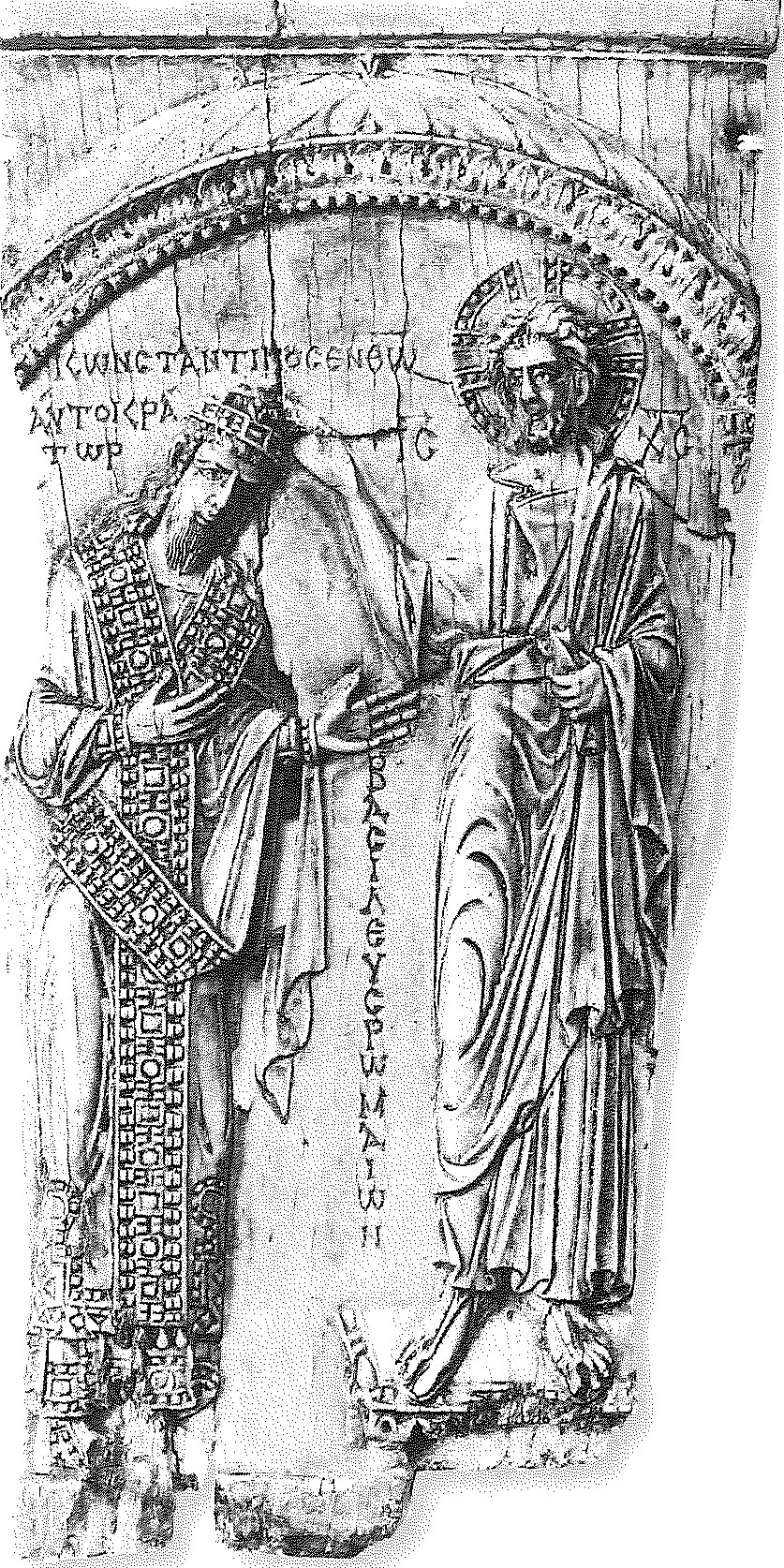
Hoved is jo wear action s Yor a state which, to a great degree, very hostile world to the skill of its diplomats, we have precious little direct information about the East Roman (“Byzantine”’) Empire’s foreign policy. What little we do have survives largely because in the late 940s, Emperor Constantine VII, a monarch of a scholarly bent but little hands-on experience, prepared a series of “Transition Briefs” for the benefit of his son, the future Romanus II. While never intended for publication, they were found a century later in the archives by some inquisitive official who had them copied out, happily preserving for posterity much of what has come down to us about Byzantine court ceremonial, provincial organization and diplomatic history and practice. Unfortunately little of this corpus is available in English, beyond a few excerpts from Constantine’s collection of accounts of Byzantine diplomatic missions and this edition of De Administrando Imperii (’On the Administration of the Empire,” the title given it when it surfaced in the West in the 16th century). Despite its name, DAI deals mostly with foreign policy, although at the end there are some notes on recent changes to provincial boundaries, a backgrounder on organization of the state barges and a rather legendary history of the Empire’s remote, but strategically vital, listening-post at Cherson, in the Crimea.
The main portion of DAI consists of a series of profiles on the Empire’s neighbours, outlining their history, their current status and attitude to the Empire, and advice to young Romanus on how the relationship with these peoples should be managed, or in modern terms: Background, Current Situation, Barbarian Position, Roman Position. Constantine even provides a detailed set of talking points to answer frequently received requests for Imperial insignia, Greek fire (the Empire’s secret weapon) and marriage alliances with the Imperial family. In all three cases the recommended response is to claim that there are divine sanctions forbidding such concessions.
Constantine saw no need for a business plan and nor were his diplomats required to outline their goals and objectives. Nonetheless, it is clear that his foreign policy was governed by certain fundamental principles, which stood the test of time:
• Wherever possible deflect attacks on the Empire by diplomatic means; use barbarians to fight barbarians;
• Never in any way or by any gesture (e.g., by the granting of insignia or marriage alliance) allow any foreign ruler to assume that any sort of parity exists between himself and the “God-protected” Emperor of the Romans;
• Never explicitly concede any territory that was ever once part of the Roman Empire;
• While those occupying what were once Roman territories do so on the sufferance of the Empire, reconquests should be undertaken cautiously so as not to endanger wider strategic interests. Constantine’s survey begins with the vital northern frontier. ArTOKP: The nascent Russian principality t wo and Bulgaria were the only powers which could directly threaten Constantinople, by sea or by land respectively. The key to peace and stability in this region was the Petchnegs, a tribe of pagan Turks who controlled the steppes from the lower Danube to the Volga. The Petchnegs could check any raid planned by the Russians, who had to portage their longships through Petchneg territory; likewise they could counterattack (with the help of the Imperial Navy) in the case of any Bulgarian incursion into Byzantine territory. The Petchnegs could also be used to overawe the Hungarians, whom they had driven from the Azov coast to their present home some fifty years earlier; or in conjunction with the Alans (ancestors of today’s Ossetians), make life very difficult for the Khazars (Arthur Koestler’s Thirteenth Tribe) on the lower Don and Volga, thereby ensuring the safety of Cherson. It was a difficult relationship, as the Petchnegs did not undervalue their services, but a key one. Constantine describes the arrangements for sending annual diplomatic missions to the Petchneg Khan, using either Cherson or a naval flotilla as a base of operations. Before the Ambassador entered their territory, the Petchnegs had to send hostages to ensure his safety. These hostages were entitled to compensation for “wear and tear” on their livestock.
Constantine’s review of the Arabs is dated and full of disinformation (e.g., he claims Allah Akbar means “for God and Venus”). With the collapse of the Abbasid Caliphate, the Arabs no longer posed a major security threat, although their raids had considerable nuisance value, and bit by bit their strongholds in eastern Anatolia and northern Syria were falling into Roman hands. Far more attention is paid by Constantine to the very complex and delicate three-way relationships between the Empire and the Moslem and Christian principalities of Armenia, Georgia and Azerbaijan. Constantine describes, as an object lesson, a failed attempt by his predecessor to subvert a strategic city in Georgia. This almost led to the wholesale defection of the other Christian princes to the Moslem camp.
The Balkans, even more Balkanized than today, are discussed at length. On one hand, the numerous principalities of Serbia and Croatia could be valuable allies against the Bulgarians; on the other, the Latin-speaking cities along the Dalmatian coast had to be protected against their inroads, as well as from Saracen raids. The official position was that Croats and Serbs had been invited into the Balkans by Emperor Heraclius, in the seventh century, to drive out the Avars (a particularly virulent nomad tribe), at which time they had nominally converted to Christianity and had been allowed to settle on Roman soil. They were therefore considered subjects of the Empire. The Byzantines were to continue to claim, and occasionally exercise, this suzerainty for the next four hundred years. The Albanians do not appear at all in Constantine’s survey. They were still in a state of what anthropologists call “pre-state formation”. Plus ça change….
The West gets very little attention. Aside from Venice, officially an Imperial vassal, the main concern was southern Italy, to which the Roman Empire still clung by its fingernails. Constantine describes the management of a complex kaleidoscope of Imperial outposts, nominally Roman city states, Lombard dynasts, and the renascent Western Empire, which usually cooperated with the Byzantines against Saracen raiders.
At the remove of a thousand years, it is hard to assess the quality of De Administrando Imperii. Certainly the analysis of the situation in the Black Sea region is succinct and very practical, but discussions of some other regions often get lost in a stream of scholarly digressions. In general, the more immediate the concern, the more useful the analysis. For each region Constantine tries to provide an overall historical review of Roman interests, coupled with a snapshot of the conditions and concerns of his own day. Historical material ranges from quite good, to pure legend. His review of Spain degenerates into an etymological discussion on why it is called both Iberia and Hispania. Information available to him is so scanty that he even cites Herodotus, who wrote fifteen hundred years earlier.
Constantine can be a bit too fond of information for its own sake and often fails to discriminate between that which is of interest and what is actually useful. The reader has the impression that he dictated any interesting morsel he found to a scribe, who then wrote it up without any further editing. The result is the frequent reduplication of material, often giving slightly different versions of events. We learn no less than three times that in the 670s the Arabs carted off the remains of the Colossus of Rhodes using either 900 or 980 camels.
Considering the vast amount of archival material that would have been available to Constantine, compared to what survives today (museums hold tens of thousands of lead seals attached to now lost official documents), we are left with a sense of acute disappointment that he did not make better use of it, particularly when history shows that Byzantine diplomats were active, effective and very well informed. On the other hand, we must be thankful that at least his works – which too could easily have been lost — did survive, giving us a snapshot of Byzantine foreign policy at the end of the first millennium.
– .. 1/T.
View the original scanned pages →
Originally published in bout de papier, Vol. 16, No. 4 (1999-2000) — Winter 1999-2000 // Hiver 1999-2000, pp. 31–32. Read the rest of this issue →



