
bout de papier, Vol. 15, No. 1 (1998) — Spring 1998 // Printemps 1998, pp. 27–29
After more than two decades of inspiration and endeavour, David Manicom’s powers of expression and persuasion have been honoured by his peers. Not, we hasten to add, by a ministerial bauble or by a certificate of excellence for his work as a member of the foreign service. Instead, we celebrate David’s recognition in the literary world, most recently with his receipt of the impishly-named but seriously-intended Prix Parizeau — devised by Mordecai Richler as a reminder of the contribution of non-francophone writers to the cultural tapestry of Québec. For the boy from rural Ontario and the resident of Aylmer — among many locales and circumstances which have shaped his writings— this achievement is richly deserved.
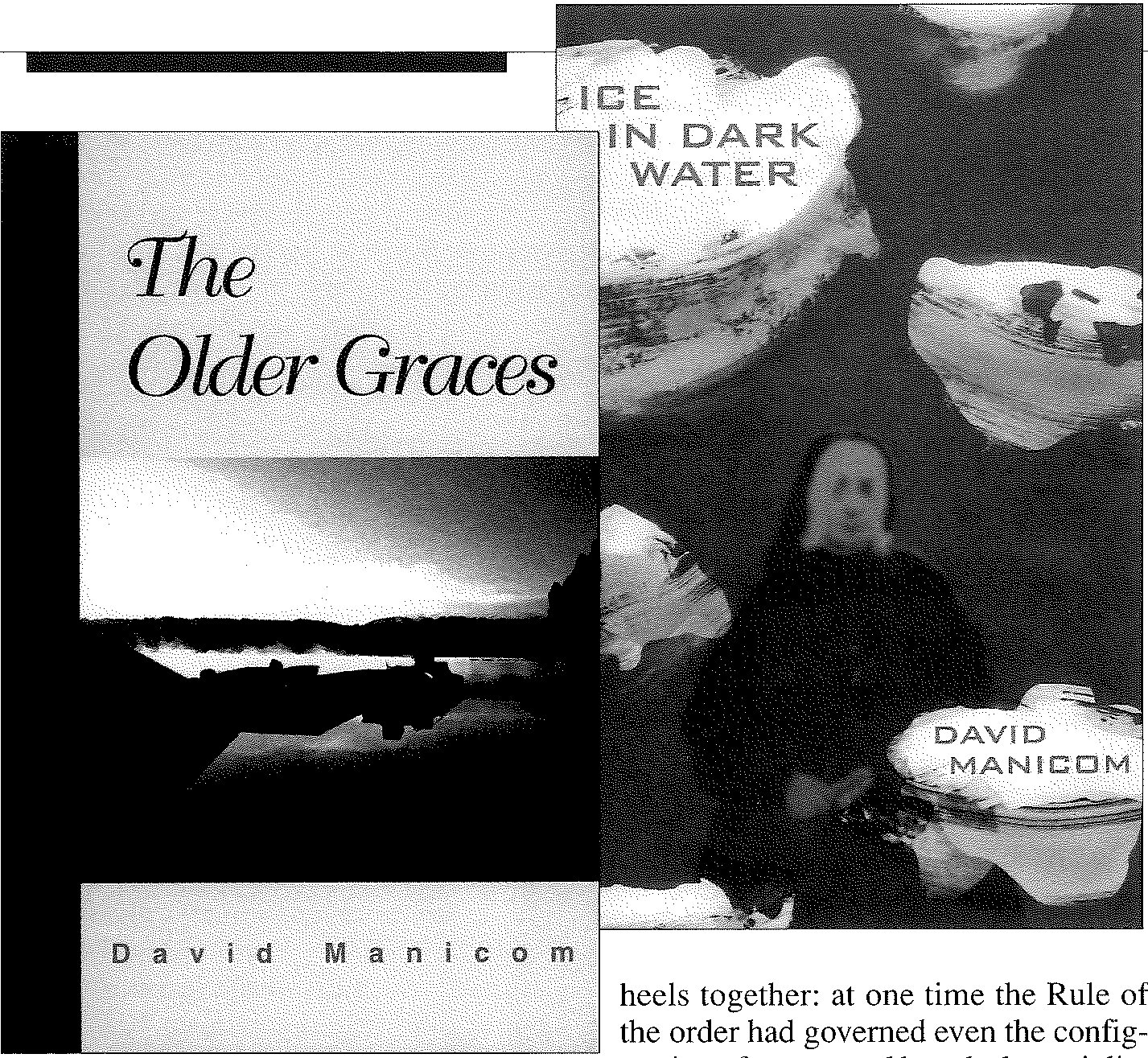
David won the Prix Parizeau for his first collection of short stories, Ice in Dark Water, which was published last year by Véhicule Press of Montréal. Last year also saw the publication of his third collection of poetry, The Older Graces, by Oolichon Press. Both include material which has appeared in recent years in major literary magazines and reviews in Canada and abroad. These works, and more to come, place him within a fine creative tradition within Canada’s foreign service — not an oxymoron, as we all know (despite occasional efforts by the public service commission and others to stifle wayward tendencies). This not uncritical coexistence of profession and vocation finds delightfully wicked expression in the second of a septet of poems on Romania, entitled “Diplomats” which should be required reading for new entrants to the foreign service.
With his prose and poetry, including poetic translations, David Manicom paints a wonderfully evocative world of memory, experience and dreams in which the pauses link rather than separate dialogue and the images somehow are both familiar and remote. To hint at the power of his writing, we have extracted below two poems from The Older Graces and the introductory passage from the short story which lends its title to Ice in Dark Water.
Ice in Dark Water
Véhicule Press, 1997, p. 148, $14.95
IN THE HEART of Montréal, wedge in the swift river, hedged by rapids, Julienne
Charbonneau awoke into the darkness before dawn amid the shrouded clutter of her small room thinking, with such intensity that the thought itself seemed to have lifted her from sleep, Gloire a toi, Marie, fille d’Israel! The night smelled blue. She sat up rigidly — to this day she slept tidily on her back with arms tight to her sides and heels together: at one time the Rule of the order had governed even the configuration of rest — and heard a lone violin, straining upward. Her eyes were too weak to focus the time, but she knew as the all-night classical program on RadioCanada reached her ears that the clock radio read 4:45. All strings. Schubert perhaps, she guessed, trying to pretend that nothing remarkable was occurring, before she abruptly recited to herself with great vigour Gloire a toi, Marie fleur épanouie dans la joie du Ciel! The air was dense with incense. She had left her window open; it had been raining. The effusions of the overgrown bank of lilacs that crowded this wall of the building were overwhelming. Now? she thought. Seventy years of silence had made her forget for months at a time that she was still waiting. The third praise settled into her mind like a leaf onto a still pool. Gloire a toi, Marie, rose merveilleuse dans le clair matin! There was no clarity, no joy. She was trembling and felt nauseous; her mind gaped, faced four directions, found blind alleys. Now, Holy Mother? Routine bustled into her body, stirred her limbs. As she stood, one knee flinched and then buckled, forcing her to grasp a chair back with both hands, like an invalid with a walker. Shuffling forward, she found her trifocals and switched on the lamp.
The thin down of her white hair glowed. In her vision, 1990s Montréal was abandoned in sleep, a dark, hunchbacked mass in the midst of a cobalt St. Lawrence, her autoroutes were silent and methodical, her trees were heavy with hoarded leaves that absorbed more and more light, her houses were lifeless stumps. Here and there, scattered across the island, stood dim outlines of the vast greystone monasteries and convents; moored and absurd, she saw, ships from the other side of the world, helpless beached leviathans; she could see their long wings, their epic corridors and embalmed chapels, their decaying and rickety networks of balconies where no one now lingered for evening air or strolled to recite the Office, their receding legions of dusty, unlit, rock-violated windows. Grey Nuns and the Sisters of Saint Anne, Redemptorist Fathers and Dominicans, Sulpicians, Augustinians, Benedictines and Ursulines, Oblates of Mary Immaculate and the Congregations of the Holy Cross, Sisters of Providence and Sisters of the Holy Names of Jesus and Mary: each order starved by epidemics of doubt until its final frail members returned to the hospitals they had founded and staffed, or were sent to more sensibly-sized cottages recently purchased in the Laurentians, leaving windows dusty, unlit, breached. She could see, from a dizzying precipice, only a single light in the entire city.
She turned off the light, gasping. In the humid night she sought a point of reference. Groping, she touched the soothing leather of her breviary on the desk and lifted it carefully in her arthritic hands, flipping it open with one of the dangling ribbons. Two eggs, soft boiled, not too runny, she thought, to reassure herself. Cautious still, she slowly reached down, turned the lamp back on, and waited. Nothing. Today was — May 29th? Monday. Of course. Yesterday had been the feast of the Body and Blood of Christ. It seemed a week ago; such a long, restless night! Father Patrice had been good enough to come up from St. Viateur’s to give mass to the four final stubborn Sisters, who lived in their over-endowed and under-populated convent like plague survivors in a mountain town. No feast or solemnity was listed for today, but on the 31st came the Visitation. for a moment, amusement eased the tension.
“You’re two days early,” she said to the window. “Or are you still using one of the older calendars?”
The sixteen panes were ice in dark water, showed no sign of light. She should know there were sixteen, shouldn’t she, each with the same rectangular proportions as the window itself? She had lived in this room, after all, for most of the last thirty years, and in one like it for thirty before that. Outside, below the lilac, the municipal tennis courts lay under slight mist bounded by ghostly lines, their geometry more forceful at night; beyond them were the somnolent oak-and-maple canopied streets of the Outremont district and the brick or stone houses of its formidably well-to-do inhabitants. Then, gripped at the core of her muddled inclinations, she thought Gloire a toi, Marie, perle précieuse dans le champ divin!, coughed and then gagged for air, jolted. Her pulse hesitated. Unable to straighten her index finger enough to turn the onion-skin page, she pushed it over with the side of a knuckle. A draft prickled the skin on the undersides of her arms and around her back. Tinged with dread, she remained motionless for a time, then decided: Go.
The Older Graces
Published by Oolichan Books, 1997, p. 84,
$12.95
Why I Need You
All the hotels in the world
Are the hotels of Minsk.
From their windows the statues
Are poets and slaughtermen
Put up in the parks
In identical poses, in the playing
Of children. There’s no heat.
The radio plays one station
Called the voices of strangers.
It’s always the middle of March.
The floorlady watches my door.
The restaurant closes
Before I am hungry.
All the women I do not love
Call to be exploited
For U.S. dollars only.
The mountains are flat.
The colours are slush.
There’s no way to get warm.
My kids don’t wake me
For glasses of water
In the middle of dreams.
The band in the bar plays Feelings.
The long distance line
Puts your voice in the room
And it seems almost real.
The shop in the lobby has cartons
Of Snickers, but no soap.
The hot water is cold.
Forget about breakfast.
This is how people live
After the divorce.
After all the wrong words,
After a hand cupping water
Goes gradually dry
There are the hotels of Minsk,
All the hotels in the world.
Flyways
I loved you most the first cold day
in September.
Toward dusk the rabbits ascended
to nibble the weather.
The swings kicked the wind in
the emptying park
As if invisible children pumping up
Through this earlier dark of fall had
dangled free
Climbing an arc, rising, all that
is easily lost.
The delicate slides stood prehistorically
still.
Above us a river of starlings surged
and blossomed,
Spanning the sky with a body of
infinite parts,
Tracking the Ottawa south, riding and
cutting the gusts;
Yet within, a turmoil of individual flight,
And, when it passed, a chaff of
stray birds
Blown in the heavens. I linked small
fists to each hand
And headed for home, as well
as I could.
View the original scanned pages →
Originally published in bout de papier, Vol. 15, No. 1 (1998) — Spring 1998 // Printemps 1998, pp. 27–29. Read the rest of this issue →



