
bout de papier, Vol. 16, No. 1 (1999) — Spring 1999 // Printemps 1999, pp. 24–27
For Earl Drake, his last posting, to Beijing, was likely his most memorable and it was certainly the one which brought him the greatest attention from the press and public. It was also, as this extract from his memoirs makes clear, an experience which confirmed his judgment that it was time for the Prairie boy to return to Canada.
Earl Drake was born and educated in Saskatchewan, graduating from the University of Saskatchewan in 1951 with an M.A. in history. His career as an historian – and his studies towards a doctorate at the University of Toronto — were halted when he joined the Department of External Affairs in 1955. Before Beijing, Drake had been posted to Karachi, Kuala Lumpur, Paris (at the OECD), Washington (as Executive Director of the World Bank) and Jakarta (as Ambassador). In Ottawa, his assignments had included stints with the Glassco Commission and at CIDA as well as progress through the ranks to Assistant Deputy Minister for Asia and the Pacific in External Affairs and International Trade Canada. But the focus of this book is on his service overseas.
Too often, diplomatic memoirs can be self-serving chronicles of encounters with the great and carefully phrased demonstrations of the intelligence and prescience of the author, with occasional asides about the cultural and/or social milieu at a post to prove how worthy of preferment, whether obtained or not, was the unquestionably distinguished and sophisticated member of the foreign service. Unfortunately, such selective renderings of the entrails of diplomatic careers tend to distance authors from readers — except for those who aspire to be memoirists themselves — helping to mystify but not to inform or to educate those who ultimately pay the bills and whose interests and values are supposed to be upheld.
A Stubble Jumper in Striped Pants: Memoirs of a Prairie Diplomat is an exception to that rule. With wit and clarity, Earl Drake conveys the trials and tribulations as well as the occasional triumphs of diplomatic life and the considerable toll it exacts from the diplomat and the diplomat’s family. Between these covers, there is humour (usually at the author’s expense) and sadness, but not affectation or pretension. For most readers, the subject which will attract their interest initially will be Drake’s account of the events in Tiananmen Square in 1989. However, there is much more in this book. The most obvious argument in favour of the foreign service, which is extracted below with permission from the publisher, occurs as a postscript to the autobiography, but the memoir generally can be read as an eloquent testimonial to Canada’s need for representatives abroad.
A Stubble Jumper in Striped Pants: Memoirs of a Prairie Diplomat, by Earl Drake, will be published later this year by University of Toronto Press (Cloth: ISBN 0-8020-4464-6; $35.00).
Earl Drake is currently an adjunct Professor at Simon Fraser University and Project Director, China Council for International Cooperation on Environment and Development.
Hector MacKenzie
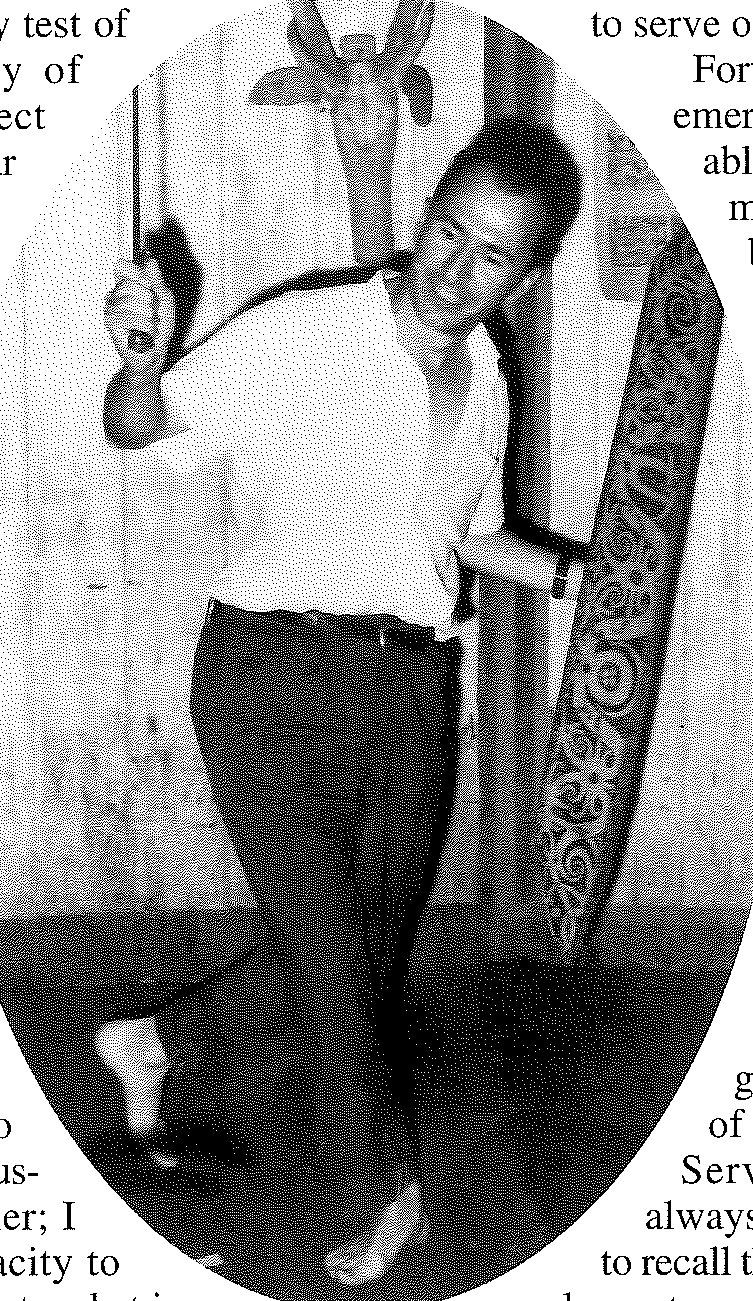
When I joined External Affairs, I was worried that I would have to do things which would make me look silly back in Saskatchewan, like kissing women’s hands and wearing tails and striped pants. In my first year in Ottawa, I was invited to my first diplomatic reception by the French Ambassador and his wife. I asked my office-mates what was expected. A colleague from Quebec advised me with a straight face that I would have to rent striped pants and a long-tailed coat from some head waiter and learn to bow deeply and kiss the hand of the Ambassador’s wife. I was appalled and apparently betrayed my feelings. My colleague relented in his teasing and assured me that I would not have to rent striped trousers until I had become a lot more senior in the service but I would have to kiss the lady’s hand. I was still suspicious of his advice and my prairie soul was deeply opposed to kissing anyone’s hand. So I sought a second opinion from my landlord, Morris Levy. He seemed worldly wise and had operated in several cultures. He was a Central European Jew happily married to an Irish Catholic and had lived in several European capitals and in Egypt before moving to Ottawa where he now prospered as an eccentric scientist. He pondered my question before delivering the following advice: “When it comes to kissing women, one must make a basic choice. Either they are worth kissing enthusiastically on the mouth or cheeks or they are not worth kissing at all. Forget hand-kissing.” As I waited anxiously in the receiving line at the French Embassy, I watched carefully what others were doing. Some kissed the hand of the hostess, others simply shook it but no-one kissed her enthusiastically. I decided to follow Morris Levy’s advice and my own prairie instincts and avoid hand-kissing. I have done so ever since.
I did eventually have to relent on striped trousers. As I became more senior, I had to attend functions where gray striped pants, a long morning coat, gray vest and tie were the official uniform. So I bought a complete outfit but never overcame the feeling that it was pretentious and symbolic of the foppish side of diplomacy. Like most Canadian Foreign Service officers, I thought of myself as a civil servant working for Canada abroad, not as a member of a privileged class wearing fancy clothes.
In my experience, a sense of humour is indispensable to survival in diplomatic life because it enables one to retain a healthy perspective — for example, to distinguish between those protocol rules which are necessary for managing civilized intercourse among national representatives and those which are simply pompous and absurd. Moreover, one who has to live in countries dominated by a zealous political or religious dogma soon learns that the ability to enjoy the amusing side of lite is a rare and precious gift. One of the things I hate most about the blind faith of either a Communist or a Muslim Fundamentalist is that the true believer has absolutely no tolerance for humour. I suspect that they fear the wise words of the Earl of Shaftesbury: “Twas the saying of an ancient sage that humour was the only test of gravity and gravity of humour. For a subject which would not bear raillery was suspicious.” One thing I find heartening about the human spirit is that after years of methodical political indoctrination in China and stern religious teaching in Pakistan, so many people of those countries have retained a wonderful sense of humour.
When I speak of the importance of humour, I do not mean the ability to communicate facetiousness as an entertainer; I mean the quiet capacity to perceive and appreciate what is comic or droll or absurd or pretentious in everyday life. The best humour is neither cruel nor crude; it is an irreverent commentary on the endless paradoxes in the human experience. It is from that perspective that I have tried to preserve a sense of humour in writing these pages. The foregoing personal recollections were not intended to be funny but to inform and occasionally amuse the reader.
These memoirs are not intended for diplomats but for the lay public. They do not purport to be a critique of the Canadian Foreign Service or a history of postwar Canadian foreign policy. They do not deal with the serious social problems inherent in such a career: the stress on children repeatedly uprooted from friends, familiar school systems and cultural settings; the problems of alchoholism or exotic disease for some; and the strain on marriages. All these problems have been largely ignored by the Department of External Affairs (now called Foreign Affairs and International Trade) which, in my time, never had a sensitive or sensible personnel policy and was notorious for its indifference to the social, psychological and physical welfare of its employees. No-one should ever contemplate joining the Department of External Affairs under the illusion that they can expect support from a sensitive or compassionate employer. The only attractions are to work on interesting problems with intellectually stimulating colleagues and to serve one’s country abroad. Fortunately, my children emerged as strong, adaptable and internationallyminded individuals but our gypsy lifestyle was frequently very hard on them. Luckily also, I have outlasted my tropical bugs and have never been attracted by liquor, although I have managed to down some dreadful stuff for Queen and country! But the Foreign Service was a contributing factor to the failure of my first marriage.
Nor do these tales give a balanced account of work in the Foreign
Service. Memoirs are always selective. One likes to recall the incidents that were pleasant, amusing or stimulating.
One glosses over the majority of time spent on routine or unpleasant things. I have devoted few pages to that half of my career which was spent in Ottawa because there is little that is unique about my experiences there. But, in recent years, time in Ottawa has been the most important for ambitious Foreign Service officers. That is where the power game is played and it is based on pleasing Ministers and top civil servants rather than advancing Canada’s interests abroad or, Heaven forfend, working in unhealthy places where one might get sick or spat upon. Some recent Deputy Ministers of External Affairs had spent little, or no, time on foreign assignments before they were appointed.
I have dealt only tangentially with the changing nature of the Foreign Service. In my lifetime, its role and importance have been affected in major ways by improved methods of travel and communication, by Canada’s changing priorities, and by the lowered esteem in which the whole Civil Service is held by politicians and the public. I am nostalgic about the passing of the old days when we were sent on month-long steamer trips to remote assignments and told that, although we would receive the occasional message from Headquarters, basically we should use our own judgment in looking after Canada’s interests. Those days seem fanciful to modern diplomats who know that nowhere on Earth is more than 24 hours’ flight from anywhere else and only seconds away by telex, fax, e-mail and CNN television.
Similarly, I recall fondly my early years when Canada’s proclaimed priorities were helping the Western Alliance maintain international peace and stability and promoting international economic development and social justice. Now they seem to be reduced to scrounging contracts for politically-connected exporters and “photo opps” for Ministers. But I must be realistic and objective. Modern telecommunications and insecure Ministers have rendered the old-style Foreign Service obsolete and it must adapt. It no longer needs romantic generalists with a taste for adventure: it needs computer-literate technocrats, trade negotiators and media “spin doctors”
What does trouble me is the recent denigration of the whole Civil Service by politicians and the media. Diplomats have been figures of ridicule and envy in every country and every age because their objectives and their lifestyle are so remote from everyday experience. It is an occupational hazard that we diplomats will never be understood, much less appreciated. Until recently, however, we could take some comfort from the belief that our image would improve if only the public realized that we were simply civil servants working abroad. We believed strongly that the Civil Service was an honourable career dedicated to serving the public and making a positive contribution to the commonweal. For generations, the ideal of serving one’s country has attracted some of the best and brightest Canadians. In recent years the whole Civil Service has been singled out, quite unfairly, for criticism as a bloated bureaucracy indifferent to public concerns and a principal source of Canada’s deep-seated debt and economic problems. I hope that this is a temporary phenomenon because, if it continues, it will discourage the dedicated and high-minded from serving their country either at home or abroad. What I miss most are the days when Ministers trustingly turned to civil servants for advice on “what is good for the country” instead of the prevailing mood where politicians make bureaucrats the scapegoats for their declining party fortunes.
Toward the end of my stay in Beijing, I attended a formal banquet in my honour at the Great Hall of the People. As I sat in that huge monument to an alien revolution in a strange country, I thought to myself that I had come a long way since leaving Saskatchewan on my quest to become a history teacher. I was even enjoying all the food which kept coming, in dish after dish, each more exotic than the last. In China I had long ago learned never to ask what I was ingesting, just to concentrate on the conversation and not even think about the food
My host observed me smiling to myself. “I am delighted to see you enjoying your food,” he said to me solicitously. “Most foreigners do not appreciate that dish. But roast dog is delicious and is particularly beneficial for someone of your advanced years.” My host meant to be courteous and complimentary: I had shown good taste in enjoying a Chinese delicacy and his reference to old age was a sign of respect. I received a different inner message, however. When an aging son of the prairies starts enjoying roast dog in the Great Hall of the People, he has been away from home too long! External Affairs had given me a fine career for more than three decades, but the Foreign Service was changing and so was I. It was time to retire, return to Western Canada and restore my roots.
Soon after that dinner, I returned home and asked to be assigned to a University in Western Canada prior to retirement from the Canadian Foreign Service exactly 37 years after entering it. I then joined the David Lam Centre for International Communication at Simon Fraser University in Vancouver as an Adjunct Professor. This Centre is dedicated to improving two-way communication between Canada and East Asia. This position has given me a comfortable eyrie from which to survey Asian-Canadian relations with lofty detachment and, at my discretion, swoop down and involve myself in them. It has also given me the time and the congenial environment in which to do some writing. After so many years of brainwashing by the Department to express myself in a balanced, cautious, anonymous and soulless way on paper, it is a distinct pleasure to write what I damn well please.
With the new luxury of writing freely, I decided to devote some spare time to record these memoirs. In them, I have tried to describe the mutli-faceted life of a Canadian diplomat, to comment on the rising importance of our economic relations with Asia, and to argue that people of character can make a difference in the conduct of national and international affairs. If I succeed in broadening the horizons of a few readers, I shall be pleased. In any event, I intend to carry on writing and working in the belief that a combination of prairie common sense and an historical perspective are useful attributes in promoting international understanding.
View the original scanned pages →
Originally published in bout de papier, Vol. 16, No. 1 (1999) — Spring 1999 // Printemps 1999, pp. 24–27. Read the rest of this issue →



