
bout de papier, Vol. 11, No. 3 (1994) — Fall 1994 // Automne 1994, pp. 22–24
Seventy years ago, what was it like for the family of a Trade Commissioner in Japan? James Langley lets his mind wander back to those far off days.
Mic Tade Consoner serice. ore than seventy years ago my
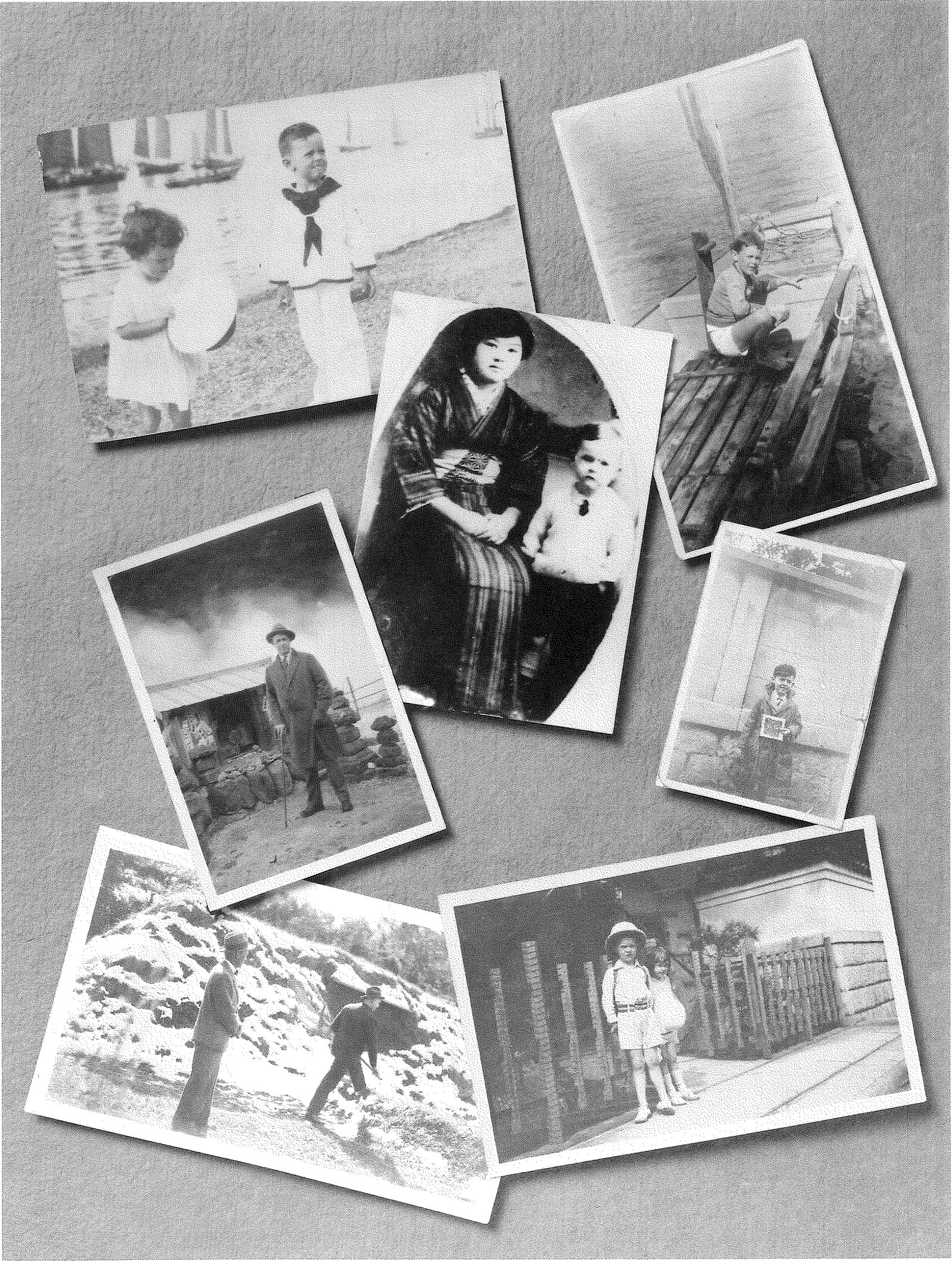
L the Trade Commissioner Service. In November 1923 he was posted as Assistant Trade Commissioner to Kobe, Japan, and in 1929 moved to Tokyo as Commercial Secretary at the newly established Legation, becoming the first Trade Commissioner formally integrated into a Canadian diplomatic mission. There are no witnesses left among the players of that era. I have therefore allowed my mind to wander aimlessly through a decade or so, centered on 1929. What follows are fragments from the life of a Canadian trade official and his young family in those early days recorded in the simple language in which they are registered in my memory.
I don’t remember much of the early good old days. I know we lived in Kobe near the yards where they kept the electric trams that crackled like lightning and showered down sparks. We always lived in Japanese houses. I liked that. You could climb on the tile roof that was hot to the feet and, if you made a small hole in the shoji (sliding partition of rice paper mounted on a wooden frame), you could see into the next room. But according to Dad, the Inspector was not pleased and said that we should set a good example and live in a Western house that had a bath with taps and WC. However, Mamma said that if you want to know the country and do well at selling Canada and wheat and stuff, you must get close to the people. So we just went on living like the Japanese, except that later we had carpets from China and shiny enamel stoves with salamanders on them that burned anthracite. Later still Mamma had glass put into the shoji instead of paper so we could see the garden from inside and the candles in the stone lanterns by the pond at night.
Dad and Mamma often went out, especially at night. Mamma wore long dresses and fur around the neck. She had a glass bowl with a silver top and great feathery puff where she kept powder that smelt very good. My sister, Lorna, and I were unhappy when they went out and very scared they mightn’t come back even though the amahs
22 bout de papier Vol. were nice and took us into their room until bedtime. Asa-san in particular would play with us. Her father was a fisherman at Atami, where we went in summer, and she stayed with us almost the whole time we were in Japan. The other servants were always from her family. They wore Japanese clothes like almost everyone, except schoolchildren and policemen.
On Sunday we always went to the English church where you met lots of friends. In Kobe there were lepers outside, some with no feet or hands and people would give them money. I got 25 sen for collection and 25 sen as my allowance. For as long as I can remember I liked to buy little things in the antique stores that Mamma and Dad went to. Sometimes it was an old coin; once it was a little ivory man with no clothes, whose legs and arms moved. I couldn’t pay all at once, but Nambu said I could pay a bit each week. That Sunday, when Dad gave me my collection money I looked at it and asked “Who is more important, Nambu or God?”
When we moved to Tokyo it was because Dad was to be an experiment at the Legation. We lived near Prince Chichibu’s palace and Dad had his office in a big building near the Imperial moat down-town. Mamma and Dad seemed to go out even more than in Kobe.
Once they had to go to a lunch given by His Excellency. Lorna and I were lonely, so I said “Let’s go and find them on my tricycle. If we’re quiet, Asa-san won’t notice and I’ll peddle because I’m bigger. You stand behind on the bar with your hands on my shoulders and maybe push a bit on the hills.” So we got the tricycle and went down the lane to the park where the policeman was, and then in front of the palace, and round the grounds of the dowager Empress’ palace. We came to the American church and turned left down a very long street to where there were soldiers at a gate and other bad men inside. We crossed the street so as not to be too close to them and went down to the big crossroads where there was a policeman cranking a stop-go sign that flapped like a bird. We went down the hill into Rippongi, then up again to Nishi-machi. When we got there, I rang the bell and Yanagawa-san (I think) came to the door. He looked very surprised and took us into the kitchen, saying “I will tell your mother who is still at lunch”. ’ She was even more surprised
I especially remember His Excellency (the Canadian Ambassador Herbert Marler). He was tall and straight and always looked as though he was wearing a uniform. Everybody was a bit scared of him, even Her Excellency (Mrs. Marler), but he was always nice to me. He would pat me on the head and call me the King’s Messenger and I got to carry his briefcase from the office to the residence. The office was like a big shoebox with windows, but the new residence was beautiful with a big ballroom and a dining-room with screens behind which the waiters waited. Yanagawa-san was like a silent magician. He watched and made a little sign and the waiters stopped waiting and flowed into the room like water and the plates disappeared and food appeared without anyone noticing. Mamma said that once Her Excellency was pretty peeved with a guest who had bad form and always turned plates over to see where they were made. At dinner one night she glued her picture to the bottom of one of them and he got a terrible shock.
His Excellency liked Dad because he got on well with everybody and was pretty practical. Dad was in charge of getting the new legation built and he also brought in food for the staff: lots of boxes full of tins and, at Christmas, frozen turkeys that were kept in a cold warehouse that glistened with frost. He went with His Excellency to China and Manchuria where they tried to sell things and ate some pretty strange stuff like turtle hearts beating in their blood and thousand-year old eggs that were dug out of the ground.
Lots of people came to our house. We always took our shoes off and walked on the tatami with our feet, but foreigners didn’t know about this, so Mamma had little canvas bags with elastic tops made and when visitors come they put them over their shoes. Then they could come inside. Also, the bags were good for running and sliding on the wood corridors though you had to watch for splinters and Mamma might say “that’s too much yakamashi!”
I liked it when they had dinner parties, especially if there was chicken to eat. Lorna and I got out of bed and sat on the stairs by the phone and Dad opened the dining-room door and gave us each a drum-stick. There was light and noise in the room. I heard someone say that Dad didn’t know much about wine and always served sauterne because he liked it sweet but that it was better than some houses where you only got Canada Dry.
One day we did what they call representing Canada at the YWCA. Though it was quite hot Lorna and I had to wear overcoats, scarves, and mittens; Lorna wore a beret and I had a long stocking hat with a tassel. We had our skates around our necks. Mamma pushed us onto the stage and a lady began to play “O Canada.” We were expected to sing but we had only tried once before and couldn’t remember the words — so we just looked at the floor. Mamma sang as hard as she could behind the curtain but nobody clapped
Dad wrote all kinds of reports to tell the government about his trips and what we can sell in different places. He also wrote for a magazine about these things. He brought his reports home and Mamma read them because she was especially good at that sort of thing. She made corrections but he didn’t seem to mind. Later he brought the magazine home and we saw his name where his reports were. He also brought home lots of Canadian newspapers with Tarzan and Burgess stories about Brer Fox and others in them.
Dad also had lots of films at the office to show people about Canada. There was wheat growing on the prairies and apples in BC, and rivers with salmon and electric dams, but the best were about the Calgary Stampede with racing wagons and cowboys riding wild horses and bulls.
Mamma was always worried about education. In Kobe I went to Mrs. Black’s school where I learnt how to add and subtract numbers. When we came to Tokyo she didn’t want to send us to the American school because “there is no discipline” and also, perhaps, because Dad says her family is UEL (United Empire Loyalist), whatever that means. Mamma hired a teacher, Miss Ingram, and ran a little school for us and friends. Then they sent me to the German school in Omori until there was too much “Heil Hitler” and I said my prayers in German. Then it was with the Jesuits to learn French and Latin. It was pretty confusing and I made a bit of a mess of things, but they said “Don’t worry, he’s a late bloomer.”
View the original scanned pages →
Originally published in bout de papier, Vol. 11, No. 3 (1994) — Fall 1994 // Automne 1994, pp. 22–24. Read the rest of this issue →



