
bout de papier, Vol. 20, No. 2 (2003) — Fall/Winter 2003 // Automne/Hiver 2003, pp. 6–9
•diplomacy. Assuming the system does not crash, we can communicate instantly by phone or e-mail, anywhere on the planet. Modern airliners can physically deliver you (if not your luggage) to virtually any destination within 24 hours, barring wars, French air-traffic controllers or the financial collapse of the national airline. The same applies to the movement of goods. We can dine on fresh New Zealand lamb, with Chilean raspberries for dessert; buy stuff off eBay from Bulgaria or Korea and pay for it on-line. This was not always the case. In antiquity and the middle ages, transport and communications were, with the exception of cursory warnings by beacon or semaphore, limited to the pace of a horse or a fast galley, and bulk goods went at the pace of an ox-cart, pack-horse or sailing ship. Even at the height of the Roman Empire, with its fine road net, highly organized postal system and state-sponsored shipping routes, it could take six weeks for a message to go from Trier on the Rhine frontier to southern Italy, while a round trip sea voyage between Rome and Alexandria averaged three months. Beyond the Imperial frontiers, the pace of travel declined even further. That said, goods, people and ideas moved from one part of the empire to the other and beyond. A Spanish-born emperor could lead British soldiers to the mouth of the Tigris, while a unit of Tigris Bargemen shivered by the Tyne in northern Britain. A decree posted in Alexandria lists the prices of, amongst many other items, Italian sausages, Celtic beer and Belgian cloaks. The historian Ammianus, whose mother tongue was likely Syrian and language of education Greek, wrote in Latin about campaigns beyond the Rhine. A professional soldier, his uniform and equipment were inspired by the fashions of Germany, Iran and central Asia.
DIPLOMACY COULD BE EQUALLY FAR FLUNG. We have several recorded instances of Roman emperors receiving delegations from India, some of which even had to travel as far as Spain to find him. In many instances, these missions may have been free lance initiatives by some enterprising merchants. Then, as now, diplomacy could provide an entree for trade, and there was virtually no way in which the credentials of these soi disant diplomats could be verified. The same happened in the opposite direction. In AD 166 some merchants, probably from Roman Syria, passed themselves off at the Chinese court as an embassy from the Emperor Marcus Aurelius. Their offerings — ivory, tortoise-shell and rhinoceros horn — were not what we would consider typical Roman products. In Antioch, in 32 BC, the Emperor Augustus, fresh from defeating Anthony and Cleopatra, received what was clearly an official delegation from a Punjabi king, bearing a letter offering a trade agreement. Only three of the Indian diplomats survived the journey, but their gifts got through intact. These included snakes, tortoises, a giant partridge, a man born without arms, and a naked “gymnosophist” (yogi), whose irrefutable closing argument to an Athenian philosophy symposium was to burn himself alive. Over a century later, his tomb still attracted tourists. Whether because of this embassy, or simply the discovery that the monsoons could speed the passage from Egypt to India, commerce between the Roman world and India would flourish, as evidenced by the Roman coins and artefacts unearthed in India and Sri Lanka.
While there are no accounts of actual Roman diplomats going to India, in the late sixth century the Romans began a series of even more daunting diplomatic exchanges with the Khagan of the Turks along the famous Silk Road. The Turkish homeland then lay in the Altai mountains where the Stans, China, eastern Siberia and Outer Mongolia converge. It was to be another 500 years before they began to settle the Anatolian plateau which now bears their name. The Turks had just overthrown their overlords, a people known to the Chinese as the Juan-Juan. They had then helped the Persians crush the White Huns, who had plagued the region north and east of Afghanistan.
WITH THEIR DEFEAT OF THE WHITE HUNS, the Turks became overlords of the Sogdians, a mercantile Iranian-speaking people who lived in the oasis cites strung along the Silk Road. Believing that the alliance between the Turks and the Persians would produce commercial benefits, the Sogdians sent a delegation to Persia, seeking better market access for their raw silk. Their overtures to Persia were rebuffed. The Shah, Khushru I, had his own sources of silk through India, and wanted no commercial rivals. He bought up the Sogdians’ silk and then, to indicate that the route through Persia remained closed, burnt it in front of them. The Sogdians asked the Turks to intercede on their behalf. The Turkish Khagan sent an embassy, but the Persians, who have frequently had problems with the concept of diplomatic immunity, poisoned his envoys. Although the Persians tried to give the impression the Turks had succumbed to heatstroke, the Khagan was not convinced — and not amused.
Now, effectively at war with the Persians, the Khagan agreed to a Sogdian suggestion that they take a message to Constantinople proposing an alliance between the Romans and the Turks against both the Persians and the Avars. The defeat of the White Huns and Juan-Juan had set in motion a wave of fugitive nomads who, as the Avars, descended on the Romans’ Danube front. Although the Roman and Persian empires had just renewed hostilities, the Emperor, Justin II, refused to pay the Avars the protection money they demanded, forcing him to fight a war on two fronts. Having satisfied himself that the Turks were indeed a major power, Justin was very open to the Sogdian overture and agreed to send a return mission to the Turks led by a senior Roman army officer, Zemarchus, to discuss the proposed alliance.
Setting out in August 569, Zemarchus and his party crossed the Black Sea and proceeded overland past the Caucasus mountains and north of the Caspian towards the Ektag, the remote Golden Mountain in Central Asia, where the Khagan kept his court. Crossing into Turkish territory, the Romans underwent a sort of security screening, being required to pass between two fires, while chanting shamans unloaded their baggage and waved burning boughs of frankincense above it to exorcize evil spirits. The Romans were lavishly entertained at the Khagan’s tented camp, impressed by his profusion of silks and gold, if not by their workmanship, and less still by the lack of real wine. Sonorous speeches were exchanged, and Zemarchus was given a captured female slave. Zemarchus then accompanied the Khagan, while the Turks attacked a Persian border town. En route a Persian mission was granted an audience with the Khagan, and yet another feast was given. The Persians were offended to see the Romans given precedence, and in countering the Khagan’s grievances against them, became a bit too free and frank in defending their position. The Persian delegation was dismissed and the Khagan resumed his march against them. Zemarchus agreed to lead a return delegation of Turkish nobles to Constantinople to finalize the alliance. Evading Persian ambushes in north Caucasia and Georgia, (and one point sending off a convoy of silk as a diversion) they regained Roman territory late in 571.
Over the course of the next five years there were at least five Roman missions to the Turks, while return missions brought over a hundred Turks to Constantinople. In the meantime, Emperor Justin had gone mad, and a senior general, Tiberius ruled with the rank of Caesar. He bought a truce with the Avars, and would have made peace with the Persians, but the Shah, Khushru, was not interested. These moves upset the Turks, at a time when the Romans were beginning to feel unease at their rapid expansion. Even as Zemarchus’ delegation had been making its way back to Constantinople, Turkish armies were moving in the same direction, threatening not just the Persians and Avars, but also tribes allied to the Romans. The Alans (ancestors of the modern Ossetians) had refused to admit the Zemarchus until the Turks in his party disarmed. A tense three days stand-off ensued until the Turks agreed. The Alans’ concerns were justified. The following year, they and the Onogurs, another tribe allied to the Romans, were overrun by the Turks. In 576 Tiberius decided it was time to repatriate the Turks residing in his capital. An Imperial Guards officer, Valentinianus, who had led two other delegations to the Turks, was selected to take them home.
He did not have far to go on the first leg of his mission. A Turkish army, led by a son of the Khagan, was gathering on the border of the Roman province of Cherson in the Crimea, with clearly hostile intent. Arriving at the Turkish camp, Valentinianus conveyed Tiberius Caesar’s greetings and expressed a hope that their alliance would endure. The Khagan’s son made it clear it would not. He bitterly accused the Romans of deceit and perfidy (even then, Byzantine diplomacy had a dubious reputation), as evidenced by their truce with the Avars and overtures to the Persians. Valentinianus remained tactful, reminding the Turkish prince that the alliance was his father’s initiative. Valentinianus was then informed that the Khagan had died, and the Romans were invited to show their grief in the traditional Turkish way, by slashing their cheeks with their daggers. The Romans complied, while the Turks executed four Hun captives, dispatching them with a message to the late Khagan. No doubt grateful that, they too, were not required to take part in this terminal mission, Valentinianus and his companions were then packed off to distant Ektag to see the new Khagan. Once they had departed, the late Khagan’s son invaded the Crimea.
WE DON’T KNOW EXACTLY WHAT HAPPENED NEXT, but echos of this rocky start to the relationship between the Turkish Khaganate and the Byzantine Empire, seemingly continue to colour the positions taken by their ultimate successor states in fora such as NATO and the EU. Meanwhile, the Roman-Persian war degenerated into a war of annihilation, which the Romans won, barely, in 628. It was a Pyrrhic victory, won at the cost of leaving the Balkans open to the Avars and Slavs. The combatants’ erstwhile Arab auxiliaries, united under the banner of Islam, were soon to sweep through the Middle East and North Africa leading to the near ruin of the Roman Empire and the utter destruction of the Persians. The ancient world was no more, but trade and diplomacy continued — much reduced, but quick to recover.
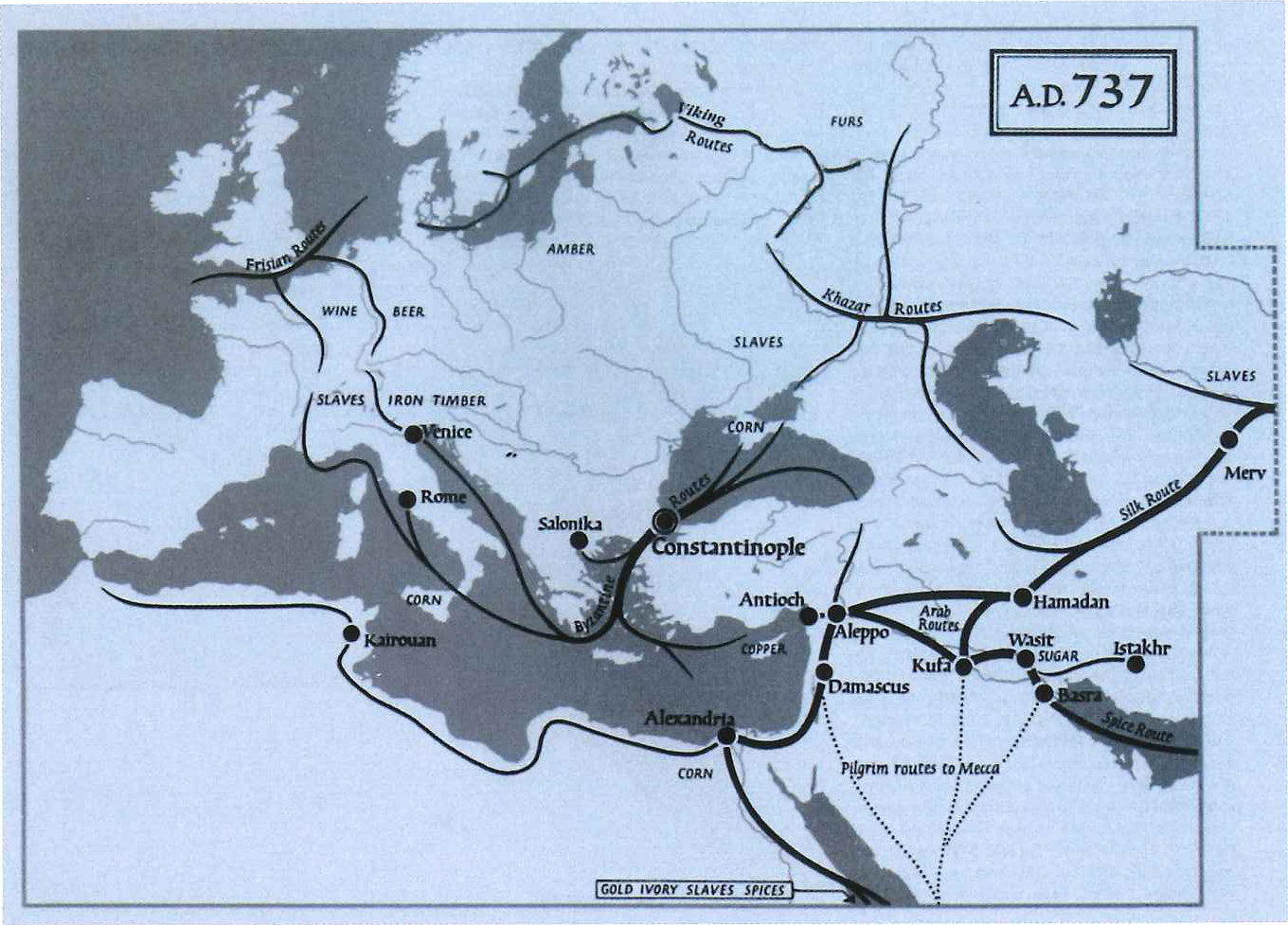
THE WORLD OF THE 700s WAS DOMINATED BY A NEW SUPER- POWER, the Islamic Caliphate, which stretched from Spain to India and Central Asia. The Roman/Byzantine empire still clung by its fingernails to Anatolia and the Balkan coastline. In the west, a new power was emerging, under the Frankish king (and from Christmas Day 800, Holy Roman Emperor) Charlemagne. His realm controlled or dominated much of the modern EU and was a major source of raw materials, quality weapons and slaves. It was also an emerging market for eastern luxuries, such as silks and spices. There are ample signs that trade and communications were reviving: western European finds of Islamic coinage; the development of pilgrim routes; letters from Jewish merchants in France seeking the advice of rabbinical scholars in Baghdad, and above all the flow of slaves through Venice, Naples, Marseilles, and Rome to the markets of the Middle East and Maghreb. There were also signs of increased diplomatic activity. While it took the better part of a year for a mission to get from Aachen to Constantinople and back (with further delays if regime change in one or the other capital rendered the diplomats’ credentials redundant), Charlemagne set his diplomatic sights further afield. Charlemagne and the Byzantines were vying for control over the upper Adriatic and southern Italy. To its east and south, Byzantium was still fighting for bout de papier Vol. survival against the Caliphate. Seeing a possible community of interest, Charlemagne twice sent delegations to the Caliph, Harun ar-Rashid, of Arabian Nights fame — in 797 and 806. The first mission took three years to complete and all the Frankish diplomats died, leaving Isaac, their Jewish interpreter and guide, to complete the mission. The second mission lasted four years, but the participants lived to tell about it. While some of the delay was occasioned by religious tourism, as they passed through the Holy intimate links and is different is the Land, the Frankish envoys had trouble actually locating the Caliph. Harun, sensibly, avoided Baghdad, in favour of frequent pilgrimages to Mecca, or campaigns on the remote frontiers of his empire. A further delay ensued bringing home Harun’s gift to Charlemagne, an elephant. It was dispatched overland to Tunis. Then, because the intervening waters were dominated by a hostile Byzantine navy, vainly enforcing a trade embargo with the Caliphate, the Franks had to mount a naval expedition to pick it up. Having expended so much effort in obtaining his elephant, Charlemagne saw it as a potential strategic asset, which he deployed against the Danes, who were monopolizing the lucrative trade route linking the North Sea and the Baltic. Ironically, as we will see, Denmark was also the terminus of another trade route linking the Islamic world with northern Europe. If it had lived to complete its mission, Harun’s elephant would have joined two great trade routes. Unfortunately, the Danish climate did for the poor beast, before its shock and awe effect could be put to the test.
WHILE VIKING VOYAGES TO THE WEST ARE WELL KNOWN, THE VIKINGS ALSO VENTURED EAST, not only to “give food to eagles” (as many dark age Swedish tomb-stones attest) but also, to trade, at least when goods could not be gained by force. The Rus, Swedish merchants/ raiders, had established a network of strongholds/trading posts and routes stretching east and south from the Gulf of Finland. One ran south through Novgorod and Kiev down to the Black Sea; the other ran east through the aptly named outpost of Belozero, near the White Sea, down the Volga to the Caspian and Central Asia. The local populace paid a tribute of falcons, furs and slaves, which the Rus traded south to Byzantium and the Caliphate. Particularly lucrative were the routes linking Islamic Central Asia with Russia and Scandinavia. Coins from Samarkand and Bokhara, silk fragments, and even a Chinese Buddha have been unearthed in the market towns of Sweden and Denmark. Indeed, seeking to give legitimacy to his coinage, the English King Offa struck pennies with imitation Arabic inscriptions. In 839 some envoys, sent by the Rus Khagan (he had adopted this Turkish title) to Constantinople, found their route home, up the Dnieper, was blocked by marauding nomads. The Emperor Theophilus therefore attached them to a delegation he was sending to Aachen, with a letter to his counterpart, Louis the Pious, asking his assistance in sending them home. Louis, already suffering from Viking raids, was dismayed to discover that these Rus, were, in fact, Swedes. Fearing they might be spies, he wrote back to Theophilus saying he was willing to repatriate them as a goodwill gesture, but not until he had established their bona fides. If they were genuine diplomats they would be sent on to Sweden, if not they would be returned to Constantinople. Regrettably the outcome is lost to history.
THE COURSE OF RUSSIAN/ BYZANTINE RELATIONS DID NOT ALWAYS RUN SO SMOOTHLY. In 860 following an unexpected Russian attack on Constantinople, a high level mission was sent to the lower Volga to negotiate an alliance with the Khazars against the Russians. The Khazars, a Turkish tribe dominating the north slopes of the Caucasus and the northern shores of the Black and Caspian seas (the Iranians still call the latter the Darya e Khazar) were valuable allies to Byzantium against the Caliphate and any threats coming from the steppes. One of the members of this mission was Cyril, the future “apostle to the Slavs” (he gave his name to the Cyrillic alphabet). In the 850s he had served as aseketis (the equivalent of First Secretary) on a series of shuttle diplomacy missions to Samara in Iraq, negotiating prisoner exchanges. During his mission to Khazaria Cyril used his free time to try to convert the Khazars. Although this secondary objective did not succeed — in the end the Khazar leadership adopted Judaism – Constantine found the missionary life sufficiently attractive to make it his full time career, one which called for all his past diplomatic skills balancing the demands of the Pope in Rome and the Patriarch in Constantinople for ecclesiastical jurisdiction over his converts. ALLIES TO BYZANTIUM, THE KHAZARS WERE A THREAT TO THE CALIPHATE’S NORTHERN BORDERS, and to its Russian/Scandinavian trade links. As the Khazars had extended their suzerainty over the entire Volga basin, and over the nomadic tribes between the Caspian and Aral seas, all trade between the Caliphate and Russia was subject to their tolls. In June 921, the Caliph, al-Muktadir, seeking to outflank the Khazars, sent a delegation to negotiate an alliance with the Volga Bulgars, located on upper Volga, east of where Moscow now lies. When the bulk of the Bulgar people had crossed the Danube in the late 600s, the ancestors of the Volga Bulgars had wisely decided to avoid the Balkans, and had headed north, where they became intermediaries in the Russian trade with the east. The Bulgar Khan had converted to Islam, and wanted to throw off his allegiance to the Khazars. He wrote to the Caliph requesting a delegation of religious scholars to complete the conversion of his people, as well as technical experts to help him build a mosque and, above all, fortify his border with Khazaria. The Caliph agreed to send a mission led by Mohamed ibn Sulamein. His secretary, Ahmed ibn Fadlan, left us an account of it.
Because the Khazars and Byzantines controlled the approaches from the south, Fadlan’s nission had to) proceed trom Baghdad. throug Iran and Khorassan, to the mouth of the Oxus (Amu-Darya) on the Aral Sea. There they overwintered – the cold almost killed them. The local governor, who himself benefitted from the Khazar trade, tried to discourage the mission with hair-raising tales about the ferocity of the steppe nomads. However, in March, still seemingly in the depth of winter (at least by Mesopotamian standards) the mission set forth, joining a caravan of 3,000 men and 5,000 animals. This was no uncharted waste they were crossing, but a well-defined trade route that linked Khorassan and the Volga and funneled Islamic silver north and west to Scandinavia and amber, furs and slaves south to the Caliphate. That said, the voyage had its perils. The Ghuzz Turks who controlled the intervening steppes were of two minds whether to let the Arab delegation pass, to kill them, or to hand them over to their nominal Khazar overlords. In the end they let them go and in May 922, I months after leaving Baghdad, they reached the Volga Bulgars. Unfortunately the objectives of the mission were blighted because the sum of 4,000 gold dinars, allocated for building the promised fortress, had been left behind, hopefully to follow in due course. This left the Bulgar Khan very dejected, as without his promised fortress, he was unwilling to take any steps that would further provoke the Khazars. In the end, the main deliverable of the mission seems to have been ibn Fadlan’s account of the deplorable hygiene and brutal habits of the peoples of the forests and steppes, especially his lurid account of the Viking funeral of a Rus chief (since made into an even more lurid Michael Creighton novel). In the end the Khazars’ downfall was to come at the hands of the Rus who sacked their capital in 965.
EVEN MORE SPECTACULAR EXAMPLES OF DISTANCE DIPLOMACY WERE TO TAKE PLACE IN THE HIGH MIDDLE AGES, when the Mongols briefly created an empire stretching from the Pacific to Silesia, and raised hopes in the west of a new grand alliance to roll back Islam. That merits an account in its own right, but as the above examples show, trade and diplomacy have long and intimate links and globalization is nothing new. All that is different is the scale and velocity of such exchanges.
View the original scanned pages →
Originally published in bout de papier, Vol. 20, No. 2 (2003) — Fall/Winter 2003 // Automne/Hiver 2003, pp. 6–9. Read the rest of this issue →



