bout de papier, Vol. 26, No. 3 (2012) — Spring 2012 // Printemps 2012, pp. 13–16
Ben Rowswell looking down over Tahrir Square.
Democracy 2
La décennie qui a suivi le 11 septemb transitions à la démocratie qui avaien enjeux de plus en plus nombreux. Pui: en Irak, ’administration Bush a invogu d’intervention militaire chez le public.
In the process Western audiences lost confidence in democracy promotion, either questioning the relevance of democracy to other cultures or doubting their governments’ ability to help other countries realize it.
In Afghanistan I saw the impact of this loss of confidence in democracy promotion. President Obama best expressed the sentiment of the
The personal opinions expressed in this article a Government of Canada. international community when he said that “nobody thinks that Afghanistan is going to be a model Jeffersonian democracy.” But if the standards of democratic governance were too high, what standards should apply to Afghanistan? How should we respond to electoral fraud, corruption and other abuses of power?
The persistence of those issues in Afghanistan has showed that we cannot escape the dilemmas of democracy promotion. If the wholesale export of the institutions of Western democracies is not viable, neither is it feasible to ignore the desire of people around the world to have some say over how their countries are run.
After two years in Afghanistan, I took a year’s leave to dive into issues of democracy promotion to explore how we could improve it.
La décennie qui a suivi le 11 septembre a été difficile pour la promotion de la démocratie. Les torrents de transitions à la démocratie qui avaient déferlé tout au cours des années 1990 s’étaient déjà taris face aux enjeux de plus en plus nombreux. Puis, en 2003, lorsqu’on n’a pu trouver d’armes de destruction massive en Irak, l’administration Bush a invoqué la démocratisation comme casus belli, rendant ce terme synonyme d’intervention militaire chez le public.
Liberation technology
Where better to dive into these issues than Stanford University, home to the world’s foremost scholar of democracy promotion, Larry Diamond? Stanford turned out to be a fateful choice, for a reason I could not have foreseen. In the end it wasn’t Diamond’s political science department that claimed most of my time at Stanford — it was the computer science department.
The two departments had teamed up in 2010 to create the first hybrid course of its kind. The “Liberation Technology” course is co-taught by Diamond, Law Professor Joshua Cohen and the Computer Engineering legend Terry Winograd. Winograd had supervised PhD students Larry Page and Sergey Brin as they invented new forms of internet search that became the basis of Google, the company they founded at Stanford in 1999.
The premise of the course is that communications technologies are transforming economic and political activity in all countries in the first place because of their ubiquity (with mobile phone penetration exceeding 50 percent in some of the poorest countries in Africa), and because they now permit the masses to send as well as receive information.
The resulting explosion and decentralization of information has already transformed the way the world does business. When billions of humans have access to tools that enable them to access far more information and organize themselves far more easily, redistributions of power cannot be far behind.
A few classes were enough to grab my attention. Over the coming year, the Liberation Technology course became my crash course in technology.
I learned how activists have used social media to mobilize millions of their fellow citizens. In Colombia in 2008, a 34-year-old man with no history of political activity started a Facebook group to protest narco-trafficker violence. The group went viral and over 10 million people poured into the streets. Oscar Morales Guevara showed how social media introduces new actors with powerful new tactics to politics.
I learned how oppressive regimes use the same technologies to combat popular movements. When Syria’s brutal crackdown on democracy protests began, security forces there extracted Facebook usernames and passwords from detained activists, enabling them not only to quickly identify sympathizers but to infiltrate key discussion groups and post false information that would lead to further arrests.
I learned how Twitter has given the rest of the world a front-row seat in democracy movements. Rather than rely on foreign correspondents writing stories that news editors might or might not run in newspapers to which you might or might not have a subscription, Twitter allows you to get news directly from those making it.
I had a dramatic demonstration of this potential when I heard the first rumblings of a revolution in Tunisia in December 2010. In the news outlets I normally follow, I couldn’t find meaningful coverage of events in Sidi Bouzid, where a young man’s seif-immolation had sparked massive anti-regime protests. So I followed the hashtag #sidibouzid on Twitter and from then on could read tweets from the protesters themselves.
Following developments from the protesters’ perspectives on an hourly basis, I could practically feel that I was in the streets of Tunisia myself. And I was not alone — the same hashtag carried messages of support from hundreds of thousands of people outside Tunisia and others inspired by the courage of the protesters.
A new laboratory for democracy movements On January 25, hundreds of thousands of Egyptians descended into Tahrir Square at the centre of Cairo. They had gathered to protest police brutality, which they had heard about through a proliferating number of blogs and reports in traditional media. The protests touched a nerve and the crowds grew, even after the regime shut down the internet. As the regime fought back and the number of dead grew to the hundreds, the crowd’s demands escalated. On February 11, they got their wish when President Mubarak resigned after 30 years of absolute power.
Media reports of the use of social media in organizing the protests seemed to confirm what I’d been learning about liberation technology. Indeed, a flood of technological triumphalism followed in Western media. But how much of a role had technology really played in Egypt’s transition? What role would it have in the difficult months ahead, as the Arab world’s largest country reinvented its system of government? Could it also play a negative role, fomenting extremism or sectarian divisions?
With so much riding on the outcome of the Egyptian revolution, and so much debate about the role that technology would play, I decided to launch a project to find out if liberation technology was hope or hype.
I teamed up with two Canadians that shared my passion for Egypt: Farhaan Ladhani is an expert in social media, and Shuvaloy Majumdar is a democracy promotion specialist. Together, we launched “Cloud to Street” — a project to help democracy activists in translating their skill at organizing online (in the “cloud””) into political impact (on the “street”).
Our idea was to identify activists that had promising ideas about how to use technology to advance their political objectives, then connect them with experts in Silicon Valley to equip them with that technology.
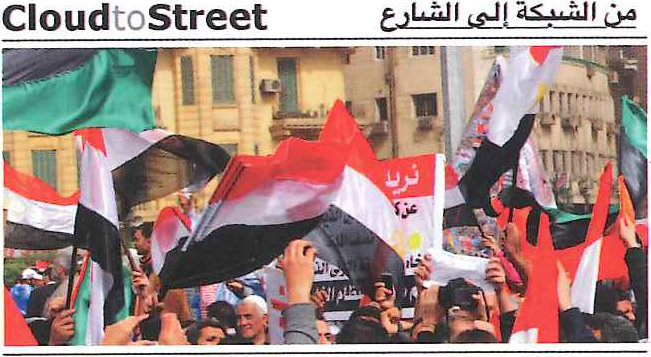
We started the project the way all democracy promotion projects should: by identifying local demand. Democracy movements are only effective, and only legitimate, when led by the people of the country themselves. Who were these Egyptian democracy activists that had forced Mubarak’s overthrow?
Farhaan and I arrived in Cairo just weeks after the regime’s fall. The atmosphere was still euphoric, as the fall of the regime had prompted a sense that anything was now possible in Egypt. We met not only with young protesters who had filled Tahrir Square during the January 25 revolution, but older Egyptians who expressed a mixture of pride in the youth, and shame that their generations had stood passively by all these years.
We met with dozens of activists, and heard about how they had organized the protests in Tahrir Square — not through any one tool but through ingenious combinations of “online” and “offline” methods. Michel de Salaberry’s article in these same pages last year attested to the organizational acumen of Egyptian civil society — a skill that they put to good use in the digital world.
When the various youth groups decided to protest police brutality on January 25, their only hope to occupy Tahrir was to have safety in numbers. So in addition to printing posters and using word of mouth, they reached out to the administrators of popular Facebook pages to post the invitation. One page that invoked solidarity with police victim Khaled Said had already amassed 400,000 followers. If only five percent of those followers answered the call, that post alone would generate enough protesters to overwhelm the police.
Another way that activists combined online and offline tools for political effect was to position webcams in Tahrir Square before January 25. These tiny cameras provided a live feed of the protests throughout the internet. When the initial waves of protesters were met by police violence, the protesters got their version of events to Egyptians first, before the state propaganda outlets could pretend that the protests weren’t happening, or that the police were acting with restraint.
By the time of our visit, activists were looking for ways to use social media for more than bringing protesters out to the streets. Unifying citizens around the simple, single cause of overthrowing an authoritarian regime was proving easier than unifying them around the messy work of designing a new system of government. There would be elections to organize, a new Parliament to install and constitutional negotiations to follow. How could activists keep citizens engaged to ensure that Egypt’s new political system will respond to their interests?
The next step for Cloud to Street was to return to Stanford with some of the ideas that activists had developed for how they could use communications technologies to assist Egypt’s democratic transition. Some activists wanted to use the internet to allow citizens to self-train themselves as elections monitors. Others wanted to aggregate data on political candidates so voters could track their promises and their performance in delivering on them if elected to office.
These were ambitious ideas for a brand new project. Happily, technology has made another new contribution to political activism. It has inspired a new movement of IT experts willing to volunteer their time and their skills to help good causes.
For years software companies have been organizing “hackathons” to bring computer programmers together to work on projects that interest them, removed from the pressures of software development processes imposed by their employers. Like any group of people that share a rare and valuable skill, programmers (“hackers” in the Silicon Valley vernacular) enjoy spending time together and learning from one another. And being engineers, they are less interested in talking about software than in actually creating it.
On any given weekend in the Bay Area, there are hackathons that bring together hundreds of people to develop technology for any range of purposes, from commercial software to improving municipal services. We decided to organize a Hackathon for Egypt to see if we could harness those skills to help democracy activists in Cairo.
The response was impressive. Over the course of three hackathons more than 100 people volunteered their time to build the tools activists had requested. Events in Tahrir Square had inspired people throughout Silicon Valley, and many were looking for an opportunity to lend a hand in any way they could.
The most interesting product to emerge from the hackathons was a website to engage Egyptian citizens in a discussion of human rights issues. A group of human rights NGOs had drafted a series of fundamental principles they believed should form the core of the new Egyptian constitution. While that constitution would not be negotiated until after Parliamentary elections due at the end of 2011, they sought to generate support for these principles to increase the chance they would be reflected in the eventual document. What better way to generate public buy-in, they reasoned, than to involve the public in the drafting of the principles themselves?
The lead Egyptian organization in this effort asked Cloud to Street to develop a platform for “crowdsourcing” the development of a “fundamental document” (or wathiqah in Arabic) of human rights principles. Crowdsourcing refers to any effort to develop content through mass collaboration through the internet. Our hackathon volunteers developed a website that would draw users’ attention to the principles proposed by the NGOs, not only allowing them to discuss them but to suggest edits or even formulate their own suggested principles. A voting system then shows which versions enjoy the most support.
To ensure the crowdsourcing effort was fully inclusive, our Egyptian partner designed an extensive campaign of face-to-face meetings to engage people without access to the internet. The more Egyptians participate, the more the results would reflect where consensus on human rights issues may lie in the broader public, and the more impact the exercise would have on the eventual constitutional negotiations.
Unfortunately, our partner never launched the “offline” campaign, as the constitutional debate got caught up in the growing tension between Islamists and secularists. The debate did not turn on the human rights issues that were the focus of wathiqah.com, but on the process for negotiating a constitution. Islamists wanted an election to be held first so that negotiators would have a popular mandate, and many secularists wanted the constitution to be negotiated first to protect against the tyranny of the majority.
Interestingly, both sides used social media to press their case. The Muslim Brotherhood has become quite adept in mobilizing through communications technologies, drawing hundreds of thousands to its Facebook page and Twitter accounts. Even the military council that still runs the country uses social media as a principal political tool, announcing new decrees on Facebook and using online polls to gauge public opinion on controversial measures such as a recent ban on public protests.
The wathiqah.com project taught us a lot about the role of communications technologies in democracy movements. They certainly are no panacea. But judging by their widespread use on all sides, they would appear to be permanent fixtures of the political landscape in Egypt. If political leaders of all stripes turn to social media to mobilize their
5 Beechwood Avenue P.O. Box 74074 Ottawa, ON KIM 2H9 supporters and engage the public, the issue seems to be less about whether these technologies are relevant, and more about how they are used.
All the more reason, then, to take them seriously and to master their use. They have already played a key role in one of the most dramatic transformations in recent Middle East history. But they do more than provide tools for activists to pursue democracy in their own countries. They provide a more promising basis for outsiders to support them.
Communications technologies offer two distinct advantages for democracy promotion. As Cloud to Street demonstrated, they can be delivered through citizen-to-citizen engagement, without any necessary role for governments. In a part of the world where the motives of Western governments are suspect, this removes a major constraint.
The second advantage is that communications technologies allow citizens of other countries to build their own democratic institutions, rather than import models from abroad. The specific solutions Canada, the USS. or, say, Belgium have developed to reflect the compromises in their own political systems and place citizens in charge of decision-making are of only limited interest to democracy activists in Egypt. Better to equip citizens in other countries with the tools to work out their own solutions.
The protesters in Tahrir Square proved that democracy is not a uniquely Western value. Citizens of the Muslim world and elsewhere will continue to press for democracy, making democracy promotion an enduring issue in foreign policy. After a decade of doubt and re-evaluation, outsiders have an opportunity to experiment with new approaches to democracy promotion — this time with tools that could be more effective, and more legitimate than what went before.
Ben Rowswell has been a Foreign Service Officer since 1993, and spent the 2010-2011 academic year as a Visiting Scholar at the Center on Democracy, Development and the Rule of Law at Stanford University.
View the original scanned pages →
Originally published in bout de papier, Vol. 26, No. 3 (2012) — Spring 2012 // Printemps 2012, pp. 13–16. Read the rest of this issue →