
bout de papier, Vol. 22, No. 3 (2006) — Fall/Winter 2006 // Automne/Hiver 2006, pp. 17–20
the Anglo-Saxons found themselves at the cutting edge of deglobalization. Indeed the island disappeared so completely from the global system that the 6th century historian Procopius – while aware that part of it was once a Roman province — believed that it harboured the abode of the dead.
At the turn of the 5th century, Britannia (the Roman part of the island) had been part of the Roman Empire for 350 years – longer than India was to be part of the British Empire — and was thoroughly integrated into its political, social and economic system. As in other West European provinces, there were signs of retrenchment, in part possibly attributable to the failed civil wars launched by the British and Rhine armies in the last decades of the fourth century. The colder wetter climate of the period and rising sea levels may also have compromised some of Britannia’s agricultural land, as it did in what is today Flanders. That said, Britannia’s administrative and military infrastructure remained intact, and the province was relatively immune from barbarian attack. The economy was highly monetarized and trade with other provinces provided a market for British surpluses and brought in goods that could not be produced locally. The larger cities may have seemed rather down-at-heel, but the small towns, where much of the industry was concentrated, and the countryside at large remained generally prosperous. While the upper classes in their rural villas enjoyed the amenities that went with classical civilization — fine jewellery and silverware, heated baths and living rooms, mosaic floors and luxury imported goods — even the humbler members of society could possess their share of quite high quality manufactured goods. The population, some four to six million, was not to be reached again until the High Middle Ages.
One hundred years later, Britannia had been reduced to ruins, broken into statelets controlled by petty warlords and their bands. The economy had collapsed, industry was dead, agriculture had sunk to a subsistence level and external trade was virtually non-existent. Literacy survived only in a few monastic refuges. Virtually nowhere else were the “dark-ages” quite so dark. By every indicator, Britannia had sunk to a level lower than it was when the Romans invaded in AD 43.
What had happened? On the last day of 406, a horde of Vandals, “lans and Burgundians, fleeing the Huns, crossed the frozen Rhine near Mainz and spread through Gaul. While one chronicler’s claim that “ ’… the whole of Gaul smoked on a single funeral pyre” makes great copy, it overstates the case. Nonetheless the devastation and disruption must have been extensive. The Rhine frontier was almost defenseless, having been stripped bare of troops after the recent failed civil wars, followed by the drawing down of surviving garrisons to keep Alaric’s Goths out of Italy. While not immune from raids by the Picts, Scots and Saxons, Britannia was spared this invasion. However, finding the “continent isolated,” Britannia’s leaders decided (as they had done on at least five occasions in the past 200 years) to set up their own emperor. After two unhappy choices, they selected a relatively obscure soldier named Constantine. Exactly 100 years earlier the British Army had proclaimed another Constantine, who eventually had taken over the entire Empire and had begun the process of making it Christian. His namesake tried to repeat this feat. Stripping Britannia of most of its effective troops, Constantine III invaded Gaul. The consequences, disastrous for the Western Empire, were catastrophic for Britannia. Rather than joining Constantine II against the barbarians, the legitimate government in Ravenna invited more in to oppose him. Having liberated much of Gaul (but without destroying the invaders) Constantine sent much of his army to Spain. There, his general Gerontius proclaimed his own emperor. In the midst of what was now a three-sided civil war, the Vandals crossed the unguarded Pyrenees and overran Spain, where they caused great devastation. When they were ousted some 20 years later, they moved on to North Africa, seizing the Western Empire’s richest provinces. Depriving it of its main source of revenue, the Vandals thus sealed the Western Empire’s doom. The Ravenna government, preoccupied with Constantine and Gerontius, also paid insufficient attention to Alaric and his Visigoths, ensconced on the borders of Italy. In 410, he got their attention by sacking Rome. By 411, Constantine III was dead, his head was shipped around the major cities of the Empire to deter imitators, and his supporters were purged.
In Britannia and in northern Gaul there were uprisings which expelled Constantine’s civil administration. The cause is unclear. His demands for more men and money may have become too great, particularly when Britannia also began to suffer from barbarian raids. British landowners may have feared that they would suffer a round of reprisals and confiscations with Constantine’s defeat. As the Romans devolved much of the local administration to the cities, Britannia’s city councils may have hoped to muddle along with no central authority until Honorius, the legitimate Emperor in Ravenna, got around to appointing new officials. In the meantime, they could enjoy a tax holiday (city councillors were held financially responsible for tax arrears). In Italy, the positions of Britannia’s governors and other officials remained on the books, and incumbents may have been appointed to fill them – and enjoy the tax exemptions and other privileges that came with the titles. However, with Gaul in chaos and Rome recovering from Alaric’s sack, none was ever sent back to Britannia, nor were any survivors of Constantine’s army.
Britannia fell off the map. There were no more demands for taxes (nor the means to collect them) and there was no more army or administration to support. The Imperial Government had been the major consumer of agricultural products and manufactured goods. Cross-channel markets for British goods and produce had departed with the Rhine garrisons. Britannia’s industries soon collapsed, as did the monetary economy. Once ties with Europe were severed, no new coinage flowed in. Much of the specie that did remain soon disappeared into hoards (many of which were very rich indeed). Bronze coinage needed to facilitate local commerce also vanished. Unlike in previous periods when coinage was in short supply, no local counterfeits appeared to fill the gap. With no central authority to impose its tax demands and no markets for their produce, the peasants saw no need to generate surpluses and reverted to self sufficiency. Within a generation, towns great and small – even London – were deserted, except for a few squatters. The wealthy villas that had dotted the countryside were falling down, their owners were either dead or had fled, and many never recovered their buried valuables. Local councils would have followed their cities into oblivion. Politically fragmented and reduced to a subsistence economy, with virtually no material culture, Britannia was well and truly “deglobalized.” There were few signs of social stratification. The nearest equivalent might be what Pol Pot hoped to achieve in Cambodia, but without recourse to the Khmer Rouge. There does not appear have been any immediate population decline. Pollen analysis shows no significant reduction in the amount of land under cultivation.
We know little of what happened next. Without coins, manufactured ceramics or other datable objects, the archaeological record becomes almost unreadable. Stone buildings were no longer built or maintained and their flimsy wooden replacements left few traces. In the west some old Celtic hill forts were reoccupied. Here and there local leaders appear to have attempted to keep up the old ways: a grand timber-framed but Roman-style building on the ruins of one town’s forum; a not inexpert water-pipeline laid in another. In Verulamium, in 429, the town council could still muster in their old style finery to greet a Gallic bishop – come to sort out a local heresy. Indeed the only institution that seems to have weathered this social, political and economic collapse was the Christian church. It maintained the rudiments of an ecclesiastic structure, and could still impart to a few some semblance of a classical education. A trickle of continental imports (wine, glassware, fine tableware) begin to reappear in the late 5th century in the strongholds of local warlords. How these were paid for, in the absence of a cash economy, is uncertain — slaves would likely be the most marketable product available. English slaves were on sale in Rome in the latter part of the 6th century.
Written sources for the period are few and far between. Those which were more or less contemporary were generally far removed, in southern Gaul or even in the Eastern Empire, while most local accounts were written down centuries later. We do get a picture of an island beset by raiders from Ireland, Scotland and, above all, from the North Sea coast of Germany. Many Britons fled across the channel to what is now called Brittany (scholars argue on the degree to which the Breton language was re-implanted by these refugees or stems from the region’s indigenous speech), where they played an active role in the unstable politics of western Gaul. Elsewhere, particularly in the less Romanized north and west of Britannia, local warlords emerged. Some seem to have followed the classic Roman practice of allowing one group of barbarians to settle in exchange for their fighting others. The county of Kent was reportedly seized by two Anglo-Saxon warlords, Hengist and Horsa, after a pay dispute with a British chief.
Archaeology shows a slow infiltration of Anglo-Saxon settlers up the river valleys of eastern England. There does not appear to have been any large organized invasion force, and many archaeologists are loath to admit that a mass migration occurred. It has been argued that the Anglo-Saxons lacked the shipping capacity required to cross the North Sea in any numbers. However there are signs that, during this period, the North Sea coast of Germany and Denmark was becoming depopulated, perhaps hastened by marine encroachments. Moreover, the strength and extent of the defences the Romans had erected along the east coast of Britannia and on both sides of the channel – the “Saxon shore” – indicate the Anglo-Saxons did pose a significant naval threat to the Romans and were capable of raiding as far south as the Loire.
The unanswered question is what became of the native Celtic-speaking Britons. There are few Celtic loan words in English. Relatively few English place names are based on those used by the Romans or the Britons. Those who dispute the idea of a mass migration have tried to create acculturation models to explain how what they claim were relatively small numbers of Anglo-Saxons totally imposed their language and culture on the Britons. Eisewhere, most German invaders – Goths, Vandals, Franks and Burgundians, who admittedly took over still functioning societies — were rapidly assimilated into the Latin-speaking majority. Only in the Rhineland (which had a substantial German population) and on the upper Danube (where the remnants of the Roman population were evacuated by the Ostrogoths) did German replace Latin.
In the 7th century, when the light of history began to shine again on what is now England, a number of Anglo-Saxon kingdoms had emerged. One by one, they converted to Christianity. Literacy was reintroduced, trade links with the continent revived, and with them a number of market towns begin to emerge beside the ruins of the old Roman cities. The Anglo-Saxons enthusiastically embraced the remnants of classical civilization that Irish and continental missionaries brought back, after two centuries of isolation. Still we know very little of what happened in Britannia during the intervening “dark age.” Genetic studies indicate that the majority of the male ancestors of the present day population of eastern and central England were more closely related to the people of Denmark and Friesland, than to those of Wales (who have closer affinities with Ireland and northern Spain). This indicates there was indeed a significant population movement. It has been suggested the plagues which ravaged Europe in the 640s hit the Britons harder than the English. Perhaps more Britons emigrated to Brittany. Perhaps the Anglo- Saxons were just as bloodthirsty as the Romans (and their own legends) said they were. The early law codes of some Anglo- Saxon kingdoms, particularly in the west country, recognize the existence of a residual “Welsh” (the Old English word for “foreigners”) population, but they do not seem to have been very numerous and later codes omit mentioning them altogether.
Much as we try to put a rosy gloss on their activities, the Saxons were not a gentle tribe of organic farmers, winning the Britons over to their ways by demonstrations of deep ploughing. To the Romans, they had a particularly unsavoury reputation, with a penchant for taking no prisoners. The adjective ferocissimus, “most savage,” is regularly coupled to their name. Indeed, the name Saxon comes from their favourite weapon, the saex, a curved single-edged knife — how would we react to a people called the “Kalashnikovs”? The Anglo-Saxon Chronicles do little to dispel this negative image. Its 9th century monkish compilers give a bloodthirsty account of how bit by bit Britannia became England. Invading war-bands are recorded destroying “with fire and sword,” or massacring a garrison “so there was no Briton left,” and elsewhere killing “four companies” of Welsh. While the chronological precision of the Chronicles is questionable, its entries were likely based on oral traditions. It is clear from the Chronicles’ tone that the historic roots of the English lager-lout go very deep indeed
Our views of Roman history often reflect the intellectual climate of the beholder. Gibbon attributed the Empire’s fall to the forces of barbarism and Christianity. In the 19th and early 20th centuries historians portrayed a Roman Empire that was a model for their own nations’ imperial missions — selflessly spreading civilization. With de-colonization in the 1960s, the Empire’s motives were perceived as much more predatory. Revolts against Roman rule, or even local usurpers, showed the stirrings of self-determination. Today, the idea of a violent end to the Roman Empire sits uneasily with the “kinder/ gentler” Europe of the EU. We are presented in its stead, with the “transformation of the Roman World.” The “Dark Ages” are no more. They have become “Late Antiquity,” emphasizing the age’s spiritual qualities, not its material decline. The barbarians (actually the word has been virtually banished) are no longer portrayed as forcibly taking possession of large tracts of Roman territory; instead the focus is on a process whereby the Imperial government settled them in various provinces under a sort of mutual defence pact. Your average Frank or Visigoth would, no doubt, happily have voted in favour of the EU Constitution.
Interestingly (considering their ancestors’ interactions) modern British historians have been bucking this trend, pointing out that the 5th century was a very messy and unpleasant time and that the passage of barbarian invaders (and for that matter of Roman armies – sometimes it was moot which was which) often had negative consequences for the inhabitants. Eight years after Alaric sacked Rome, large sections of Italy still required substantial tax relief as they recovered from the Goths’ devastation. Cities were sacked, in the case of Trier no less than five times. Villas, the mainstay of the rural economy, suffered heavily, particularly along the Rhine and Danube. The bottom line is that the Roman Empire in the West well and truly fell, with dire economic, cultural, and probably demographic consequences for those forced to live through it.
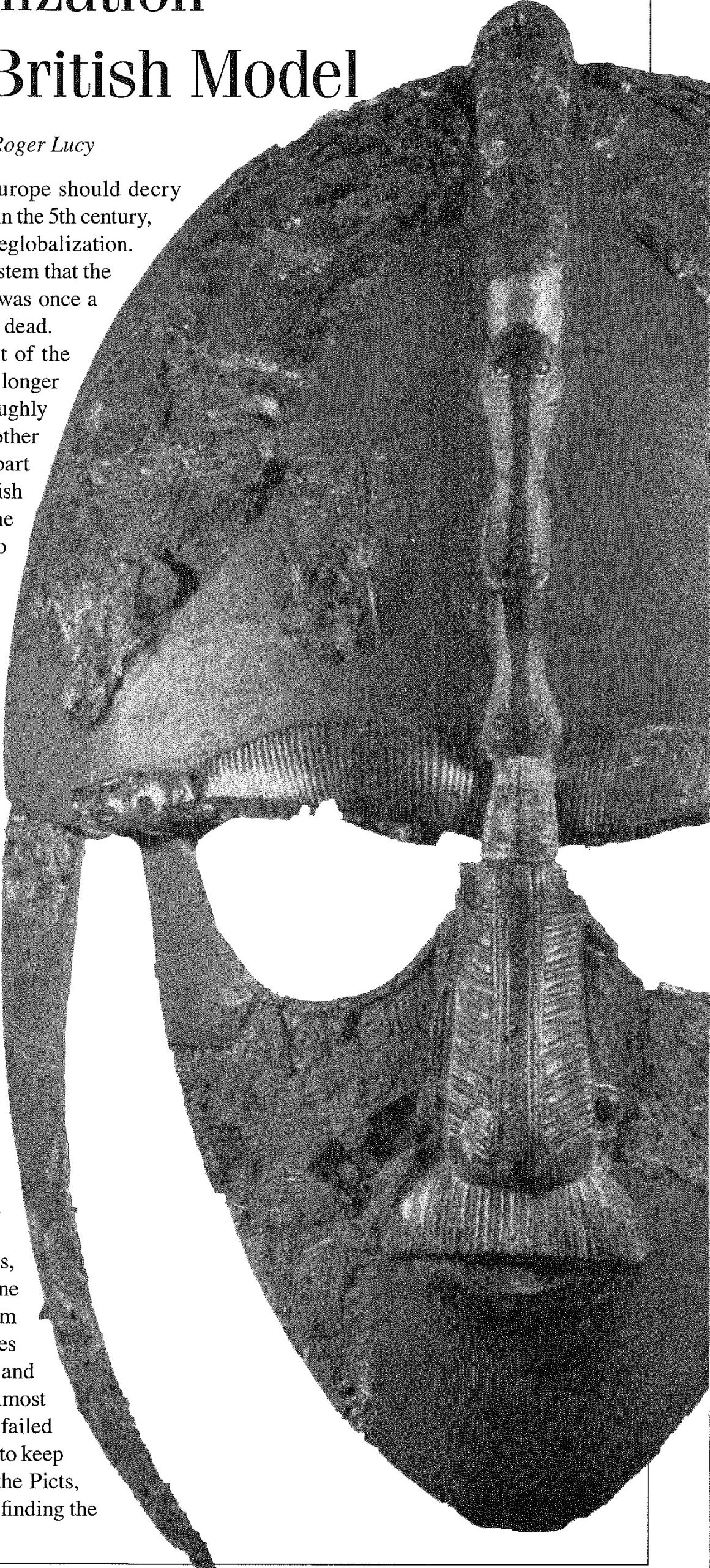
In his recent book examining the fall of the Empire (The Fall of Rome and the End of Civilization, Oxford, 2005), the British historian Bryan Ward-Perkins calls one of its consequences “the end of comfort.” The Romans had produced a lot of “stuff,” much of it of high quality. We only know a traction of it, as much was made of perishable materials, but an awful lot of ceramics, glassware, stone work and metal work have survived. An archaeologist, Ward-Perkins is well aware of the huge difference between the rich material culture found in deposits of the Roman period and the impoverished Dark Age layers that follow. In Roman times, quality goods were not only produced in profusion but were widely distributed, socially and geographically. Even quite humble citizens could own manufactured goods of a quality not found again until the late Middle Ages. An ordinary family in Roman Britain could own good wheel-thrown tableware made from carefully selected clays. This vanished with the Legions (along with baths and central heating). Two centuries after Roman rule ended, an Anglo-Saxon monarch, who could adorn himself with intricately wrought gold-work, still had to drink his mead from crude, hand-formed, poorly-fired cups.
Estimates of the quantities of Roman output belie the notion that theirs was a pre-industrial economy; one factory in Gaul filled a 20-cubic-metre refuse pit with pots which had failed to meet its standards. Rome’s “Monte Testaccio” – the mother of all landfills — is a 50-metre-high dump comprising the remains of over 50 million amphorae. When filled, they had held six billion litres of Spanish or African olive oil; on a per capita basis, Romans consumed an average of 25 litres a year. Estimates of other measures of Roman production include an Empire-wide requirement of over 80,000 tonnes of iron a year, and lead and copper production so high that they lett pollution spikes in the Greenland icecap
– not to be encountered again until the Industrial Revolution. The density of shipwrecks on the Mediterranean floor also shows a volume of trade not to be equalled until early modern times. In many regions of the Middle East and North Africa, specialized export-oriented agricultural production and careful water management opened areas for cultivation which have lain as desert ever since. While the Roman Empire fell short of being a fully open economy (somewhat like in Canada, interior tariffs were levied on goods crossing provincial boundaries), it united the Mediterranean Basin and surrounding territories into a single political entity, consolidated over time with a single currency, citizenship, and legal code. The road network, state-subsidized shipping (to supply the Army, feed Rome and Constantinople, and transport inter alia wild beasts for the arenas and marble pillars for the baths) and, above all, peace and security stimulated trade and encouraged economies of scale and specialization, as well as the exchange of goods over very wide areas. The fall of the Western Empire disrupted these trade and transportation links. Over the longer term the new barbarian rulers were unable to maintain the machinery of government they had inherited. This eroded their tax base and their ability to maintain order. Across Europe, levels of literacy, agricultural productivity, industrial production, the degree of monetarization and the volume of trade all precipitously declined. While the fate of Britannia was a worst-case example of this deglobalization, the end of the Western Roman Empire had a profoundly negative effect on the material well-being of its inhabitants, one that took over a millennium to overcome. A
View the original scanned pages →
Originally published in bout de papier, Vol. 22, No. 3 (2006) — Fall/Winter 2006 // Automne/Hiver 2006, pp. 17–20. Read the rest of this issue →



