
bout de papier, Vol. 18, No. 3 (2001) — Fall 2001 // Automne 2001, pp. 11–19
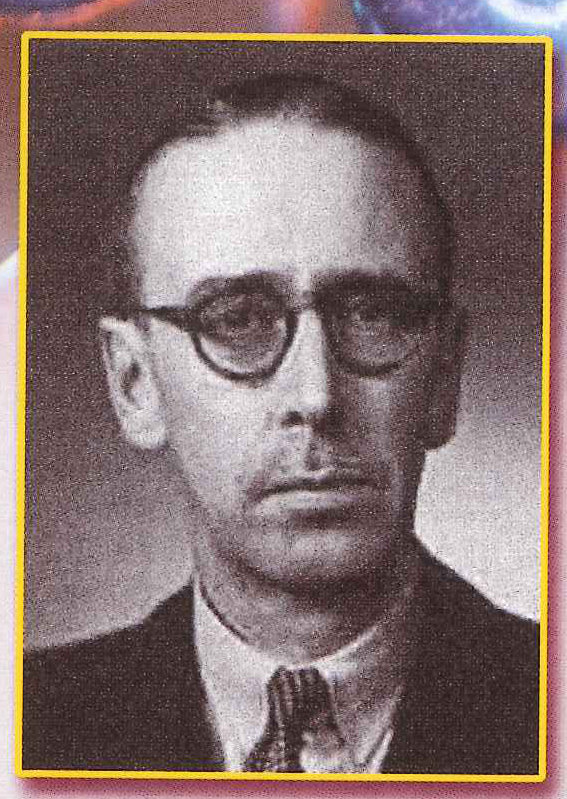
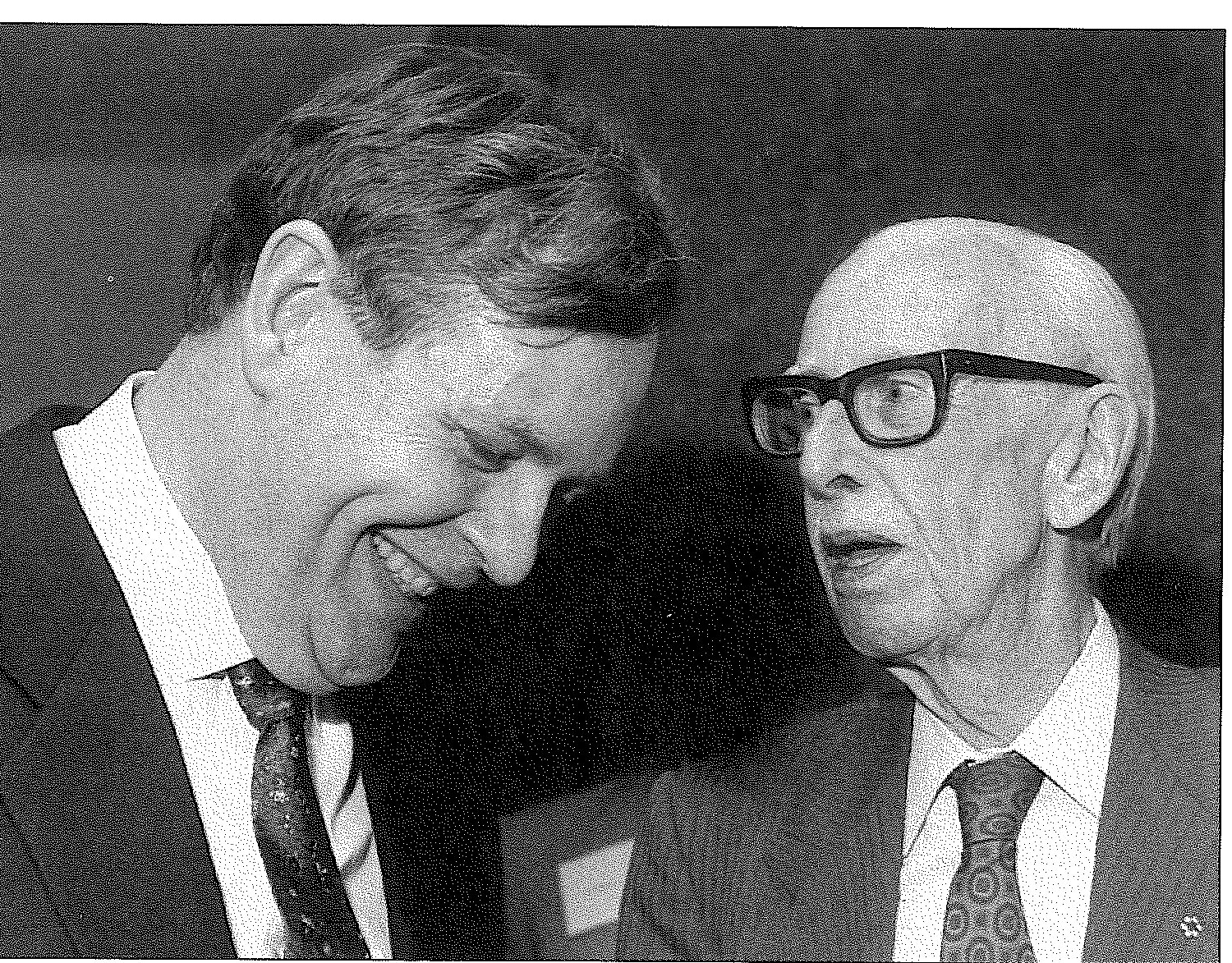
The editorial board and readers of bout de papier are delighted that McClelland and Stewart Ltd., The Canadian Publishers, have reprinted the published diaries of our late colleague, Charles Ritchie, as well as his reminiscences (My Grandfather’s House) in an attractive new edition. To mark the occasion, Charles Ritchie’s niece, the late Elizabeth Ritchie, and members of the Retired Heads of Mission Association, notably Doug Small, Randolph Gherson and Michael Shenstone, organized An Evening to Remember Charles Ritchie, 1906-1995 at the Rideau Club in Ottawa on October 25th, 2001. The participants included the publisher, Douglas Gibson, author Jane Urquhart and prime ministerial adviser Mitchell Sharp.
Two distinguished denizens of Ritchie’s world were among those who paid tribute to him.
John Starnes made his first appearance in Diplomatic Passport, wherein Ritchie observed that Starnes “would make a better Ambassador than I. He has an acute, questioning mind and a grasp of German affairs. He is also a companion and friend with whom one never has a dull moment. Helen, his wife, is a delight – lovely to look at, funny, and equal to any occasion.” This favourable impression evidently did not dim the prospects for the Counsellor in the Canadian Embassy in Bonn, as John Starnes went on to head that post as well as missions to Egypt and Sudan in a distinguished career of public service. Mr. Starnes is a member of the editorial board of bout de papier (on which Mr. Ritchie also served) and a frequent contributor to the magazine.
The other speaker whose remarks we have reprinted is Basil Robinson, who first appeared in Storm Signals. “I am lucky to have Basil Robinson as No. 2 in this Mission,” Ritchie recorded from the vantage point of Ambassador in Washington. “He has a good tough mind and great sensitivity to the currents of politics, which he has learned in a hard school during his service in the Prime Minister’s Office. And he has a passion for integrity and fairness. In addition, I feel him to be a friend and an enjoyable companion.” Of course, Mr. Robinson went on to serve as Under-Secretary of State for External Affairs, so that others obviously shared Ritchie’s assessment. Thus, two diary entries have been given opportunities to comment on the diarist, surely an unusual situation. As these amusing and affectionate tributes indicate, however, the warmth and respect of the diarist for his subjects were reciprocated.
With the publisher’s kind permission, we have also reproduced below a few entries from the personal diaries of a master of that literary form and extraordinary diplomat. While it is certainly an invidious task to do so, we have made a brief selection from four volumes which themselves consisted of extracts chosen for publication by the diarist himself. Our choice from the books is unrepresentative, as it pays considerably more attention to Charles Ritchie’s work than he intended when he jotted down his impressions of the world (and especially its inhabitants) around him.
… on Charles Ritchie — by H. Basil Robinson
It is a great privilege tonight to be asked to speak of Charles
Ritchie to this audience. I realize that many of you knew him — as a member of the family, as a friend, as a colleague, or as a close reader of the diaries. Many of you could relate your own story about him.
At first I thought it would be a simple task to talk about Charles Ritchie for ten minutes. But it wasn’t as easy as one might think. He was a man of so many dimensions. He lived a long life, had wide interests, a brilliant mind, hundreds of friends, a highly distinguished career.
And through his diaries he revealed his own inner self, and gave a picture of his life and his diplomatic career in a fashion no other Canadian public servant has done.
With all that, the dilemma is where to start and how to end?
When I first met him in October 1945, fifty six years ago almost to the day, he was a rising star in External Affairs, and I was a recruit in the Department, just discharged from the Army. As I remember, he was known as the kind of man that things happened to. People gathered around to hear of his latest misfortune.
So much so that if the internet had been invented fifty years sooner, I am sure someone (not Charles himself) would have produced a Charles Ritchie web site. And the whole system would have been choked with Charles Ritchie episodes, from week to week, recording his tussles with the world of household machinery, or, at another level, with heart-stopping social situations.
Of course, we couldn’t have imagined, then, the time when the Queen and Prince Philip were coming to dinner with the Ritchies in London, and Charles found that the occasion had been too much for the butler. “Your Majesty,” Charles said, as he welcomed the Queen, “I am sorry to say that the butler is drunk.” Fortunately for Charles and Sylvia, the Queen rose to the occasion, smiled sympathetically and said, “Oh, can he cope?” I can’t tell you the answer to the Queen’s question, but the point I’m making is that Charles had survived another misfortune.
It wasn’t only in social tangles that things happened to Charles. I plan to focus tonight on the first two years of his time as Canadian Ambassador in Washington – 1962 to 64. That was a time when so much was happening in the political world around him, so much that would exercise his genius for adapting to unexpected situations. I was fortunate to be there for those two years.
Today we are in the midst of unexpected and ominous happenings, with September 11th and its aftermath. But it does no harm to remind ourselves of the world, the unstable world, that confronted Charles Ritchie when he succeeded his friend, Arnold Heeney, as the Ambassador in Washington in April 1962.
Let me recall what that world was like.
For a start, the Diefenbaker-Kennedy relationship was beyond repair. There came the Cuban Missile Crisis, a close brush with nuclear disaster. There was a raging political dispute between Canada and the United States over nuclear weapons issues. Then, the tempestuous collapse of the Diefenbaker Government and the coming to office of a Liberal government under Mr. Pearson. And within a few months the shocking assassination of President Kennedy — and the succession of LBJ. All this — and the looming shadow of trouble in Southeast Asia.
Apart perhaps from the intensity of recent weeks, I wonder if there has been a time when the judgment and diplomatic skill of our ambassador in Washington would be more severely tested.
He was taking on a difficult assignment, perhaps the most demanding of his career. But you would hardly have known it. He so obviously enjoyed the job. With imaginative and practical support from Sylvia, he took the social part of an ambassador’s life in his stride, and he used it to extend his contacts. He had been in Washington before the war and had learnt the trade under Hume Wrong, the wise counsellor of Embassy at that time, later himself the ambassador.
Charles had kept up with his friends from the thirties, who were either still important themselves or knew who was important now. Names like Acheson and Bundy turned out to be connections between the sixties and the thirties. And he could indulge his gift of finding new friends — from within the deep pool in Washington of influential American officials, foreign ambassadors, and his particular favourites, well-placed journalists (Walter Lippman, Scotty Reston, Max Freedman, to name a few) — so that he had endless sources of news about the powerful and their doings and their thinking.
There he was, absorbing it all, reacting, with good humour and without panic, to unexpected upsets, to periodic explosions of indignation from American officials exasperated by the latest utterance of their nemesis, John Diefenbaker. For those who served with Charles it was an advanced lesson in the practice of our profession, and a constant source of enjoyment, to see him in operation at the height of his own career.
Within the Embassy, he was easy-going. He expected the place to run smoothly. He preferred not to get caught up in the normal flow of reporting, but he was always available to consult if his name at the foot of an outgoing telegram would give it a better prospect of a fruitful life in Ottawa. He also did his own reporting, sometimes after a lunch at the Jockey Club, or a weekend in the country, passing on some fascinating revelation, alas not intended for the official archives, to the Under-Secretary, Norman Robertson in those years, who might give it further discreet circulation. And occasionally, he wrote directly to the Minister, Howard Green, whom he liked and respected. Never, as I recall, did he write a Dear Prime Minister letter, not, that is, until Mr. Diefenbaker had been succeeded by Mr. Pearson.
Charles worried about his capacity to keep track of everything that was going on under his wide-ranging command. With this in mind, he ran weekly meetings of the various heads of section. But he enjoyed sitting down individually with members of the staff, the experts in the various specialties. On such occasions, he gave perceptive advice, much treasured by his co-workers. He gave credit and congratulations with discrimination, not loosely. It had to be earned. And if people were in some personal trouble, he acted with the greatest sensitivity and understanding.
I spoke of the several unscheduled situations that Charles Ritchie had to confront as ambassador in Washington. I can’t deal with more than one of these tonight. P’ll spend a couple of minutes on the one that gave him the most trouble — the dispute over nuclear weapons.
For months, even years, before the Diefenbaker government fell in 1963, differences with the United States over nuclear weapons had been coming to the boil. Why would Canada, an ally in North American air defence, with the Cold War still on, why did Canada refuse to allow nuclear ammunition to cross its border for Canadian or United States defence forces? That was the basic question.
It went on for ages and ages, a source of political conflict and military frustration. Charles did his best to explain the government’s policy. He put it in the context of nuclear disarmament and nuclear weapons testing, crusades that were the chosen avenues of Howard Green. He was careful never to lose touch with his Minister.
But as for the Prime Minister, ‘the old rascal’, as he called him privately, Charles simply played it by ear, as best he could. As he put it in his diary, he had been finding “the delays, ambiguities, and indecision of the government … not easy to explain and defend.” That was putting it mildly, diplomatically. It was in fact an inexplicable position, and Charles could do nothing to change it.
But with the future of Canadian American relations in mind, he could and did survive, with his credentials and his sense of humour intact. Despite the prevailing tension, he led the way in maintaining personal contacts with his American counterparts — from the two Bundys, through Dean Rusk, and George Ball, Willis Armstrong, and many more. Of course he expected his staff to do the same, at our various levels. It was important to keep the channels of communication open, despite the furious breezes in the upper political atmosphere. Charles’ handling of an impossible case, through a most exacting time, was to my mind a remarkable, unsung diplomatic achievement in his Washington years.
Finally, the voters in Canada replaced John Diefenbaker with Mike Pearson. A huge sigh of relief was to be heard in official Washington. Soon, President Kennedy and Prime Minister Pearson met at Hyannisport. Charles, of course, was part of the Pearson team. Nuclear negotiations were resumed, and the Embassy’s job changed from damage control to reconstruction. Charles was there to carry on the still challenging work in much happier circumstances.
But then came the tragic assassination of President Kennedy, completing the package of unexpected drama in Charles’ first two years. Now Washington belonged to LBJ and a whole new team and some thorny new problems.
At the end of those two years, the Robinsons were posted back to Ottawa. We really didn’t want to leave. In a letter to my parents, I said how very much I had enjoyed working with Charles. The letter ended: “He is a rare man, and a friend.”
And that is how I feel tonight.
Thank you very much.
… on Charles Ritchie — by John Starnes
I was about ten when our family thermometer smashed and I became the proud possessor of a lovely, small globe of mercury. In the 1920s the extremely toxic properties of the liquid metal must have been recognized but apparently not to the extent that children were prohibited from playing with it. No matter what I did, I found it impossible to control or to follow its lightening-quick movements. Charles Ritchie’s mind and personality were like quicksilver. Appropriately, Mercury was the Roman god of eloquence.
Charles’ lively wit and his extraordinary gift for story-telling were so entertaining that they tended to mask the quite unusual qualities of his mind and his beliefs, sometimes leading to the creation of an impression that he was a most amusing acquaintance but in effect a dilettante. I am sure he even fostered the impression, perhaps simply as a form of protection of his most private feelings. Certainly the impression was completely wrong if one applies the Oxford dictionary definition of dilettante — one who toys with subjects or studies it without seriousness. Nor can he ever, ever be said to have been trifling, lacking in thoroughness or an amateur.
I found it difficult to decide whether his weaknesses or his strengths were the more appealing. For example, his fabled lack of manual dexterity. Some of these shortcomings are referred to in his diaries, concerning his difficulties in dealing with things mechanical or electronic, from an inability to drive a motor vehicle, operate an elevator or open the cellophane wrappers used to package soda crackers. Sometimes these were regarded as weaknesses when in reality they were strengths as inevitably they became part of his legend without in any way diminishing his undeniable and extraordinary skills as a diplomat and senior advisor to various Prime Ministers and Ministers. Many people went to him for advice which he gave unstintingly.
He possessed an uncanny ability to cause people to be indiscreet. On one occasion he was speaking to the wife of a French-Canadian he liked and with whom he worked from time to time but did not regard as one of his most brilliant colleagues. Charles said something nice about her husband. To Charles’ surprise and delight she replied: “Ah, mon mari. Vous savez, il a les gaz qui échappent partout.”
Charles had distinct likes and dislikes of people. For the most part he kept his dislikes to himself although I have no doubt they are to be found in some of the diaries which have not been published. He suffered fools, although not gladly. On occasion he found it difficult to suppress his obvious irritation with those whose views he found overweening, tiresome and long-winded.
Charles succeeded Tommy Davis as ambassador to the Federal Republic of Germany, a posting which at first blush he did not enjoy. He would have preferred some place like Paris or Vienna. However, although he did not find Germans particularly sympathique, he gradually became intrigued by them and the job of finding out what made them tick. German is not an easy language to master but he set about trying to do so with determination and verve. He had a teacher, Aga Furstenburg, who decided that Little Red Riding Hood was an easy, suitable way of introducing him to the subtleties of the German language. Since my room was adjacent to his and the walls were paper-thin I learned more about Little Red Riding Hood than I ever wanted to know.
Following a meeting he had with the West German foreign minister, I recall his dictating a telegram reporting on the discussion which had centred on German rearmament and a possible future role for the Federal Republic in Europe — a quite extraordinary display of his total recall and a very shrewd political analysis, couched in the lyrical literary style so clearly demonstrated in his diaries. A thoroughly professional piece of work. The most amazing aspect, however, was the fact that he made no revisions to what he had dictated.
Many years later when he and Sylvia were living on Metcalfe Street and she had become ill, they were determined to make the trip to Chester, Nova Scotia, for the summer. Because she was dependent upon a constant supply of oxygen, the trip was quite an undertaking since, among other things, airline regulations required that the aircraft’s oxygen must be used. We went with them to the airport. On our way there I checked to be sure Charles had the tickets. In the hurried search which ensued, it became apparent that he also was carrying all the money he reckoned he might need for the summer — about three or four thousand dollars, stuffed into his pockets. He simply did not place much faith in banking devices such as travellers’ cheques, feeling that cash was more satisfying and reliable.
In the early 1940s, while I was with the Army in London, Charles, then posted at Canada House, was called back to Canada for brief consultations. He very kindly agreed to deliver to Helen a birthday present I had bought her. Serendipitously it transpired they both found themselves under the same roof in Montreal, staying with Helen’s aunt and uncle.
Charles had some purchases to make. They agreed to sortie together. Charles wanted a jar of beluga caviar and a pair of pure silk pajamas. They eventfully found both. The caviar was astronomically expensive as were the orange-coloured pajamas. Charles suggested they have lunch at the bar of the nearby Café Martin.
On the rather steep, stone steps leading down to the bar, for whatever reason, Charles suddenly lost his footing and the parcels he was carrying shot out of his arms. The large jar of caviar smashed to smithereens. Within the twinkling of an eye and with obvious delight, cats of every shape, size and description converged on the caviar — coming from the countless alleys and door-wells around the café. Charles simply chose to ignore the incident and they washed down an excellent lunch at the bar. The pajamas survived, winning the admiration of Charles’ various lady-friends around the world.
It is very fortunate that McClelland & Stewart has republished in a paperback edition with a new format, a better grade of paper and new, attractively designed covers, all five of the books. Several months ago, before Elizabeth Ritchie’s kind invitation to participate in this evening’s celebration, I had begun to re-read the books, for the sheer enjoyment of doing so. In Appetite for Life I came across a comment in an entry for 5 December 1926 which is so quintessentially Charles that I could not resist mentioning it tonight.
He had been to see a movie at the Super Cinema in Oxford — Adolph Menjou in Surrender. He described it as a slight but charming film. He then referred to a rumour of having talking films at the Super to replace the silent ones. He wrote in his diary, “I intend to start a protest group. Talking films would absolutely ruin the movies”.
I find it very difficult to choose between the five books and to do so almost seems profane. Yet, I have a preference for My Grandfather’s House since it was written by Charles not as a young man but when he was in his eighties, beginning to experience the frailties of advancing years and very upset and concerned about Sylvia’s deteriorating health. I recall he was worried about having spent every penny of the substantial advance he had received from the publisher without having been able to produce even a page of manuscript. That eventually he was able to do so and with such éclat is a remarkable achievement. Moreover, he did so in a style which I believe surpasses some of his earlier writing. The immediacy of the stories he tells and the freshness of the language he uses is quite unusual. Even more extraordinary is the fact that the material upon which he drew was in the memory banks of his brain not in diary entries or notes he had made seventy-odd years earlier.
From time to time we would discuss the possibility that he might try his hand at writing fiction but invariably he would shy away from the idea, saying that he simply did not have the imagination necessary to write a novel. Although he had a very lively imagination perhaps he was right and the singular skills required of an exceptional diarist such as Charles might not translate easily into the very different skills involved in writing fiction. However, I cannot rid myself of the wish that he had been willing and able to write fiction!
At this point I can just hear Charles saying, “Oh, come off it John. You’ve gone on far too long. Cut it short.” He would have been absolutely right, as he so often was.

An Appetite for Life: The Education of a Young Diarist, 1924-1927
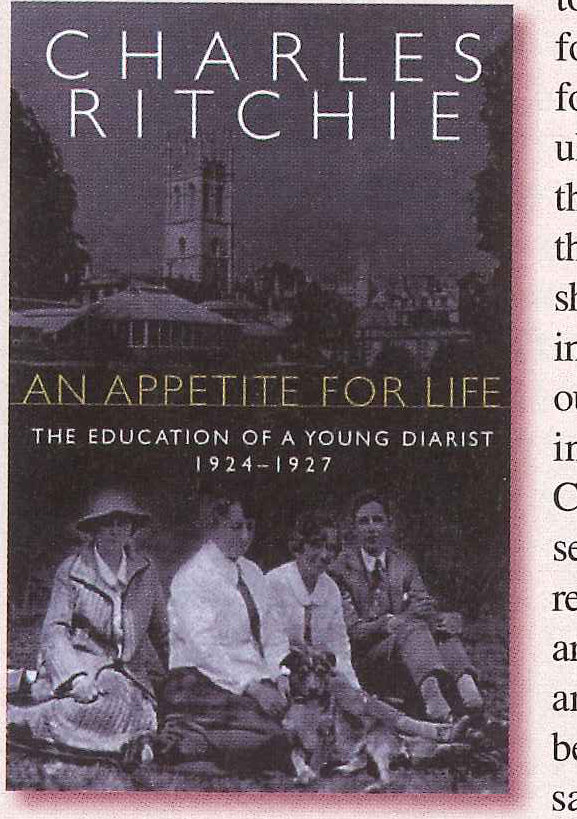
31 January 1927 Sir Robert Borden, our former Canadian Prime Minister, is coming to Uxtord shortly to make some kind of speech and will be staying at All Souls. I intend to call on him – he and my father were law partners, and great friends.
When I was still at school he wrote to me about the Department of External Affairs in Ottawa, suggesting that it might be a career for me as he knew from my mother that I was interested in international affairs and he thought the Department would expand into a Canadian diplomatic service. I have this possibility in the back of my mind.
It is true that in the last year or two I have lost interest in international affairs, but as a boy I used to follow them in the newspaper and make copious notes on them. Of course, I would have to get a good degree to get into the Department and also to pass their exams. I think I could do it. I have been working quite hard during the vacation and since this term began. But I do not write about work in this diary.
The Siren Years, A Canadian Diplomat Abroad, 1937-1945
15 December 1938 am to be posted to London to the High Commissioner’s Office Leaving next month. This means the end of this holiday 11 Washington, for no one could take too seriously my marginal responsibilities in the Legation. If I have learned anything here it is thanks to Hume Wrong, the Counsellor of the Legation. Each of my draft despatches has been returned to me with detailed emendations in his elegant script. He has applied acid to what he terms my “impressionistic” manner of expressing myself. He will not allow the word “feel” as in “there is a feeling that the United States Administration’s attitude is hardening”. “Members of the Canadian Foreign Service,” he says, “do not feel — they think”. The most gratifying moment of my time here has been seeing his report on my work which states that I have an instinct for political realities”
23 October 1941 for more aid to Russia. I thought of staying to see what it was like, but it was so cold. There were a lot of grubby men in dirty mackintoshes with packages of red leaflets. They looked like the sweepings of the Communist Party hoping to stir something up. Charlie Hébert (a Canadian officer friend of mine) was with me — solid, military, well-fed. They seemed to look at him with envious, hating sidelong looks as if they longed to be strong enough to pull him down.
I should like to have seen the Masseys standing next to Maisky (the Soviet Ambassador) and singing the Internationale at the private viewing of the Soviet films. It is quite a long step from “dear Alba” (the Spanish Ambassador) “the last great gentleman in Europe” and Lord Halifax and “all of us”. When I came here two and a half years ago there was no more devoted adherent of Chamberlain than Mr. Massey. Churchill, of course, in those days had “no judgement”. I could never get Mr. Massey to accept an invitation to Maisky’s (“I feel uncomfortable with that little man) but the Masseys have followed the English ruling class in the most spectacular somersault in all recorded history and never have they felt consciously insincere except perhaps now they do feel their conversion to the USSR a little – shall we say — sudden. The more candid just go on hating communism as much as ever — “Anything to save our bacon.” But they will not feel comfortable for long in this open cynicism. Already the Archbishop of Canterbury has found that communism contains the seeds of Christianity — even if the Russians wear their religion with a difference. A few really consistent Tories are in danger of being locked up in Brixton jail. They are guilty of the unpardonable sin of putting ideas before the interests of England. The English always said they were not interested in an ideological war. Mind you, I think they are quite right, but what does a little appal me is that when the storm is past they will bring back the old prejudices and what is much worse — the “old principles”.
10 February 1942
Dined at the Conservative Club. Gossip about Stalin — they say he wishes [British Ambassador Sir Stafford] Cripps would not come and bore him by talking communism to him. Stalin hates bores but takes a great interest in the Windsor-Simpson story. He cannot understand why Mrs Simpson was not liquidated.
21 April 1945
On the train en route to San Francisco [for the founding of the United Nations]. Luncheon with [Prime Minister W.L.] Mackenzie King and was charmed by the fat little conjurer with his flickering, shifty eyes and appliqué smile. He has eyes that can look like grey stones or can shine with amusement or film with sentiment. He chats away incessantly —he seems very pleased with himself, delightfully so, pleased with his own cleverness and with his own survival. He talked of the “fun” of parliamentary tactics which cannot, he added regretfully, be so freely indulged in time of war. He talked of the conscription crisis and said that when it was viewed from the historical point of view its most significant feature would seem to be that the French-Canadian Ministers remained in the Government. That is what saved Canada’s unity. I irritated him by remarking that our troops must be thoroughly tired by now. He replied, “They have had two months’ rest,” (when? I should like to know) and said, “I knew during the recruitment crisis that they were due for that rest but this I could not reveal.”

He described [US President Franklin D.] Roosevelt’s funeral at Hyde Park naturally and effectively, the silence in the garden and the rightness of the ceremony. He spoke affectionately but not over-sentimentally of Roosevelt himself, adding, “When I last saw him I felt the end might come at any moment. When any subject came up about which he had a complex of worry he collapsed completely. When they called me from the White House to tell me of his death I did not even go to the telephone. I knew what had happened without being told.”
Talking of Mussolini he said, “A remarkably fine-shaped head — the head of a Caesar — deep-set eyes full of intelligence. He did a lot of good — cleaned up a lot of corruption, but he had too much power for too long. They worship false gods in Europe — that is the trouble — Europe is too full of pictures of Napoleon and statues of the Caesars.”
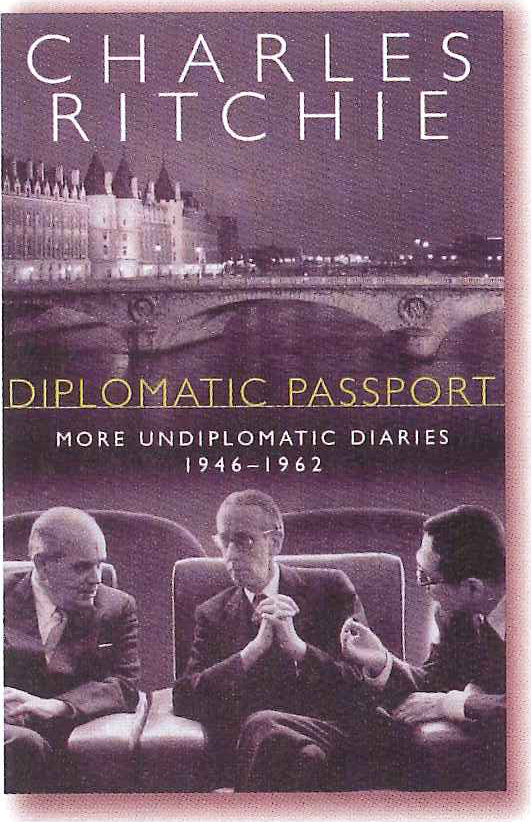
Diplomatic Passport, More Undiplomatic Diaries, 1946-1962
21 May 1951
It is not the work in the Department that I dislike; in fact, it absorbs me totally. It is the “surround” that goes with it. There is the underlying assumption that anyone who is not overworked, underpaid, eye-strained, joy-starved — in fact, not a senior civil servant — is frivolous or materialistic, that these are the hallmarks of a higher calling, the stigmata of the faithful. “Poor so-and-so, how tired he looks, how overworked,” we murmur in tones in which respect mingles with compassion. Why respect? Why not contempt? That a man should so mismanage his life as to be totally immersed in office work is lamentable, unless he loves it. If he loves it, he is doing what he wants, like another who drinks himself to a standstill, and he has no particular call on our sympathy. A civilized, curious, pleasure- and thought-loving man, reduced to a dreary, weary automaton. What is there to respect in that painful spectacle?
20 March 1952
This last week has flashed by in days of high-pressure work, absorbed in this absorbing little world where politics and diplomacy merge into personalities. You spend the day working with this group of politicians, officials, and diplomats, then you dine with them and their wives, gossip with them, and drink with them. The dominant theme — the only theme in this place — is the pursuit of power. It obsesses the men and infects the women. Other societies may be dominated by money, snobbery, or the search for pleasure. Here the game of political power is the only one that really counts. It creates an atmosphere very uncongenial to love, very unflattering to women — almost any man in official Ottawa would rather talk to a Cabinet Minister than to the most beautiful woman in the room. It is easy to understand this once you are inside the game. You are tuned in to the power waves and you can hardly hear any others, except as “interference”. This is the game for middle-aged men — you can even play it into the sixties or seventies with growing expertise, when you would be at a sad disadvantage in the games of love.
26 June 1954
I am trying to learn German. The woman who is teaching me is making me learn the German version of Little Red Riding Hood by heart. This is the only German I so far know. Last night we went to a German dinner party. I was seated between two wives of German high officials, stout bodies, little gold crosses on chains round their necks, reddish faces, not a word of English. Finally, unable to stand the silence any longer, I turned from one to the other and launched into Red Riding Hood. “Red Riding Hood comes into the wood. She is not frightened of the wolf. When she sees the grandmother she asks, “Why have you got such big eyes? Why have you got such big ears?” All this in quite fluent German. The two ladies stared at me in dumb amazement. One of them asked on a questioning note, “Bitte Exzellenz?” Otherwise, no reaction. However, the German official on the other side of the table, who could not hear what I was saying, came up to me afterwards and complimented me on my fluent German.
Where are all the former Nazis in Germany? I mean, physically, where are they? They are certainly not to be met in Bonn, or, if they are, they are well disguised. On the evidence of one’s eyes and ears one would be led to believe that the entire German population was subjugated by Hitler and a small gang of his criminal associates. Another curious thing is that of the many ex-officers of the German army I have met, none mention serving on the Western Front. With Rommel in Africa — yes, but mostly they talk of their service on the Eastern Front against the Russians, and the theme of their story is that they recognized the communist menace, that they were fighting to defend Western civilization against a danger which we were too blind to recognize. As to their casualties in Russia, they are mentioned in a tone which suggests “these died not only for us but for you.” If the Nazis have gone to ground, the Jews have vanished into the gas ovens. I have only met one Jew since I have been here. When the word “Jew” is mentioned among the Germans, a self-conscious silence sets in, as if a social gaffe has been made.
4 February 1956
Have been staying with Norman and Jetty Robertson in London, where he is now High Commissioner. Norman was at his most delightful, with his wonderful, wide-ranging curiosity and interest in everything and everybody, his pleasure in his own cleverness, his mixture of boldness in thought and of caution. Isn’t he in the long run profoundly on the side of constituted authority although he enjoys dissecting it? He is a non-believer of Presbyterian origin. How different in mentality is a Presbyterian from an Anglican agnostic, not to mention a Roman Catholic one. You can renounce your own faith but its particular imprint remains. I measure myself against Norman and I know that he is a wiser and better man than I am. I come away even fonder of him than I was before and I tremble to think what he would make of this diary. “Burn it,’ he would say, and I have little doubt that he is right. I love Jetty too. Her receptiveness, responsiveness, and funniness charm me.
18 November 1956 — Cologne
I am trying to go over and over in my mind this beastly Suez affair so that I can decide on the line to take in talking to my diplomatic colleagues and to the Germans. It is one thing to criticize the English to their faces or to my fellow Canadians. It is quite another thing to criticize them before foreigners and before those who hate them. My friend the Admiral came in this morning for a drink. We were both very careful in discussing Suez to keep unemotional for fear of another row between us over politics, and he kept on calling me “Charles” affectionately to show that there was “no offence” after our last argument. I would have reciprocated if I could have remembered his first name.
19 February 1957
I have excluded from these diaries almost any reference to office work or mention of members of the Embassy staff or descriptions of any official business or negotiations with the German government. I have absolutely no wish to write about such things, which anyway are covered by memoranda and dispatches in the office. Then there is another consideration — security. I have always been almost excessively “security-minded”. In addition, this house is full of German servants of varied backgrounds. Then Bonn is, I think, riddled with spies of different persuasions. The result of all this is that the diaries have a very unbalanced look as though I were a man of leisure who did nothing but go to parties and never did a day’s work. The truth is that I very much like office work and very much enjoy the transaction of business. Indeed, my main complaint about this post is that there is not enough business to transact. As a result of leaving out any political or diplomatic record the diaries would be of less interest to readers, but this does not matter as I do not intend that there should be any readers. I have provided in my will that all my papers should be destroyed at my death. Why then do I write the diaries? It is a compulsion, like smoking.
4 June 1958
Our new Minister of External Affairs, Sidney Smith, has been here for a visit. He has been extremely kind and understanding in his dealings with me and I like him. He is shrewd enough too, but all the same I ask myself what can be the secret of his success. It is certainly not force of intelligence or grasp of issues. And he does talk such nonsense. Last night he began comparing Canada to his thirteen-year-old daughter, “both adolescents at the difficult age”. He says, “We must not let ourselves be treated like Tunisians.’’ What can he mean?
26 September 1960
I have just come in from my morning walk in Central Park and have paid a visit to the macaws and heard the lion giving its waking roar. The Prime Minister [John Diefenbaker] is in New York for the United Nations and has made no effort whatever to contact or consult me. So I sit in my room waiting for a telephone call. I am determined not to approach him. Of course, I should have known what Prime Ministers think of resident ambassadors (when they think of them at all). They simply think that they are “officials” and as such a mixture of flunkey and clerk.
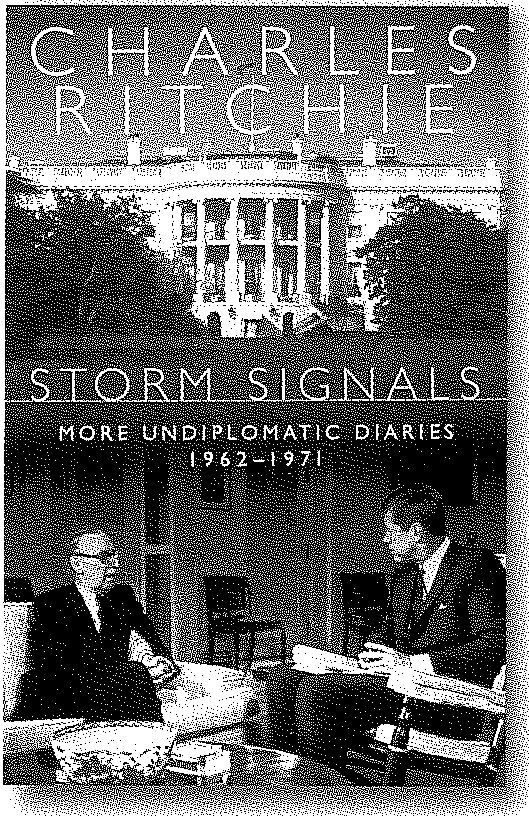
Storm Signals, More Undiplomatic Diaries, 1962-1971
28 August 1968 he Department of External Affairs is becoming more and more a branch office of a huge expanding bureaucracy. Our Foreign Service is becoming more and more like other Foreign Services. This is inevitable, but it does not suit me. I loved the old, small, ramshackle Department where eccentricity was tolerated and where everyone was a generalist who flew by the seat of his pants.
The Victorian Gothic of the East Block was the perfect setting for the Department as it was in those days. The building makes no concessions to efficiency and is a standing rebuke to progress. How many of the waking hours of my life I have spent there; how well I know the dark attics with windows at floor level, one of which I shared as a junior with Temp Feaver and Alfred Rive, and later, on my progress upward in the Service, the spacious rooms with their monumental fireplaces, which were reserved for senior officials. How often have I trod those echoing stone-floored corridors and caught the dusty, musty smell that lingers there from the 1870s. How often have I paused, leaning on that ironwork balustrade that looks down on the pit of the entrance hall, trying to pull together my thoughts before an interview with the Minister or the Prime Minister of the day in his office in the corridor beyond. And how often, too, have I paused there again on my way back after the interview, to curse myself for being talked out of the point of policy that I was trying to make.
14 April 1963
The government is out. Diefenbaker is gone and Mike [Pearson] is in. The wreckage is strewn all around — Ministers with whom I have been dealing in these past years now are relegated to powerlessness. I must at once write to Howard Green to express my respect for him and my gratitude for his steady support. I shall not be writing to Diefenbaker. I consider his disappearance a deliverance; there should be prayers of thanksgiving in the churches. And these sentiments do not come from a Liberal.
27 August 1963
Back here [in Washington] I am switched abruptly into the present by the Prime Minister’s voice on the telephone. Mike is in one of his querulous moods. He asks my advice, brushes it off as irrelevant, then circles back to it, picks up a point I have made, turns it inside out, and makes something of it. What emerges more clearly every day is that the Hyannisport honeymoon is already over. Things have never been the same between us and the Americans since Walter Gordon’s Budget.
22 September 1963
When I was a young bachelor in Washington my mantel-piece was piled high with invitations to dinners, luncheon parties, and dances. I attributed this to my social and conversational charms. Now I realize that anyone in trousers serves the purpose in the desperate hunt for a spare man for dinner in this widow-populated city. When an apparently case-hardened bachelor takes it into his head to get married, there is lamentation among the hostesses as they cross his name off their lists: “How could he be so inconsiderate?” Death among the elderly single men is unavoidable, but marriage is unforgivable.
28 November 1963
“Less than a week ago,” we all keep repeating to each other in bewilderment and horror. Yes it is “less than a week ago” since I was in Boston making a routine speech at some civic affair organized by the Mayor. When I sat down at the end of my speech the Mayor rose to his feet and, instead of the conventional thanks, he said, “I fear that I have some extremely bad news to announce. The President of the United States has been assassinated.” Sylvia and I walked out into the sunny Boston streets in a state of shock. People were standing at street corners or walking along the pavements weeping openly, a sight I have never seen before. Now the original shock seems buried under these shoals of tributes and eulogies pouring in from all over the world and the hundreds of shifting TV images of the assassination and its aftermath. What can one find to say? The adventure is over, “brightness falls from the air”, ’, that probing mind, that restlessness of spirit, are snapped off as if by a camera shutter. We shall no more see that style of his, varying from gay to grim and then to eloquent, but always with a cutting edge.
Now for the anticlimax —to L.B. Johnson. We have come from the hills to the plains.
Bobby Kennedy remains untamed among the flood of public grief. His silence is significant of a deeper and different kind of grief.
30 August 1968 — Ottawa
The Prime Minister [Pierre Trudeau] began our interview by asking me whether I thought that the Department of External Affairs was really necessary and, if so, why? I said that I viewed the Department as an instrument for the protection and advancement of Canadian interests abroad and not as a seminar to discuss abstract policy considerations. I think that Trudeau has got it into his head that the Department is divorced from the real interests of Canada and is embarking on international projects which have no firm basis in Canadian needs, and that this has been characteristic of the Pearson era.
5 June 1969
Yet another Cabinet Minister — [Jean-Luc] Pépin, the Minister of Trade and Commerce. Went to the airport to meet him. I had never seen him before but guessed as he came off the plane that he would be carrying a spare suit on a hook under a cellophane cover, and I was right. He is big and jovial, and looks a cross between an Assyrian emperor and Groucho Marx. Very easy and open in manner. A group of us went back to the Dorchester to work on his speech. It is a long time since I have put in such a session, yet how many hundreds of times I have done it and with so many different Ministers-battles of wits, will, prestige, over the inclusion of one civil servant’s draft or the substitution for it of another; attempts by civil servants, gently, firmly, persistently, to eliminate the Minister’s wilder, bolder-or just more vote-getting-passages in the text. Block that metaphor! Drop that joke! A final exhausted tug-of-war over the elimination of the word “despite” in paragraph 4.
19 May 1971
A letter from the Department – “I regretfully must confirm that you should plan your retirement at the normal date, that is, September 23, 1971.” So that’s that. It will take some sharp hustling to get out of this house by that date, with two months of the London Season and continual entertaining coming in between, and then the dead month of August. It is the end of thirty-seven years in the Foreign Service.
View the original scanned pages →
Originally published in bout de papier, Vol. 18, No. 3 (2001) — Fall 2001 // Automne 2001, pp. 11–19. Read the rest of this issue →



