
bout de papier, Vol. 25, No. 3 (2010) — Fall 2010 // Automne 2010, pp. 16–17
Editor’s note: Our interview with Kathryn Hewlett-Jobes of FOCAL is the third in a series on Canadian organizations that strengthen Canada’s global and regional presence (the first dealt with the IDRC, the second with the Canadian International Council). The challenges in doing so are many, from sustaining financial support in Canada to ensuring access to decision makers abroad. FOCAL’s Hewlett-Jobes, our former High Commissioner to Jamaica, is determined to meet them.
bout: Tell us about the Canadian Foundation for the Americas (FOCAL).
KHJ: FOCAL is Canada’s only think-tank dedicated to strengthening Canadian relations with Latin America and the Caribbean. Our goal is to build understanding of Canada throughout the hemisphere. We aim to promote good governance, economic prosperity and social justice, basing our work on principles of intellectual integrity, racial diversity and gender equality.
We research social, political and economic issues and bring together Canadian and regional experts from civil society, academia, government, and the private sector to advance understanding of crucial issues and policy options. Activities are often undertaken in co-operation with other Canadian organizations such as the Canadian International Council (CIC) or one of our network partners in the Americas.
For example, FOCAL is partnering with the Mexican Council on Foreign Relations (COMEXI) on the Canada— Mexico Initiative. Co-chaired by Hon. Bill Graham and Mexican Senator Rosario Green, this Initiative is working with both governments, the private sector and academics to develop pragmatic ideas on how to build public support for, and re-energize, the bilateral relationship.
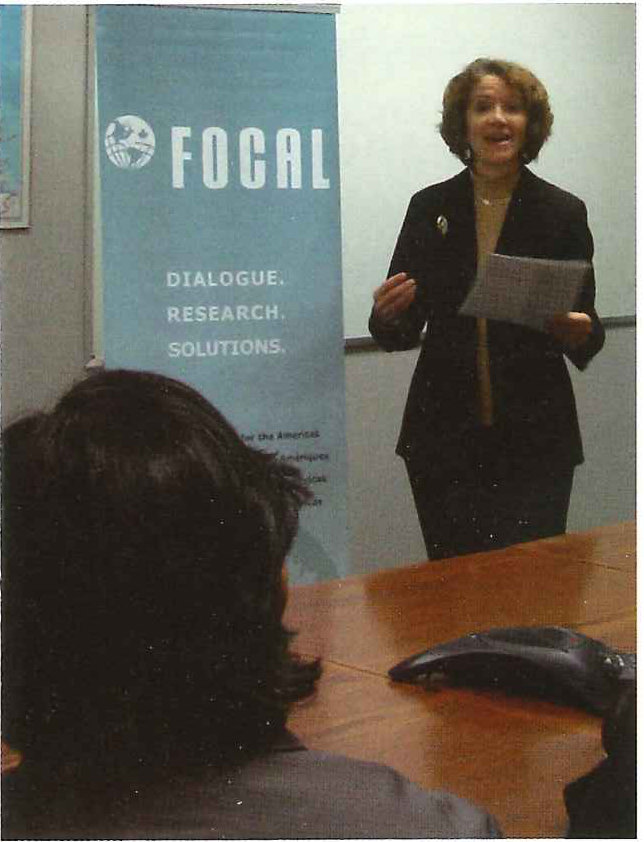
Other current work includes a Health and Education program that examines gaps for marginalized populations in the Andes, an Inter-American affairs program with particular emphasis on the Summit of the Americas (the next one to be held in Cartagena, Colombia in 2012), a Labour Mobility and Development program to foster dialogue on temporary foreign workers in Canada and the development impact of diasporas, and a program on the Private Sector and Development. FOCAL also runs Research Forums on Cuba, Haiti and North America.
bout: You must be pleased that the Americas are now a foreign policy priority for Canada.
KHJ: We are — and hope that this time it becomes a lasting area of focus. FOCAL was created 20 years ago as a result of an earlier Americas thrust. At that time, Canada joined the Organization of American States (OAS) and Canadian firms, academics and civil society began to turn more attention to the region. However, it has proven difficult to sustain interest. The Latin America and Caribbean region has only slowly crept into the Canadian psyche and even now the level of awareness is much lower than one would expect.
Economically, this region deserves our attention: trade has been growing rapidly in recent decades and now exceeds $40 billion annually, even in the context of last year’s recession. This is facilitated by a number of free trade agreements (FTAs) with the region; in fact, Canada has signed more FTAs in Latin America and the Caribbean than in any other region of the world. We have comprehensive agreements with Mexico (through the North American Free Trade Agreement, NAFTA), Chile, Costa Rica and Peru, and others pending ratification (Caribbean, Central America, Colombia and Panama).
An even more significant economic rationale, however, is investment. Canadian investors have given Latin America and the Caribbean a strong vote of confidence in sectors as diverse as mining, banking and tourism. Canadian direct investment in the region, roughly $100 billion, is three times that directed at Asia, including China and Japan.
In foreign policy, there is much to be gained from solidifying our engagement with Latin America and the Caribbean where, to an impressive degree, our values and interests coincide. Underneath the obvious differences, we have common linguistic, religious and historical roots. Canada could better use these affinities, and better exploit the pool of good will that exists. A good example of this is Canada’s bid for a non-permanent seat on the United Nations Security Council in 1998, when all 34 countries in the hemisphere supported Canada, even the US and Cuba. That was a one-off affair, but one that illustrates the potential of effective regional diplomacy.
And there are numerous other linkages from active academic exchanges, growing tourism and an increasing number of Canadians opting for retirement homes in the region. However, the average Canadian is far more likely to identify Asia as the key area of focus beyond the US.
bout: Why do you think this is the case?
KHJ: rm tempted to say that FOCAL obviously needs more funding!
In my view, there are several major factors, each of which deserves a book to be fully discussed. Perhaps the most important is simply the dominant role played by the US in the hemisphere. The very significance of this relationship makes it difficult to see past it. As one South American colleague put it: it is hard to see over the elephant.
Another key reality is the importance of shared history and culture. Canada has deep historical connections with Europe, and Canadians can easily look across the Atlantic for resonance in culture and values. And as the world reacts to the echoes of post-Cold War power shifts and new security challenges, the North Atlantic Treaty Organization (NATO) continues to be of major importance, a tendency that is currently reinforced by our joint engagement in Afghanistan.
While Canada and the countries across the Americas have compelling contemporary reasons to build deeper ties, with the exception of the Caribbean, until the past few decades our histories had evolved rather separately. I recall well the days when trade and immigration connections were few, tourism virtually unknown, and democratic governance in Central and South America was not the norm.
Today it is quite a different picture, but broadly-based perceptions are still lagging; this largely explains why Canadians often continue to make the mistake of leaving our relations in Latin America and the Caribbean on the back burner.
bout: Will it be different this time?
KH: it depends on whether we maintain our focus or once again lose interest.
By making the Americas a foreign policy priority, the Canadian government took a major step to establish the current importance of the region to Canada and harness the potential of deeper connections. Since its inception, the policy has racked up impressive accomplishments in bringing a whole-of-government approach to raising awareness of the Americas.
The upcoming Annual Meeting of the Inter-American Development Bank that Canada will host in Calgary in March 2011 offers an excellent occasion to highlight this new engagement.
Government efforts reinforce the ongoing and diverse activities of the private sector in the region. Canadian companies are highly visible in the resource extraction, financial, industrial and agricultural sectors. Universities across the country have programs and academic exchanges with the region and many International Development Research Centre (IDRC) programs support the deepening of ties across the Americas.
Canadian business has an active voice through its Canadian Council for the Americas, and the Canadian International Council (CIC), the Centre for International Governance Innovation (CIGI) and some specialized NGOs that have produced special reports and commentary on Americas topics.
Spanish is now the third most commonly spoken language in Canada and growing immigration, increasing tourism exchange and educational connections are cultivating exciting new cultural and social ties.
However, there is a need for further steps to ensure continued and concerted attention to the many opportunities that closer ties with the Americas will bring to Canadian society as a whole.
bout: What should be done?
KHJ: The whole-of-government commitment to the Americas policy must be followed by a whole-of-Canada effort. Otherwise, it will become another example of the cost of missed opportunities.
Creating this sense of purpose calls for a range of actions. First, one needs something worth saying. Independent, solutions-oriented research has become even more important in today’s world where information is more readily available, but thoughtful analysis is scarcer.
Government-produced information can be seen as lacking independence and is often brutally discounted by the key audiences. Firm-produced information tends to be viewed in an even more suspect light. Academic analysis is seen as much more credible, but frequently addresses topics in a manner that is more theoretical than needed by those seeking advice and information.
FOCAL plays a special role in integrating these diverse perspectives, ensuring that information is grounded in solid research and developing practical policy options for decision makers. But analysis is only useful when it is effectively communicated. Today’s audience has neither the time nor the patience to dig up information. The central challenge for FOCAL is not only to produce useful policy advice and the information needed to substantiate it, but also to disseminate that intelligence as widely as possible.
We take the facts to those who need them by convening person-to-person exchanges of views, making it easy to connect to a range of sources through our website and social networking tools, attractively presenting information in FOCAL Point, our flagship newsletter that analyzes policy issues in the Americas, and by acting as the media go-to place for commentary on Latin America and the Caribbean.
So next time you see us on The National, or pick up one of our policy papers, you will know that we are working to build this whole-of-Canada support for engagement in the Americas, to promote good governance, economic prosperity and social Justice in our own backyard.
bout: Thank you, Kathryn.
View the original scanned pages →
Originally published in bout de papier, Vol. 25, No. 3 (2010) — Fall 2010 // Automne 2010, pp. 16–17. Read the rest of this issue →



