
bout de papier, Vol. 20, No. 2 (2003) — Fall/Winter 2003 // Automne/Hiver 2003, pp. 11–14
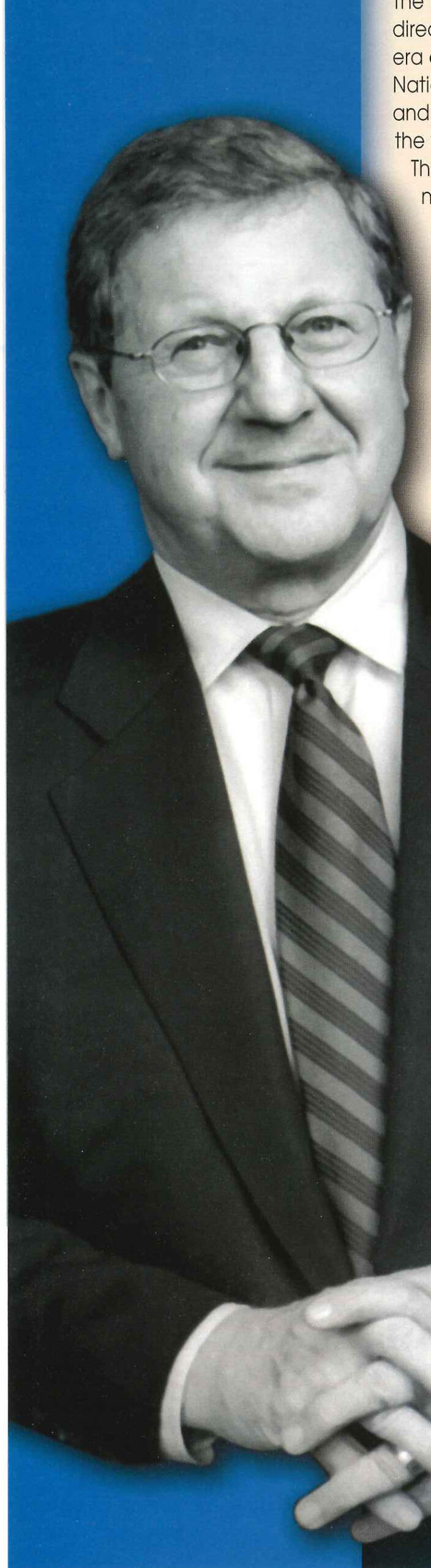
Canada’s former Minister of Foreign Affairs, Lloyd Axworthy, who is now Director and CEO of the Liu Institute of Global Issues at the University of British Columbia, has drawn upon his considerable experience of international relations and Canadian politics to write a new study of Canadian foreign policy and how it should be adapted to changes in world affairs. Readers of bout de papier will not be surprised to find that Professor Axworthy’s argument is advanced in print with the same passionate commitment that he brought to his ministerial endeavours. In light of what has happened lately around the globe and what will soon be happening in Ottawa, the appearance of this eloquent testimonial to the relevance of liberal internationalism is timely. – Hector Mackenzie
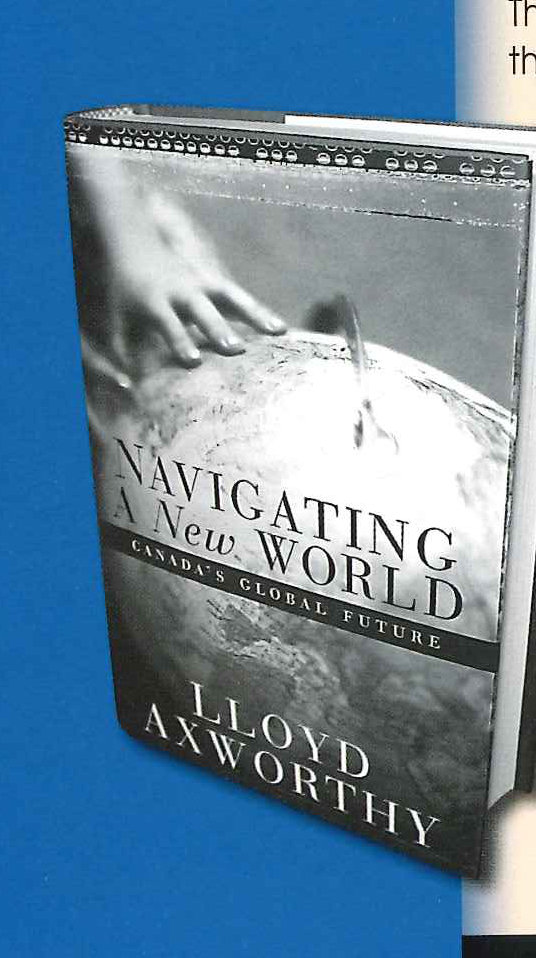
With the kind permission of the publisher, the following extracts are taken from Navigating A New World Order: Canada’s Global Future by Lloyd Axworthy. Copyright 2003 Lloyd Axworthy International, Inc. Published by Alfred A. Knopf Canada, Toronto, 2003, xi, 450 pp. (included notes and index), Cdn $37.95 in hard cover. Reproduced by arrangement with the Publisher. All rights reserved.
Prologue: Canada and the World
Canadians are on the road to global citizenship. Increasingly in work, travel, education and in personal and political engagement the world is our precinct, with international trade, finance, technology and business driving much of our global interests. But there is also a political, cultural and even moral dimension to our emerging role in global society.
Canadians take pride in what we do in the world. Our sense of identity is often tied up in such achievements as peacekeeping, placing in the top rung of the United Nations Human Development Index of best places to live, and winning a gold medal in Olympic hockey or a Man Booker Prize in literature. The values we express internationally help define who we are when other distinctions are being erased. Equally, our welfare is closely tied to international rules and practices. Daily while at Foreign Affairs I saw how little separates what we do inside our border from what happens outside and vice versa. We occupy the global village that Marshall McLuhan prophesied we would half a century ago. What this means is that we win in a stable, equitable, cooperative world. We lose when it is turbulent, divisive and unfair. It only makes sense, therefore, to examine carefully what we can do to tip the global system in a constructive way. That is what I would like this book to achieve.
I don’t feel we yet fully understand the responsibilities and obligations that come with being a global citizen or make the full connection between the need for well-resourced international initiatives and our domestic interests. Too often we try to do things on the cheap, and avoid the tough commitments. In the federal election of 2000, I watched with some dismay how the entire campaign unfolded with nary a word about foreign policy. There was great discussion of domestic economic priorities, but nothing on how to strengthen our capacity for effective international action – and this despite growing disenchantment with a variety of global developments, expressed most notably in protests and demonstrations. My own years at Foreign Affairs were very much occupied with the effort to define a distinctive international place for Canada. When I arrived there in 1996, a decided shift was taking place in the perceptions and calculations arising out of the end of the Cold War and the surge of globalization in economics, technology and information. In the early nineties there had been fond hopes of a new era of prosperity based on the liberalization of markets, deregulation and the global movement of capital. Poverty in the Third World would be whittled away by the powerful forces of the marketplace. By the middle of the decade, though, that tide of optimism was on the wane. Inequities were growing, not receding. The value of global trade and investment agreements
Traveller, there is
no path. Paths are made by walking.
– Antonio Machado
was under challenge by Southern countries, and there was growing skepticism from civil-society groups. The spectre of ecological disaster was creeping into prominence.
Similarly, President George Bush Sr.’s bold claims for an emerging system of security based on international cooperation – the “New World Order”
– had already run aground in Somalia and Bosnia. The United States was increasingly shy of exerting direct leadership in the security requirements of an era of messy internal ethnic conflicts. The United Nations was discredited by its inaction in Rwanda and impoverished by the nonpayment of dues by the world’s superpower and other financial shirkers. There was a definite vacuum in defining security needs and responses. This was especially so in scoping out answers to the dark side of globalization – the increasing threats from international terrorists, pedophiles, drug dealers, small arms traders, illegal-diamond merchants and people smugglers. The same networks of information that allowed capital to move around the world in seconds, or brought scenes of suffering into living rooms around the globe, gave these predators the capacity to exploit the vulnerable and establish international connections that could overwhelm the capability of individual nations to protect their citizens. Drug trafficking, for example, had become a multi-billion-dollar business and confronted police forces with the most sophisticated tools of communication, transportation and organization. Ugly signs of dangerous terrorist networks were being detected. Already in 1996 I was calling for a starvation policy to deny criminal perpetrators access to money and arms.
There was an obvious demand for more effective international teamwork to meet all these challenges. Halting steps were being organized at the UN, the G-8, the OECD. But there was an opposite pull. The strong hold of beliefs in national sovereignty, and anti-internationalist feelings, meant that many governments resisted multilateral cooperative ventures. The philosophy of go-it-alone was alive and well even in the face of a shared risk. Traditional notions of national interest were stoutly defended even while they simply didn’t match the tempo of interdependence that was under way. Complicating the efforts to govern this global interdependence was the pre-eminent position of the US. The collapse of the Soviet Union had confirmed the dominance of American power and influence as the reality of the global system. With this came increasing US claims that its dominant position carried special responsibilities and therefore prerogatives to act unilaterally. The Clinton administration generally set its actions inside the framework of international institutions and laws. But not so the government of George W. Bush. The terrorist attacks of September 11, 2001, launched an aggressive US effort to assert US interests, repudiate multilateral, collaborative governance, and follow a radical security doctrine that prescribes the use of US military supremacy to establish the US’s unchallenged right to determine the character and shape of the world – what might be called imperial ambitions.
From a Canadian point of view, the US’s reluctance to submit to international treaties and agreements, and its new doctrine of pre-emption, are cause for great concern. While over the past decade most agreements in arms control and environmental or human rights have not been ratified by Congress, now the Bush administration is not just a reluctant signatory but also a ferocious opponent of any agreement that does not directly serve specific ambitions of the US – hardly a promising atmosphere in which to construct a new global architecture.
The US stance poses real difficulties for Canadians as we become ever more integrated into a North American economy and security arrangements. The September I attacks, the subsequent antiterrorist campaign and the controversy over the invasion of Iraq have brought pressures for further alignment with US goals, and closer military ties. But how far do we go in the integration of our systems before we lose the capacity to pursue independently our own preferences for multilateral, international collective action and collaboration? As we shall see, the paradox is that global interdependence can enhance the scope for distinctive Canadian actions.
By the time I became foreign affairs minister, a realistic and imaginative look was needed to make sense of these conflicting and confusing trends. The old paradigm of nation-state supremacy couldn’t deal with evolving interdependence. The alliance system of the Cold War didn’t provide a relevant basis for global cooperation. Even the multilateral system centred on the UN was rooted in post-Second World War thinking and didn’t encompass forms of governance to meet economic and technological changes and new security threats. During my time at Foreign Affairs a number of international challenges, from Zaire to Haiti and from Cuba to Kosovo, suggested the need for a new approach that would emphasize the human and humanitarian dimension and also promote Canada as an innovative player. The concept of human security emerged as the lens through which to view the international scene. The security risk to individuals was our focal point, and around that we developed a strategy for working towards new standards of international behaviour, using the soft-power tools of communication and persuasion. While simple in concept, in some ways it was revolutionary, since it set the notion of human rights against deeply held precepts of national rights.
We proposed a way of seeing the world and tackling global issues that derived from serving individual human needs, not just those of the nation-state or powerful private economic interests. This is not through some form of all-powerful, centralized world government. Rather, it is a form of global governance that operates under global rules, works through global institutions and will require a form of global democratic politics to make decisions. It seeks a way to transcend particular interests for a common good.
This new outlook has to date mostly been applied to achieving security from violence. But it can equally be applied to other issues, particularly environmental security. Increasingly, people are asking how we move towards a more effective, enforceable management of environmental problems that might emulate the ways we deal with violence and conflict. For the truth is that there is as much dislocation and suffering through environmental degradation and climate change as there is through conflict situations. The number of refugees caused by environmental damages equals or exceeds that of war. People in one jurisdiction suffer from actions taken in another (as we have seen in North America with smog, or in Southeast Asia with the Indonesian forest fires) and this highlights the need to find solutions that transcend traditional cross-border agreements. As we shall see, the same lens of human security can be brought to bear on other global concerns such as public health, migration, the management of resources such as water, and even the monumental task of alleviating poverty. As we increasingly struggle with growing gaps in equality and with the exploitation of the world’s poor, and as we witness partial and often self-defeating development programs, we have to ask if we are not coming up with answers still rooted in conventional thinking. It’s time to look with new eyes.
The idea of human security seems a particularly good fit for Canadians. We are in a position to promote a blueprint for ordering global affairs that improves upon the present, frequently ineffective model. We have inherent strengths as a people of wealth and talent who have forged a community of interests, express a humane set of values, know the struggle to assert and maintain a sense of independence and understand the benefits of working in collegial fashion. In a survey of forty-four countries, with thirty-eight thousand respondents, Canadians showed the highest level of satisfaction with their lives and the general direction of their country. There was not the degree of angst over crime, corruption and the state of public services as in other countries, nor by a long chalk the level of animus against immigration found virtually everywhere else. These characteristics, particularly the latter, translate into real strengths for Canada in pursuing a role in the world.
The accepted wisdom has been that we are an honest broker, a mediator, a peacekeeper, a country that uses our proximity to the US to act as an interlocutor between them and other nations or international organizations. Today such a middle-power role is not enough; indeed, such a role is losing much of its validity. Canadians instead can draw on the strengths I have just listed to take a special kind of leadership in helping manage a world dominated by the power and influence of our continental neighbour. I was once asked in Minneapolis if I agreed with the definition of the US as the “indispensable nation.” I demurred answering directly, out of politeness to my American audience. But I did say that I believed Canada was the “value-added nation” in the international system
– Canadians can help carve out a global system of security based on protecting individual social, political and economic rights. Such a course would reflect the opening lines of the UN Charter, which begins, “We the Peoples” – not “We the Leaders” or “We the Diplomats.” Canadians are in a unique position to help write the new navigation manuals in these stormy times.
It is an approach that stands in stark contrast to those who see a world dominated by military force and naked self-interest. The instinct of the Bush administration to dismiss treaties, disdain common efforts to cope with global issues and argue for “full-spectrum dominance” and pre-emptive, unilateral action needs a constructive response.
So do the fanatical extremists who murder and maim indiscriminately. They need to be brought to justice. We need a strengthened commitment to open democracy and the enhancement of rights to counter the growing power of narrow fundamentalism among all faiths and its translation into acts of intolerance and political violence. Justice and caring are also due the dispossessed of the world who feel cut off and ignored by the rich developed world as they languish in camps of refuge and displacement or are left to die of AIDS or malaria untended and alone. They need inclusion and the better distribution of wealth. This book, then, is dedicated to the proposition that we in Canada – each and every one of us – can make a difference to the building of a humane global community relevant to our times. It describes a world seen through my eyes from different vantage points over a number of years. It asks that we begin to rethink the international dimension from the perspective of individuals – their security, their needs, their potential, their hopes and dreams. I have attempted to offer and set out choices for Canadians to consider. If Canadians can get this global role right, if we can maintain and strengthen our capacity and will for creative independent action, we will fulfill our duty as global citizens and define our own place in the contemporary firmament.
Chapter 17, “Navigating a New World: The Road Ahead”
This agenda of international collaborative action within a framework of rules and laws may seem strangely at odds with the temper of our times. Most talk of the future paints a dismal picture of unrestrained American dominance, mixed with anarchy let loose by the forces of criminal fanaticism. What I have presented here is an alternative road map. It is not unrelated to the dominance-doomsday scenario, but it takes into account that under different leadership the US is capable of using its immense power to create strong international institutions and uphold the rule of law. Those Americans who argue for a return to a constructive role for the US can be greatly helped by close friends setting out a blueprint. Similarly, effective global institutions grounded in democratic practices and following human security principles are the best means of countermanding and controlling the global underworld.
Working on an agenda of this kind is not only a good fit for Canadians, it is also the right thing to do. Canadians can help set the right navigational coordinates, but to do so we must enhance, not reduce, our freedom of action and guard against forces in our country that want us to travel only in the company of our powerful neighbour.
There is no sure way to navigate this world. No yellow brick road leads to a guarantee of salvation at its end. Each and every one of us will be called upon to broaden our global perspective, explore new options, honour different ideas and voices – above all the voices of youth – and show resiliency in the face of the unknown. It is a journey we Canadians take together by deciding together, not because other nations choose for us. Though we welcome their company and their perspectives along the way.
Canada is only one community amongst many. We have no pretensions about wielding a big military stick, nor do we have any whiff of manifest destiny. But we can offer ideas, skills, resources, a political commitment to working with others to find practical, peaceful solutions, and a sense of quiet optimism about the future. We can hold out hope for many around the world. We can mark the road towards a horizon where justice, security and fairness beckon. We can set a beacon to guide both Emmas as they define their own pathway into this new century.
View the original scanned pages →
Originally published in bout de papier, Vol. 20, No. 2 (2003) — Fall/Winter 2003 // Automne/Hiver 2003, pp. 11–14. Read the rest of this issue →



