
bout de papier, Vol. 10, No. 4 (1993) — Fall/Winter 1993 // Automne/Hiver 1993, pp. 18–21
Story and photos by Barbara Shenstone
As I came down the steep bank towards the boat, I noticed the crowd of children by the water’s edge. They were not making much commotion, but obviously there was something of interest in the water. “It’s a body,” my partner said, “I think it’s been tortured. Where are the Civpol?”
Diane turned back towards the UN truck at the top of the slope. As she radioed for the UN police (Civpol), I stood looking down the bank towards the Mekong River. There were adults on the bank. After a few minutes I did go closer. As Diane said, we had to know what was going on. We both took one look.
The corpse was the bloated remains of a man who had suffered greatly before his death. As he floated on his back, I could see his hands were tied above his head to a pole; he wore a black shirt and pants, but his chest and genitals were exposed, revealing bloody gashes and what looked like burns. The face was pulp.
I remember thinking afterwards how matter-of-fact we were that morning — all of us, not only Diane and myself, but also the people of the village, the Cambodian police, and our colleagues in the UN police. Although the situation was shocking, we behaved as though it was all in a day’s work.
In retrospect, it was all in a day’s work that year, from May 1992 to June 1993, when 35 Canadians like myself were posted as district election supervisors for the United Nations in Cambodia.
This was not the last time we were to come across corpses in the river. In the months leading up to the elections of May 1993, lawlessness and political violence coloured every aspect of life in Cambodia. Although we tried to take on the role of referees, we were helpless to control or even understand the events we witnessed.
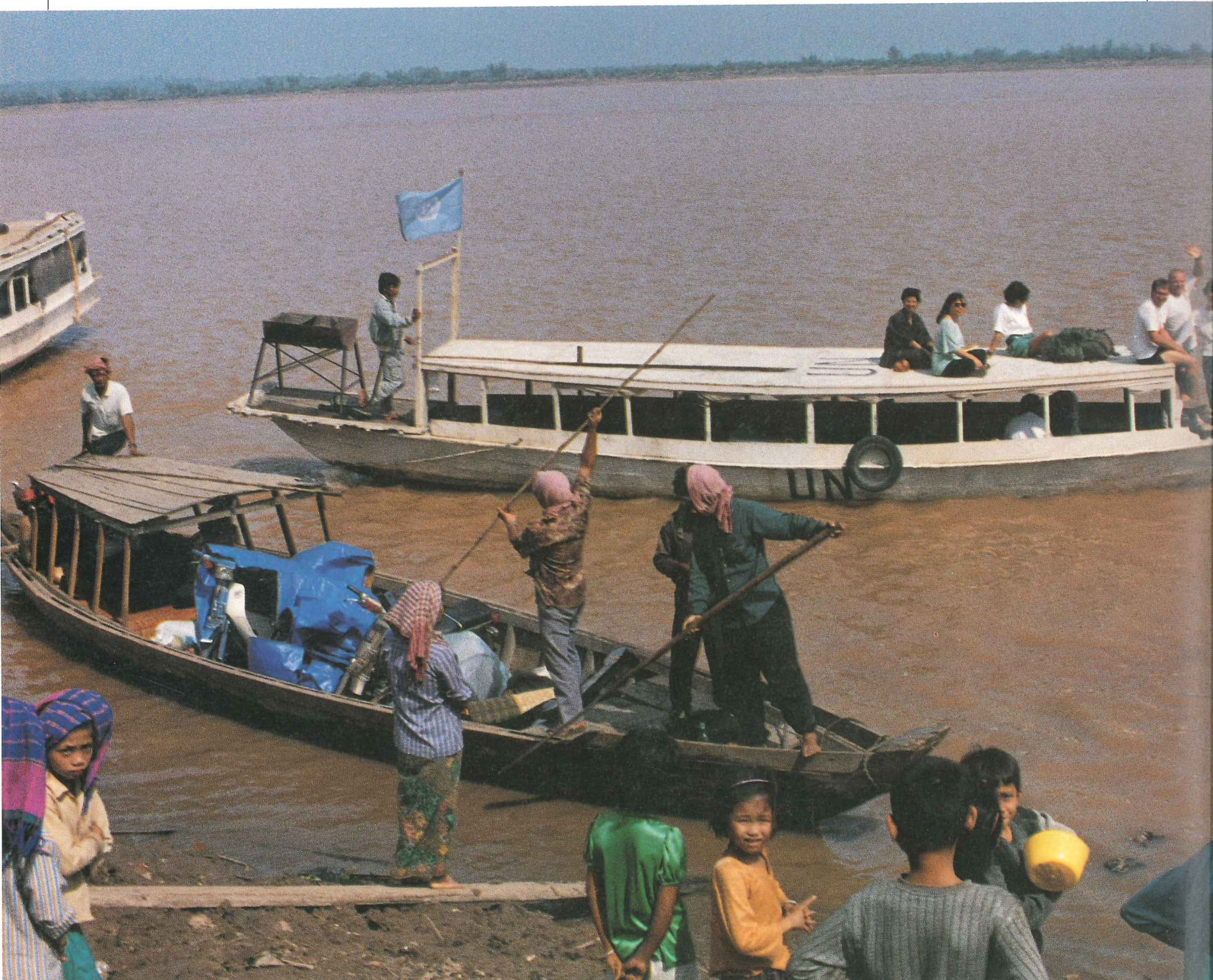
There were about 400 district electoral supervisors (known familiarly as DES) in Cambodia, representing about 50 different nationalities. Among the 16,000 other civilian and military personnel, we enjoyed a unique status as volunteers.
The pay was minimal; the job was enormous. We were the front-line “grunts” of the UN. Deployed in twos or threes in each district of the country, our job was to make the election happen: first by organizing the registration of voters, and later the polls themselves.
Setting up an office in each district, hiring local staff, training them, identifying temporary registration sites, spreading the word in each community, supervising teams of registrars, and trouble-shooting — this was the job.
It also meant liaising with local political factions, including the infamous Khmer Rouge, as well as the many new political parties that burgeoned in the country during those eventful months. Later, it meant investigating complaints and violations of the election campaign rules, using whatever means we could to persuade the political parties (and the police and military connected with them) to desist from violence and intimidation.
To encourage political activity and the voters themselves, we also undertook extensive civic education programs to inform Cambodians about their political and human rights, how to vote, and above all, in order to protect them from intimidation, the secrecy of the vote.
Cambodia was a difficult place to work. The country had been destroyed by more than 25 years of war. Largely agricultural, much of the land was now unusable because of land mines. There was really no post office or communications system, let alone health care. What were once roads were now intermittent tracks that had become impassable in the rainy season or at best a series of mud pits that sucked a 4 by 4 vehicle to the top of its wheel hubs in seconds. There was a small and corrupt civil administration and a skeletal school system for those who could afford it. It was not unusual for teachers (who earned $15 to $20 per month) and others to go without pay for six months at a time.
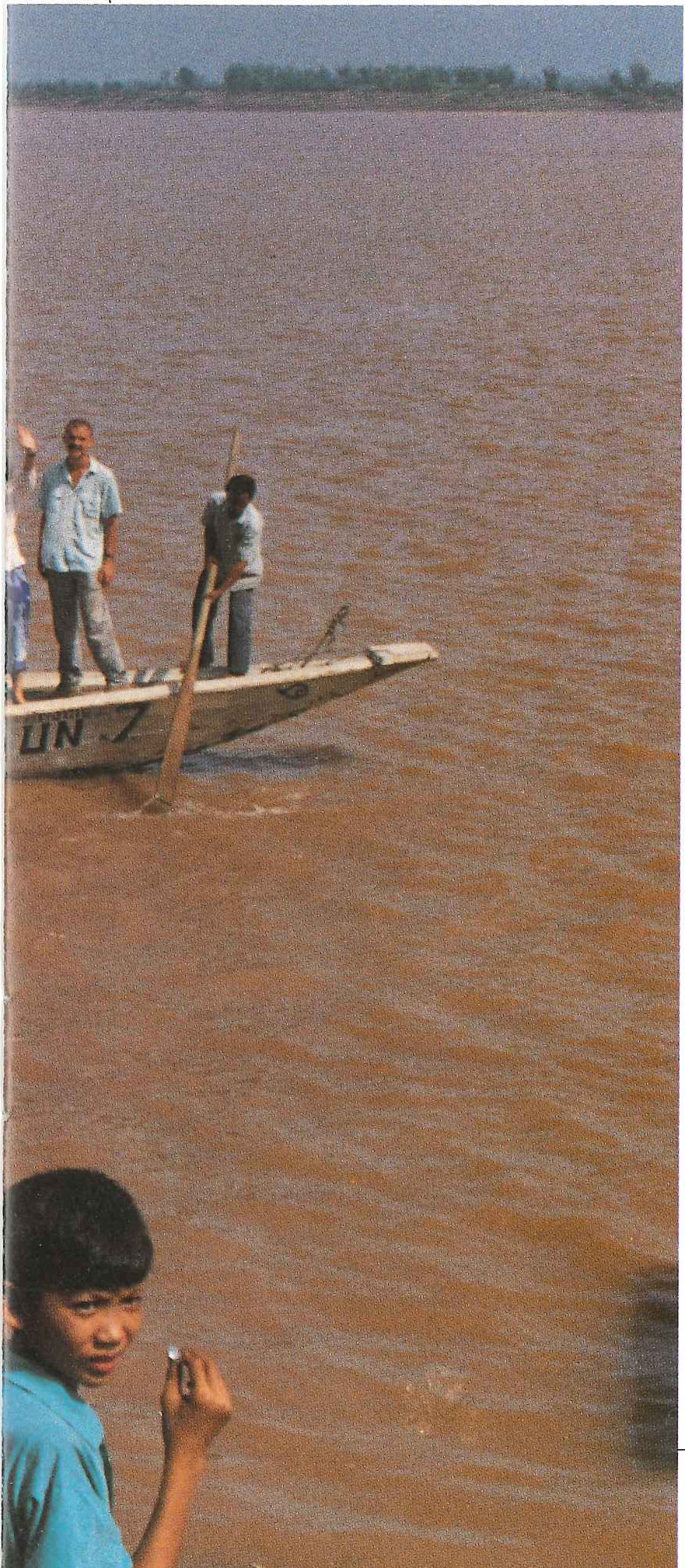
All this meant that many districts were isolated and difficult to get around. The countryside was lawless. It was difficult to find qualified personnel to do the clerical work involved in an election. To get to our districts, we spent many hours travelling by truck, boat, or helicopter. Once there, we were often cut off from other UN components, although we had radio communications. Within a district, the DES and the Cambodian staff working with them moved by UN truck, UN helicopter, motorcycle, pony or ox cart, and often on foot.
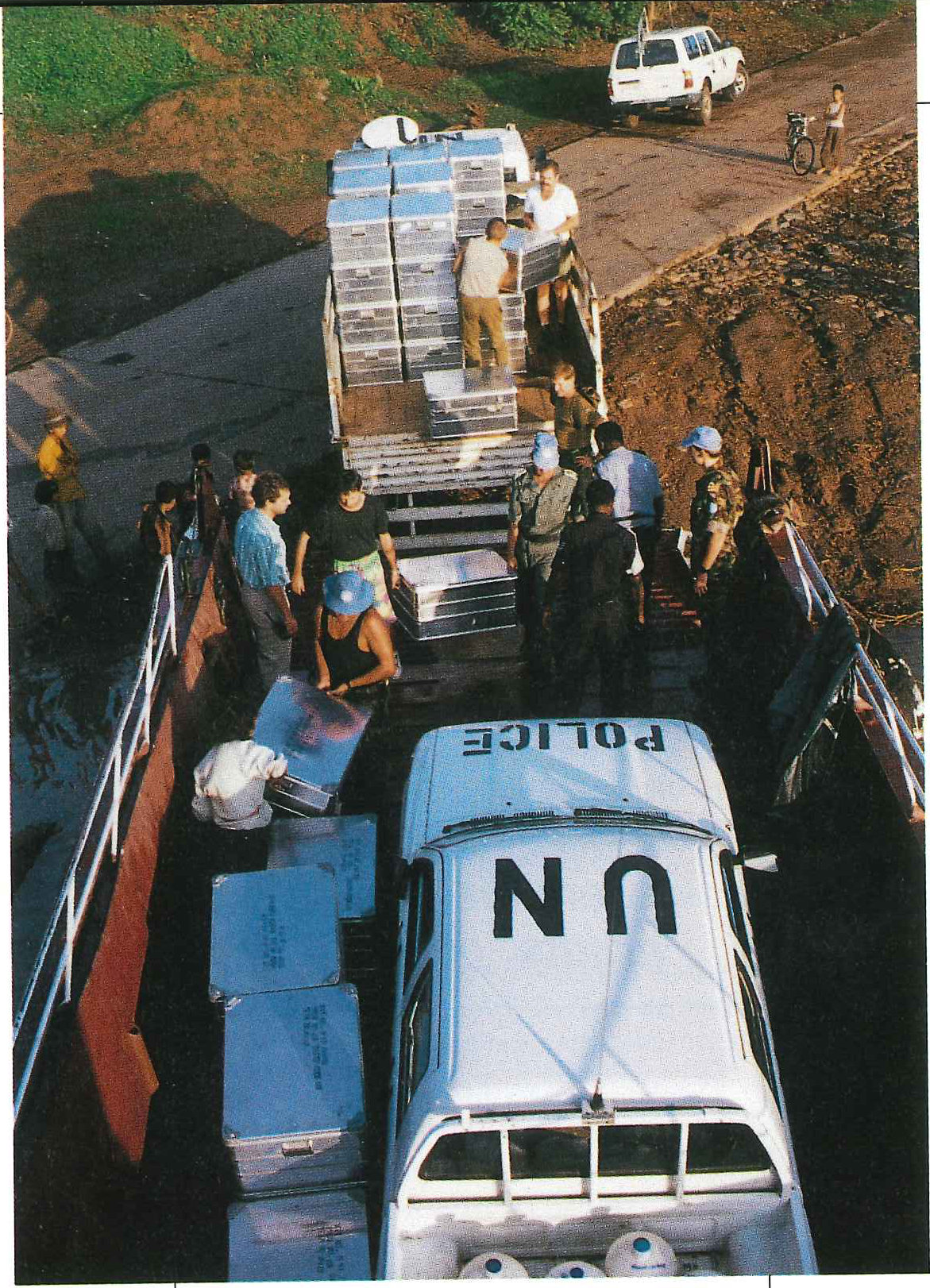
For those of us who had not seen an operation of this size, we were amazed how much equipment we were constantly moving: diesel for trucks, drinking water, office supplies, posters and pamphlets, tarps, generators, and electrical gear like extension cords, plastic card laminators, cameras, lamps, fans. All of it had to be delivered, warehoused, loaded on and off vehicles and boats, set up and taken down in the right places, and kept track of.
On top of this, the climate of Cambodia was extremely hot and humid, making any physical activity arduous. Everyone was vulnerable to malaria, dengue fever, dysentery, hepatitis, and those other famous tropical diseases. If someone fell sick or injured, help was difficult to get.
Although the DES were the outermost arm of the UN, we were always conscious of being part of a gigantic operational machine. Supporting us was a great network of people organizing supplies, working out procedures, producing videos and posters. An election office worked at the provincial level, and another at the national level. The UN was committed to planning, organizing, and delivering the entire election.
Elections was one of several major tasks the UN had committed itself to carrying out in Cambodia. As DES were scrambling to organize voter registration, UN military components were attempting to get the four Cambodian military factions to demobilize, as the factions had promised in the Paris Agreement of October 1991. The UN was also monitoring Cambodia’s borders, verifying the withdrawal of foreign troops, and seeing that no new troops or weapons were coming in.
The UN Civil Administration component was taking charge of key ministries in the existing Cambodian government to put an end to the worst abuses of power, smoothing the path for a “free and fair” election and a transition to peace and democracy.
About 350,000 Cambodian refugees, most of them in camps along the Thai border, were returning home and resettled with the help of the United Nations High Commission for Refugees (UNHCR).
At first, the only other UN presence the DES ran into in many districts were the UN police, known as Civpol. Civpol were small units of 10 persons drawn from the national police forces of about 40 UN member states. Their role was to supervise the local police, investigate complaints of human rights violations, keep an eye on returned refugees to see they were not being harassed, and help DES at registration and voting sites, and in their travels throughout the districts.
The UN’s plans for Cambodia were ambitious. As events unfolded over the first six months, things were not working out as originally planned. The failure to demobilize and disarm the military factions, and the refusal of the Khmer Rouge to take part in the elections, were the first major setbacks.
By late 1992, the Khmer Rouge had reneged on the promises made in Paris, stepping up attacks on villages and closing their regions to the UN. They also began a new policy of murdering ethnic Vietnamese residents of Cambodia. They apparently wanted nothing to do with UN efforts to hold an election.
The UN Civil Administration component also came up largely empty-handed. By all appearances it failed to take hold of the existing government structures with authority, thus undermining the confidence of other military factions, including the Khmer Rouge. Gross corruption continued unchecked. Police and army elements continued to intimidate and even murder political opponents.
The UN Civilian Police failed to worked effectively either, for a variety of reasons, among them language problems, poor training, and cultural tensions, contributing, on occasion, to an embarrassing show of incompetence and cultural insensitivity, or an infuriating display of sloth and an unco-operative disposition. For example, the tortured corpse that floated ashore in Kroch Chhmar District was never identified. The investigation was quickly dropped because, as the Civpol explained, “We think he was only a robber anyway.”
While things looked glum by early 1993, there had been success on two fronts. The repatriation of refugees, although behind schedule, was taking place in a generally orderly fashion. Many retugees tended to settle in urban areas, but some did end up in districts like Kroch Chhmar. There, because of their education, their influence was felt almost immediately by the UN. For those DES looking for staff to act as registrars and polling officials, they were invaluable. Not only were they literate, but they were also already familiar with many concepts of democracy and human rights.
The other big success was voter registration. Over 4.5 million Cambodians had registered by early January, 1993. This represented almost 100 per cent of the estimated voter population of the country, surpassing everybody’s expectations. Many DES viewed the results with some scepticism. While people had turned out in large numbers to get voter cards, would they actually vote on Election Day? We were not convinced that Cambodians really understood what the card was for. In any case, political events threatened to overtake the whole process and render the election a farce, if not a blood bath.
The security situation was going from bad to worse in many districts of the coun try. Kroch Chhmar District, about 150 km northwest of Phnom Penh up the Mekong River, was typical. Before Christmas a boat carrying eight Vietnamese fishermen was attacked on a creek not far from the UN office. Four people died, and another disappeared without trace. The assailants were never identified. The local police blamed the Khmer Rouge. Although seven political parties made efforts to open campaign offices, local authorities launched what looked like a concerted effort to intimidate and frighten as many people as possible. Villagers suspected of joining rival political parties were rounded up and forced to sign contracts renouncing any connection with these parties. Inflammatory pamphlets and posters, some of them clever imitations of UN posters, were printed. A number of Cambodians told us they would suffer if they were even seen speaking to an official from a rival party. The local authorities also seemed to be testing the UN, for instance, dropping hints that election offices would be attacked. Cambodian UN staff were harassed and threatened by local army and police. At the end of January, a member of the FUNCINEC party was murdered in his bed. He had visited our UN office only a few weeks before to complain that he feared for his life.
On April 8, a Japanese DES, Atsuhito Nakata, and a Cambodian interpreter, Lay Sopheak, were brutally killed in an isolated district of Kampong Thom province. Atsu was found dead under a UN truck, where he had apparently crawled to get away from his assailants. He had been shot several times, and beaten about the face with a rifle butt. Sopheak, a returned refugee, died later that day of gunshot wounds to the stomach.
For many DES in Cambodia, this event marked a turning point. We were angry about Sopheak and Atsu’s deaths. The political temperature of the country was rising dramatically and it was time to take measures and even rethink the entire mission. We thought that some UN military and Civpol units had been downright negligent in their duties. It outraged many DES that the first person on the scene for Atsu and Sopheak had been another DES, and that both Civpol and the military unit in that region (a notoriously hot one) had hesitated and delayed taking action, even after repeated requests from Atsu’s partner who had heard Sopheak’s call for help on his truck radio.
It did not console us to learn later that Atsu and Sopheak were not killed by Khmer Rouge, as was first thought, but probably by a disgruntled soldier who had been turned down for a job as a polling official in Atsu’s district. The DES had been saying for months that the dangers all UN staff faced in the districts came not only from the Khmer Rouge, but equally from the other still-armed factions and the general lawlessness of the country.
Since December, the DES had stressed to headquarters in Phnom Penh concerns about security. We repeatedly had asked two questions. With so many weapons and soldiers around, how was the UN to guarantee a “free and fair” election? Given that the factions had not put down their weapons as originally planned, what new measures was the UN taking?
The official answer had always been very frustrating. “Stop being negative. You DES should do your job and leave the rest to the experts.”
In fairness to the top ranks of the UN, even before the deaths of Atsu and Sopheak, some changes were taking place in the UN. If the elections did not take place, or became a farce, the UN could be held accountable for one of the most expensive failures in its history. All components, including military and Civpol, were slowly making the elections the focus of their work. In my opinion, however, the deaths galvanized a new focus, energy, and determination by all the components by the end of April.
Security became paramount in every district. In Kroch Chhmar a company of large and fierce-looking Indian soldiers from Kashmir moved in. They set up camp underneath our office, a traditional wooden house on stilts, with sentries, sandbags, trenches, wire – the whole kit. They began making armed patrols throughout the district, letting it be known that if any groups were interested, they were looking forward to having it out with them. From then on, DES and Cambodian UN staff moved whenever possible with an armed escort.
DES also worked closely with unarmed UN military and naval observers who were assigned in teams to each district. Their job was to keep tabs on the armed factions, monitor troop and weapons movements, and advise DES about unsafe areas for travel. In Kroch Chhmar, we worked mostly with naval observers from New Zealand, Britain, and Canada — a great bunch of guys — hard-working, professional, and brave.
Political tensions continued to rise as the elections approached. The Khmer Rouge leadership had left Phnom Penh and cut off communications with the UN in early April. In many parts of the country Khmer Rouge troops were on the move, gathering in larger groups, apparently in preparation for new operations. Khmer Rouge leaders announced they would do all they could to disrupt the elections, predicting a blood bath.
UN staff in the districts lived with sickening feelings of tension and dread. We constantly reworked plans for the poll. We agonized over the location of polling stations. Which ones were more likely to be attacked? How could we protect them? There was the Cambodian polling staff to worry about, and, as the election was to take place over six days, the ballot boxes. They had to be transported and protected at night, and eventually delivered to the provincial centre where the counting would take place.
To the DES, it seemed an endless balancing act, and to many a bluff, because we all knew (and the Cambodian staff working with us knew even better) how easy it would be to make it all go horribly wrong. One day I asked an interpreter what the rest of the staff feared most about election day. He said they did not fear a large-scale military attack from the Khmer Rouge. They feared a man on a motorscooter driving past a polling station and tossing a grenade into the crowd. This scenario haunted all our plans and preparations.
By the middle of May, we had reduced the number of planned voting centres to the bare minimum. In two communes in Kroch Chhmar district, we eliminated voting centres altogether, hoping people would be willing to walk the six, seven or even ten kilo metres to the next commune. In several areas we no longer dared venture at all, for fear of making ourselves targets for the growing number of Khmer Rouge who appeared to be collecting there. Elsewhere, we took circuitous routes by river or track to avoid hot spots, where we feared ambushes or mines.
Three days before the election, it began to rain. The country became a river of mud. In our district, a lake appeared in front of one polling station, cutting if off from the road. The voting materials and boxes would have to be carried across the lake on people’s heads or with ox or pony carts — twice a day for three days. Still, we consoled ourselves that at least at this voting centre it would be hard to drive a grenade-laden motorscooter within lobbing range.
Torrents fell all night before the first day of the election. UN staff braced themselves for a low turnout at the polls. We had expected the first day might be slow in any case, as voters were likely to be cautious.
What took place, however, was one of the most moving sights I have ever witnessed. Against all the odds, the voters came by the thousands — rowdy soldiers, saffron-robed monks, ancient women bent double, young girls, families. They waited in the rain before the polls opened at 7 am, having slogged through mud and rain, waded across lakes, and trudged or bicycled for miles in the dark. They came in large numbers all day the first day, and the ballot boxes filled to bursting.
As DES, we knew from our civic education efforts that Cambodians were keen to vote, but this surpassed all expectations. The turnout was enormous all over the country. I asked the Cambodian presiding officer with whom I worked what he made of it all.
“Satharioh,” I said, “will everyone who got a voter card come to vote?” Satharioh looked at me as though I had two heads. “Of course,” he said, “all Cambodian people want to vote.”
Over half the population had voted by the first evening. By the last day, the turnout was 90 per cent country-wide, and in some districts an incredible 99 per cent.
Although there was some isolated violence, the Khmer Rouge did not after all make much effort to disrupt the election. It is still a mystery why. Was a deal with one of the political parties made behind the scenes at the last minute? Did the Khmer Rouge not have the strength they pretended? Or did they realize there was little to be gained from interfering in an activity that was so enthusiastically engaged in by so many Cambodian people?
Most DES loved their work in Cambodia. Although they were part of a gigantic, multifaceted UN mission, the nature of their work, as well as their isolation, meant that they actually enjoyed great personal freedom and individual responsibility The work was different every day. We dealt with real problems and issues; and we had enormous satisfaction. Amidst all the frustrations, we, the DES, used to say that we had the best
View the original scanned pages →
Originally published in bout de papier, Vol. 10, No. 4 (1993) — Fall/Winter 1993 // Automne/Hiver 1993, pp. 18–21. Read the rest of this issue →



