
bout de papier, Vol. 26, No. 3 (2012) — Spring 2012 // Printemps 2012, pp. 5–8
choc ont débordé les frontières intern était le seul indice que deux diplômât fonctions d’émissaires de l’ONU au Ni racontée avec conviction dans le nou\ toutefois, ceux et celles qui ont eu la
On December 20 of last year, PAFSO’s President, Tim Edwards, introduced Bob Fowler to a packed audience at the Pearson Building. “Proof of Life” indeed: the “returning-warrior” (and something of a hero to many of us) came to share his 130-day experience as an Al Qaeda captive. Stating the obvious, he has served his country with distinction: he was policy advisor to three Prime Ministers, Deputy Minister of National Defence, and Canada’s longest serving ambassador to the United Nations. Now retired from the Foreign Service, Fowler was on that assignment to the United Nations as the Secretary General’s Special Envoy for Niger when kidnapped. He was accompanied by another of our diplomats, Louis Guay (also a former ambassador), who had been seconded to the UN mission.
Fowler noted that the writing of A Season in Hell was part of his “therapy” in recovering from this ordeal. The book might have been co-written with Louis Guay, had he wished to join in. However, as Fowler put it, “Louis prefers to maintain a private profile; I don’t.” He acknowledged receiving useful advice from the editors at HarperCollins who guided him on best practices in the telling of such accounts: “decide first for whom you’re writing the book. When you’re in the desert, stay in the desert — don’t jump from day 2 to day 47 and back again.” When he asked why, they replied “did you know Tom Hanks would make it home when you saw ‘Apollo 13’?”
Al Qaeda’ s “Proof of Life”, a cell-phone photo ESV AS (for purposes of extortion) to demonstrate that their hostage, or “asset”, is still alive.
This grim narrative begins on December 14, 2008. Fowler was returning to Niamey to dine with a friend after having visited a Canadian-owned gold mine near the Burkina Faso border. Fowler’s mission was to encourage Niger’s Tuareg rebels and its Government to get to the bargaining table; the mine visit was conducted to gather further intelligence regarding how resource revenues might be used to grease the skids of a deal to end the two-year-old rebellion. About 35 km from Niamey, Fowler and Guay’s white Land Cruiser, bedecked with the familiar blue UNDP logo on each door, was force-stopped by a marauding pick-up truck bearing a couple of Kalashnikov-wielding figures in the back. Shouting in accented French, they frog-marched Fowler, Guay and locally engaged driver Soumana into their vehicle. The captives were thrown into the truck, covered in foul smelling blankets, sat upon heavily by their aggressive captors and driven, without pause and in a physically battering race, across hundreds of kilometres of off-road, desert frontier.
In his remarks, Fowler covered the essential facts of the kidnapping: who did the deed, where and why they did it, what they wanted, and the extent to which they met their objectives. At any given time, their captors ranged from 4—31 in number, and in ages from 7—47 (the eldest, Omar I, being the person-in-charge of the original grab). He wanted to convey what it is like to find oneself in such hostile hands, to endure the rigour of captivity in primitive conditions, and to withstand the inevitable psychological challenges.
The behaviour of their captors was not always predictable. Odd things prompted outbursts of anger: snatched just outside the oddly appropriate town of Karma, Fowler noted that his captors were furious to learn only Louis Guay had ID papers — that he was “assisting” the Secretary General’s Envoy for Niger. They gave Fowler the rounds of the kitchen because he had left his papers behind: “it is both irresponsible and illegal to be travelling without papers” they fumed!
In his remarks Fowler offered a roadmap of the evolution of Islamic zeal in
Lorsque Bob Fowler et Louis Guay ont été « portés disparus » en Afrique vers la fin de 2008, les ondes de choc ont débordé les frontières internationales. Un VUS abandonné, moteur en marche et portières béantes, était le seul indice que deux diplomates canadiens étaient tombés dans un guet-apens dans l’exercice de leurs fonctions d’émissaires de l’ONU au Niger. L’histoire de ces tribulations mêlées de danger et d’angoisse est racontée avec conviction dans le nouveau livre de Fowler, A Season in Hell (voir la page 8 pour un extrait); toutefois, ceux et celles qui ont eu la bonne fortune de l’entendre de lui viva voce sont privilégiés.
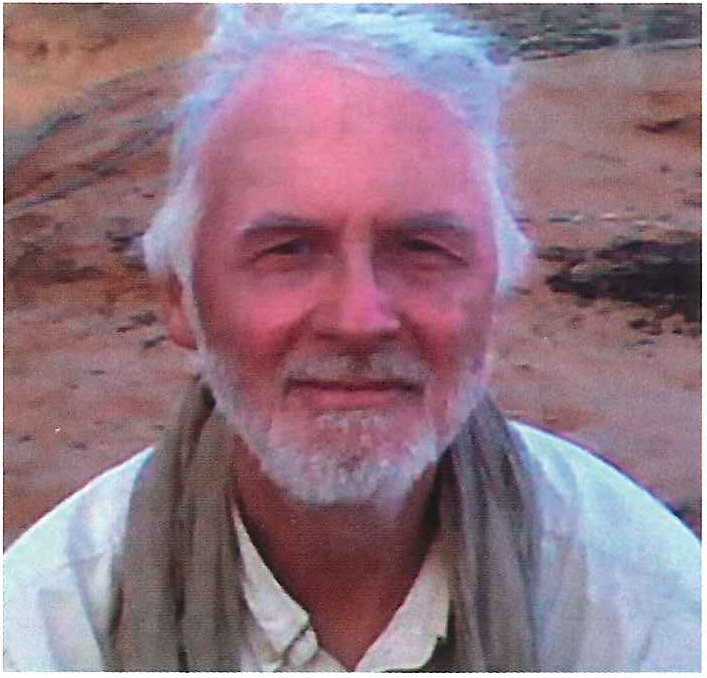
Africa, starting with the formation of the Islamic Salvation Front in 1992 to the current Al Qaeda in the Islamic Maghreb (or AQIM, to which Omar I and the Mokhtar Belmokhtar “katiba” belonged). He also described the total focus of his captors, members of AQIM, to one goal: nourishing the cause of Islamic jihad. “They hate the UN and all humanitarian actors whose only purpose in their view is to corrupt Islamic minds,” he said. Their attacks on UN facilities in Baghdad in 2003, Algiers in 2007 and Abuja in 2011 provide a consistent theme.
What motivates them? “It’s not about unemployment and development assistance but about extending a Caliphate across the globe, a world of stern leadership with no small talk and no sense of humour. It’s about God, it’s about religion; Sam Huntington was right — it is a clash of culture and civilization,” Fowler said. He described a world-view set in the 7th century wherein Hadith sayings replace material gain. Revenue derived from kidnappings is not to finance weekend R&R or the nickel-plating of their Kalashnikovs but to foster the attainment of Paradise with its literally-believed rivers of milk and honey.
The biggest difference between the Western mindset and that of AQIM followers is their approach to time; to them three years is irrelevant. It doesn’t matter whether it takes 20 or 2000 years for jihad to succeed. They
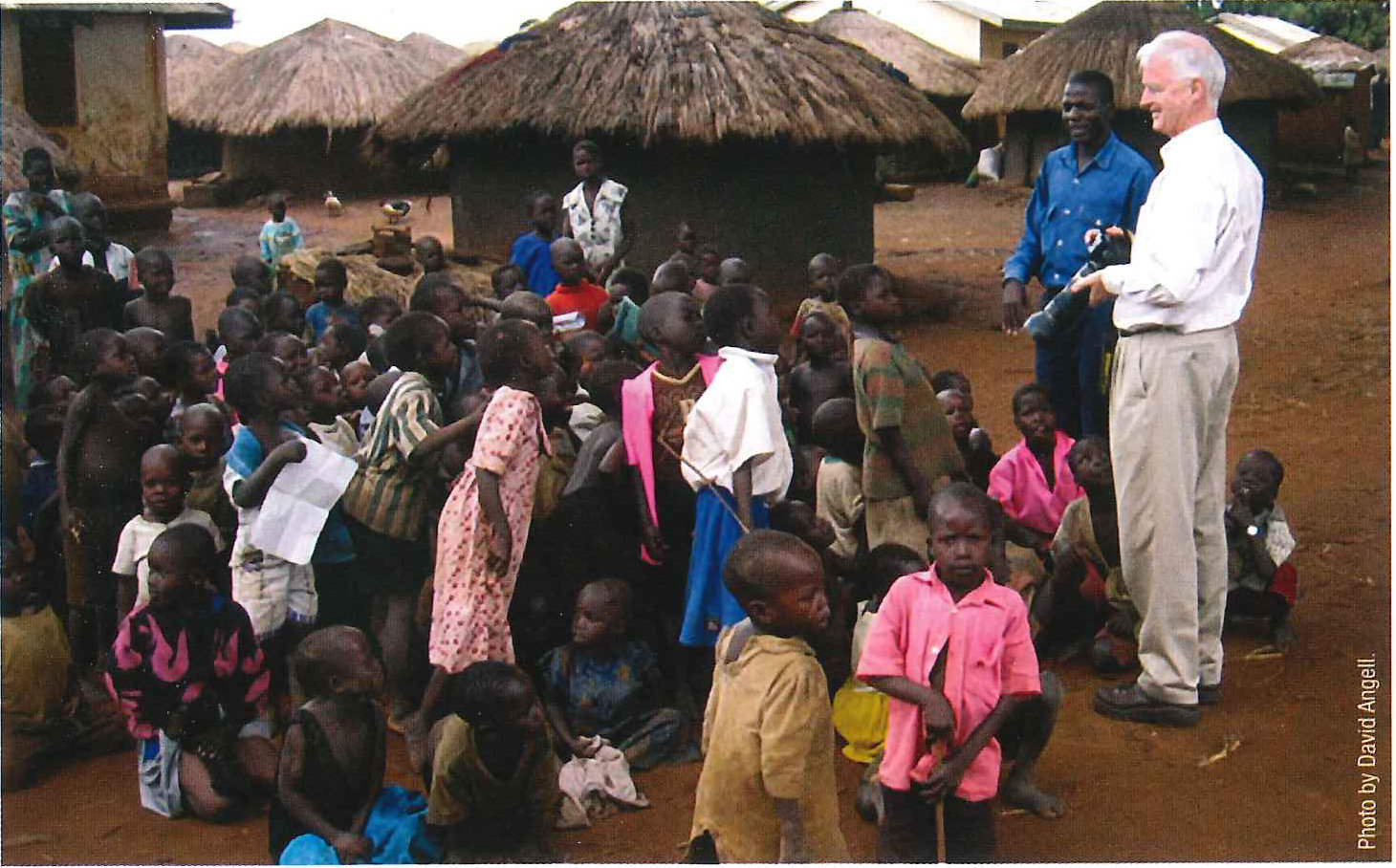
Kids in Northern Uganda (2004). hate democracy, freedom, liberty — all inappropriate surrogates for God’s commandments — even the exercise of democratic choice is simply man supplanting his will for God’s. Despite their long-term view, Bob observed that his captors chafed at the boredom of having to hold “two old white guys” in a series of isolated camps — “they had places to go and people to kill”.
Fowler outlined current AQIM strategies on the African continent, namely to turn more of its real estate into copies of Somalia, to force the switch from Christianity to Islam. Nations such as Nigeria, Côte d’Ivoire and Senegal are in the cross hairs. He noted that 15,000 Nigerians have lost their lives in the last 10 years to the Christian/Muslim divide, adding, “If Nigeria implodes, it will take out North Africa.” He took care to acknowledge the important contribution of international development assistance, not least to help contain the appeal of extremist groups like the AQIM. He noted approvingly that at a time of economic hardship, the U.K. has undertaken to move its national contribution to aid from 0.54 percent of GDP to 0.7 percent. Others apparently are not so committed: Canada, he said, is letting its share decline from its current level of only 0.31 percent of GDP.
In his remarks Fowler did not go into specifics about the nature and duration of captivity. Readers should consult his book — it provides unflinching detail of the frankly terrifying circumstances of life as a hostage. Bob Fowler and Louis Guay endured countless hours bouncing around in the backs of pick-up trucks. Their journey took them to 28 different locations in northern Mali, close to the Algerian border, much to the detriment of Fowler’s sensitive back and vertebrae. In the various camps (which they nicknamed Camp Canada, Central Station, TV Camp, Board of Directors, etc.) they were fed basic rations similar to those available to their captors. They faced the chronic risk of snake and scorpion bites, recurrent sand storms, ubiquitous sand penetration (hair, body, clothing), constipation (given the diet), and the perpetual scarcity of water…but otherwise were not physically abused. Bathing was a distant fantasy. Fowler also describes how all of the captors tried, daily, to convert their captives to Islam in a methodical, assertive manner (they saw it as their religious duty, or da’wah, to bring non-believers into the fold).
On three occasions tents were assembled, and these represented dire forebodings for the captives. While each occasion, in their case, turned out to be another stage-setting for the filming of a “proof of life” video (complete with armed, masked mujahideen standing ominously in the background), such tents were the settings in other kidnap scenarios for ceremonial throat-cuttings, as in the recent case of Daniel Pearl. Both captives noted one of the least “friendly” of their captors deliberately digging a deep trench near their personal encampment. They thought they were witnessing the preps for a soon-to-be grave until the perpetrator actually climbed into what turned out to be his own “foxhole” for better shelter. His season in hell now concluded, Fowler said how happy he is to be alive, to be healthy, to be free and to be in a state of such grace that he doesn’t really care too much what he says — he no longer has a lot of time for political correctness.
The Q&A period that followed included queries on the prosaic (what did you do with yourself all day?) to the practical (was a ransom paid?). latter, Fowler said that while he had no reason to disbelieve Prime Minister Harper’s assertion that the Government of Canada paid no ransom and freed no prisoners, nonetheless “…somebody did! We have a lot of friends out there.” He added, bluntly: “we were released because our captors ‘got enough’.”
An intense discussion followed on lessons learned. Fowler made his dissatisfaction very clear with the manner in which both the RCMP and some officers in DFAIT dealt with the situation — particularly in relations with the Fowler and Guay families. He insists they were inadequately briefed, and insensitively kept in the dark, noting that while the “proof-of-life” video made on December 18 in the middle of the Sahara was seen by many in Ottawa before Christmas, neither his nor Louis’ wife were told of its existence (or that they were even alive) until 30 January — six weeks later.
Fowler then described the intensive debriefing he had at UN headquarters (it lasted 17 hours) and the resulting “UN Hostage Incident Card” that was produced within 48 hours of his debriefing. It was distributed to UN employees world-wide, providing key conclusions and recommendations surrounding kidnap risks and how to behave when captured. Fowler said he had been similarly debriefed by a number of Canadian and foreign entities — including the New York Police department. He contrasted that with his experience with DFAIT. He said that no one with the department had debriefed him or Louis (who continued to work within the Department for a further two and a half years following his release) on their experience and observations of Al Qaeda, or had drawn conclusions and lessons learned that could be shared with Canada’s own foreign service. He encouraged foreign service officers and their professional association to take whatever steps they can to address conditions under which they will be assigned to postings that place personnel “in harm’s way”.
Fowler recommended that governments not apply cookie-cutter strategies to all kidnap phenomena — each must be dealt with on a case-by-case basis. He provided a long list of precedents in jurisprudence dealing with kidnapping situations that have resulted in negotiated, positive solutions. He contended that “we can’t simply say ‘we don’t negotiate…we don’t make deals’ .”
Asked by a female diplomat if women officers might be treated differently from men in such situations (notably in Africa), Fowler noted that his captors were nonplussed to learn that, among Canada’s ambassadors in the region neighbouring Niger and Mali, many were women. “Our Muslim captors are confused by women and do not see them as worthy investments” [i.e., for the cause].
Obviously relishing the prospect of further confusing the AQIM, Fowler added, “I suggest you (Canada’s female diplomats) face a flourishing career in Africa.”
And, in answer to the question “why weren’t you bored?” he conceded that worrying 1s tiring, hard work that takes up a lot of time. Fowler shared a rule that he and Louis Guay had developed early on: “no talking about bad stuff after lunch” in order to reduce the risk of sleeplessness — bad thoughts after noon were punted to the following morning.
In thanking Bob Fowler, PAFSO President Tim Edwards underlined that consideration of postings to risky destinations requires a credible assurance of serious protection before an incident (and by implication, the prospect of genuine support after the fact for the victims of crimes like hostage taking). But for most who attended the breakfast, the conclusion was even simpler: best read A Season in Hell soon to know what you too may face someday.
Now retired, Richard Kohler’s 35 years in the Foreign Service included stints as Chief Information Officer; Ambassador to Brazil; Chief of Protocol of Canada and Consul General in Sydney. He later served as ADM International Relations in Ontario Premier McGuinty s Cabinet Office and represents RHOMA on bout 5 Senior Editorial Board.
A Season in Hell: excerpt from “Aftermath”
“There is a vigorous debate…about whether governments should even negotiate…
A few days later I learned of Abou Zeid’s demand for the release of Abou Qutada (allegedly the head of Al Qaeda operations in Europe) from a UK prison in return for Edwin Dyer’s life. I knew then — was certain — that Mr. Dwyer would be killed and offered that view, unbidden, to DFAIT along with my prognosis that after an unbearably horrible period of weeks or, less likely, months, Werner Greiner would be released were he to survive the aftermath of such torment and the summer in the Sahara.
However much I had expected that AQIM would kill someone, I was devastated by Dyer’s beheading, on 31 May 2009, principally, of course, because so very often I had envisaged that Louis or I, or both of us, would suffer just such an end. And how easily it might have been one of us. Greiner then had to spend a further six weeks as Abou Zeid’s prisoner before being released on 12 July 2009.
The next Westerner to be executed by AQIM was Michel Germaneau, a year after Dyer’s murder. An Agence France-Press report out of Mali noted, “the Frenchman was decapitated before the eyes of the head of the radical AQIM group that was holding him, Abdelhamid Abou Zeid, who last year executed a British hostage, Edwin Dyer… AQIM has announced that it executed Germaneau, a 78-year-old aid worker, on Saturday [24 July 2010], in revenge for a joint raid last Thursday by Mauritanian and French troops, in which six fundamentalists were killed. Germaneau was seized in Niger on April 19th.”
French hostage Pierre Camatte was released on 23 February 2010, three days after four members of AQIM were freed from Malian jails and after vigorous intercession by both French Foreign Minister Bernard Kouchner and President Nicolas Sarkozy. Camatte had been taken by the Abdelhamid Abou Zeid katiba at the end of November 2009 from his hotel in Ménaka in the far eastern part of Mali. According to the 30 March 2010 edition of Jeune Afrique. He knew the date of his release because he kept a scrap of cloth in his pocket, which, at the moment of his liberation contained eighty-nine tiny knots.
There is a vigorous debate—only some of it public—about whether governments should even negotiate, let alone make any kind of deal, with hostage takers or, more specifically, pay ransoms or exchange prisoners to free their citizens. This dilemma is particularly acute when it involves those who have been sent into harm’s way by those same governments or international organizations acting on behalf of their member states. The attitudes of governments, organizations, companies, NGOs, and families across the world toward such hostage crises cover the full spectrum of opinion and practice on this thorny question, and a great deal of hot air is expended seeking to justify one stance or another.
There tends to also be a significant difference between what governments do and what they say, and this seems to me quite reasonable. There are good arguments on most sides and a wealth of unhappy experience to buttress just about every position. Every time a “principled position” is invoked, there are exceptions. Many countries adopt what are more or less admittedly pragmatic approaches while others proclaim immutable doctrine, but I know for certain that everybody has blinked at one time or another.
I am also well aware that there is no way I can be objective about such issues. I tried, but it’s just not possible.
View the original scanned pages →
Originally published in bout de papier, Vol. 26, No. 3 (2012) — Spring 2012 // Printemps 2012, pp. 5–8. Read the rest of this issue →



