
bout de papier, Vol. 10, No. 4 (1993) — Fall/Winter 1993 // Automne/Hiver 1993, pp. 28–29
Story and photo by Brigadier General Ian Douglas
The worldwide hand-wringing, posturing, and sense of impotence over the tragedy unfolding in the former Yugoslavia, is a constant reminder of the fragility of international peacekeeping. A short review of another, much smaller but completely successful, peace mission illustrates the value and importance of this mechanism.
The Organization Naciones Unidas Centro America, ONUCA, was the United Nations answer to the plea from the Central American Presidents for international support for the implementation of their regional peace plan. The plan was for a small international military group, headquartered in Tegucigalpa, Honduras, to negotiate the disengagement and disarmament of the combattants in the civil wars in Nicaragua and El Salvador.
The end of civil war in Nicaragua and the demobilization of the Nicaraguan Resistance, the Contras, is well documented. Problems have been evaluated, logistics scrutinized, costs calculated, and reports written. When all is said and done, however, it was the people and their efforts which made the peacekeeping mission a success.
The advance party of ten Canadians, including myself, left Ottawa in the dawn hours of 3 December 1989 in a blinding
– 18°C snow storm. We arrived that evening in San Pedro Sula, Honduras, to a tropical downpour and 90°F heat. Having been briefed that summer had arrived in Central America, and told that it probably would be hot and dry until the following May, you can imagine our surprise! We wondered what other parts of the briefing were questionable. Within a week, it was obvious. I had to write home and ask for all of my winter sweaters. I found myself freezing to death after dark. In my wisdom, I had chosen to rent a bungalow with a magnificent view over the tree tops. It turned out to be above the morning cloudline, unheatable, and chilly as an Arctic bunker. As many of my guests pointed out, while they shivered in one of my sweaters, the nights are cold on the hilltops of Honduras all year round.
We had deployed without accommodation or infrastructure, bunking in temporarily in the offices of the United Nations Development Program (UNDP) in Tegucigalpa. Just one big happy UN family, so to speak; three to four officers crammed into one office with priority one chasing up scarce secretarial and other support resources. Generally speaking, a “we’ll make it work” attitude drove the chaos that became ONUCA.
Establishing relationships within the disparate parts of the ONUCA group was essential. As Christmas approached, an opportunity to enhance cohesion became obvious. It was decided to have a Christmas party for all members of ONUCA, representing at least six different countries, and UNDP, representing at least another six. As logistical details were still in flux (and that’s an understatement), the problem of obtaining Christmas cheer while avoiding exorbitant local prices became critical. A member of the US Embassy came to the rescue. While the legality of the transaction was not in question, it was obvious that the transaction could not take place at either the US Embassy or the UNDP offices. There was nothing else to do but back up two Landrovers on a quiet street and transfer the goods. The party was a resounding success. Excellent relationships were established between the two UN agencies, and the team started to gel nicely.
The other essential relationship, at least for Canadians, was the one with the Canadian diplomatic and consular staff in the region. As UN observers, we were in theory cut off from formal contact with our consular staff. Formal contact perhaps, but whoever suggested that our Ambassador in the region was formal. Seriously, Ambassador Gar Pardy and his team throughout the five countries of the mission area were most proactive and helpful, both professionally and personally. From insightful briefings and a relaxed dinner for the entire advance party, to practical counsel and help with visa applications for new brides from the area, we never felt alone. The staff in all offices truly lived by the slogan “being there to help.”
While the Chief of Mission and his political staff worked at Government level to establish working and personal relationships, those in uniform started the bonding process with the military in the region. The history of the region underscores that the military of Central and South America enjoys a place in society quite different from that in our own. Despite this and other cultural differences, they felt comfortable with others in uniform and it was common to find oneself discussing topics more relevant to the affairs of the politicians and diplomats. We emphasized the political/military team, and ONUCA became an excellent manifestation of joint political/military operations.
As it became more and more obvious that the United Nicaraguan Opposition (UNO) and Violetta Chamorro might indeed win the Nicaraguan election of February 1990, the possibility of demobilizing the Contra Army became a reality. Notwithstanding the magnitude of the equipment and logistic problems, the real problem was to cement a good, positive working relationship with the Commandantes of both the Contras and the Sandinista Army. The advantage of face to face dialogue versus a third party discussion was well manifested as we wrestled with the problem of security zones. The exact location and size of these zones, which the Sandinista Army would vacate and then the local Contra organizations would enter, had to be negotiated. After a few attempts at shuttle diplomacy — Tegucigalpa – Managua — Tegucigalpa — Managua — we decided that face to face discussion was essential.
Convincing the Contras that they should return, unarmed, to Nicaragua from their stronghold in Honduras to discuss the peace process with the Sandinistas was an interesting exercise. It was marvellous to watch their faces during the trip. Obviously feeling very awkward in civilian clothes and naked without their weapons, these hardened warriors fidgeted uncomfortably as we flew south. Their faces changed from anxiety to amazement to genuine pleasure as we flew over Lake Managua and approached the city. It had been almost ten years since they had visited Managua, their capital city, or indeed their country, without a weapon in hand and the very real possibility of being killed or, at least, wounded.
The highlight of the trip, however, was the actual meeting of the two disparate groups of Nicaraguans. The initial contact was cool, in fact outright frigid, but the normal gregarious nature of Nicaraguans soon thawed the atmosphere and personal conversations began. Within thirty minutes the anecdotes were flying. We had achieved that which for so long was impossible – to get the two combatants face to face. Though essential and a breakthrough, this personal sociability had to be turned into serious negotiations. Once started, the political hard ball went on for almost forty-eight hours. A final agreement was reached at three-thirty in the morning and became effective only two or three weeks later.
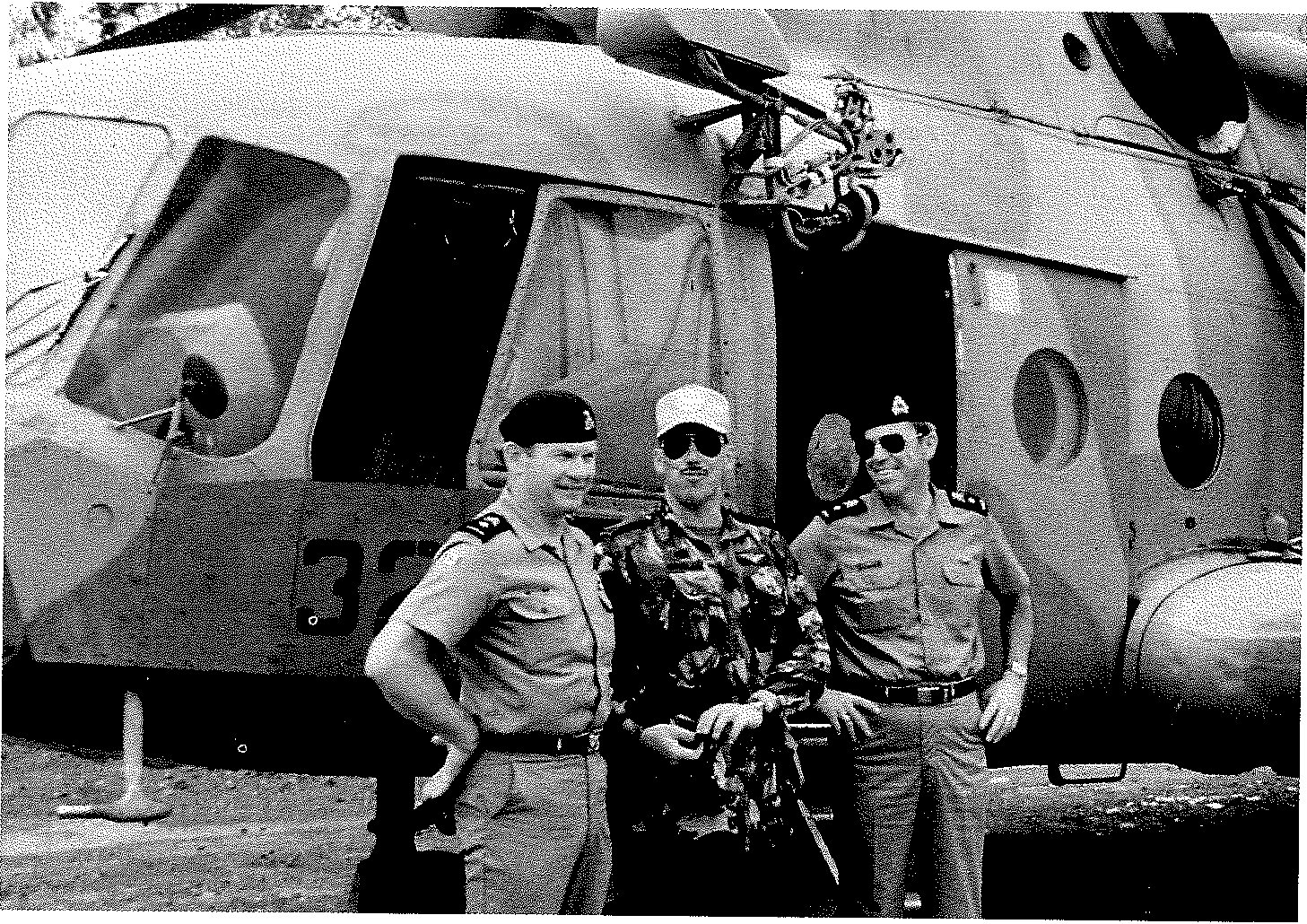
The actual demobilization process was also one of people making things work. A group of military observers with some support/administrative background, augmented by a UN purchasing officer who had been called out of retirement for the job, carried out the logistics organization. That fellow, a Greek national who had retired in Ireland, was a charming character and one of the most positive men I have ever met. He could negotiate a contract with the devil himself. The entire logistic support for up to a thousand soldiers, in eight different remote jungle locations, was creatively managed in flamboyant UN resupply convoys of smoke belching, multi-coloured banana trucks.
In a country where food supplies were scarce, devising varied menus defied even creative problem-solving. For periods of time it was necessary to exist on beans and rice, rice and beans and mixed rice and beans for breakfast, lunch and dinner. The complaints were minimal and spoke very highly of the professionalism and downright understanding of the soldiers concerned.
The Contras on the other hand were fed in the security zones by CIAV, an organ of the Organization of American States (OAS). CIAV was mandated to feed and provide civilian clothing to the soldiers after we had demobilized them, to give them two months food for their family and, finally, to relocate groups in chosen areas of the country. From a human point of view, what is interesting is that beans and rice were the staple and this, along with a small bottle of cooking oil, was all that the Contra families received.
Hardship rations for us were the food of choice for the Contra soldiers. A newly demobilized Contra dressed in his Calvin Klein jeans and shirt, his family of two or three children in tow, happily boarding a banana truck with his bags of rice and beans, and a bottle of cooking oil, was a moving sight to witness. At first,. it was very hard to understand as a Canadian, who had so much, why this individual with so little, felt so good. But, when you have had nothing, a little is a lot. He was no longer at war, he had food for a few months, and he was off to his home village where he hopefully would be granted a small plot of land on which he would subsistence farm.
Though no panacea for the ills of Nicaragua, the demobilization and repatriation did stop the formalized and organized killing. We had achieved our mission: the Contra Army of 22,000 plus, fundamentally consisting of dissatisfied campesino farmers, was now a thing of the past. The country, with horrific economic and fiscal problems, is still working on the long term solutions, but it no longer has to waste scarce resources on a fratricidal war. After a short period to ensure that stability had indeed been gained, ONUCA faded away. Some of its members were repatriated; others moved over to El Salvador where another army, the Farabundo Marti para la Liberación Nacional (FMLN), needed demobilization. That process continues today.
From the young soldiers, sailors, and airmen of 89 Rotary Wing Air Unit (RWAU), the helicopter squadron, to the Military Observers scattered throughout the five countries, much sacrifice and effort was expended. One member, Capt Bergeron, a pilot with 89 RAWU was decorated for gallantry when he entered a crashed Sandinista helicopter, which was burning fiercely, and helped drag the pilot to safety. As someone who had the rather more comfortable job of directing operations from the HQ, I applaud the efforts of all who left family and friends from periods of six months to a year and devoted themselves to the cause of peace.
In these days of horror and anguish over how the problems in the former Republic of Yugoslavia might be solved, it is encouraging to note that given the correct conditions and people, much can be gained by the blue helmeted peacekeepers.
View the original scanned pages →
Originally published in bout de papier, Vol. 10, No. 4 (1993) — Fall/Winter 1993 // Automne/Hiver 1993, pp. 28–29. Read the rest of this issue →



