
bout de papier, Vol. 14, No. 1 (1997) — Spring 1997 // Printemps 1997, pp. 20–22
“I’se the bye who builds the boat, and I’se the bye who sails and bails her, and I’se the bye who catches the fish and brings them home to Liza.” With apologies to this traditional Newfoundland folk song’s original author, it was this refrain which came to mind time and again as the Halifax G-7 Summit Sponsorship Program was created and executed. The challenge was to develop a program while simultaneously implementing it, repairing defects while in operation, and delivering a product which was constantly being redefined, all within an inexorable deadline.
At the beginning of the program in mid- November, 1994 only three things were known: (1) the Summit would have public events for which funding support would be sought; (2) the Summit would solicit as many “in kind” contributions of goods and services as possible in order to reduce government expenditure; (3) the Summit would commence in seven months on 15 June, 1995.
Private sector sponsorship presented a “unique challenge” for the Halifax Summit as no relevant experience existed. Now all experienced foreign service officers know to steer well clear of unique challenges as potentially career-limiting activities. However, as a native Haligonian with a burning desire to ensure Halifax was a great choice of venue by the Prime Minister, the author took the plunge.
Precedents did not exist. There was no sponsorship program for the Ottawa Summit (1981). For the Toronto Summit (1988), financial sponsorship ($1.8m) was organized entirely by the private sector in much more buoyant times. Sponsorship of goods and services in Toronto ($2m) was accomplished strictly as an adjunct to the purchasing process.
At our first meeting with the Province of Nova Scotia and City of Halifax in late November it was apparent that they were anxious to proceed with large scale sponsorship and had already made preliminary approaches to potential major contributors. A joint sponsorship campaign was the only approach to take. This was particularly important for the federal government as we were last on the scene, had overall responsibility for the Summit, the greatest need for sponsorship, and the most to lose both locally and internationally should a competition emerge for scarce private sector support. A Sponsorship Committee was formed with one ex officio member from each of the three levels of government plus the Chamber of Commerce.
Next came the issue of staffing the program. It was readily apparent that, with little time available and a large commitment to be met, sponsorship’s success or failure would be a function of the individuals who participated on the team. All came to the project from other activities and returned to them immediately following completion of the project, making their personal commitment crucial. At the Halifax Summit the federal government team consisted of three elements: (1) departmental staff; (2) Fundraising Counsel; (3) sponsorship private sector chairs.
A small nucleus of departmental staff was required within the Halifax Summit Office staff to assemble and direct the larger government team, recruit the Fundraising Counsel, assist in identifying the private sector chairs, liaise with the summit staff and deliver the program for Len Edwards, the federal Executive Director. In Halifax this nucleus was not established as a full time staffed requirement until January 20, five months before the Summit, when the author was selected as sponsorship coordinator. One staff officer and a secretary were in place by mid-February and officers to manage groups of sponsors added during the final six weeks. Our staff officer, Diana Hudson-Whalen, was a real find. With an MBA from Dalhousie she had the business smarts and local connections we needed, coupled with her knowledge of the Foreign Affairs system where she had worked as a consultant on several postings as the spouse of trade commissioner Michael Whalen. Diana’s stellar performance proved once again how much real talent there is “hidden” within the foreign service community. Three “late-arrival” officers, Lucien Proulx (PARIS), Ken Sunquist (PEKIN) and Chris Thornley (BOSTN) helped us over the many humps as we closed the finish line.
The key role of Fundraising Counsel was discharged in Halifax by Mabley and Associates. The Fundraising Counsel brought professional campaign experience to the process, including advice on techniques in the industry, lists of pre-screened contacts, and advice on presentation materials and documentation. Most importantly, in Halifax a highly experienced and skilled principal in the firm (Robert Geraghty, a former Nova Scotia Deputy Minister) became a full time in-house member of the team and acted as secretary to the private sector Senior Executive Sponsorship Committee.
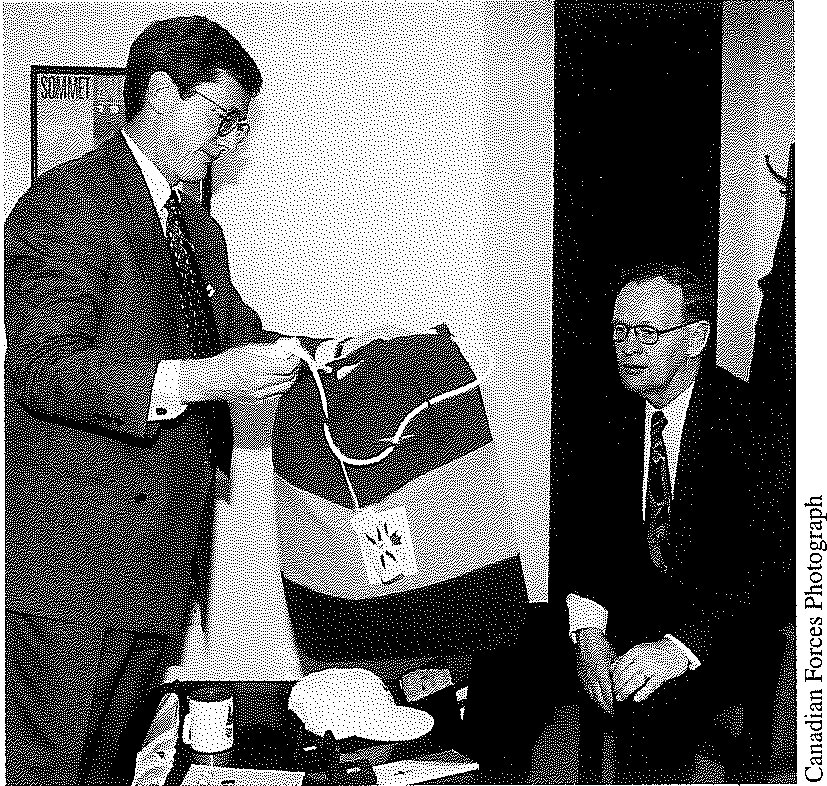
Government officials and institutions do not have the credibility or clout to raise funds in the private sector. In order to spearhead the program and give us the maximum opportunity to be successful, a national industrial leader was required to act as Sponsorship Campaign Chair. Purdy Crawford, Chairman of IMASCO, was identified as the ideal candidate, with impeccable national credentials and firm roots in his native Nova Scotia. It was felt of equal importance to ensure that the chairman of the leading Nova Scotian firm involved in the Summit, Ivan Duvar of Maritime Telephone and Telegraph, act as the other co-chair. The success of the fundraising process is largely attributable to the reputation and ability of the chairs to convince their fellow industrial leaders to participate. Messrs Crawford and Duvar were not in place until mid-March, just 55 working days before the Halifax Summit was to begin.
The chairs then established a Senior Advisory Committee on Sponsorship which consisted of CEOs of major contributing firms: Air Canada — Hollis Harris; Royal Bank — Gordon Feeney; McCains — Harrison McCain; General Motors — Maureen Kempston Darkes; Oxford Foods — John Bragg. Each of these brought to the table their own group of contacts, eg Air Canada for Bombardier, which they undertook to solicit. It was, however, readily apparent that the real key to success lay in the dedication and commitment of the national chair.
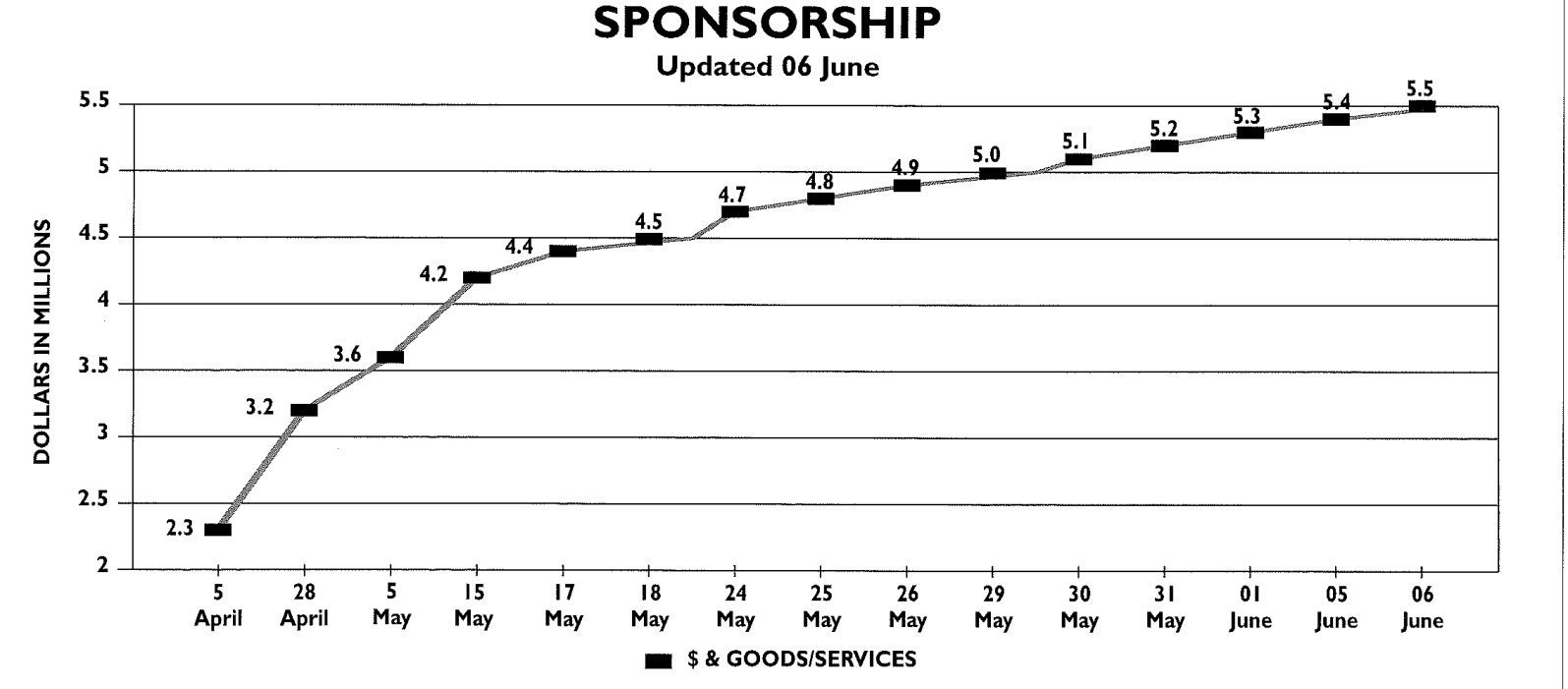
Notwithstanding the fact that we were reduced to an 11 week campaign, 206 firms were approached of which 118 agreed to participate in the program. Early success in obtaining support in the order of $500,000 each from 5 firms (IMASCO, MT&T, Royal Bank, Air Canada and Bombardier) was followed by a steadily growing number of firms (15 in all) who contributed in excess of $100,000 each. This resulted in an income curve which rose at a dizzying average of $100,000 per business day until the Summit itself intervened to halt the program. A final total of $5,547,640 (Funds $3,290,618 and Goods and Services $2,257,022) was achieved.
In developing our program, the most important planning element without doubt was the decision to approach sponsorship from a business perspective. That is, to offer sponsors recognition, principally advertising, but also use of the Summit logo and attendance at exclusive events in full-value return for their contribution. This required the constant application of a business approach by the sponsorship staff: “What is the bottom-line return to participating companies for sponsorship?”. Within the milieu of the Summit Office, the sponsorship team took on the look of a group which had sold its soul to the devil himself.
Great care had to be taken to ensure that the events we were marketing would be seen by the public and media as appropriate ancillary activities to the Summit. During this process we were constantly faced with two problems: (1) we did not know until very late in the game (3-4 weeks to go) the exact nature of the elements that required funding; and (2) we did not know what forms of recognition we could provide until as little as 10 days remained before the Summit began. This significantly curtailed our ability to market the program. In consequence, once Mr.Crawford had obtained the initial commitment to participate, we used two-man teams who worked the companies’ key operational personnel, in a process which most closely resembled smoke and mirrors, but without the benefit of smoke to hide what wasn’t in the mirror. Integrity became our main selling point as we endeavoured to find out what the sponsors wanted in the way of recognition and expended every effort imaginable to realize their expectations. An accommodating Prime Ministerial staff, an Executive Director and Director General Patricia Smith — none of whom were risk-averse — allowed us (with an additional dose of good fortune) to develop a very credible set of deliverables.
As we were embarking on an untested process, establishing cut-off points early in the process proved crucial. With no precedents it was impossible for the committee to know how successful the campaign would be. If it did not realize its full goals then a battle could easily ensue amongst the participants over the receipts to be disbursed. Accordingly the individual budgets as submitted by the partners were divided into high priority (top 40%), medium priority (middle 40%) and low priority (bottom 20%). It was agreed that the participants would move up the scale together. This proved to be a decisive element when insufficient time to campaign necessitated termination at the 80% level.
Establishing the level of the “ask” was another key element. Every sponsor requires servicing and it is much easier to work with one $100,000 contributor than ten $10,000 firms. The Fundraising Counsel recommended a high threshold for the top level “Official Sponsors” of $500,000. In the early going this was not an easy sell. However, with the co-chairs’ firms both in at that level to provide an example, it was possible to attract another three firms at $500,000 each; two at $250,000; and 13 at $100,000. These provided the core of $4.2 million in funds, goods and services which the sponsorship program required
Beneath the major sponsors, a structure was created to allow smaller firms, many of them locally based, to participate in this international event and to supply numerous important components. 98 firms supplied the remaining $1.3 million, mostly in goods and services. While this group did not have the financial impact of the major players, they made the Halifax Summit a part of the business community throughout the region and provided essential equipment ranging from copiers to security fencing.
Once we had decided to take a business approach, the essential element for each individual sponsor was their recognition package. We discovered that major sponsors wanted two things from the Halifax Summit Office: exclusive sponsorship of high profile public events; and access to Summit events for their CEOs. At the outset we did not offer exclusivity but rather full sponsorship of all events to the major sponsors. The line we took was that this was in an effort to be seen to be fair to all sponsors as we are the government and they are all taxpayers. In addition, our real inability to identify what we had to offer hamstrung the process of identifying exclusive events for sponsorship. In the end, our hand was forced by Air Canada and Bombardier who had worked with the Le Cirque du Soleil before and demanded exclusive sponsorship of the Gala before they would participate. In the circumstances this was granted and we began a mad rush to match sponsors to events. Fortunately we were able to give “titled” events to each of our $500,000 and $250,000 contributors. In consequence we received the added bonus of being able to go back to the firms which had come in first and offer them an improved package, a truly unheard of set of circumstances for any business dealing with government run events.
Access to Halifax Summit events proved an equally difficult problem. With security considerations and the need for Prime Ministerial approval, we were again faced with initially offering only “an invitation to an event hosted by the Prime Minister (undefined)” to our leading contributors. Fortunately necessity smiled on us once more. The requirement to have the Prime Minister’s Gala attendees seated in advance for security, with the leaders on hold nearby, led to creation of a VIP tent adjacent to the Cirque du Soleil where all $100,000 plus contributors participated in a reception with the leaders. The Finance Minister then added an invitation to Brunch with his counterparts and the structure was in place to attract more than a dozen CEOs of major Canadian firms to participate. Their personal participation, and the impact on them of meeting the leaders, sealed any doubts which their staffs may have had regarding the value of sponsorship of the Halifax Summit. However, our bounty cost us dearly as it necessitated the creation of a whole program for CEOs, including arranging accommodation, tours of the site, harbour cruises and a sail on the famed racing schooner “Bluenose”.. All of this was achieved during the final 10 days before the Summit. But by this stage no day was complete if we did not pull off at least one miracle.
Each Summit is bound to have a theme and ancillary activities which will seek sponsorship. At the Halifax Summit the theme was “A Green Summit”. In response to the environmentalists’ goal of seeing the Summit communiqué on recycled paper, we located a firm willing to supply the specified product on a sponsorship basis. This took several weeks and approaches to a dozen firms to achieve, but the result was worth it. For a biodegradable poster with seeds embedded we identified STORA, a Nova Scotia based pulp and paper firm, as sponsors and a Shoppers Drug Mart, a major drug store chain which is part of IMASCO, as distributors. Fundraising paid for two days of free bus and ferry service which resulted in record ridership. In consequence the environmental audit of the Summit, another first, gave us a hard-earned passing grade.
It was appreciated from the outset that sponsors would want maximum media coverage for their participation. Consequently, levels of publicity were written into the recognition guidelines and sponsors were encouraged to indicate what type of promotion they would appreciate. Our media relations staff saw the value of promoting sponsorship as a communications objective, devoting considerable staff time to working with the sponsorship staff and firms to maximize exposure. Each of the major sponsors had a press conference linked to their sponsored events and every sponsor received name recognition in the form of press releases and signage.
Meanwhile, asking the private sector to pay for a public event was seen as a two-edged sword from the hardcore news perspective. In consequence the press spokesman, Malcolm McKechnie, took a keen interest in sponsorship, became well versed in the details and, along with Executive Director Len Edwards, took the opportunity of interviews to highlight sponsorship as an innovative and cost-effective means of operation. The resulting coverage in the national and local media was universally positive. A highly supportive full-page article in the 8 May issue of Maclean’s magazine proved to be a timely marketing tool. Of equal significance from a media relations perspective there were no questions in the House of Commons or Nova Scotia Legislative Assembly regarding the sponsorship program.
The result of the efforts of those named plus many others was that our boat was built, bailed and rowed and that it delivered the fish to Liza.
View the original scanned pages →
Originally published in bout de papier, Vol. 14, No. 1 (1997) — Spring 1997 // Printemps 1997, pp. 20–22. Read the rest of this issue →



