
bout de papier, Vol. 11, No. 1 (1994) — Spring 1994 // Printemps 1994, pp. 30–32
It happened quite some time ago: during the summer of 1958. The Socialist Federal Republic of Yugoslavia was still very much a going concern under the inspired and undisputed leadership of Marshal Tito. The fifteenth anniversary celebrations of the dismal failure of the German Army to destroy the Partisan Movement through a series of battles on or about the Sutjeska River valley in Montenegro, known locally as the Fifth Offensive, had come and gone. If, as a result of Tito’s unrepentant challenge of the Kremlin’s authority as to what ought to be the right Road to Socialism, the country had forfeited a not inconsiderable amount of aid and assistance from the Soviet Bloc and was hurting from its cancellation, it was putting a bold face to it all.
I had only recently arrived in Belgrade with my wife, to take up my new assignment as First Secretary and Consul at the Embassy. Our number one priority had been to familiarize ourselves as rapidly as possible with our new surroundings which, needless to say, differed greatly from those we had left behind. Doggedly stumbling through both the local language and the cyrillic alphabet, we went about discovering, and coping with, strange and oftentimes disconcerting ways of managing affairs and doing business. We thought the French National Day reception would provide a welcomed respite from our current exertions.
Even so, I could not help but be concerned as to the import of a telephone message which the Embassy had received earlier that morning from the Foreign Ministry. The caller had pointed out that a Canadian citizen, whom he identified as a Major William Jones of the Canadian Army, would be arriving in Belgrade in the course of the afternoon. Major Jones, so went the message, was most anxious to meet with the First Secretary at the earliest opportunity. As it happened, I was also acting as Chargé d’Affaires in the Ambassador’s absence from the country.
By closing time, I had not yet heard from Major Jones or his whereabouts. I therefore left for home, not without having informed the guard on duty beforehand of my forthcoming engagement and instructed him as to where I might be reached in between times and after, should anything of moment develop.
I had barely reached home when the guard called to say that Major Jones, who had by now arrived in town and was installed in the Hotel Metropol, had asked that I see him immediately following my return from the French National Day to discuss, or so he intimated to the guard, what was a most pressing matter.
The reception over, I therefore saw my wife home and called on Major Jones at his hotel. Jones, who received me in his room, was a man in his mid-sixties, of somewhat less than average height, slight of build, and wearing a crumpled pearl grey suit. All in all, a most unprepossessing man, whatever the nature of his business might be. The introductions over, I was told by Jones, in what struck me at the time to be in a most casual way, that the First Vice-President of the Republic, His Excellency Edvard Kardelj, whom he kept referring to as Edo, was awaiting him with friends for dinner at his official residence in that select portion of Topcider, a residential Belgrade suburb, known as Dedinje. It was to be a very informal affair and both my wife and I were expected to accompany him.
At that time, ranking Yugoslav Communists were not known to open their homes to foreigners, least of all, to diplomats. Theirs, like those of the Soviet Union or of the Satellite States, was very much a closed society. This, to a newcomer like me, made the situation all the more intriguing. When I pointed out that I would have to inform my wife of this quite unexpected development, Jones replied that this had already been done, presumably by Protocol at the Foreign Ministry. And so, preceded by a chauffeured black Mercedes limousine in the back of which our Major Jones sat happily ensconced, and with the customary outriders racing ahead, I sped home in our Opel sedan to pick up my wife, no less bewildered than I at this unprecedented turn of events, and thereupon made for the Vice-Presidential residence on Tolstoyeva.
A word now about Major Jones. At the time of his visit to Yugoslavia, he operated in Wellandport, Ontario, what was then known as Belgrade Farms. A native of Digby, Nova Scotia, he had fought overseas with the Black Watch of Canada during the First World War, been wounded five times and lost an eye in action in 1917. For his distinguished conduct in the face of the enemy, he had been twice awarded the DCM and promoted through the ranks from private to captain. Following the outbreak of war in 1939, Jones, notwithstanding that he had but one good eye, would try to enlist as a fighter pilot in the RCAF by memorizing the eye-chart. Found out and rejected from the service, he made for England as a seaman aboard a merchant ship where he was commissioned in the RAF and employed for a while as a drill instructor. Posted in the course of time to the Middle East, he would be transferred to the Special Operations Executive (SOE) (the ultra secret British organization that parachuted volunteers into occupied Europe to liaise with resistance groups), with the rank of major in the British Army. It was in this capacity that, wearing an eye patch and the tam-o’-shanter of the Black Watch, he was dropped by parachute behind enemy lines in Croatia, near what was then Partisan headquarters in Yugoslavia, on the night of May 18/19, 1943. The first of a series of military liaison officers to be sent by the British to Tito during the war, he was also by all accounts the oldest of them all.
I referred earlier to Topcider. Topcider still retained something of its pre-war attraction if only because of its choice location within the City limits. A number of Ambassadors and sundry members of the Diplomatic Corps had been housed in the area. Dedinje in particular had the distinction of housing the leaders of the Yugoslav establishment of the day. Especially favoured by them were the two avenues, Tolstoyeva and Uzicka, which ran parallel to each other and topped the brow of the hill. Together, they formed a heavily guarded and patrolled enclave where none but the privileged few ever gained admittance.
Before the war, its stately homes, each of them sheltered by high walls from prying eyes, had housed the rich and the mighty of the day. Once Tito had firmly installed himself as Head of what would come to be known as the Federal Socialist Republic of Yugoslavia, the properties in question were rapidly commandeered and their occupants unceremoniously turned out to make way for the new gratin. Rumour had it that the place was honeycombed with interconnecting tunnels and studded with concealed pill-boxes and machine gun nests which could transform it within minutes into a formidably defended perimeter.
The residence which Vice-President Kardelj then occupied on Tolstoyeva was of polished grey stone, reminiscent in style of a well-to-do French residence, with a glass-canopied entrance at the end of a well-tended driveway. A guard stood at the door where all three of us were met by the ubiquitous UDBA factotum, attired in the usual blue serge suit. We were then taken through a marble hall, up two flights of red carpeted stairs flanked on both sides by potted rubber plants, and on to a small hallway leading to what appeared to be a massive oak door. When opened, the door revealed the private apartments of the Vice-President and his wife, Pepica.
There to greet us in shirt sleeves stood our host. A man of average height, rather on the portly side, he reminded me with his bespectacled round face of a character out of Dickens. Surrounding him, besides his wife, were Marietta Kidric, Marijan Brecelj, Ales Bebler, Vladko Velebit and Joze Vilfan, all of them quite relaxed and in an unexpectedly open and friendly mood. While my wife and I were understandably greeted with a certain amount of formality, the welcome afforded Jones by them all was most effusive.
Just who were these assembled comrades? As I would subsequently find out, they came from the highest echelons of the Party. They had been with Tito through thick and thin from the start, and now savoured in power the results of their past endeavours. Kardelj, of course, besides being Tito’s right hand man, was as well the leading theoretician of the League of Communists of Yugoslavia. Kardelj’s wife, Pepica, like him, a dedicated Communist, had joined the Party’s youth wing in the Thirties. Answering Tito’s call of July 1941, she had fought gallantly alongside the Partisans to liberate her country of its German and Italian occupants.
Marijan Brecelj, a former Partisan who hailed from Slovenia and had most likely known Jones when he was attached to Tito’s headquarters, was currently serving as Yugoslavia’s Minister of Foreign Trade. Ales Bebler, was a Communist of long standing. After having served as Deputy Minister for Foreign Affairs during the early years of Tito’s regime (1946), and subsequently, as Foreign Minister, he was, when we met, presiding over the Skuptina (Federal Parliament)’s Committee for Foreign Affairs. As for Joze Vilfan, we would learn, shortly after our evening at the Kardeljs, that he had been called upon to chair Slovenia’s National Assembly.
By far the most interesting character of the lot was Vladimir (Vladko) Velebit. The scion of a distinguished Croat military family, he had risen to the rank of lieutenant-general in the Army of Socialist Yugoslavia, ostensibly for services rendered to the Communist cause in the course of its fight against the German and Italian occupants. Velebit was, by profession, a lawyer. His polished manners as well as his gift for languages (he spoke English like an Oxford don) had led Tito to appoint him as his first Ambassador to the Court of St. James. He had also served a term as Deputy Foreign Minister.
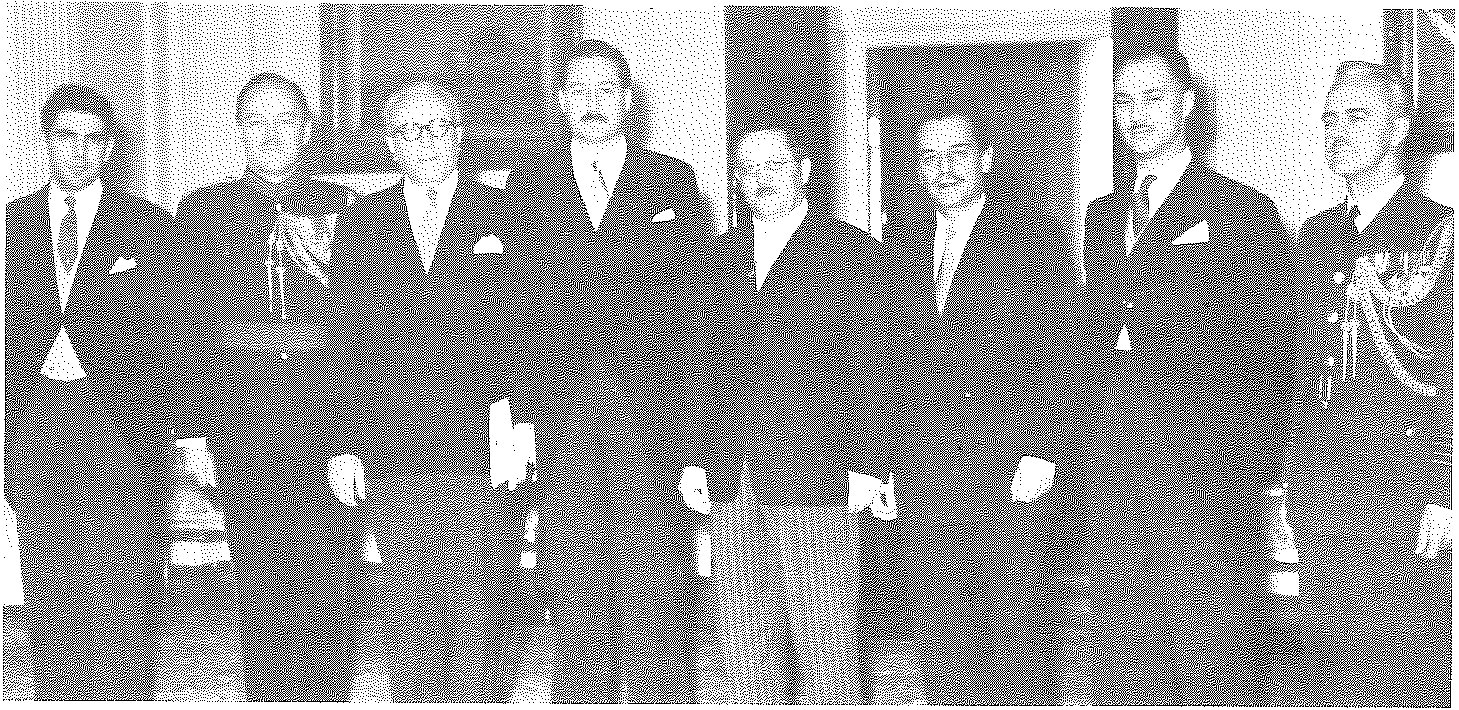
And then, of course, there was Marietta Kidric. Her presence among the Kardeljs’ guests was not a mere coincidence. She had been the wife and devoted partner of the late Boris Kidric. Kidric had been one of Tito’s most trusted advisors. Jones had known him when he was chief political commissar of the Slovenian partisans. When he died in 1953, the Party, we are told, “honoured his At presentation of credentials: I. to r. D. Stevens E. Kardelj, Lt. Gen. Popovic, J.E. Thibault, B. merits in the cause of Titoism by a funeral of almost Byzantine splendour”
At the time of his death, Boris Kidric was Chairman of the Economic Council. As such, he had been responsible for the application of Yugoslavia’s ill-starred Five Year Plan. Announced with great fanfare on the first anniversary of the proclamation of the Republic (November 26, 1946), the Plan aimed at the rapid industrialization of the country, with special emphasis on heavy industry. It outdid in conception anything ever conceived in Russia during the stormy “twenties’ and ’thirties’ ’. What it had regrettably overlooked however was the fact that Yugoslavia possessed neither the resources nor the trained industrial specialists and technicians to see it through to fruition. Added to which, Belgrade assumed that the Hungarians, the Czechs and the East Germans might be counted upon to assist both materially and financially in the venture. Nothing could have been farther from Moscow’s intentions. This, as much as any other factor, would eventually result in Yugoslavia’s isolation from the Communist world
Inasmuch as Tito favoured the Plan, it would go ahead, come what may. Not unexpectedly, it turned out to be, at a time when the country could least afford it, inordinately costly and especially wasteful in resources, material and manpower. Help had of course to come from the outside, and when it did, it came not from the East but from the West. In the meantime, criticism of the Plan, however well informed, was stifled when it was not purely and simply equated with treason.
So much for history.
The presentations and greetings over, Jones, my wife and I were ushered into what was in effect a living cum dining room. A large green tiled ceramic stove, located in the center of it, served as room divider. In style, decoration and furniture, the apartment was meant to reproduce the interior of a Slovenian peasant home. Scattered about were mementos of the Kardeljs’ travels and acquisitions. On the walls were several framed sketches. One was of our host, the Vice-President, done while he was serving as chief political commissar with the Partisans. Yet another depicted an area most likely reminiscent of some event with which our host or his wife had, at one moment in their life, been intimately connected. That which readily caught everyone’s eye, however, and was the source of much merriment, was one of the VP, drawn by a cartoonist friend of his and which purported to show him addressing the faithful from a podium and assuring them that “I will be brief” “, while his script coiled like a serpent from his hands to his legs and on to the floor. Finally, in a corner of what served as the sitting room stood the very latest in Telefunken radio and phonograph equipment. All in all, a very respectable bourgeois interior, not altogether different from that which one might find in the decadent West.
Round after round of slivovitz (plum brandy) and sladko (maraschino cherry liqueur) now became the order of the day and endless healths drunk: to friendship, the Partisans, the Canadian and Yugoslav peoples and, of course, to the country’s great leader and mentor, Marshal Tito.
Having already been served a variety of local appetizers, we were invited to feast on venison, shot by the VP some kilometres out of Belgrade and prepared by his wife. Local wines flowed freely. So did the conversation.
The invitation to Jones, to whom we had been associated so fortuitously, was but a thinly veiled cover for old wartime comrades to get together; comrades whose association went back to those fateful days when, in the mountain of Yugoslavia, a ragtag band of insurgents under Communist command and led by Tito, had taken it upon itself to wage unrelenting guerilla warfare against the country’s occupiers and their local sympathizers.
What did impress my wife and me was the relaxed atmosphere in which we found ourselves and the genuine spirit of camaraderie which prevailed. With the record-player droning on endlessly in the background, perhaps as a measure of security against prying ears, everyone reminisced as to how well they had carried out, against tremendous odds and with little more than captured weapons and equipment, the good fight from one end of the country to the other, always with kith, kin and wounded following, and never more than a step ahead of the enemy.
The evening reminded us of like meetings where veterans, the world over, reminisce of battles and encounters shared in a distant past. The difference in this case, however, was that it referred to happenings which, barring what Churchill had had to say in his memoirs as to what had seemingly gone on between friend and foe in this remote European theatre of operations, were virtually unknown to us in the West. I was then of course quite unaware, as I suspect everyone at the Embassy was, that Jones had been interviewed by Maclean’s or that he had recounted his wartime experiences in a booklet entitled Twelve Months with Tito’s Partisans and published in England by Bedford Press in 1946.
For the twelve months or so during which Jones was attached to the Partisans, he so endeared himself to Tito and other leaders of the Movement that he had been singled out for special attention and treatment at the time of the Sutjeska celebrations. He travelled from Wellandport to Yugoslavia as a privileged guest of the country’s establishment.
Wherever Jones went in Slovenia, Croatia or Bosnia, he was reportedly showered with gifts of all kinds by the local branches of the Yugoslav war veterans’ association and, I suspect, awarded as well the country’s highest honours for his signal contribution to the Partisans’ final victory over its occupants and their local collaborators. Time and again in the course of the evening at the Kardeljs, my wife and I were reminded, not the least by the Vice-President himself, what a selfless individual and an exceptional source of strength and comfort Jones had proven to be to the Partisans’ leadership in its hour of need. The feeling of Jones for the Partisans was mutual. The years had not in any way dimmed his admiration or enthusiasm for Tito and his fighters.
Velebit for his own part would tell me that even though Jones had been clearly outranked by several of his former British colleagues who had also been invited to attend the Sutjeska celebrations, Tito had nevertheless had him sought out and brought to him for everyone to see. In doing so, he had wished to demonstrate to those present the abiding nature of his friendship for this Canadian who, notwithstanding his age, handicap and the hazards involved in coming as and when he did to help him and his embattled fighters, had done this from the highest of motives and to the limit of his capabilities.
On this high note, the old comrades’ reunion came to a close. Yugoslavs, at such times, can become quite emotional, especially when having to take leave of old and trusted friends. There were accordingly more than one tearful embrace reserved for Jones, not least from the male members present, when we finally left.
On reflection, I thought at the time that there was somehow a touch of irony in all of this. Here indeed was a man — Jones — who, in wartime, had done his utmost to assist Tito and his embattled Partisans in their hour of need. His determination, courage and selflessness in so doing had won him the undying admiration and gratitude of the Yugoslav leadership and peoples, and yet his deeds remained, for all intents and purposes, unknown to his fellow citizens.
I did not to see Jones again. I learned much later that he had passed away in August of 1969, presumably at his farm in Wellandport. In his declining years, he had expressed concern over the pension rights of the handful of Canadians of Yugoslav ancestry who, for quite obvious reasons and at London’s request and on its behalf, had been recruited, trained and, like him, parachuted in Croatia and Bosnia as part of the British Liaison Mission to the Partisans in April of 1943. It was a measure of the man that he continued, even at that late date, to be concerned with the welfare of those who, at one time or another, would in all likelihood have come under his command.
View the original scanned pages →
Originally published in bout de papier, Vol. 11, No. 1 (1994) — Spring 1994 // Printemps 1994, pp. 30–32. Read the rest of this issue →



