
bout de papier, Vol. 22, No. 4 (2007) — Winter/Spring 2007 // Hiver/Printemps 2007, pp. 21–24
With Canada engaged in what seems like a long-term commitment in Afghanistan, comparisons have been drawn with the past experience of other western armies in this now poor and always warlike country. The examples most readily at hand are the unhappy experiences of the British and the Soviets in the nineteenth and twentieth centuries. Their inability to quell the Afghans reinforced the impression that Afghanistan is a country that is easy to overrun, but impossible to hold. We forget that there was a time when what is now Afghanistan was apparently a rich and prosperous land, with abundant agriculture, vigorous trade and reputedly 1,000 cities. Between 330 and 327 BC. it was conquered by Alexander Ill of Macedon (known to his admirers as “the Great”). His successors held the land for 200 years and in the process greatly contributed to the region’s wealth, prosperity and close links to western civilization.
In ancient times Afghanistan, north of the Hindu Kush, was known as Bactria. Bactria and its environs were the heartland of Iranian culture, home to prophets and poets from Zarathustra to Omar Kayyam. Before Alexander, the Iranian world was far more extensive than today.
Bactria was the crossroads between two quite different Irans. To the south and west lay the Persian Achaemenid Empire, centred on modern-day Iran but extending from the Nile to the Indus. It was heir to the millennia-old civilizations of the fertile crescent.
Another Iran lay to the north, HAL A inhabited by Iranian-speaking nomads – such as the Scythians and Sakas — who dominated the steppes from China to the Danube. While Persia endures (and has never forgotten its past glories), the Scythians’ last defendants, the Ossetians, are now Xandra confined to a tiny corner of the Caucasus, hemmed in amidst ANG E the Russians, Chechens and Georgians. In their heyday, however, the Scythians and their kin were both a recurring threat and a rich source of military manpower for the Achaemenids. They passed this steppe nomad “package” on to their Turkic and Mongolian neighbours — some of whose descendants still pursue it in Iran, the “Stans”
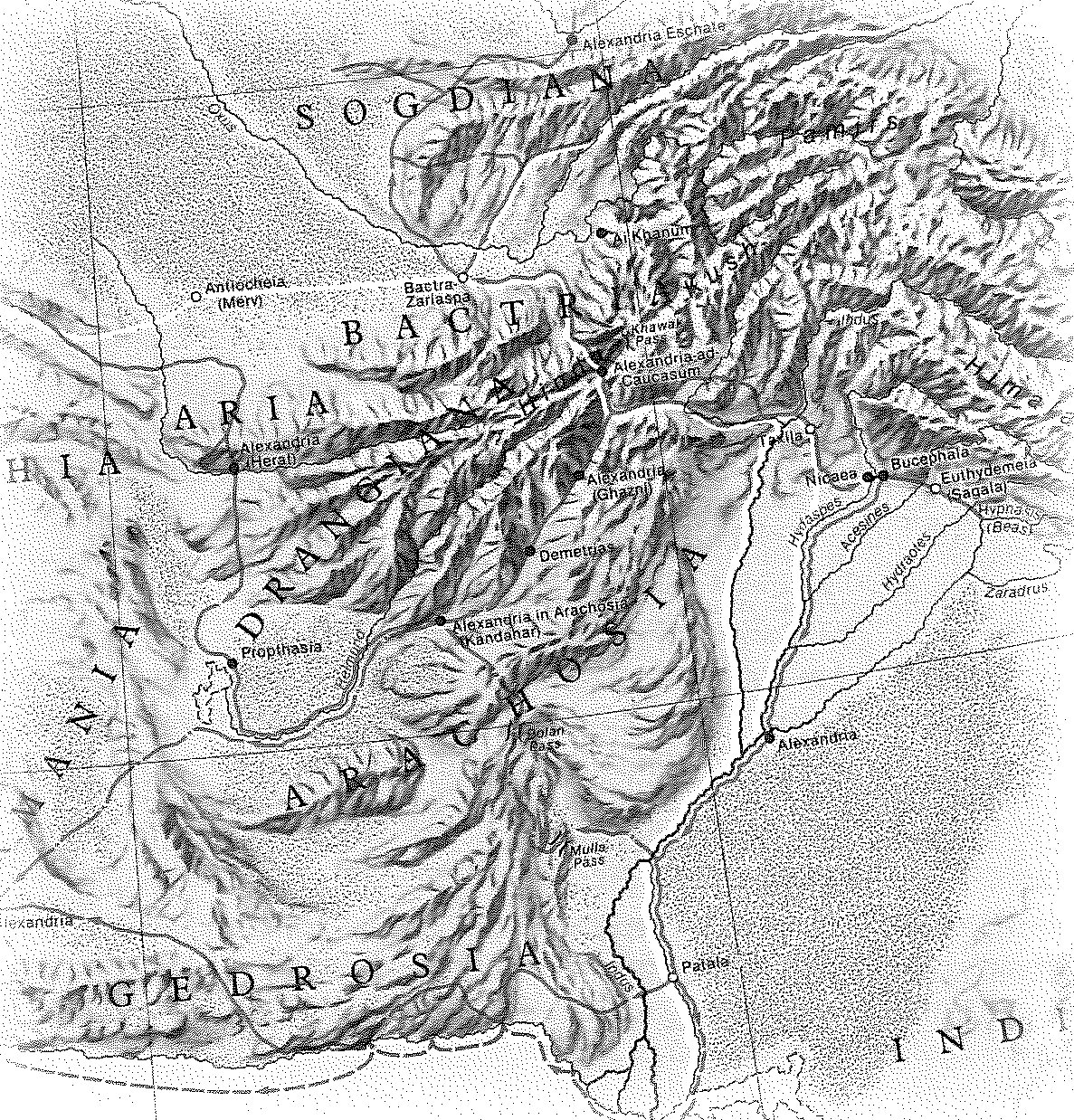
Bactria and its northern neighbour, Sogdia (modern Tajikistan and Uzbekistan), were where these two Irans met. The first cities grew up there in the second millennium BC, in response to the Mesopotamian and Indus Valley civilizations’ search for mineral resources such as tin, turquoise and lapis lazuli. The beginnings of urbanization also saw the beginnings of intensive agriculture, supported by irrigation along the river valleys, particularly the Amu Darya (the ancient Oxus) Bactria’s — and now Afghanistan’s — northern boundary. Sometime in this period, the Indo-Aryans came south from the steppes, moving on into Iran and India, but leaving behind them a vast reservoir of nomadic peoples. As further nomad waves passed south, Bactria and Soghdia acted as a filter, giving them a veneer of civilization before they moved on to Persia and India. process, the hill barons of Bactria and Sogdia, the backbone of the Persian Empire’s armoured cavalry, absorbed much of the nomads’ military culture. Their assertion that all a gentleman needed to know was how to “ride, shoot and tell the truth,” formed the core of Persian aristocratic values. Alexander was not the first Westerner to enter what is now Afghanistan. The Persians had learned the hard way — i.e., at Marathon and Thermopylae – that they could not match Greek heavy infantry, and they soon began hiring Greek mercenaries in large numbers. In due course, many of these Greeks were settled in northern frontier areas, including Bactria and Sogdia. They were augmented by deportees from the Greek cities in Asia Minor, which passed in and out of Persian rule, and by exiles from the politics in turmoil of the European Greek city states, in which the Persians were always happy to meddle. Many Greeks saw no contradiction in fighting for Persia, against Alexander; indeed, when he crossed into Asia in 334 BC, more Greeks were fighting for the Great King Darius Ill than for him.
Alexander entered what is now Afghanistan near Herat (which he refounded as Alexandria-in-Areia) in August, 330 BC. He was pursuing Bessus, satrap of Bactria, who had deposed and murdered the defeated Darius III. Bessus proclaimed himself Great King, of the now very shrunken Persian Empire, hoping the rough terrain and warlike peoples of the Iranian heartland would check the Macedonians’ unstoppable progress. After passing through the Helmand region, Alexander had to halt in Kandahar (where he founded Alexandriain-Arachosia) to deal with a number of threats. The former Persian satrap, whom he had left in charge in Herat, had revolted and slaughtered the Macedonian garrison. Alexander also faced dissension in his own ranks. His soldiers were becoming mutinous as they were dragged ever further east. His conservative Macedonian generals were unhappy with Alexander’s adopting Persian royal insignia and co-opting former Achaemenid officials to administer his empire.
Alexander ruthlessly quashed both threats. With characteristic speed he led flying columns of elite cavalry and light infantry, taking the rebels in Herat off guard. Resistance quickly collapsed. Dissident Macedonian commanders were tried and executed on trumped up charges. Their supporters in the ranks were given dangerous assignments or sent to garrison insalubrious places. (Alexander knew who they were, as he encouraged his soldiers to write home and then read their mail.) Soldiers were also offered large re-enlistment bonuses or were allowed to cash out and go home. There were lots of replacements — new drafts from the Balkans and Asia Minor, locally engaged Iranians, and the descendants of the Greeks settled there by the Persians. Soldiers were also encouraged to take local wives, to dispel homesickness.
Despite the winter season, the march resumed in February, 329. At Begram, Alexander founded Alexandria-in-Caucasus (Hellenistic geography was a bit hazy; the Hindu Kush was believed to be an extension of the Caucasus, the Don to flow into the Aral Sea). Crossing the Hindu Kush, through its highest and most snow-bound pass, at the head of the Panjshir valley, Alexander surprised and routed Bessus out of his capital, Bactris (near modern Balkh). Bessus fled across the Oxus but was overthrown by Spitamenes, satrap of Soghdia. Spitamenes handed Bessus over to Alexander, who had him tortured, tried, mutilated and eventually executed. Iranian resistance still did not end. In August, 329, Alexander crossed the Oxus, spending the next two years trying to subdue Sogdia. He even ventured beyond the bounds of the Persian empire, over the Jaxartes river (the Syr-Darya) pursuing Spitamenes’ Saka allies. At the edge of the Fergana valley, where Khojand Tajikistan now stands, he founded Alexandria Eschate — “Alexandria the Furthest.”
Spitamenes rallied the nomads from beyond the frontier and stirred up a bloody revolt within Sogdia and Bactria. Large Macedonian garrisons were isolated and smaller ones slaughtered. Macedonian relief columns were ambushed. Even Alexander did not escape unscathed, suffering an arrow through his leg, a head wound that almost blinded him and a bad case of “Darius’ Revenge.” Gradually he got the upper hand. Rebel strongholds were stormed. The mass execution of prisoners encouraged others to capitulate. Macedonian heavy cavalry overawed the Saka horse-archers, who eventually agreed to Spitamenes’ rendition. Alexander’s Balkan and Anatolian mountain troops seized seemingly impregnable fortresses perched on crags in the Pamirs. To seal his conquest, Alexander married Roxane, daughter of Oxyares, who held the Sogdian Rock, the most imposing of the Pamirs’ fortresses. His generals were also “encouraged” to take Iranian wives; one of them, Seleucios, received Spitamenes’ daughter. In the spring of 327, the conquest of the region was complete and the way was clear for Alexander to turn south to invade India.
He left behind, however, a strong occupation force — 13,500 European troops backed by local auxiliaries trained in Macedonian techniques, in a network of garrisons across Sogdia and Bactria including a chain of strategically located “Alexandrias” at or near Merv (now in Turkmenistan), Herat, Kandahar, Kabul, Termez, Ai Khanum and Khojend. In addition, time-expired or ex-Persian Greek mercenaries were settled across the region. These were not all happy campers. Whatever Alexander’s pan-Hellenic pretensions, most Greeks despised Macedonians, as just another group of Balkan barbarians. When a rumour spread that Alexander had fallen in India, 3,000 Greek settlers mutinied and set off back for Greece. Likewise, two years after Alexander’s death, 26,000 other Greeks mutinied and had to be ruthiessly suppressed — by loyal Macedonians.
Alexander died in Babylon on the 10th of June, 323 BC. Not even a self-proclaimed god could survive the cumulative effects of wounds, strong drink, malaria, and an extreme “type-A” person-
• ality. With Alexander’s passing, the spotlight of history no longer shines on upper Asia. We are left with a faint and flickering strobe. Almost no contemporary sources survive. Scholars must sift through some Roman-era histories and geographies; a brief window of Cold War archaeology (abruptly shut down in 1979); imaginative efforts to tweak information from Chinese and Indian accounts; and large quantities of often very high quality coins found across the region. Elaborate edifices of Bactrian and Indian Greek dynasties and kingdoms have been built upon these fragments. Some historians have portrayed the Bactrian Greeks as a sort of proto-Raj stretching from western China to the lower Ganges and from Merv to the Bombay region. Others believe Greek control was confined to Tajikistan, Afghanistan, Pakistan and the Punjab. As Alexander’s generals fought each other for his empire, few showed enthusiasm for inheriting Bactria, with its warlike population and fractious colonists. We are told it was assigned to a Greek- Cypriot officer, Stasanor, “because none of the Macedonians would deign to accept it.” In due course, Bactria became, by default, the property of Seleucios Nicator (the Conqueror) – the easternmost part of a realm that stretched west to the Aegean. Seleucios traded off his territories south of the Hindu-Kush to the Indian king Chandracotta, in exchange for 500 war elephants – the ancient equivalent of a Panzer Korps. With these, Seleucios crushed his chief rival, the octogenarian Antigonos the One-Eyed. Seleucios entrusted what remained of the eastern satrapies to his son (by Spitamenes’ daughter) Antiochos. Antiochos sent another punitive expedition over the Syr-Darya to keep the nomads at bay, and further encouraged Greek colonization of Bactria. A string of cities called variously Seleucia or Antioch now supplemented (or replaced) the Alexandrias. However, after Antiochos succeeded his father in 283, Seleucid interest in upper Asia waned. The heartland of the Seleucid realm lay in former Iraq — a few crumbled ruins of its capital (yet another) Seleucia can be still found just south of Baghdad – and the Seleucids became preoccupied with wresting Syria away from Ptolemaic Egypt. For most of the second century BC, Seleucid kings showed little interest in Bactria. Sometime around 250 BC, the satrap of Bactria, Diodotos, declared himself king, taking Bactria out of the Seleucid realm. According to the Roman historian Justin, when the “ … governor of the thousand cities of Bactria revolted, and assumed the title of king, all the other people of the east, influenced by his example, fell away from the Macedonians.” Modern historians disagree whether Diodotos’ UDI was the cause or an effect, but around this time, the Parthians, one of the nomad tribes from the steppe, bypassed Bactria, and seized what is now Mazandaran northern Iran. Gradually they conquered all Iran. These conquests largely isolated the Bactrian Greeks from the rest of tellenistic world.
Nonetheless, and somewhat surprisingly, the Bactrian Greeks continued to maintain the ways of their distant homeland, as is evident from what archaeologists have found in the ruins of a city now known as Ai Khanum. Located on the south bank of the Amu-Darya, it was probably the site of Alexandria in Oxiania. Destroyed by nomads circa 130 BC, it lay abandoned until it was discovered by French archaeologists in the 1960s. It was deserted again after 1978 and has since been thoroughly trashed in the ensuing Afghan wars. Ai Khanum has all the appurtenances of a Greek city — theatre, gymnasium, temples (although some reflect Persian architectural styles), Greek-style sculptures and mosaics (albeit of an old fashioned type). Fragments of inscriptions and documents reveal a Greek style administration and a taste for Greek philosophical texts. In sum, rather like Victoria, BC, it presented a rather dated and idealized version of the old mother country. Unfortunately (for archaeologists), all the other cities of Bactria continued to flourish and have been built over, leaving few traces of this period, beyond the very abundant coinage of the Greco-Bactrian kings. The coinage, however, is remarkable, depicting some forty different rulers. Many of the coins are of a very high quality and use the Athenian drachma (the currency of account of the day) as their standard. The coins have realistic royal portraits on one side and Greek gods and heroes on the other. Some rulers wear a second century BC version of the Afghan cap, others headgear that looks remarkably like a pith helmet. The coins’ quantity and purity are seen as indicators of ample resources and a flourishing foreign trade. Other coins, with bilingual inscriptions and Iranian or Indian deities on the reverse, are struck to local standards. Probably for local circulation they reflect a highly monetarized economy. Chinese descriptions of Bactria describe the population as poor soldiers — afraid of battle — but clever merchants.
Circa 230 BC the son of the rebel satrap, Diodotos, was overthrown by one Euthydemos, an officer from Magnesia in western Asia Minor. Soon after, under Antiochos III (also styled “the Great”), the Seleucid empire struck back in an effort to reclaim its lost eastern provinces. In 210, thwarted in his efforts to wrest Syria from Egypt (he was defeated at Raphia — today’s Raffa in Gaza), Antiochos set out in Alexander’s footsteps on a grand tour of the Asian provinces. Having reaffirmed Seleucid rule in Armenia and Iran, and extracted allegiance from the Parthians, Antiochos invaded Bactria. Euthydemos’ heavy cavalry was outmaneuvered outside Herat and Euthydemos was besieged for two years at Balkh. According to Polybius, Euthydemos was able to negotiate a settlement by persuading Antiochos he was an essential bulwark against the nomad hordes. Euthydemos had to surrender most of his war elephants and a lot of treasure, but was allowed to retain his royal title. Antiochos then “… crossed the Caucasus [Hindu Kush] and descended into India, renewed his friendship with Sophagasenus, the king of the Indians and received more elephants…” He then disappeared back into the west, only to fall afoul of the Romans. In 198 he lost his army and most of his hard-won elephant corps at a battle fought near Euthydemos’ home town, Magnesia.
Sophagasenus was a descendant of the great Indian king Ashoka (273-232 BC). After conquering most of the sub-continent, Ashoka suffered a crise de conscience and converted to Buddhism. Around his empire he set up pillars exhorting his subjects to embrace his new-found ways and become peaceful vegetarians. That his influence stretched as far as what is today Afghanistan is clear is as one such pillar was found at Kandahar. It was inscribed in Sanskrit, Greek and Aramaic. He even sent emissaries to the Seleucids and Ptolemies urging them to follow his example. Noble though Ashoka’s sentiments were, they did not bode well for the long term future of his empire. With the Seleucid threat removed, and Ashoka’s descendants under threat from a rival dynasty, Euthydemos began a Drang nach Osten. After reinforcing his hold on Sogdia and grabbing some western provinces from the Parthians, he gobbled up southern Afghanistan and eastern Pakistan. At some point, his son Demitrios invaded India proper. Much ink has been spilled as to whether he actually advanced all the way to Pataliputra — modern Patna on the middle Ganges — Ashoka’s former capital. At this point history becomes even more murky.
Our only western source, the first century geographer Strabo, relies on Apollodoros’s history of the Parthians (whom Strabo did not consider very reliable). According to Apollodoros, the Greeks “extended their empire even as far as the Seres and the Phryni”, i.e., into modern China. Whether Greek political control actually extended that far, there certainly were commercial links. Bactria began to strike coinage made with nickel, a metal then available only from what is now north-west China. Apollodoros also claimed that the Greek king Menander (circa 150 -130 BC) subdued more tribes than Alexander, advancing as far as Imaus (the Himalayas), Palibothra (Patna) and down the coast to Sarostus (modern Surat). While Menander’s rule may not, if fact, have extended much beyond the Punjab, he is renowned in Indian literature as a convert to Buddhism and the source of many aphorisms.
Some time around 160 BC one Eucratides (who may have been acting for the Seleucid king Antiochos IV; modern scholars can present equally compelling arguments for and against this hypothesis) invaded Bactria overthrowing Euthydemos’ successors. The Euthydemids mounted a counterattack from their Indian possessions. They failed to dislodge Eucratides, but in the course of this civil war, the Parthians regained considerable territory in the west. Sometime around 145 BC the Kushans, a horde of nomads, equated with a tribe known to the Chinese as the Yuezhi, were driven out of western China and overran Sogdia. Around 130 the Kushans overran Bactria, Ai Khanum was destroyed and the last king Heliocles fled across the Hindu Kush. His descendants hung on in the Kabul region for another generation or two, while other Greeks continued to rule in the Kandahar and Ghazni areas. Around 70 BC Hermaeus, the last king of Greek origin to rule in Afghanistan, was, in turn, overthrown by the Kushans. The Indian branch survived somewhat longer, but was slowly crowded out as another nomadic horde, the Sakas, were driven south by yet more eruptions on the Chinese frontier. The last Greek ruler Strato II, located somewhere in the eastern Punjab, vanished from the scene sometime around 10 BC, some 20 years after the Roman Emperor Augustus overthrew the last of the Hellenistic kingdoms — Cleopatra’s Egypt.
Alexander’s conquest of the region transformed it, but the region transformed his successors. The result was a blending of East and West that so successfully implanted elements of western culture in the region, that the cities they founded, the use of the Greek language and their Hellenistic artistic heritage only slowly faded from what is now Afghanistan and the neighbouring “Stans.” For the next century the Kushans continued to mint copies of the Greco-Bactrian coinage and use Greek in their inscriptions. They even adapted the Greek alphabet, to write their own Iranian dialect. Ai Khanum excepted, the cities continued to flourish. Begram in particular seems to have been an important trading centre and excavations have yielded many imports from the West. Just as the Greco- Bactrians were fading from the scene, the classical world discovered the monsoon, speeding the passage to and from India. Western trade with India bloomed to the extent that Roman senators worried about a serious balance of trade deficit. When the first century AD philosopher Apollonios of Tyana visited Bactria and India, he reportedly had no problem conversing in Greek. Another legacy of this ongoing contact was Gandaharan art — a tusion blending Hellenistic, Iranian and Indian forms — which continued to influence local styles until the arrival of Islam in the seventh century. The great Buddhist statues in Bamiyan and many other surviving masterpieces of Gandaharan art survived the many changes that followed, only to be destroyed by the Taliban in 2001.
View the original scanned pages →
Originally published in bout de papier, Vol. 22, No. 4 (2007) — Winter/Spring 2007 // Hiver/Printemps 2007, pp. 21–24. Read the rest of this issue →



