
bout de papier, Vol. 14, No. 2 (1997) — Summer 1997 // Été 1997, pp. 6–8
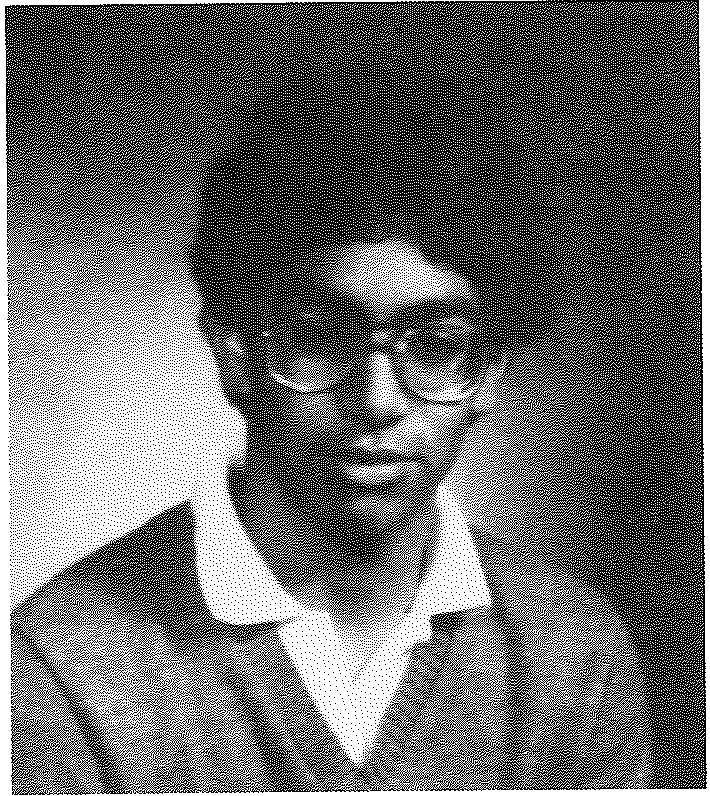
As another June goes by, I can’t help but remember my friend Vinod
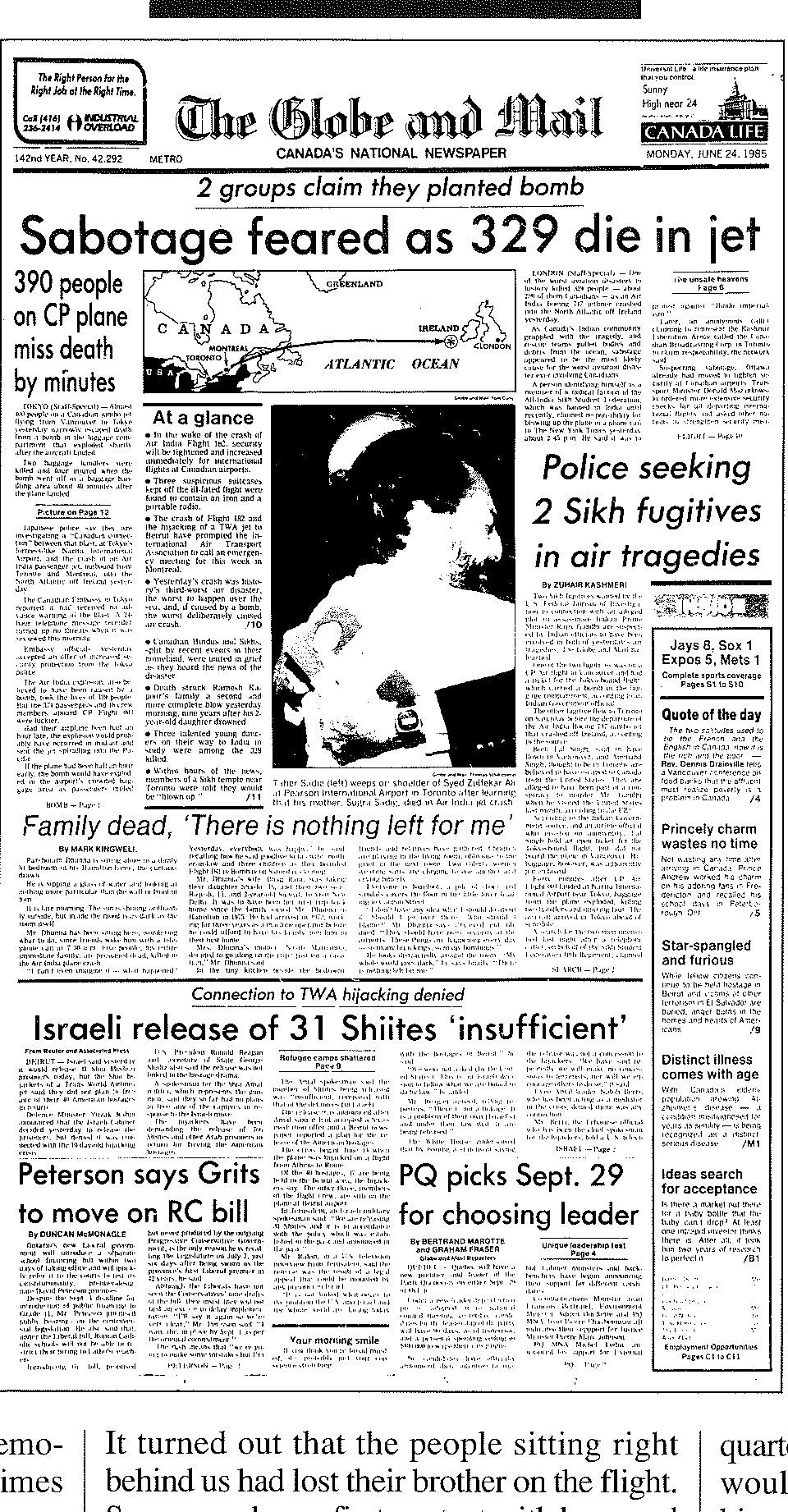
Thomas and his family who were murdered twelve years ago on the ill fated Air India Flight 182. The Thomas family was one of two families from Halifax, Nova Scotia, to perish in the disaster off the coast of Cork, Ireland. All 329 people on board the Boeing 747 — 278 of them Canadians — were killed when the plane exploded over the Atlantic Ocean en route from Montreal and Toronto to New Delhi and Mumbai (Bombay). The tragedy remains, today, the worst civilian airline disaster over the sea and the worst mass murder in Canadian history. bout de papier Vol.
I had just finished grade eleven and was in Montreal studying French when I heard the news. I couldn’t believe it. I didn’t want to believe it. That summer, the innocence of youth was lost amongst my peers as we realized, for the first time in our lives, how terrorism could affect us, even in Nova Scotia.
Vinod and I had known each other for five years, but our friendship had grown in the last two years of his life. We used to talk to each other at school a lot. You see, his locker was next to mine, and we were in many of the same classes. Naturally, I would see him throughout the day when we would get our books for class. We grew closer that year because we were “locker buddies”
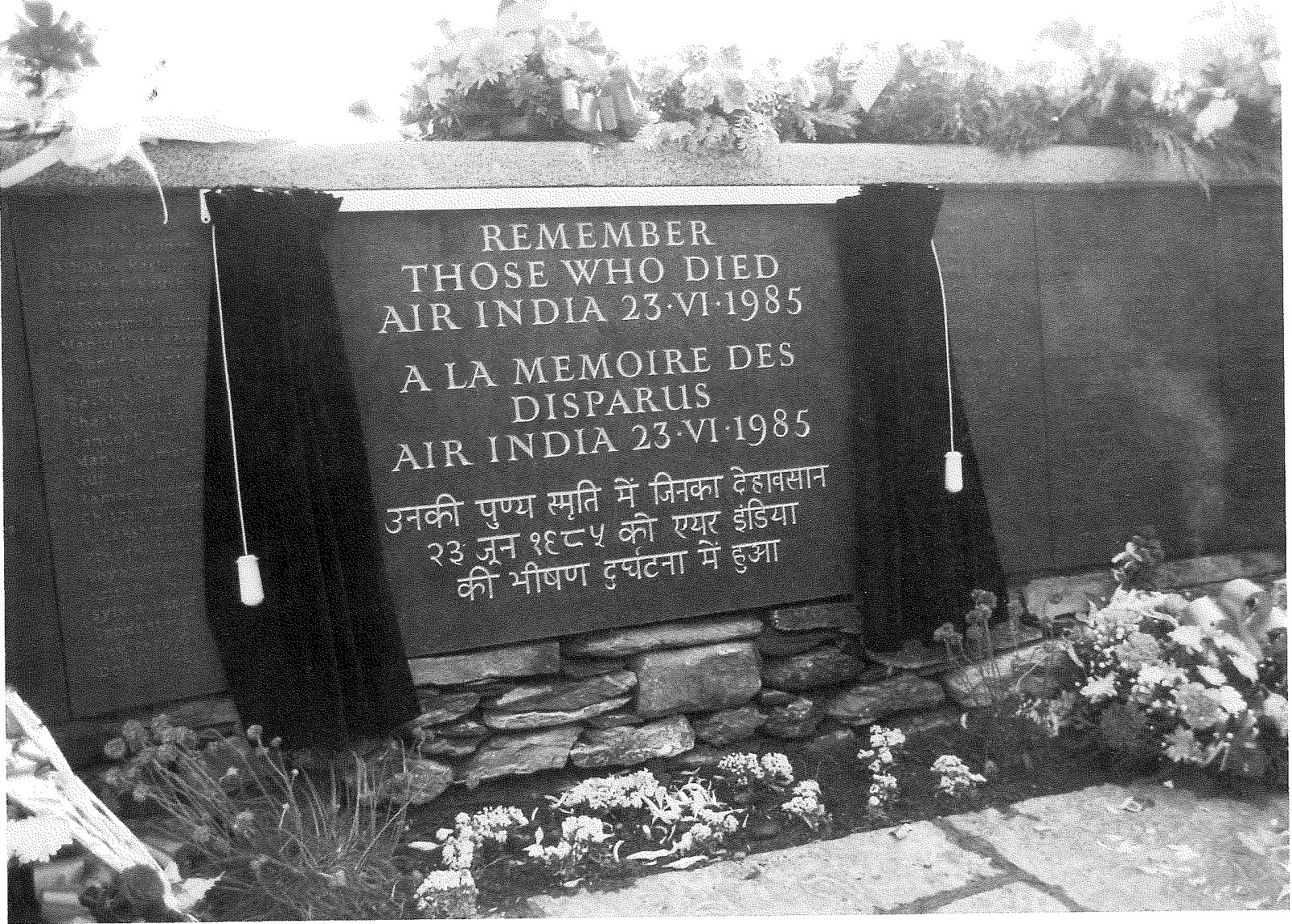
A trilingual monument was dedicated on June 23, 1986 by then External Affairs Minister Joe Clark. It is located in Dunmanus Bay, Ireland, the closest point of land to the crash site.
Vinod was an honours student with such great potential. He always placed in the top ten students on the honours roll at Halifax West High School. Unlike many of the other honours students, however, Vinod was always eager to help if you had a question or needed assistance. He was not competitive. He had a very gentle manner and regardless of his academic achievements, he did not seek the limelight.
Vinod’s father was a professor of biology at Saint Mary’s University (SMU) from 1968 until his death in 1985. He chaired the department for several years and was well respected by both faculty and students. After his death, students renamed SMU’s biology society in his honour.
While many of the Air India victims came from Toronto and Montreal, the tragedy of losing two entire families from a smaller city like Halifax was devastating. The Thomas family, in particular, was well known to many, partly because Dr. Thomas had taught so many students throughout his career at the university.
While I know how my friends in Halifax felt, I often wondered what was going through the minds of Canadian government officials on June 23, 1985, the day of the tragedy. Twelve years later, this feeling has intensified greatly, in part because I recently learned that I will be posted to Mumbai — the destination of flight 182 — as Vice-Consul.
Canadian Officials Arrive in Ireland The first departmental official from Ottawa to reach Ireland was Daniel Molgat, who, in June, 1985, was on pre-posting training in preparation for his new assignment as Ambassador to Spain. Today, he is the Executive Director for Senior Assignments. Daniel Molgat still finds discussing the experience very tional and fought back tears several inroughout our discussion.
Molgat received a call from then External Affairs Minister Joe Clark’s office two days after the disaster asking him to leave, immediately, for Cork:
“The Minister knew that there was a large consular case developing, and while I had no previous consular experience, I was asked to assume the responsibility of getting things organized on the Canadian side. We had a problem in Ireland at the time, as the then Canadian Ambassador, Edgar Benson, had just finished his assignment and had not yet been replaced. So, I headed to London where I was joined by Michael Phillips who, today, ironically, is Ambassador to Ireland but who was then the Minister of Political and Public Affairs at the Canadian High Commission.”
The two diplomats had their first taste of what was to follow during their flight to Ireland. “We asked the pilot to make an announcement asking if anyone was heading to Ireland because of the Air India disaster. so, we made our tirst contact with bereaved family members in the air.”
Upon arriving in Cork, Molgat and Phillips went to the Cork Regional Hospital, where a temporary morgue had been set up, to establish contacts with the Irish authorities. The task at hand was overwhelming, as many of the bodies were disfigured beyond recognition. Forensic specialists, one of whom was Indian, had been brought in to assist with identification. Overall, Molgat was impressed with the organization of the response. “The Irish authorities had quickly mobilized to deal with the crisis,” he said.
Most bereaved family members began arriving within 24 hours of the incident. Because of the shortage of hotel rooms in the area, some of the relatives ended up staying as far as 45 minutes outside of Cork. Molgat and Phillips were joined by a half dozen core departmental employees including Gavin Stewart, Bob Hathaway, Stanley Noble, Helen Amundsen and Scott Heatherington (both presently with Citizenship and Immigration), Shelley Wann, and the two communicators, the late Daniel Villeneuve and Ron Massette. Members of the group travelled daily to all of the hotels around the area to brief family members on the progress of the investigation. The visits by Canadian officials with family members also served as an opportunity for bereaved relatives to mourn with departmental officials. It was a difficult time for the team members, as it took a long time before the hospital authorities were in a position to make the bodies available for identification. Many of the bodies were missing, too, so family members had to be prepared for the possibility that their loved one(s) had not been retrieved.
Once the bodies had been recovered, photos were taken of each and placed in a large room of the morgue. Family members were then brought in and asked to attempt to identify their relatives.
Molgat and his team spent six weeks working with the Irish authorities. He praises the work of his team: 66 …for many, it was their first time dealing with such an emotional situation. They were an exceptionally dedicated group who spent long hours passing messages back to Canada and visiting families.”
He also praises officials at headquarters who, at any time of the day or night, would respond to requests from him and his team and send them the resources they needed without fail.
Task Force Established in Ottawa Back in Ottawa, one of the key departmental officials who was heavily involved in the Air India crash was Henry (Gar) Pardy, then Director of Asia-Pacific South and now Director General of the Consular Affairs Bureau.
In late July 1985, Pardy became the department’s representative on the Air India Interdepartmental Management Group, which included representatives from the RCMP, CSIS, Justice, PCO, Transport, and the Aviation Safety Board (now known as the Transportation Safety Board). The mandate of the committee was to oversee all aspects of the Air India investigation, including relations with the Indo-Canadian community. According to Pardy, at the time in Canada, relations within the Indo- Canadian community were badly fractured. “The Sikh community was isolated from the rest of the Indo-Canadian community because of the assassination of former Indian Prime Minister Indira Gandhi by her Sikh bodyguards the year before. Joe Clark had encouraged ethnic communities to raise their concerns to the Government of Canada, but he drew the line at using violence. However, Clark felt that the alienation of any community from their own government was wrong and that it was very important that the Government of Canada be seen to be reaching out to any community in distress.”
The Indian community at large had reason to be distressed, for in a response to media immediately after the crisis, then Prime Minister Brian Mulroney referred inadvertently to the victims as “Indian citizens”. Mr. Mulroney corrected himself soon after learning that the vast majority of the victims were, indeed, Canadian citizens. However, this initial slight, according to one senior government official, was never forgotten by the families of the victims. Some called it a form of “inadvertent racism”. Those close to Mulroney at the time said that the former Prime Minister sincerely regretted his initial comment for years to follow.
In the fall of 1985, while still a member of the Interdepartmental Committee, Pardy was charged with planning and implementing a monument to the victims to be unveiled by SSEA Clark and the foreign ministers of both India and Ireland on the first anniversary of the disaster. The Irish government donated a piece of land on Dunmanus Bay for the monument, the nearest point of land in Ireland to the crash site. This bay is located one hour’s drive west of Cork, Ireland.
An Irish sculptor, Ken Thompson, was tasked with designing the monument. A sundial was chosen as the main part of the tribute, and was surrounded by a semicircular wall with the names of all of the victims inscribed on it. On the sundial were the following words: “Time flies, suns rise, and shadows fall; Let it pass by; Love reigns forever over all”
In an effort to reach out to the victims’ families, several months atter the ceremony, each victim’s family was presented with a video of the monument unveiling and an accompanying written piece. SSEA Clark wrote:
“I had the opportunity to meet many of you last June at the dedication of the Air India memorial in Ireland and to share your grief. The shock, distress, and anger that the Air India disaster continues to cause touched me most deeply. I can only express the wish that time will lessen your pain and allow you to rebuild your lives.
The Memorial on the beautiful Irish coast will never be a substitute for lost loved ones. Yet in the wall of names, the dramatic sun dial, and the evocative location can be found a permanent monument to the memory of those who perished in this senseless tragedy. I hope that it will become a place of pilgrimage for you in the years to come.
Many of you could not travel to Ireland to participate in the dedication ceremony. I hope that, in time, you will be able to visit the Memorial… This booklet and videocassette commemorate the Memorial and dedication ceremony. It may, in some small way, ease the burden of your loss to know, that with this small token, your grief is shared by all Canadians.”
One thing Gar Pardy will never forget is the way the people of Ireland, and those living in Cork in particular, treated the families and dignitaries attending the original monument unveiling:
“Cork is such a small place, and so many people wanted to attend the unveiling. So, the people of Cork opened their homes and hearts to those needing places to stay, including hundreds of family members of the victims. The ceremony was, in effect, a total community effort on the part of the Irish, most of whom never even knew any of the victims”
Today, on the anniversary of the disaster, the caring displayed by the people of Cork continues, for a ceremony is conducted annually at the monument with victims’ family members.
“Justice Must Be Rendered”
In Canada, progress in the Air India investigation has been slow. Up until two years ago, it looked as if the perpetrators of the Air India tragedy would escape unpunished. Then, the RCMP offered a one million dollar reward for information, and new leads developed. It appears that as a result of these new leads, the RCMP will be able to lay charges in the very near future against several individuals living in Canada. Proving the charges will be difficult, regardless of the new leads, given the fact that so little of the wreckage was salvaged from the bottom of the ocean. Nonetheless, the Indo-Canadian community has never given up its demand for answers and will carefully watch the court proceedings leading to, it is hoped, the eventual conviction of those responsible. According to people like Gar Pardy, who spent a significant part of their lives dealing with this tragedy, “it shouldn’t matter how long it takes … justice must be rendered.” Daniel Molgat, who remembers the distraught families, couldn’t agree more. “If it was murder, then those responsible must be punished.”
Vinod Thomas, his father, mother, sister, and the other 274 Canadians who perished on that day, deserve nothing less. A
View the original scanned pages →
Originally published in bout de papier, Vol. 14, No. 2 (1997) — Summer 1997 // Été 1997, pp. 6–8. Read the rest of this issue →



