bout de papier, Vol. 15, No. 3 (1998) — Fall 1998 // Automne 1998, pp. 44–48
Having deciphered Jimmy the Turk’s report on the terrorist danger to the First Ministers’ conference, Liebnitz rushed with Chief MacBannock to board the Centre’s ram-jet snowmobile for a quick trip to the meeting site at Stratford, confident that their combined brainpower would make quick work of the threat to the nation’s very political fibre. After twenty minutes, correctly ascribing their utter lack of forward motion to the fact that it was mid summer and snow was scarce, they caught the “Leacock Special” express train and were met an hour later at Stratford station by the Centre’s liaison officer, Inspector Wa.
Before they had even had time to brief the Inspector on their discovery, Wa began telling them about an assassination plot brewing at the conference. Intelligence had confirmed that someone had hired the latest new free-lance terrorist, known only as “the Crimson Kumquat”, to murder one of the ten provincial Premiers. But no-one knew which one, or why, or how. Fortunately, the Kumquat was one of those villains who enjoyed challenging the authorities to a game of wits* and had been dropping clues around the site.
These clues were in the form of a piece of paper found at daybreak in front of each of the twelve seats spaced equally around the main conference table — one each for the federal Prime Minister, the ten Premiers and the conference secretary. The one before the PM read “3B-4B-5C 4B-10C-1C-3C 3B-4B-5B-3B 10A-8B-11C-9C-3C 4A-5C 10B-5B-3B-5C-3C 4A-2C 3B-4B-5C 9C- 10C-8C-1C 9B-11C-9A-3B 3C-10C-5C.” The one before the Secretary on the other hand read: “4C-10C-7A-5C 9B-5C 3B-4B- 5C 3C-5B-4C-4C-5C-2B-9A. 3B-4B-5C 9A-9C-5C-5C-3A-10C-1C-4C 5B-1C-3C 3B-4B-5C 3C-5C-5B-3C 5B-2B-5C 4A- 11C-3B 5B-9A 3A-10C-1A-3B-11C-2B- 5C-9A.”
The ones in front of the Premiers were all quotations from different Shakespearean plays (as appropriate to Stratford) and related to death (as appropriate to the occasion). In three cases, the place where each had been found was recorded by seat number: (#1) “Cowards die many times before their deaths; the valiant never taste of death but once.” (#8) “I kissed thee ere I killed thee. No way but this — killing myself, to die upon a kiss.” (#10) “Glamis hath murdered sleep and therefore Cawdor will sleep no more.”
* Orto use the technical terminology, he had a high AFI (Apparent Fruitcake Index)
For the other seven quotations, however, no seat number was recorded:
— “He that dies pays all debts.”
— “As flies to wanton boys are we to the gods. They kill us for their sport.”
– “Murder most foul.”
– “If you poison us, do we not die?” — “For God’s sake, let us sit upon the ground and tell sad stories of the death of kings.”
– “I am dying, Egypt, dying. Only I here importune death awhile.”
– “When he shall die, take him and cut him out in little stars.
MacBannock, who had once recommended Shakespearean drama (especially Timon of Athens) to the Centre’s interrogators as an undetectable form of torture, stared blankly at the Inspector. “That’s all very well, Wa,” he said, “but how about the basics? For example, why would anyone want to kill any of these premiers?” As it turned out, every one of them was in fact under some kind of death threat, for a variety of reasons:
(a) Leo Labouche had just launched an election campaign on the platform of nationalizing his province’s wine industry (under the slogan “raisin d’état”). This was of course violently opposed by the industry and anyone who had ever endured the Premier’s taste in wine. (b) Christian Narthex was the first Premier to be declared persona non grata by his own legislature, after he had locked up the entire opposition for three weeks in an abandoned cinema with 24-hour a day reruns of The Wayne and Shuster Hour “to teach them real Canadian values”.. He was under threat by the (few) survivors and human rights activists. (c) Mogens Eiswein had recently become notorious when he threatened to chop the federal Fisheries minister up for bait in the wake of salmon negotiations with the USA. The Minister’s own constituents had welcomed the suggestion, but it had been violently opposed by environmental radicals and by salmon gourmets everywhere.
(d) Glynda Kybosch wanted to solve the global nuclear testing problem by volunteering her province as a test site for others. This pleased psychiatrists but alarmed disarmament activists, downwind provinces and those who realized that a nuclear permafrost meltdown would cause the northern half of the country to slide into the sea.
(e) Clyde Umbridge was vocally promoting his plan under which the provinces would accept more money from the federal authorities for health, education and welfare and in exchange send the sick, the illiterate and the poor to Ottawa. This was opposed by almost everyone — not least the sick, the illiterate and the poor.
(f) Jane Deere wanted to unite her province with adjacent Syzygy. Profound differences in language, society and economic structure (and the fact that the political culture of both provinces was based on their mutual hatred) made this highly unpopular but did not phase the premiers involved, who had long been lovers and were tired of commuting. (g) Herb Garnish had become the messiah of a new “Socialist Credit” drive proposing a total revision of the capitalist economy under the slogan, “From each according to his ability; to each according to his area code.” He was under constant attack by an odd coalition of Old Marxists, the provincial Reform
Party and people with low area codes. (h) Yada Ohara had proposed a modified
Tobin tax on financial transactions. Under his variation, first suggested by a certain Maritime premier, the tax would be paid in cod, raising tax revenues while supporting offshore fisheries by driving up fish prices. This was opposed by every bank in the country and by tax collectors en bloc.
(i) Jens Yggdrasill had opened a new front on land claims by the country’s first nations, urging that Toronto be returned immediately. His idea had firm support from nine out of ten premiers, but was strongly opposed by many aboriginal leaders (who had appealed to the UN Human Rights Commission) connoisseurs of ennui across the land (j) Petronius Intaglio, after studying recent exchange rate movements, had proposed to solve the Y2K problem by devaluing the year, that is by turning the clock back to 1950. He had been ridiculed by those with any knowledge of computers and violently attacked by the Canadian Historical Association and everyone who remembered 1950s television.
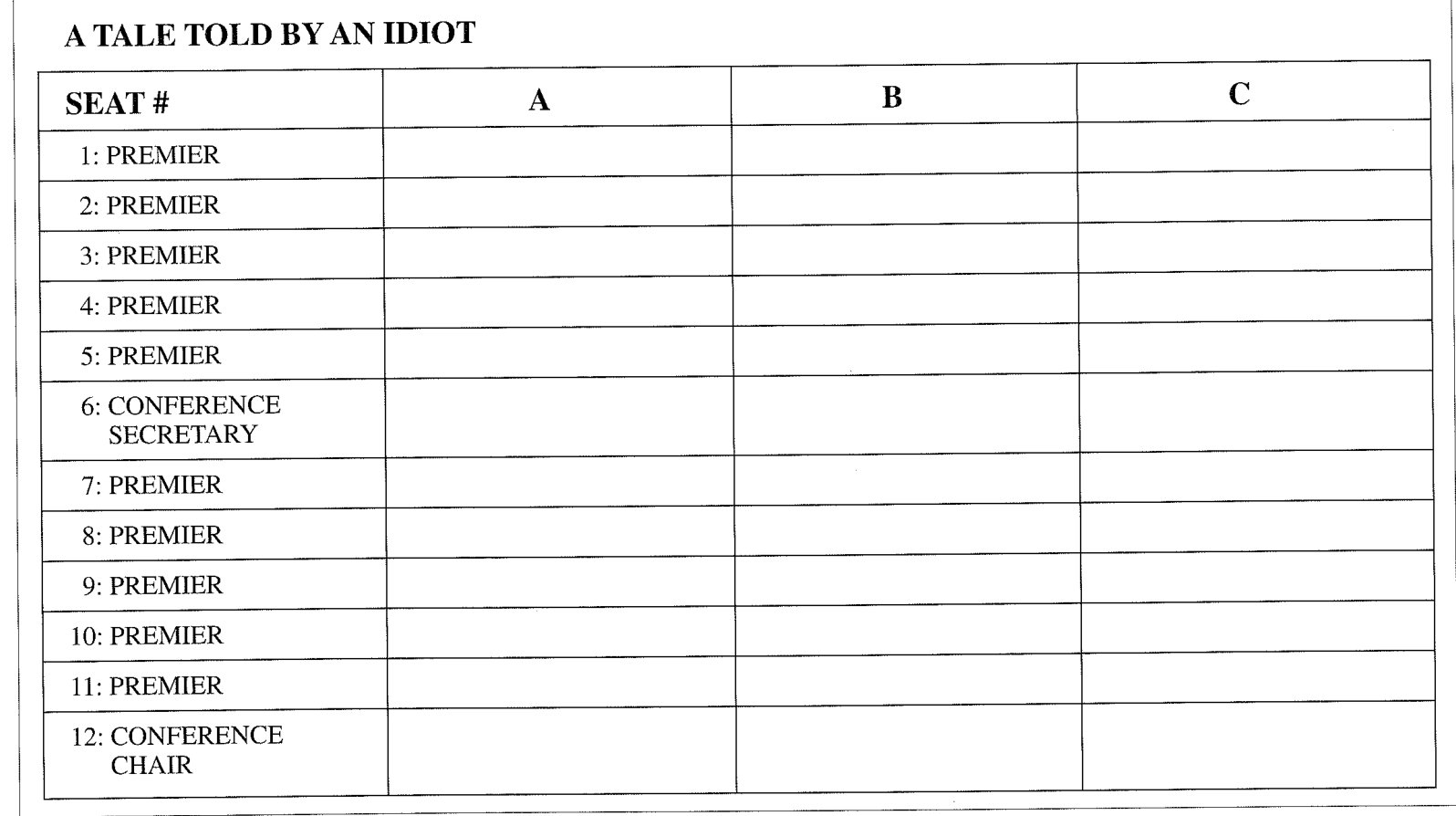
“Well,” said Liebnitz,, “it’s clear that the Kumquat is using a variation of the clock cypher. The twelve seats at the conference table are arranged like the numbers on a clock, with the PM at location 12, the secretary at 6 and the premiers in the remaining seats. You will notice that the numbers on the encrypted messages left with the PM and the secretary use only the seat numbers corresponding to the premiers — I to 5 and 7 to 11. Now there are twenty-six letters in the alphabet, so a cypher based on ten positions would need three rows under each position — call them A, B and C. That also corresponds to what you find in the cypher messages — 5B, 11C, 4A and so on. Let me draw something to make things clearer.” So saying, the ace logician sketched the appended blank table.
’The letters that go into each blank box are the first letter of some word associated with the premier at that position,” he added. “But how on earth are we going to find out what they are?” Just then, Jimmy the Turk strolled up with a large basket and a smug expression on his face. “I think I can help you there, old boy. This basket was just delivered to my suite. Since the only people legitimately aware that I am here know how much I hate tropical fruit, I can only assume it came from our assassin. Sure enough, the mangos and papayas tested positive for various poisons. But the kumquats — ah, the man’s a gamesplayer to the end — each had a pencil-thin moustache and the following message drawn in invisible (and inedible) ink: A = Province; B = Play; C = Surname.”
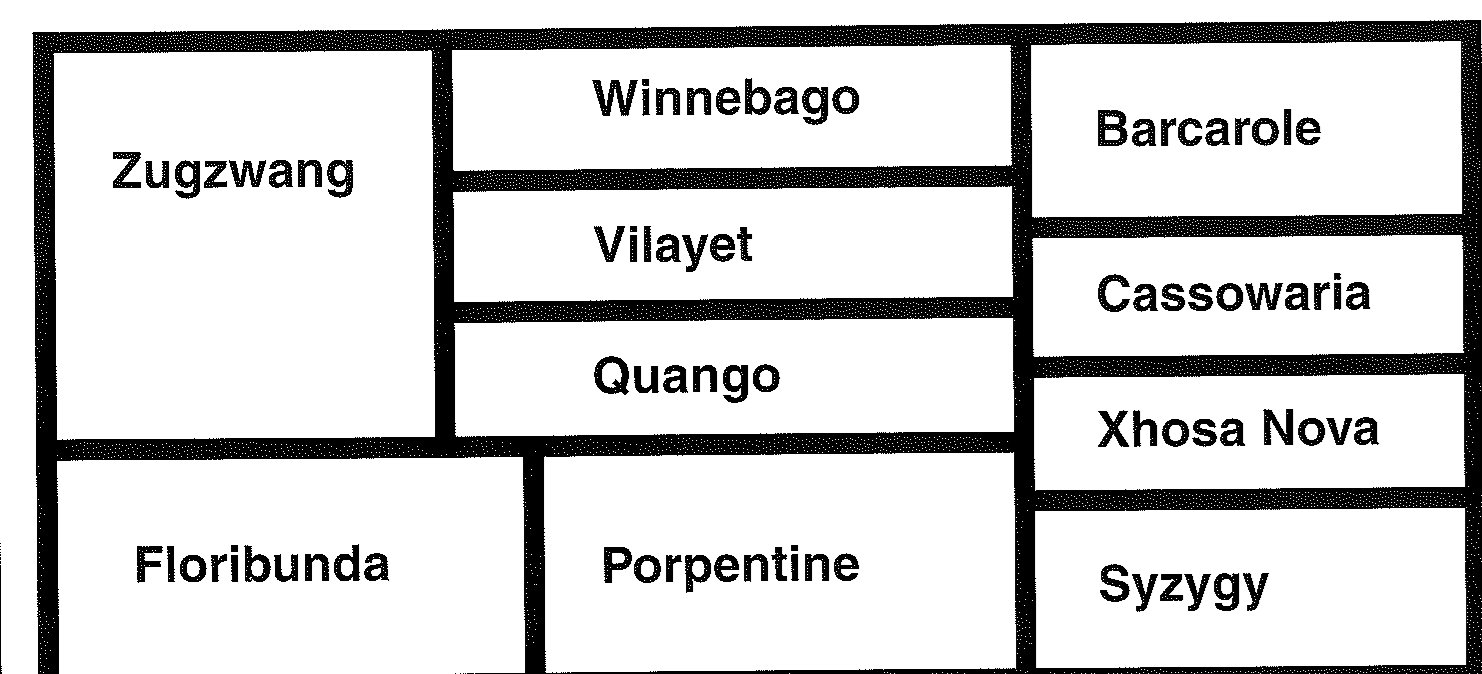
“Excellent, Jimmy,” replied Liebnitz. “I almost forgive you for all those absurd puzzle reports you keep sending. Now all we have to do is work out the premier’s name and province and the name of the Shakespearean (ignoring any “the” or “a” at the beginning) that was the source of the quote left at each place and we will have the cypher complete.” Turning to Inspector Wa, he asked what information was available regarding the seating arrangements. The Inspector blushed and brought out a tattered notebook, explaining that it had been savaged in the hotel lobby by a near-sighted Pekinese. As best could be worked out from the tatters:
(a) No adjacent premiers are from adjoining provinces (see map), but every premier is sitting directly across the table from the premier of an adjoining province.
(b) Narthex from Cassowaria got the quote from Julius Caesar.
(c) Ohara is beside the Premier of Syzygy and across from the man who got the Romeo and Juliet quote.
(d) Umbridge from Quango is beside the Premier who got the Macbeth quote. (e) The Premier of Floribunda got the Othello quote; Premier Kybosch beside him got the quote from Richard II. (f) Deere, the Premier of Zugzwang and the recipient of the Hamlet quote are all on the same side of the table (seats 1-5 or 7-11).
(g) The Premier of Barcarole’s seat number is the square of Yggdrasill’s, and the seat number of the Premier with the Merchant of Venice quote is the square of the seat number of the Premier with the Tempest quote.
(h) Garnish is seated beside the Premier of Porpentine and across from Intaglio. (i) Eiswein has the quote from either King
Lear (if his seat number is even) or Antony and Cleopatra (if his seat number is odd). (j) Labouche is seated next to the Premier of Winnebago (k) When both are in their proper seats, the Premier of Vilayet is the nearest leader to the Premier of Xhosa Nova’s left.
With that information, Liebnitz was able to construct the cypher table, read the two enciphered messages and work out the details of the intended crime. Although the Crimson Kumquat escaped capture, his plot was foiled and the First Ministers’ meeting went off smoothly (or as smoothly as they ever do). As MacBannock concluded happily, “All’s well that ends well”.
Can you duplicate Liebnitz’s feat by providing three key pieces of information: the intended victim, the motive and the means? bout de papier will decide the winner by drawing from a box containing all correct entries received by January 31, 1999. The winner will receive a book prize autographed by A Aalto.
Not necessary to enter the contest, but can you also link each of the twelve Shakespearean quotes (the ten in front of the Premiers plus the two encrypted ones) to the eleven plays from which they come?
Winner of Uncharted Waters:
WAINE McQUINN, Nepean, Ontario
View the original scanned pages →
Originally published in bout de papier, Vol. 15, No. 3 (1998) — Fall 1998 // Automne 1998, pp. 44–48. Read the rest of this issue →