
bout de papier, Vol. 12, No. 3 (1995) — Fall 1995 // Automne 1995, pp. 11–13
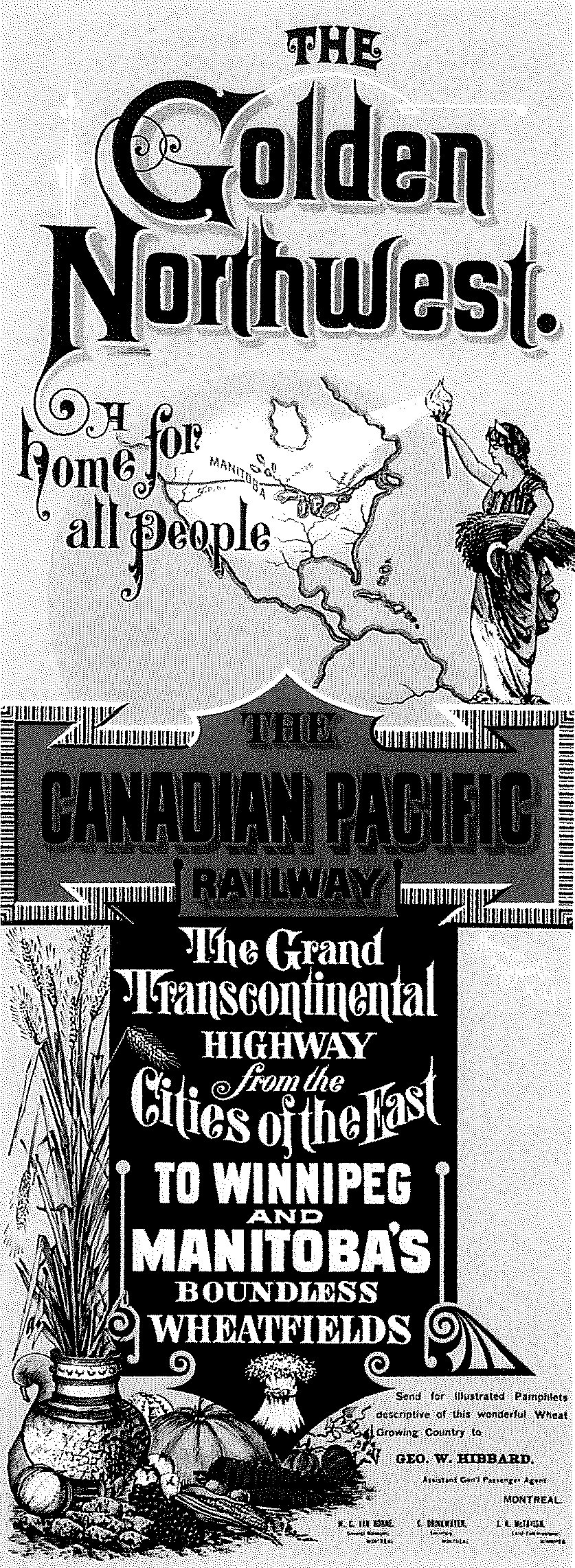
Confused about when the different waves of immigrants landed in Canada? Who was Clifford Sifton and why was he saying all those wonderful things about us? Home children? War brides? All-white immigration? Refugees or immigration queue jumpers? All you wanted to know about the history of Canadian immigration but were afraid to ask? Here is a short primer on the history of immigration.
Early Immigration Policy (1869-1896)
Early immigration to Canada was generated by a network of emigration agents — salesmen who advertised Canada’s attractions to prospective immigrants. They targeted wealthy farmers, agricultural labourers and female domestics, preferably from Great Britain, the United States and northern Europe.
Canada’s first immigration legislation, the Immigration Act of 1869, reflected the laissez-faire philosophy of the time. It did not say which classes of immigrants should be admitted, merely that the “Governor” could prohibit the landing of pauper or destitute immigrants at any Canadian port.
The Chinese, who were arriving in large numbers to build the railway, were a special target of fear and suspicion. An act passed in 1885 to “restrict and regulate” Chinese immigration, was later complemented by head taxes designed to discourage Chinese immigration. It was not until the 1960s that regulations and restrictions on Chinese immigrants were completely lifted.
Clifford Sifton and the Settlement of the West (1896-1905)
The 19th century closed with worldwide depression and a slowdown in immigration to the west. All that changed in 1895. Clifford Sifton was appointed as Minister of the Interior at the start of an economic recovery. Sifton believed that “a stalwart peasant sheepskin coat” made the most desirable immigrant, and set out to attract people suited for farming. In 1896, 16,835 immigrants entered Canada. When Sifton left in 1905, the number was 141,464. It rocketed to 400,870 by 1913. Some three million newcomers arrived between 1896 and the outbreak of World War I.
Sifton’s policies triggered criticism, despite his success in attracting newcomers. Immigrants from central and southeastern Europe raised a groundswell of hostility on the prairies. Residents did not believe these newcomers could assimilate readily into the dominant Anglo- Saxon society.
Stricter Selection (1905-1925)
Sifton’s successor did not share Sifton’s views. Frank Oliver believed ethnic and cultural origins were more important than occupation. He moved quickly to make Canadian immigration more selective. The Act of 1906 defined “an Immigrant” and excluded certain groups of people. It established a better immigration service including controls along the Canada-US border, the deportation of prohibited individuals, and the drawing up of regulations to enforce the Act’s objectives.
Parliament passed legislation in 1908 requiring all immigrants to come to Canada directly from their country of origin. This shut off immigration from India, since there was no direct steamship line. On May 23, 1914, 376 prospective East Indian immigrants arrived in Vancouver Harbour on board the Komagatu Maru. Its human cargo stayed there for two months while the legality of an exclusion order was tested. The order was upheld and, cheered on by local residents, the vessel and passengers were sent back
Home Children (1868-1925)
While Britain grappled with its thousands of poor children, Canada needed cheap farm labour. “Home children” fed the demand. Boys aged about eight, nine and ten were located on farms and apprenticed as farm labourers. Girls were sent to small towns to work as domestic servants. Most children came to Canada without their parents even though only one-third were orphans. The movement continued through the turn of the century and was not stopped until 1925. By then 80,000 children had been sent
The Great Depression (1930-1938)
No single cause, other than World War II, did more to choke off immigration to Canada than the Great Depression of the 1930s. Like the rest of the world, Canadians became preoccupied with the economy in the 1930s and this was reflected in immigration policy. In March 1931, all non-farmer immigrants were banned unless they were Britons or Americans with enough money to support themselves until they found jobs. Immigration plummeted from 1,166,000 in the decade 1921-1931 to only 140,000 between 1931 and 1941.
The worsening situation in Europe was not recognized, and no special measures were taken to permit the entry of refugees. This led to the tragedy of the SS St. Louis. Its 936 passengers, mostly Jewish, lett Europe on the “voyage of the damned” in May 1939, seeking refugee status in the new world. They were refused asylum first by Cuba, then the USA and last by Canada. All options exhausted, the ship returned to Europe where almost certain death awaited most of its passengers.
World War II (1939-1945)
Among the small number of people who did come to Canada in 1940 were highly educated refugees and civilian enemy aliens, who were transported from Great Britain. Many stayed I in Canada after the war, providing this country with one of her most remarkable pools of foreign-born talent. The war was also responsible for an influx of British “guest children,” mostly through a government financed evacuation program. These children were sent to Canada to live with foster parents until the war in Europe ended.
The Post-War Boom and the Liberalization of Immigration (1947-1957)
Immigration policy continued to be restrictive following World War II. Then, in response to a growing pro-immigration bout de papier Vol. lobby, the availability of more ships to transport refugees and displaced persons, and the requirements of Canada’s labour market, the government began to lower immigration barriers. Large numbers of non-sponsored displaced people were admitted to Canada from 1947-1950. Many entered the country under a “bulk labour” scheme, designed to supply workers to meet the needs of an expanding Canadian economy.
When the Soviets crushed the Hungarian uprising, Canada responded by admitting close to 40,000 Hungarian refugees in 1956- 1957. Normal immigration regulations were waived to allow officials to respond quickly to this emergency situation.
Canada’s All-White Immigration Policy Abolished (1962)
Although the government gradually eased immigration restrictions during the boom period of 1947-1957, access from countries other than those that belonged to the “old” Commonwealth, the United States and Europe was severely restricted
This continued until 1962. New regulations were introduced to eliminate racial discrimination. Any unsponsored immigrants with the proper qualifications were considered suitable for admission, no matter what race, colour or national origin, provided they were able to support themselves until they found jobs. In 1967 an objective “point” system based on such qualifications as language and job skills was implemented.
The cornerstone of present-day immigration policy is the Act of 1976. It broke new ground by spelling out the principles of Canadian immigration policy and imposing on the government a mandatory responsibility to plan for the future. It also included an identifiable class for refugees, selected and administered separately from immigrants, and established Canada’s first refugee determination system.
The changes due to the opening up of Canada’s immigration policy and introduction of the point system started making themselves felt during the 1970s. While 87 per cent of Canada’s immigrants in 1966 were of European origin, in 1970 fifty per cent came from new regions: Hong Kong, India, the Philippines, Indochina, the West Indies, Guyana and Haiti.
In 1969, when Canada signed the Geneva Convention on the Status of Refugees and its 1967 Protocol, the way was paved for refugees outside Europe to gain admission to Canada. Among those welcomed were refugees from Tibet, Uganda, Chile and Indochina (the “Boat People”). Canada has accepted 600,000 refugees since the Second World War.
The Refugee Challenge (1980s)
Canada was confronted by a fast-developing refugee phenomenon in the 1980s. Spiralling numbers of individuals were claiming refugee status within the country. Many were fleeing persecution. Some were not. A backlog of refugee claimant cases and a public backlash against “immigration queue jumpers” developed. Legislation to streamline the refugee determination system went into force in 1989 and was strengthened by further legislation in 1993.
Entering the 21st Century …
The 1990s opened as busy years for immigration. Bill C86 became law in 1992, buttressing the enforcement powers of the program. In 1993, the Immigration and Refugee Board recognized the special persecution some refugees may face solely because they are women.
In the fall of 1993, the Department of Citizenship and Immigration was created. Emphasizing his desire for all Canadians to participate, Minister Sergio Marchi announced unprecedented consultations with immigrant-serving organizations and the public to establish a “new vision” for immigration. The consultations helped create a new five-year plan establishing annual immigration levels for immigration and a 10-year framework for immigration policy to take Canada into the 21st century.
Follow the Bouncing Ball: A History of the Immigration Foreign Service
Following Confederation, responsibility for immigration matters rested with the Department of Agriculture, until 1892. Upon introduction of the first Immigration Act in 1869, federal immigration officers were posted to Great Britain and other European countries.
The Department of the Interior was responsible for immigration between 1893- 1916. During this period, overseas posts and activities were expanded in what became Canada’s first foreign service assignments. In 1913, some 400,870 immigrants arrived on Canada’s shores, the greatest number of landings for one year in this century.
Midway through World War I, in 1917, an independent Department of Immigration and Colonization was created. The immigration program remained there until it was absorbed into the Department of Mines and Resources in 1936.
Immigration affairs operated from a branch of the Department of Mines and Resources through the end of the Depression, throughout World War Il and during the resettlement of thousands of “displaced persons” from refugee camps in Europe. Many immigration officers posted overseas were veterans of World War II. They found themselves revisiting countries in times of peace and reconstruction where they had formerly been as members of a liberating army.
The 1950s was a crucial decade in Canada’s immigration history. It began with the creation of the Department of Citizenship and Immigration in 1950 and was followed by the proclamation of the Immigration Act of 1952. The decade’s achievements were topped in 1957 with the admission of 282,164 immigrants — a post-war record which stands to this day.
Two years before the introduction of the “universal” selection criteria in 1967, which eliminated the last prohibitions on the basis of race, the responsibility for immigration was shifted again, this time into the newly created Department of Manpower and Immigration. This formally marked the link between employment policy and the selection of new immigrants. The job of choosing those immigrants overseas was carried out by “Canadian Immigration Affairs Officers”, who eventually became rotational Foreign Service Officers in the early 1970s.
In 1981, the “Foreign Branch” of the Canada Employment and Immigration Commission (CEIC) was transferred to the Department of External Affairs, under the consolidation of all members of the rotational foreign service. The operational delivery of the program overseas was managed by External while policy continued to be formulated by CEIC. The 1980s also marked the expansion of the “Social Affairs Stream” ; as the Foreign Branch became known, from its original contingent of almost 250 staff to its present complement of 330 officers.
The Social Affairs Stream was transferred from External Affairs back to CEIC in September 1992, and was reconstituted into the International Service Group. Consolidation of the overseas delivery of the immigration program was enhanced in June 1993 with the transfer from Health and Welfare Canada of the Immigration Medical Services Program to the International Service Group. After a brief sojourn in the short-lived Department of Public Security, the immigration program was reunited with its former citizenship partner in October 1993 following the creation of the Department of Citizenship and Immigration Canada.
The ball has stopped bouncing … at least for now.
View the original scanned pages →
Originally published in bout de papier, Vol. 12, No. 3 (1995) — Fall 1995 // Automne 1995, pp. 11–13. Read the rest of this issue →



