
bout de papier, Vol. 31, No. 1 (2020), pp. 36–39
EDUCATION MARKETING IS NOW A DYNAMIC DOSSIER, well established within International Trade activities at Global Affairs Canada (GAC). In a statement released on 22 August, 2019, the then Minister of Trade Diversification, Jim Carr, noted that “in 2018, more than 720,000 international students at all levels studied in Canada and contributed an estimated $21.6 billion to Canada’s economy.” This figure reflects transportation, housing, food, and other costs paid by students while in Canada.
As well, Canadian education marketing boasts one of the classiest and most effective websites among all federal government departments in Canada. Statistics for the EduCanada.ca website show 751,903 visitors and 6,963,125 page views in 2018 alone! It is worth a visit to see for yourself. The Canadian educational “brand” is extremely well represented!
There will soon be more than 30 full-time employees plus co-op students and contractors at GAC headquarters to support these activities, according to Nancy Hector, Deputy Director in the International Education Division (BIE) in Ottawa. As well, there are 72 employees at Missions in the education sector, of whom 18 are dedicated full-time to education activities.
Education officers at our missions abroad are supported by Regional Education Trade Commissioners (RETCs) who oversee specific geographic locations and support a wide variety of education marketing services. RETCs located in Säo Paulo cover Asia and Oceania, Latin America and the Caribbean. Two other RETCs are in Ottawa and are responsible for Europe, the United States, the Middle East and Africa.
Internationally, education marketing activities are distributed among trade and political officers, depending on the Mission. These operatives work in close cooperation with Immigration Refugees and Citizenship Canada (IRCC) officers, who have the statutory authority to provide international students with the legal documents to study in Canada. From the very beginning of the Canadian government’s involvement in education marketing, officers from Global Affairs Canada have enjoyed close and complementary working relationships with their Immigration colleagues.
The beginning of education marketing as a departmental activity
While education marketing has grown enormously over the years, it had its humble origins in a mid-sized Canadian Embassy in Seoul, the capital of the Republic of Korea in the late 1980s and early-to-mid 1990s.
In order to understand why Seoul is rightly credited with being the birthplace of Canada’s education marketing abroad, we need to place South Korea in the context of what was taking place economically in various areas of Asia, vis-a-vis what was taking place in Canada at the same time.
During the late 1980s and early 1990s, certain Asian countries and jurisdictions experienced massive economic growth. South Korea, Taiwan, Hong Kong and Singapore were known as the “Four Tigers”. In 1992, the Department of External Affairs and International Trade, as it was called at the time, issued a detailed statement predicting that by the year 2000, those Four Tigers “were likely to reach a European level of industrialization with higher economic growth rates than any of the countries belonging to the Organisation for Economic Co-operation and Development (OECD).” The statement continued, “Japan alone is a larger market for Canada than the United Kingdom, France, Italy, and West Germany combined…”
The document further noted that Canada attracted direct investment from Asia Pacific businesses and entrepreneurs, which exceeded CAD $3 billion in 1988. As well, it was estimated that each year “over 950,000 tourists from the Asia Pacific visited Canada and as the economies of the region continue to strengthen, these numbers are expected to increase.”
In 1989, Canada responded to — or some might argue, anticipated — the emergence of Asia’s monumental growth by launching an imaginative project in the Asia Pacific Region, popularly known as the Pacific 2000 programme. The Right Honourable Joe Clark, then Secretary of State for External Affairs and International Trade, addressed the Business Council of British Columbia in Vancouver on 19 April, 1989, indicating the Pacific 2000 initiative would include, inter alia, a Pacific 2000 Project Fund “so that Canada could become better known in Asia Pacific.”
A lonely telex appears at External Affairs and International Trade headquarters
While there was no direct reference in the Pacific 2000 document to increasing the number of international students from the Asia Pacific region, a single telex from our High Commission in Singapore (Singapore being one of the FourTigers)to the Lester B. Pearson Building in late 1988-89 asked if the High Commission should be represented at an international student fair run by a well-known international company. The telex from Singapore also asked which section of the Commission should represent Canada at the fair if attendance was recommended.
The External Affairs officer who received the telex was a colleague of mine, a member of the political and economic stream working in the briefly integrated immigration section of the Asia Pacific Branch on the 5th floor of LBP. The telex apparently elicited scant interest from trade officials on the Sth floor of LBP, who, it was thought, were primarily focused on promoting trade, not in services but in tangible products. As well, at that time, the Academic Relations Division of External was mainly dedicated to the establishment of Canadian Studies Programmes abroad, as well as dispensing Commonwealth scholarships — far from the business of promoting Canadian educational services abroad.
With little interest from either the trade officials in the Asia Pacific Branch or the Academic Relations Division, my political officer colleague asked if I might be interested in dealing with Singapore’s request. He was surprised, I think, and somewhat relieved when I responded that I was most interested in responding to the telex. At the time, I had just returned from the Consulate General in Chicago, where I had served as a Political, Economic and Public Affairs officer for four years.
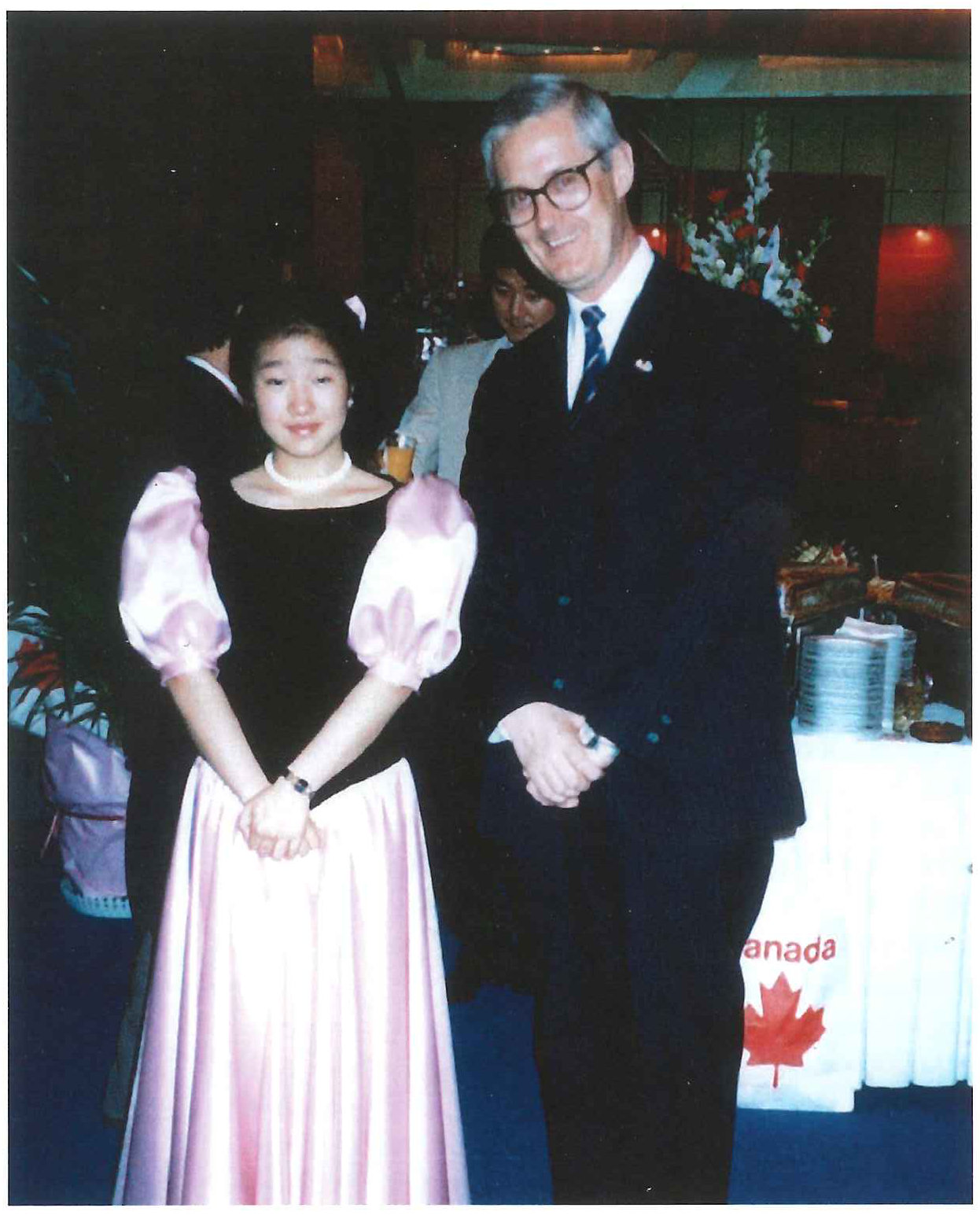
The thought of working on a file which dealt with international students resonated with my background and work experience. My wife, Linda, and I had served as Canadian University Services Overseas (CUSO) volunteers in Guyana, South America from 1966-68. I had taught a first-year World History Course at the fledgling University of Guyana and Linda had taught at a private school for girls. After our two-year stint in Guyana, we had returned to the University of Alberta (U of A), our Alma Mater. I had taken a position as Foreign Student Advisor and Assistant Dean of Men. Both my wife and I had served as live-in Wardens in the Graduate Student residence, which had a large percentage of International students. It was after a year in that position that I joined the federal Department of Citizenship and Immigration, where I learned the importance of laws pertaining to visa requirements for international students wanting to study in Canada. I later transferred to the Political and Economic stream of External Affairs.
So, I guess by default, I wound up being responsible for encouraging our office in Singapore to send a Commission representative to the Fair. I cannot recall if we were advised that a Commission representative ever in fact attended the Fair. Neither do I recall ever seeing a report from our Mission in Singapore indicating the Mission had participated in the Fair.
Meanwhile, in about the same timeframe as the Education Fair in Singapore, telexes started being directed to me in the Asia Pacific Branch from the Embassy in Seoul from Greg Shea, a Second Secretary and Vice-Consul in the Political and Economic Section.
Greg used a new vocabulary when sending telexes to External Ottawa on education matters. Words such as “promotion,” and terms such as “marketing Canadian education services and products” started to take their place with such terms as “academic relations” and references to the well-known Canadian Studies and Women’s Studies Programme in Seoul. However, even the term “trade”, at that time, so far as I recall, did not enter the lexicon in describing what was going on at posts in education marketing matters!
Major challenges in education marketing lay ahead for the embassy
Soon it became obvious that while the Embassy staffers in Seoul were interested in promoting Canada as a destination for South Korean students, the Embassy was starting from a very basic level. While the Mission in Seoul made great strides in the late 1980s in raising Canada’s profile in South Korea through a number of highly public events, the Embassy still had many challenges to overcome in order to even think about the “promotion” of Canada as an education destination for Korean students.
Our competitors had an edge. American and British educational capacities in education were well-established and well-known in South Korea so they did not need to promote their education systems.
Australia had already made education marketing inroads in Korea. It was widely known that the Australians had a number of stand-alone Education Centres operating internationally which could attract Korean students with a 10-hour plane trip between Seoul and Sydney, versus a 16-hour flight from, say, Seoul to Toronto!
Under the Canadian Constitution, provinces have primary responsibility for education matters. Promoting education at a federal level therefore brought a new institutional landscape to navigate.
The Association of Universities and Colleges of Canada was a powerful, country-wide non-government entity furthering the interests of the Canadian university community. The Association of Canadian Community Colleges was its counterpart, representing community colleges. The Canadian Bureau of International Education was another non-government agency interested in international education matters, which even tried (but failed) to establish a Canadian education information office in Kuala Lumpur. While the Embassy in Seoul took these organizations into account, it did not seek them as education marketing partners.
The Canadian Embassy in Seoul and External in Ottawa made every effort not to offend either the existing international education players in Canada or disturb provincial sensitivities. Examples of this accommodation saw External Headquarters in Ottawa and the Embassy in Seoul eventually treat education marketing as a trade-oriented file. Ironically, the political officers at the mission were initially in charge of the international education programme providing information for prospective students obtained directly from Canadian education institutions and other education providers.
The Embassy in Seoul did a masterful job in steering through a maze of obvious and not so obvious challenges to provide a hitherto unknown service to the Canadian education industry.
A new entity is born in a Canadian mission abroad
By 1993, the Canadian Education Marketing Office in Seoul had evolved incrementally and was firmly in place. It was located within the Embassy with two locally-engaged staff who were overseen, not by a Trade Officer, but by Ron Macintosh, the Political and Economic Counsellor and Consul. While Ron oversaw the office’s operations, he gave much credit to previously mentioned Greg Shea, for being the major driver of the education marketing file at that time. Greg introduced the concept of actively assisting Canadian education institutions and other suppliers in promoting their institutions.
With the establishment of the Education Information Office in Seoul, Ron also had high praise for the role of Citizenship and Immigration (C&I) staff at the Embassy. Ron noted that while C&I officers were not directly involved in the operation of the Education Office, they regularly dispatched personnel to fairs to answer student visa and authorization questions. He also noted that family members of Canadian C&] officers attended student fairs, volunteering their time as resource persons to promote Canada as a study destination.
Rodney Briggs, another officer from the Political stream, came to the Seoul mission in 1994 and assumed his position as Manager of the Education Information Centre. Rodney was instrumental in overseeing an increase in the number of student authorizations from 400 to 8,000 by the time he left the post in 1996 to assume his position as President of the nascent Canadian Education Centre Network (CECN) with the Asia Pacific Foundation of Canada in Vancouver.
The rapid growth of the education marketing file over subsequent years
In late 1993 and early 1994, as word spread and excitement — yes excitement — built on the success of the Seoul model, the Asia Pacific Branch in External undertook a comprehensive marketing study to review the success of the Seoul operation and to determine the possibility of establishing additional Education Centres throughout Asia Pacific region. The findings of the marketing study were published, widely read, and well received by a variety of Canadian education players, senior External and International Trade officials, and at least one By 19! Federal Minister! The report was a hot number.
To follow up on the positive results of the marketing study, the Asia Pacific Branch of Foreign Educa Affairs and International Trade (External had Marke been renamed) held a much-anticipated education marketing conference from 11—14 March, 1994 in Office Vancouver to discuss the results of the study. The had e\ invitees included representatives from federal and provincial governments, academic institutions, INCKEIT educational associations and non-government and w organizations countrywide to develop a five-year strategy for marketing education products and iN plac services in the Asia Pacific region.
There was general agreement at the conference that many jurisdictions in the Asia Pacific region provided excellent marketing opportunities for a wide range of Canadian education providers. Delegates to the conference expressed strong interest in developing new educational markets beyond the Asia Pacific region, and indicated there was domestic capacity to meet new market demands!
Six months later, on 1 November, 1994, International Trade Minister Roy MacLaren announced the intention of the Department of Foreign Affairs and International Trade, the Canadian International Development Agency (CIDA), in cooperation with the Department of Citizenship and Immigration, to establish a Network of Canadian Information Centres (CICs) in Asia Pacific in partnership with the well-placed and well-staffed Asia Pacific Foundation of Canada in Vancouver. Beyond South Korea, additional markets of interest included Malaysia, Singapore, the Philippines, China, Indonesia, Vietnam, and Thailand. In subsequent years, many Canadian Education Information Centres opened in those very countries.
The lonely telex has the last word!
While Prime Minister Chrétien was scheduled to open the Canadian Information Centre in Bangkok, Thailand, in early 1996, his trip was delayed, much to the disappointment of Mission staff. The Prime Minister, however, did open the Canadian Information Centre’s first Canadian Education Fair in Thailand during what was described as “prime education fair season” as part of a 1997 Team Canada visit.
The Education Fair has become a prominent instrument of Canadian education marketing, giving human expression to the Canadian brand of education. Missions participated in more than 280 education promotion activities in 2018, including education fairs.
External Affairs and International Trade, under the recent moniker of Global Affairs Canada has indeed come a long way from the lonely telex that had trouble finding a landing spot at Headquarters back in the late 1980s!
Originally published in bout de papier, Vol. 31, No. 1 (2020), pp. 36–39. Read the rest of this issue →


