
bout de papier, Vol. 24, No. 2 (2009) — Spring 2009 // Printemps 2009, pp. 34–35
Recently I have been involved in what I am sure is a retiree passage, the attempt to winnow through the paraphernalia that accumulates over a career. This may be more difficult for former Foreign Service Officers because there is often some element of the exotic in what would otherwise be junk. A copy of Mao’s Little Red Book? A penis gourd from the South Seas? An autographed 45 rpm of “Ag Pleez Deddy”? Keep? Pitch? Whatever!!
Two items, though, I am jettisoning with little anguish, partly to close a chapter and partly as a service to possible future biographers. They are letters of identical text from the Public Service Commission offering me employment as a Foreign Service Officer in the Department of Trade and Commerce. One is dated March, the other September, both of 1963. Between those dates lie the darkest days of my life.
On the basis of the first letter, I resigned from what appeared to be a promising career with the Saskatchewan government, terminated a lease, rationalized possessions, said farewells and otherwise prepared for a major career change. Two weeks before departure I received a laconic telegram from an officer of the Public Service Commission stating that there had been a small error and that I was not, in fact, eligible for a Foreign Service appointment. Rather, I had qualified for a position as a Junior Executive Officer, but that if I were to accept, it would be at a lower rate of pay and in a department not of my own choosing. This was a startling development, and its intent seemed deliberately to be discouraging. I replied, asking for an explanation of the error, and was told that it had been a simple case of files in wrong piles.
My situation had quickly become very difficult. Bridges were well burnt and my future seemed suddenly to have fallen into considerable doubt. I sought the counsel of a senior Saskatchewan government official who reviewed the correspondence exchanges and said, “Looks like security to me.” I was staggered. The Cold War was in full bloom and McCarthyism stalked the land, but I had always been careful to avoid dubious causes. I also knew that I had done well in the FSO competition, and this sudden apparent loss of merit did not ring true. I was staggered, but also frightened because the consequences of security problems were very real, but impossible to quantify; to know how they might affect your life, employment, travel, association. I finally decided that whatever the situation, it could only be resolved in Ottawa, and so Carol and I set off into the unknown.
In Ottawa I reported to a PSC officer who tried to make light of the matter, but quickly chilled when I asked whether security questions had been a factor in the change of offer. He looked me straight in the eye and said, “Of course not. Whatever could have put that in your head?” I was assigned to the Department of Northern Affairs where, curiously, my first task was to go to the National Research Council to get a year’s supply of “One-a-Day” pads, a cipher system for secure communications used by government officials stationed throughout the north.
Then the fog closed in completely. No one would tell me anything. The Department of Justice was running recruiting ads for lawyers, but when I responded, no positions were said to be available. I went to see Saskatchewan senator John Hnatyshyn, but he merely repeated the PSC line. To be fair, his party was heading to federal defeat, and the travails of a junior lawyer probably did not count for much in his immediate priorities. I went to see Alvin Hamilton, formerly my MP, but got no more than a promise to consider things. At every turn I found walls of silence.
difficult to describe the despair that fell on me. I was in a strange city with no friends, no one to turn to for counsel or support,
no one willing to give straight
answers, and no confidence in
any aspect of my future.
Compared to more recent examples, I can probably be said to have had it easy. I wasn’t frogmarched to a Syrian prison. I wasn’t tortured physically. I didn’t disappear. But the anxieties you experience when the country you have loved, honoured and obeyed decides you are a non person, are devastating.
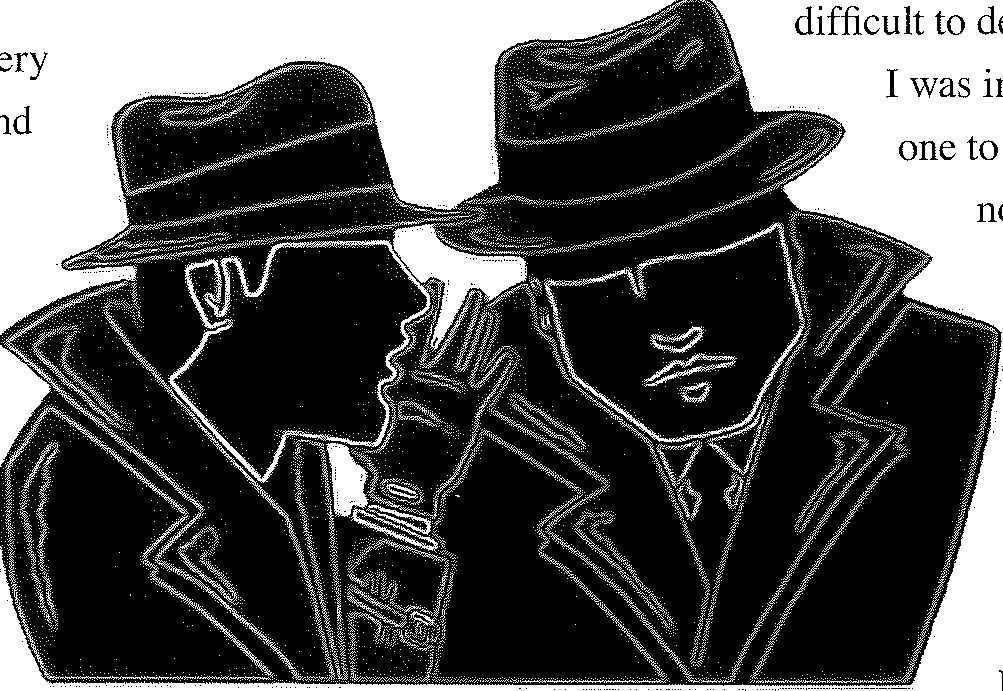
And then some light began to filter through. It was fortunate that a change of government occurred, and that the Pearson administration seemed inclined to let some fresh air into the dank corridors of the Ottawa establishment. It was fortunate that two security cock-ups of preposterous nature and quality occurred around that time, and gained considerable adverse press coverage. But my greatest fortune was to find myself working for George Carty, a gentleman who had served for a considerable time as Paul Martin Sr.’s executive assistant. He was well-connected around town, and was not intimidated by bureaucracy. He took an early and sympathetic interest in my case, and decided that the first priority was to determine the basis of my situation.
One evening as he was riding home on the bus (in those days senior officials rode buses), he met an RCMP officer he had known in his previous position, who had become a leading member of the force’s security establishment. He mentioned my name and asked if the officer could shed any light on my status. In due course he came to learn that the problem was my uncle, a professor at Royal Roads Military College in Victoria, whom I had met briefly only twice in my life. His wife was an active member of the Voice of Women, and he himself was head of the Canadian section of the World Federalist Association. That was the whole bill. On that evidence and on that genetic link, my reputation had been shattered. With the facts now determined, Mr. Carty helped me craft a letter to Mitchell Sharp, the Minister of Trade and Commerce, requesting reconsideration of my situation. It was an excellent letter, exposing the tenuous basis on which my doom had been sealed, and couched in a fine balance of fawn and threat. I mailed it with some sense of hope, but, to reinforce the impact, I shopped it around. I took a copy of it to Jean-Luc Pépin, then Sharp’s parliamentary secretary. He read it and said, “If all of this is true, you have suffered a serious abridgement of your human rights.” I could have kissed him.
I took a copy to Tommy Douglas, then leader of the NDP, whose support the minority Liberals needed in order to hold office. He took me to the parliamentary cafeteria for lunch. As we were leaving, Mitchell Sharp rushed up to seek my host’s favour on some legislative issue. Before he could begin, however, Mr. Douglas introduced me and added, “Bob used to work for my government in Saskatchewan. We thought the world of him.” Sharp reacted as though he had been pole axed. He staggered back and then said something to the effect that he had heard recently of me. Score a big one for the forces of good!!
Life in the dark went on, but encouraging signs began to appear. Then the September letter arrived, and life took up where it had halted so abruptly in March.
I do not criticize the RCMP for the silliness of their assumptions in my case. The force at that time had an entry requirement of Grade 10, and training centered on learning to ride a horse. The members were hopelessly unqualified to make political judgements, to appreciate distinctions between interest and persuasion, between involvement and commitment. And so they resorted to the policeman’s logic of contamination. If the Voice of Women or the World Federalists espoused causes inconsistent with accepted endorsement, they were suspect, their members were suspect, and members’ friends and relatives were suspect. A neat way of separating good from evil without the application of enlightened consideration.
In retrospect, it is alarming that the people who were obliged by law to protect my professional interests, the Public Service Commission officials, didn’t. Instead, they lied deliberately, emphatically, repeatedly. (Interestingly, one of them subsequently became a senior officer in Elections Canada) It is, however, encouraging that people who owed me nothing came to my aid for reasons no more profound that that they thought I had been wronged.
An interesting sidebar to all of this is that Leonard Lee, who later established and built the commercial juggernaut, Lee Valley Tools, was also a candidate for the Trade Commissioner Service in 1963, but was deemed by the selection process to be 13th in quality. The Service was able to recruit only 12 people that year, so he was initially disappointed. When I came down with a security sickness, however, a position came open and he was invited in. No hint of security concerns dogged his arrival. No question of patriotism marred his escutcheon. No doubt attended his political attitudes. Of course not! He had previously been an RCAF officer cadet who, for two years of his training attended Royal Roads Military College where he was taught History and Political Science by — wait for it — my uncle.
View the original scanned pages →
Originally published in bout de papier, Vol. 24, No. 2 (2009) — Spring 2009 // Printemps 2009, pp. 34–35. Read the rest of this issue →


