
bout de papier, Vol. 20, No. 1 (2003) — Spring/Summer 2003 // Printemps/Été 2003, pp. 25–28
Sixty-five years ago the peace of the world and the security of North America were jeopardized by the expansion of Nazi Germany in Europe and of Imperial Japan in Asia. Both Canada and the United States had long taken comfort in their distance from the most likely battlegrounds, as well as the advantages of sharing a continent that was separated by vast oceans from the most dire threats to international order and stability. After the extraordinarily costly Great War, both countries had attempted to stand aloof from the crises that other nations less fortunately situated and more directly threatened could not avoid. For Canada, however, its relationship with Britain through the Empire and Commonwealth was increasingly likely to entangle it in overseas difficulties. Even so, the foundation of Canada’s position in world affairs, then as before and since, was a continental partnership with the United States, frequently celebrated with predictable references to “the longest undefended border in the world” and “more than one hundred years of peace” in bilateral relations.
Perhaps no leaders in the twentieth century personified that close relationship better than Franklin Delano Roosevelt, who became President of the United States in January 1933, and William Lyon Mackenzie King, who returned to office as Prime Minister of Canada in October 1935. Though it is easy to exaggerate the length of their association and the depth of their personal friendship, there is no doubt that both Roosevelt and King possessed a sympathetic understanding of their respective countries and political positions, as well as an appreciation of the importance to policy-making of reliable bilateral contacts to advance mutual interests.
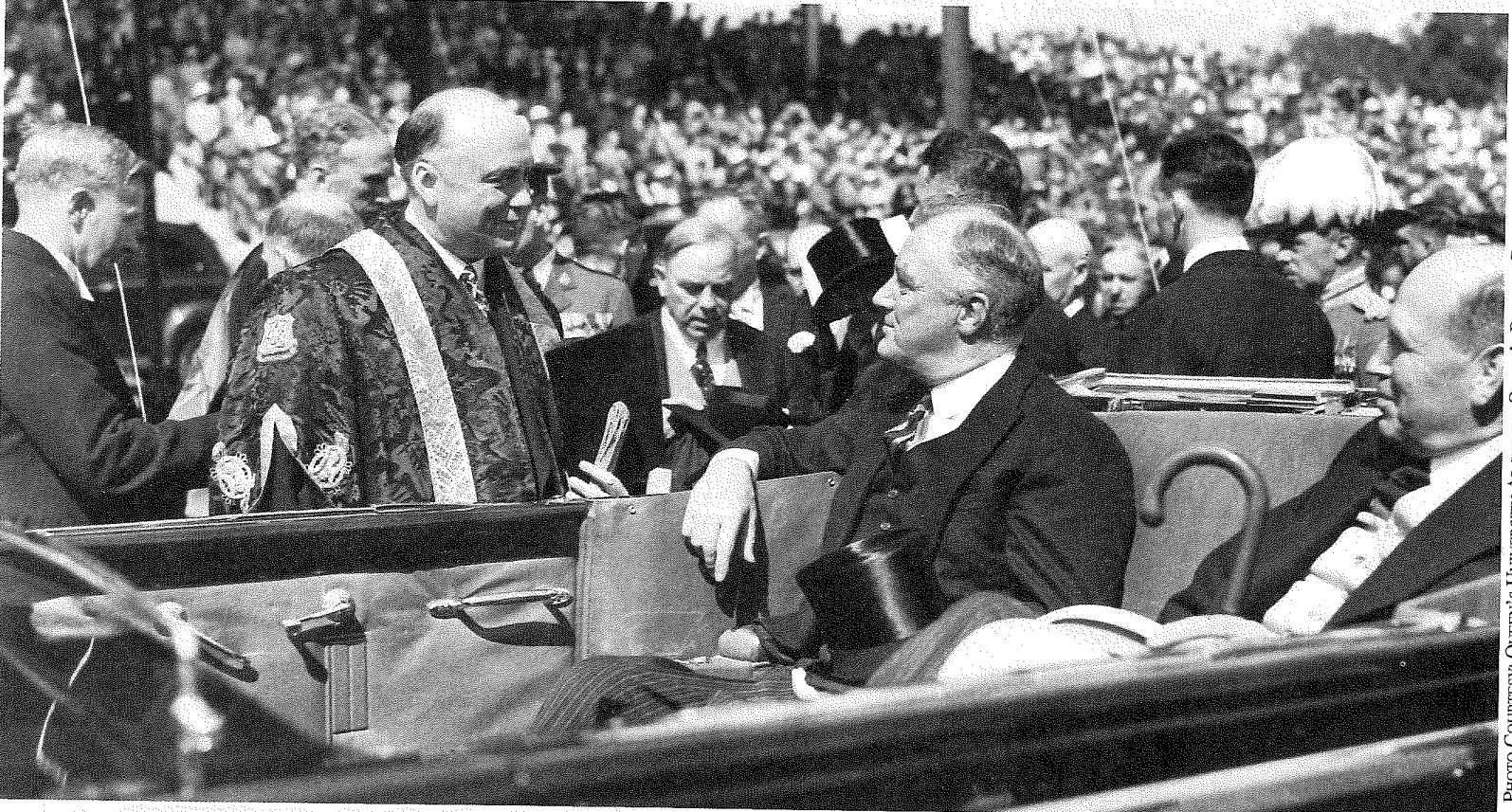
Apprehension about the wider world on both sides of the border had prompted concerns about the defence of North America from foreign threats. In this context, Roosevelt used the occasion of the acceptance of an honorary degree from Queen’s University as a Canadian platform for a firm declaration of the common needs and implications of continental defence. This affirmation was even more remarkable because it was given when the broad thrust of American policy was simply to defend the neutrality of the United States. Moreover, the reciprocal pledge by King was a realistic response that demonstrated how Canada’s national defence was in the interests of both countries, whatever the disparity in power between the neighbours.
The speeches by King and Roosevelt which are reproduced below were published as a pamphlet in 1939 by the King’s Printer under the overall title “The United States and Canada: Reciprocity in Defence.” King and Roosevelt also spoke at the dedication of the Thousand Islands Bridge later on the same day. The Diary of William Lyon Mackenzie King, from which two extracts are taken below, is available on-line at http://king archives ca (the original and typescripts are preserved in the King Papers at the Library and Archives of Canada, formerly the National Archives of Canada).
Hector Mackenzie Extract from Diary of William Lyon Mackenzie King, Thursday, August 18, 1938. On board Car 100.
… I was up at 7.30. The day looked very threatening, much the same kind of a day as when I was at Kingston last. Went over the speech [which King would be giving at the dedication of the Thousand Islands International Bridge] once, and a little after ten left my car to go into the President’s car, it having arrived at Kingston via Niagara Falls and Toronto about half an hour before. The Lieutenant-Governor [of Ontario Albert] Matthews went in first, and had a word with the President [Franklin Delano Roosevelt] When I came to the car, he greeted me by saying: “Hello Mackenzie”, I remarked to him at once how much thinner he was looking but also how well. He told me that he had lost weight largely by eating about one-third of what he had formerly done. I spoke appreciatively of his visiting Canada again, and how glad I was to see him. I also spoke of how sorry [Baron] Tweedsmuir [Governor- General of Canada] was of not being able to be present. We talked of his health for a short time. A little later, I presented [Norman] Rogers [Minister of Labour and Rector of Queen’s University] and [C.D.] Howe [Minister of Transport] to the President, the latter having formally [sic?: formerly] met him. Also some of the Kingston officials and the Mayor [Harry A. Stewart], and he left by open car in company with the Lieutenant-Governor to drive to the Stadium at Queen’s University, Rogers and I with [Major-] General [C.F.] Constantine [Adjutant-General of Canada] followed in another car. The streets were well lined with people all along the route.
A great crowd was assembled at the Queen’s Stadium. The proceedings there passed off very well. The President’s Address was a most significant one. He promised Canada that the United States would not stand idly by if an effort was made to “dominate” this country by any foreign power. He referred, in his Address, to our both bout de papier Vol. being from Harvard using, in this connection, the expression “Mackenzie King and myself. After the President had received the degree, we drove together with the Chancellor of the University [James A. Richardson] back to the College where an informal luncheon with the Governors and members of the Faculty and others was arranged in one of the halls.
The President was given a splendid reception all along the way. At luncheon, I sat to the President’s right and had Jim MacDonald [sic: Macdonnell, Chairman, Board of Trustees, Queen’s University] to my left. The latter made a very good speech on behalf of the University. There was no other speaking. After the luncheon, the President and I drove from the University to the Thousand Islands Bridge, a distance of some 20 miles. While in Kingston, we were taken through different streets crowded with people on both sides; cheers were given for each of us along the way. I felt very proud with the appearance of the city and the behaviour of the crowds. The evident good-will on all sides was a striking and memorable feature. On the way, I directed the President’s attention to Fort Henry, and told him of the proceedings there a few days before, and also of the incident of the Battle of the Windmill, and of my mother’s birth in the United States during the period of exile of her father [William Lyon Mackenzie] in this country.
Declaration by Franklin D. Roosevelt, President of the United States, at Queen’s University, Kingston, Ontario, August 18, 1938.
To the pleasure of being once more on Canadian soil, where I have passed so many of the happy hours of my life, there is added today a very warm sense of gratitude for being admitted to the fellowship of this ancient and famous university. I am glad to join the brotherhood which Queen’s has contributed and is contributing not only to the spiritual leadership for which the college was established, but also to the social and public leadership in the civilized life of Canada.
An American President is precluded by our Constitution from accepting any title from a foreign prince, potentate or power. Queen’s University is not a prince or a potentate but it is a power. Yet I can say, without constitutional reserve, that the acceptance of the title which you confer on me today would raise no qualms in the August breast of our own Supreme Court.
Civilization is not national – it is international — even though that observation -trite to most of us, is today challenged in some parts of the world. Ideas are not limited by territorial borders; they are the common inheritance of all free people. Thought is not anchored in any land; and the profit of education rebounds to the equal benefit of the whole world. That is one form of free trade to which the leaders of every opposing political party can subscribe.
In a large sense we in the Americas stand charged today with the maintaining of that tradition. When, speaking recently in a similar vein in the Republic of Brazil, I included the Dominion of Canada in the fellowship of the Americas, our South American neighbours gave hearty acclaim. We in the Americas know the sorrow and the wreckage which may follow if the ability of men to understand each other is rooted out from among the nations.
Many of us here today know from experience that of all the devastations of war none is more tragic than the destruction which it brings to the processes of men’s minds. Truth is denied because emotion pushes it aside. Forbearance is succeeded by bitterness. In that atmosphere human thought cannot advance.
It is impossible not to remember that for years when Canadians and Americans have met they have light-heartedly saluted as North American friends, without thought of dangers from overseas. Yet we are awake to the knowledge that the casual assumptions of our greetings in earlier times today must become a matter for serious thought.
A few days ago a whisper, fortunately untrue, raced round the world that armies standing over against each other in unhappy array were to be set in motion. In a few short hours the effect of that whisper had been registered in Montréal and New York, in Ottawa and in Washington, in Toronto and in Chicago, in Vancouver and in San Francisco. Your business men and ours felt it alike; your farmers and ours heard it alike; your young men and ours wondered what effect this might have on their lives.
We in the Americas are no longer a faraway continent, to which the eddies of controversies beyond the seas could bring no interest or no harm; instead, we in the Americas have become a consideration to every propaganda office and to every general staff beyond the seas. The vast amount of our resources, the vigour of our commerce and the strength of our men have made us vital factors in world peace whether we choose or not.
Happily, you and we, in friendship and in entire understanding, can look clear-eyed at these possibilities, resolving to leave no pathway unexplored and no technique undeveloped which may, if our hopes are realized, contribute to the peace of the world. Even if those hopes are disappointed, we can assure each other that this hemisphere at least shall remain a strong citadel wherein civilization can flourish unimpaired
The Dominion of Canada is part of the sisterhood of the British Empire. I give to you assurance that the people of the United States will not stand idly by if domination of Canadian soil is threatened by any other empire.
We are good neighbours and true friends because we maintain our own rights with frankness, because we refuse to accept the twists of secret diplomacy, because we settle our disputes by consultation and because we discuss our common problems in the spirit of the common good.
We seek to be scrupulously fair and helpful not only in our relations with each other, but each of us at home in our relations with our own people.
But there is one process which we certainly cannot change and probably ought not to change. This is the feeling which ordinary men and women have about events which they can understand. We cannot prevent our people from having an opinion in regard to wanton brutality, in regard to undemocratic regimentation, in regard to misery inflicted on helpless peoples, or in regard to violations of accepted individual rights.
All that any government, constituted as is yours and mine, can possibly undertake is to help make sure that the facts are known and fairly stated. No country where thought is free can prevent every fireside and home within its borders from considering the evidence for itself and rendering its own verdict, and the sum total of these conclusions of educated men and women will, in the long run, become the national verdict.
That is what we mean when we say that public opinion ultimately governs policy. It is right and just that this should be the case.
Many of our ancestors came to Canada and the United States because they wished to break away from systems which forbade them to think freely and their descendants have insisted on the right to know the truth — to argue their problems to a majority decision, and, if they remained unconvinced, to disagree in peace. As a tribute to our likeness in this respect, I note that the Bill of Rights in your country and in mine is substantially the same.
Mr. Chancellor, you of Canada who respect the educational tradition of our democratic continent will ever maintain good neighborship in ideas as we in the public service hope and propose to maintain it in the field of government and of foreign relations. My good friend, the Governor General, in receiving an honorary degree in June at that university of Cambridge, Massachusetts, to which Mackenzie King and I both belong, suggested that we cultivate three qualities to keep our foothold in the shifting sands of the present — humility, humanity and humor. All three of them, imbedded in education, build new spans to re-establish free intercourse throughout the world and bring forth an order in which free nations can live in peace.
Extract from Diary of William Lyon Mackenzie King, Saturday, August 20, 1938. On board Car 100.
Had concluded, before reaching Toronto, I should speak at North York on Roosevelt’s two speeches. Fortunately, had telephoned Ottawa for some material, and spent the morning trying to throw what I received into shape. [O.D.] Skelton [Under-Secretary of State for External Affairs] had given me excellent material. It was really an answer to prayer to have had this come at the time, as I really could not bring myself to prepare any general review of the Government’s work, at the afternoon’s picnic. Worked all morning in the car. Had a little rest after luncheon, and, at three, motored with Mrs. Mulock and Mr. [J.E.J Lawson [MP, Yorth South] to the Fair Grounds at Woodbridge. Had I been feeling well and prepared, I should have enjoyed the day immensely.
There were many old friends present at the gathering who seemed glad to renew associations. I missed, however, the representation there should have been from the Government of Ontario. Morgan Baker [MLA, York North] was present, along with another of the Ontario members, each of whom spoke showing in no mistaken fashion their loyalty to myself, and indignation at the attitude of the Ontario Government. Baker said he was quite prepared to face, as he would have to, the bitter hostility of [Mitch] Hepburn [Premier of Ontario] for being present at the gathering. It is perfectly outrageous that Hepburn should seek, as he does, to destroy our Party, and be permitted to do so by his own following.
Tonight, at Sir William [Mulock|’s, Baker told me that [William Limburg] Houck [Minister without Portfolio and Vice-Chairman, Hydro-Electric Power Commission of Ontario], a member of the Government, had told him that when Peter Heenan [Minister of Lands and Forests, Province of Ontario] had returned from Ottawa and was speaking kindly of the reception he had received, Hepburn had been most offensive in the language he had used in the Cabinet toward myself and the Government. That at a more recent meeting of the Cabinet, he had instructed his Ministers to do nothing to embarrass Dr. [Robert James] Manion [Leader of the Opposition], and that he was planning to help Manion in the campaign by seeing that two Liberals were put in each constituency. I was not in good shape for speaking at the picnic. There was a very large crowd which Willie [W.L.] Mülock [MP, York North] said was an answer to Hepburn, and they were most enthusiastic.
Acknowledgment of President Roosevelt’s Declaration, by Right Honourable W.L. Mackenzie King, Prime Minister of Canada, in a Speech at Woodbridge, Ontario, August 20, 1938.
I am sure the people of Canada will wish me to take this opportunity to say a word about the visit paid to us this week by the President of the United States. I had the privilege of welcoming Mr. Roosevelt on their behalf, and everything that happened during the visit, and everything that has been said since, has shown how warm and sincere our welcome actually was:
Our people will particularly expect me to say how deeply we appreciated the friendliness and import of the President’s great speech at Kingston, which, a little later in the day, I said would meet with a warm response in the hearts of all who love liberty, justice and peace. The press cables show that the speech has already been noticed abroad, and its international significance duly appreciated.
The President spoke of the deep concern felt by his people in the face of the tragic events troubling other parts of the world. He spoke of their hopes that pathways might be developed to contribute to the peace of the world; of the resolve, even if those hopes are disappointed, that this hemisphere shall remain a strong citadel of the ideas and civilization which we hold in common. He described the way of democracy; how public opinion ultimately governs policy and how, in the end, the national verdict arises from the sum total of the conclusions of free men who are allowed access to the facts, and to discuss them freely. These are our concerns, and our ways in Canada as well, and we greatly value this confirmation.
But our people will expect me to express their warm appreciation of the assurance which the President has given directly to them that the people of the United States will not stand idly by if domination of Canadian soil is threatened. Every utterance by the press and others throughout Canada during the past two days has testified how greatly we value this assurance, and how well we understand it. We know that these words of assurance are the words of a friendly people and neighbour We are glad that our common affairs have been so managed, and our mutual confidence so established, that such words can be frankly spoken and received without reserve. We realize that there is here no thought of military alliances, which are not a part of the tradition of the people of the United States nor of our own. We recognize the President’s words as fresh evidence of the special neighbourly relations which have grown up between Canada and the United States, and we are glad that we are valued as a neighbour.
And, as Mr. Roosevelt has said, we are good neighbours and true friends because we maintain our own right with frankness. As I have already said, the people of Canada deeply appreciate all that is implied by the President’s visit. At the same time, they know they have their own responsibilities for maintaining Canadian soil as a homeland for free men in the western hemisphere. They will recognize that there is no room today for shirking these responsibilities. Indeed, the times being what they are, they will be quick to see that the assurance given by the President has, if anything, increased rather than lessened our responsibilities
We, too, have our obligations as a good friendly neighbour, and one of them is to see that, at our own instance, our country is made as immune from attack or possible invasion as we can reasonably be expected to make it, and that, should the occasion ever arise, enemy forces should not be able to pursue their way, either by land sea or air to the United States, across Canadian territory.
During the past two years, we have been making special efforts to put our own means of defence in order. The country has approved the many measures taken to this end, and I am confident that, within the limits of our capacities and responsibilities, the country intends that we shall keep on going forward on that course. In that way, I am equally confident, we shall best play the part of a good neighbour.
This policy, I might add, accords wholly with that agreed to by Canada at the Imperial Conference held in London, last year, and which set forth that each Dominion was responsible for its own defence. Our defence, as well as the defence of all other parts of the British Empire, we believe, is further to be secured by consultation and co-operation with the other members of the British Commonwealth. The common concern which each part would be expected to have for the whole was recognized by the President, when, in conveying the assurance he did, he prefaced his words by explicitly pointing out that the Dominion of Canada is part of the sisterhood of the British Empire.
View the original scanned pages →
Originally published in bout de papier, Vol. 20, No. 1 (2003) — Spring/Summer 2003 // Printemps/Été 2003, pp. 25–28. Read the rest of this issue →



